The History of Emerald in Royal Jewelry: From Cleopatra’s Mines to the Crown of Windsor
I once stood in a dimly lit gallery at the Victoria & Albert Museum, pressed against a glass case like a child at a sweet shop window, staring at a necklace I had read about for years but never expected to see in person.
The Beauharnais Emeralds.
Huge emerald briolettes, the color of an Amazonian canopy at midday, dangling from a double strand of antique diamonds. Napoleon Bonaparte gave them to his adopted daughter Stéphanie in 1806, on the occasion of her marriage to the Grand Duke of Baden. More than two centuries later, they glowed under museum lighting as if the Emperor himself had delivered them that morning.
I stood there long enough that security began to watch me.
What is it about emeralds and royalty? Why have these green stones—fragile, inclusion-filled, notoriously difficult to cut—been pursued by emperors and empresses, sultans and shahs, queens and kings, for more than three thousand years? Why did Cleopatra claim them as her own? Why did Catherine the Great hoard them in the Vladimir Palace while revolution burned outside her doors? Why did a 19.77-carat emerald become the symbol of the most controversial love story of the twentieth century?
This is the history of emerald in royal jewelry. It spans continents and millennia, from the sands of Upper Egypt to the vaults of Windsor Castle, from the last Mughal emperors to the daughter of Sarah Ferguson walking down the aisle in a borrowed kokoshnik.
It is, in every sense, a story fit for a king.
The First Kings and the Secret Mines
The story of emeralds and royalty begins not with a crown, but with a queen.
Cleopatra VII, the last active ruler of the Ptolemaic Kingdom of Egypt, was famously obsessed with emeralds. She believed in their power, adorned herself with them, and perhaps most significantly, claimed ownership of the very mines that produced them.
These were not the Colombian emeralds that would later conquer Europe. They were stones from the ancient mines of Upper Egypt, near the Red Sea coast—deposits worked by slave labor, sometimes under unimaginable conditions, to extract a gemstone the queen considered hers alone. Archaeological evidence suggests these mines were active as early as 1500 BCE, making them the oldest known emerald sources in human history.
Cleopatra’s emeralds were carved into intaglios bearing her profile, set into golden collars, and buried with her in ways that remain mysterious. The precise location of her tomb is still unknown. But her identification with the stone was so complete that for centuries afterward, any fine emerald of uncertain origin was romantically—if inaccurately—attributed to “Cleopatra’s Mines.”
This pattern would repeat itself across millennia. Rulers did not merely wear emeralds; they claimed them. The stone became not just adornment but assertion: This land is mine, these riches are mine, this green fire answers to me alone.
The Mughals and the Color of Paradise
We must now travel east, to the courts of the Mughal emperors, where emerald reached heights of artistic and spiritual expression unmatched anywhere else on earth.
For the Mughals, green was the color of paradise. The Mughal gardens of Lahore and Kashmir, with their geometric pools and rows of cypress trees, were intended as earthly reflections of Jannah—the Islamic garden of Eden. Emeralds, with their deep, lush green, were physical fragments of that paradise, brought to earth and set into gold.
The emperors did not simply mount these stones in jewelry. They carved them.
The Mogul Emerald, one of the largest and most historically significant emeralds in existence, dates to 1695 and weighs an astonishing 217.80 carats. This is not a gem that was faceted for brilliance; it was treated as a canvas. One side is engraved with intricate Islamic prayers; the other bears delicate floral motifs. It was meant to be held, turned over in the hand, contemplated as both jewel and scripture.
This tradition of carving emeralds was unknown in Europe. Western jewelers prized flawless, transparent stones cut to maximize light return. The Mughals saw something else: a sacred material to be inscribed with meaning, worn not for sparkle but for talismanic power.
The Mughal emerald hoards were legendary. When Nadir Shah of Persia sacked Delhi in 1739, he carried away not only the Peacock Throne but countless chests of emeralds, rubies, and diamonds. These stones flowed into the treasuries of Persia and the Ottoman Empire, where they were set into daggers, turbans, and ceremonial swords.
The Ottoman Sultan Abdul Hamid II, the last Caliph of the Islamic world, possessed a 75.47-carat emerald of exceptional quality—a stone whose provenance almost certainly traced back to the Mughal workshops of the previous century.
Europe, at this same moment, was about to discover an emerald source that would make even the Mughal emperors envious.
The Conquest of Green Gold
In 1521, Hernán Cortés conquered the Aztec Empire. Among the treasures he sent back to Charles V of Spain were emeralds of a quality and size the Spanish crown had never seen.
They were not, however, the best ones. Those had been hidden.
The Aztec emperors had long treasured a specific type of green stone, which they called quetzalitzli—”stone of the quetzal feather.” The conquistadors, obsessed with gold and silver, initially dismissed these stones as inferior. But when gem cutters in Seville and Madrid examined them, they recognized something extraordinary.
These emeralds were cleaner, brighter, more intensely green than any stones from the Egyptian mines. And they came from a place the Aztecs had protected ferociously: the mountains of Muzo and Chivor in present-day Colombia.
The Muzo people, a warlike tribe of the Colombian Andes, had kept the emerald sources secret for centuries. They considered the mines sacred. Emeralds were not commodities to be traded; they were offerings to the gods, buried with chieftains, hidden in temples. The conquistadors hunted the Muzo through the jungles, tortured them for information, and eventually, brutally, seized control of the deposits.
By the 1540s, Spanish galleons were carrying Colombian emeralds across the Atlantic. The effect on European courts was instantaneous and overwhelming.
Suddenly, every prince, every cardinal, every aspiring noble wanted Colombian emeralds. The stones were rarer than diamonds, more exotic than rubies, and carried the intoxicating aura of the New World—of jungles and treasure fleets and civilizations that had crumbled at the touch of Spanish steel.
The Spanish crown, recognizing a monopoly when it saw one, restricted emerald trade so tightly that Colombian stones became more valuable than their weight in gold. For nearly three centuries, virtually every significant emerald in Europe came from the Muzo and Chivor mines, cut in secret and smuggled through Cartagena and Seville.
The French Crown and the Emperor’s Emeralds
The French Crown Jewels, like the Spanish, were enriched by Colombian emeralds. But their story is one of dispersal and survival, of stones that outlived the crowns they adorned.
The collection began in the 16th century under François I, who decreed that the Crown Jewels were the inalienable property of the monarchy—not of the monarch personally, but of France itself. An inventory dated June 15, 1530, proclaimed that “these rings are the gift of François I to his successors to the French crown; with each change, may their inventory, their state, weight, paint and metal be verified”.
Louis XIV expanded the collection enormously. By the end of his reign, it was the largest and most magnificent in Europe. The Sun King wore the Crown Jewels for the last time on February 19, 1715, to receive the Persian ambassador. Saint-Simon, ever observant, noted that the king “was bedecked with the Crown’s finest diamonds, some twelve million five hundred thousand pounds worth, and he bowed beneath their weight”.
Then came the revolution.
In 1792, the Crown Jewels were stolen. The collection was shattered, scattered, partially recovered, and eventually reassembled by Napoleon I, who rebaptized it as the French Crown Jewels and commissioned new inventories.
The Coronation Crown of Napoleon III.
In 1855, Emperor Napoleon III commissioned his jeweler, Alexandre Gabriel Lemonnier, to create a new coronation crown. It depicted eight golden eagles and palm leaves, richly adorned with diamonds and emeralds.
When the crown was dismantled in 1887—the Third Republic, eager to erase royal symbolism, auctioned off most of the Crown Jewels—the eight large emeralds were given back to Empress Eugenie. The fifty smaller emeralds, each approximately one carat, were donated to the École Nationale Supérieure des Mines de Paris, where they remain today.
A 2016 gemological study of these forty-five surviving emeralds confirmed what had long been suspected: forty-one are natural Colombian emeralds, mined in Muzo, with no evidence of clarity enhancement. Four, however, are artificial glass—possibly set in the crown since its creation, a small deception from the Emperor’s own jeweler.
These emeralds are now displayed at the Musée de Minéralogie in Paris, their first public exhibition in more than 130 years. They are not the largest or most valuable emeralds in this history. But they are witnesses: to an empire, a revolution, and the peculiar fate of royal jewels, which so often survive the royals themselves.
The Russian Obsession
The Romanovs, like the Bourbons and the Habsburgs, were consumed by emeralds.
Catherine the Great, perhaps the most voracious gem collector in Russian history, amassed some of the largest emerald specimens known to her time. She owned an emerald necklace that originally weighed 107.67 carats—a stone that had already spent more than a century in the Russian Imperial collection before she inherited it.
When the revolution came, her descendants faced a desperate choice.
Grand Duchess Vladimir, aunt to Tsar Nicholas II, possessed one of the most magnificent jewelry collections in Europe. As the Bolsheviks closed in, she hid her most important treasures—including an emerald necklace and a 65-carat emerald brooch—in the Vladimir Palace, hoping they would survive the chaos.
They did. Her jewels were smuggled out of Russia by a British diplomat and eventually reached her son, Grand Duke Boris, living in exile in London.
The Vladimir Tiara.
The tiara created for Grand Duchess Vladimir is one of the most famous pieces in the British royal collection—but its emeralds were not originally part of it.
The original tiara, made in 1874, featured pearl drops. When Queen Mary purchased it from Grand Duchess Vladimir’s exiled heirs in 1921, she commissioned a transformation: the pearls could be removed and replaced with fifteen cabochon Cambridge emeralds.
These emeralds came from Mary’s own collection, inherited from her grandmother, the Duchess of Cambridge. They were of exceptional quality—large, smoothly domed, intensely green—and their presence elevated the Vladimir Tiara from beautiful to legendary.
Queen Elizabeth II inherited the tiara from her grandmother in 1953. She wore it throughout her reign, often with the emerald drops, occasionally with the pearls. The Vladimir Tiara became one of her signatures, a shimmering connection between the Romanovs and the Windsors, between imperial Russia and constitutional Britain.
The Windsors and Their Green Heirlooms
The British royal collection contains more significant emeralds than perhaps any other institution outside Tehran or Istanbul. And unlike the French Crown Jewels, which were auctioned off by a republic uncomfortable with monarchy, the British emeralds remain in active use.
Queen Victoria’s Serpent Ring.
The story begins, appropriately, with love.
In 1839, Prince Albert of Saxe-Coburg and Gotha proposed to his first cousin, Queen Victoria, with a serpent engagement ring. The serpent motif, considered a symbol of eternal love, was already popular in sentimental jewelry. But Albert added a deeply personal touch: he set the ring with an emerald—Victoria’s May birthstone.
Victoria was besotted. She wore the ring constantly, and her joy legitimized both serpent jewelry and colored gemstone engagement rings for an entire generation of Victorian brides. The ring remains in the royal collection, a tender artifact of one of history’s great love matches.
The Cambridge Emeralds.
The most substantial collection of British royal emeralds, however, came not from Victoria but from her granddaughter-in-law.
Queen Mary, wife of George V and grandmother of Elizabeth II, was an obsessive collector and restorer of royal jewels. She inherited the Cambridge emeralds from her grandmother, the Duchess of Cambridge, and set about incorporating them into nearly every conceivable form of jewelry.
There were tiaras and necklaces, brooches and earrings, stomachers and bracelets. Mary wore the Cambridge emeralds with extraordinary splendor for the Delhi Durbar in 1911, appearing before the Indian princes as Empress of India, dripping in green fire.
She also commissioned new pieces. The Cambridge Emerald Necklace, later known as the Diana Emerald Choker, was made for Mary in the 1920s. Fourteen large, round emeralds—cut in the sixty-facet brilliant style usually reserved for diamonds—set in platinum and diamonds. It was bold, modern, and unmistakably royal.
Mary left the Cambridge emeralds to her granddaughter, Elizabeth II, who wore them throughout her reign. But it was Elizabeth’s daughter-in-law, Diana, who would make one particular piece legendary.
The Diana Emerald Choker.
When Diana Spencer married the Prince of Wales in 1981, the Queen gave her a wedding gift of extraordinary generosity: the Cambridge Emerald Choker.
Diana wore it as a necklace, as it was intended. But in 1985, during a charity event in Australia with a disco theme, the Princess of Wales did something no one expected. She wrapped the choker around her forehead, knotting it at the back, and wore the fourteen emeralds as a headband.
The photograph is iconic. Diana, young and radiant and utterly unselfconscious, transformed a formal heirloom into the most glamorous bohemian accessory imaginable. The emerald headband became instantly famous, and the Cambridge Emerald Choker became, forever, the Diana Emerald Choker.
The Greville Kokoshnik—A Modern Masterpiece
We must now examine a tiara that spent nearly a century in the vault before emerging, twice, to worldwide astonishment.
Dame Margaret Greville was a society hostess and avid jewelry collector of immense wealth. In 1919, she commissioned the Parisian jeweler Boucheron to create a tiara in the kokoshnik style—a broad, halo-shaped diadem inspired by traditional Russian headdresses, popularized at the court of the Romanovs.
The result was extraordinary.
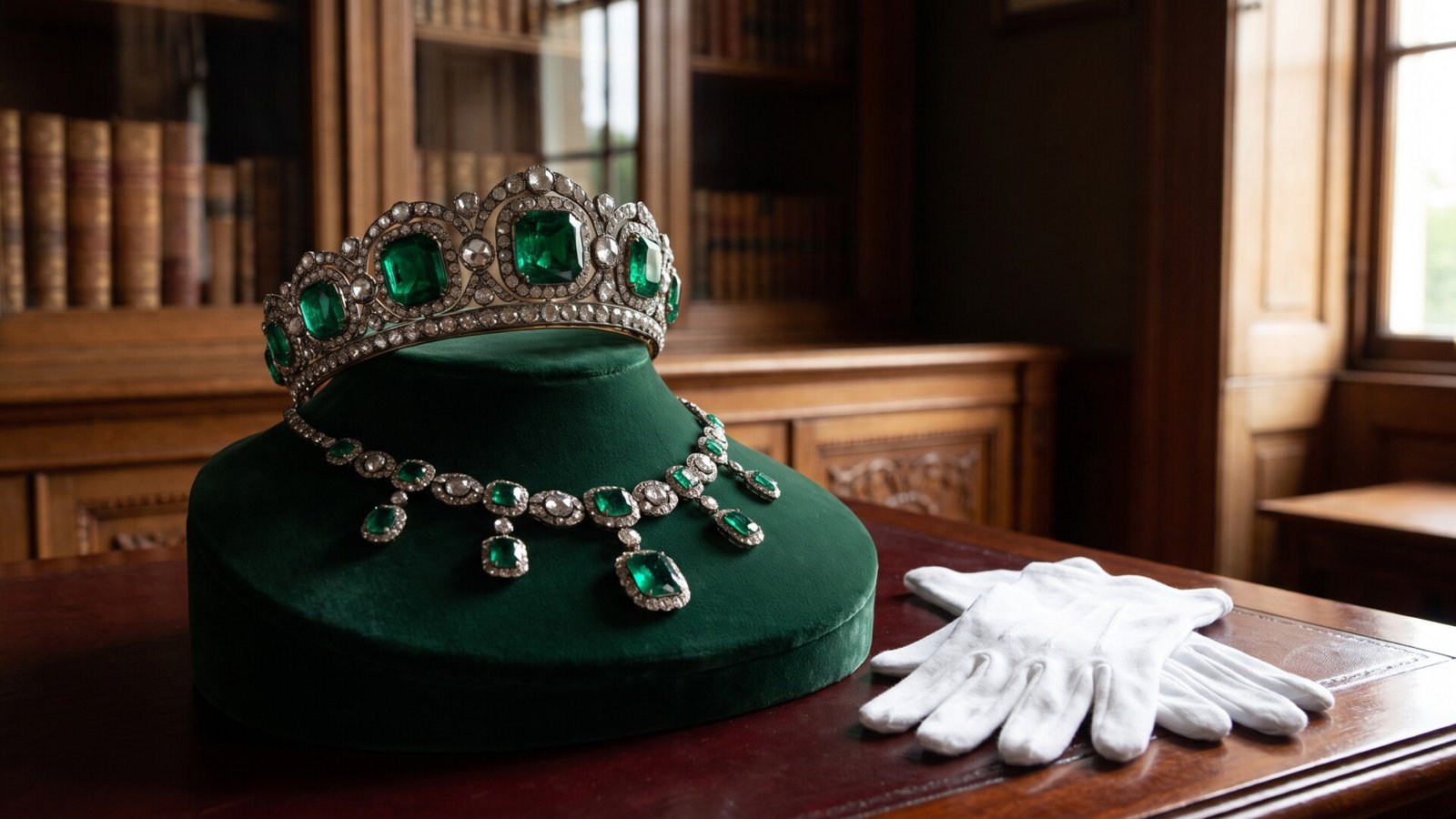
The tiara is primarily composed of rose-cut and brilliant-cut pavé diamonds, set in platinum. But the stars are the emeralds: thirteen of them, six on each side and a central cabochon of staggering size and quality. That center stone weighs 93.7 carats .
When Greville died in 1942, she left her entire jewelry collection to the Queen Mother. The Greville Emerald Kokoshnik, however, remained unworn. There is no record of the Queen Mother ever wearing it in public. Her daughter, Queen Elizabeth II, who inherited it in 2002, similarly kept it stowed away.
For seventy-six years, one of the most valuable tiaras in the Windsor collection collected dust.
Then, in 2018, Princess Eugenie of York announced her engagement to Jack Brooksbank. Royal watchers expected her to wear the York Diamond Tiara, which her mother, Sarah Ferguson, had worn in 1986. Instead, the Queen lent her granddaughter the Greville Emerald Kokoshnik.
The tiara made its public debut at Eugenie’s wedding, paired with new emerald and diamond earrings gifted by her husband. Jewelry expert Maxwell Stone called it “the most extravagant ‘something borrowed’ in royal history”.
Eugenie later reflected on the experience: “I’ve never worn a tiara before in my life. It was the most incredible thing to wear such a piece of history that my grandmother had lent me”.
Some interpreted the emerald choice as a nod to the bride’s maternal heritage. Sarah Ferguson wore kelly green to the ceremony; Eugenie’s wedding dress incorporated a shamrock, symbolizing the Ferguson family’s connection to Ireland.
Seven years passed. The tiara returned to the vault.
Then, in November 2025, Queen Camilla wore the Greville Emerald Kokoshnik to the Diplomatic Corps reception at Windsor Castle.
It was only the second public appearance of the tiara in 106 years. Jewelers and royal watchers interpreted Camilla’s choice as deliberate—a show of support for Eugenie, whose father, Prince Andrew, had recently been stripped of his royal titles.
The tiara is now valued at an estimated $13 million, making it one of the most valuable jewels in the British royal collection.
The Twentieth Century’s Royal Romantics
The emerald’s royal history does not end with thrones and crowns. In the twentieth century, two couples—one royal, one presidential—created emerald engagement rings that captured the world’s imagination.
The Duchess of Windsor.
In 1936, Edward VIII abdicated the British throne to marry Wallis Simpson. Their love story was controversial, costly, and ultimately triumphant. The former king became the Duke of Windsor; his twice-divorced American became the Duchess.
The Duke proposed with a Cartier emerald engagement ring: 19.77 carats of Colombian green, set in platinum, engraved inside the shank with the words, “We Are Ours Now, 27.x36” .
That date was October 27, 1936—the day Simpson’s divorce decree was finalized. The Duke had waited years for this moment. His emerald, far more unusual than a diamond, announced that his love was not conventional and he did not care who disapproved.
In 1958, the Duchess returned the ring to Cartier to have it modernized, resetting the emerald in yellow gold surrounded by diamonds. But she kept the original shank with its inscription—a private message in a public jewel.
When the Duchess died in 1986, the ring was auctioned at Sotheby’s Geneva. It sold for $2.1 million, more than ten times its estimate, the proceeds donated to the Institut Pasteur.
Jacqueline Kennedy.
Two decades after the Windsors’ engagement, another American woman captured the world’s imagination with an emerald ring.
In 1953, John F. Kennedy proposed to Jacqueline Bouvier with a Van Cleef & Arpels engagement ring featuring a 2.79-carat emerald and a 2.84-carat diamond, side by side in a two-stone setting accented with tapered baguettes.
The emerald symbolized Kennedy’s future—youth, vitality, the “New Frontier.” Like the Duchess before her, Jackie eventually had the ring reset with additional diamonds to reflect changing tastes. But the original design remained iconic: two stones of nearly equal size, representing two people entering a partnership of equals.
The Kennedy ring cemented the emerald’s status not merely as a royal gemstone but as a choice for modern, independent women who defined elegance on their own terms.
The Mughal Legacy Continues
Even as European royal houses accumulated Colombian emeralds, the stones of the Mughal emperors continued their own journeys.
The Mogul Emerald, inscribed in 1695, spent centuries passing through collectors and museums before its most recent sale. In 2001, it was acquired at auction for £1.4 million—a fraction of its current estimated value.
The Chalk Emerald, a 37.82-carat Colombian stone of exceptional purity, originally belonged to Indian royalty. It was set in a necklace before being recut and mounted as a ring by Harry Winston. Today, it resides at the Smithsonian Institution’s National Museum of Natural History, where it is seen by millions of visitors annually.
The Inca Emerald Crown, created around 1590 by Spanish settlers in Peru, represents the collision of Old World and New. The gold frame alone weighs more than 100 pounds, and it is set with 453 emeralds totaling approximately 1,500 carats. Indigenous and European artisans collaborated on its creation, which was likely intended as an offering to God to heal the land after decades of conquest and epidemic.
What Endures
I have traced emeralds from the tombs of Egyptian queens to the auction houses of Geneva, from the Mughal courts of 1695 to a disco in 1985 Australia. I have told you about crowns dismantled and reassembled, about stones hidden from revolutionaries and smuggled across borders, about love affairs announced and defended through the language of green gems.
But what have I really told you?
I have told you that emeralds are fragile. They are brittle, easily chipped, often included with the “gardens” that make each stone unique. They are harder to cut than diamonds, harder to set than sapphires, harder to care for than almost any other precious gem.
And yet, for three thousand years, the most powerful humans on earth have pursued them obsessively.
Cleopatra claimed the Egyptian mines as her personal property. The Aztec emperors considered emeralds too sacred to trade. The Spanish conquistadors tortured the Muzo people to steal their mountains. The Mughals carved them with prayers. The Romanovs hid them in palace walls. The Windsors wore them to weddings and funerals and diplomatic receptions, passing them from grandmother to granddaughter, from one century to the next.
Why?
Because emeralds do something no other gem can do. They do not sparkle like diamonds; they glow from within, a deep, liquid fire that seems alive. Their color is the color of spring, of new leaves and new beginnings, of hope itself. The Romans dedicated emeralds to Venus, goddess of love. The Mughals saw them as fragments of paradise. The Victorians, sentimental to their core, gave them as engagement rings because they symbolized enduring devotion.
Royalty did not wear emeralds because they were already powerful. They wore emeralds because the stones themselves conferred power—the power of the earth, compressed over millennia, shaped by human hands into objects of transcendent beauty.
That is the history of emerald in royal jewelry. Not a chronicle of ownership, but a story of longing. Kings and queens looked at these green stones and saw something they desperately wanted: permanence in an impermanent world.
They knew, on some level, that their crowns would be dismantled and their empires would crumble and their names would fade from memory. But the emeralds—the emeralds would remain.
The Beauharnais Emeralds are in a museum case at the V&A, viewed by strangers who know nothing of Stéphanie de Beauharnais.
The Mogul Emerald is in a private collection, its prayers still legible, its emperor long forgotten.
The Greville Kokoshnik, after a century in darkness, now catches light at Windsor Castle and will, someday, catch it again.
The stones endure.
They always do.