Pearl: Meaning, Properties, Uses & Value
I have a confession that still makes me cringe when I think about it.
My grandmother left me her pearl necklace when she passed. It wasn’t a strand of perfect South Seas—she was a teacher, not a tycoon—but it was beautiful, creamy white, with a delicate rose gold clasp. I was in my twenties and knew nothing about caring for organic gems. I wore that necklace constantly. I showered with it. I slept in it. I spritzed perfume directly onto it because I was late and in a hurry.
One afternoon, I looked down and noticed the pearls had changed. They weren’t glowing the way they used to. The surface had developed a faint, dull haze, and one or two had a slightly yellowish cast. I took them to a jeweler, who looked at them with the particular sadness of someone witnessing the aftermath of well-intentioned ignorance.
“Do you know how pearls are different from other gems?” she asked.
I did not.
“Pearls are organic,” she said. “They’re born in the sea, and they need to be treated like something alive. Perfume kills them. Sweat dulls them. Airtight safes dehydrate them. Your grandmother’s pearls lasted fifty years because she understood this. They lasted two years with you because you didn’t.”
I wanted to cry. That necklace was one of the only things I had left of her, and I had damaged it through nothing but ignorance.
The jeweler was kind. She taught me how to wipe pearls with a soft cloth after wearing, how to store them properly, how to have them restrung. The necklace is still beautiful, though it will never be what it was. And I have spent the years since learning everything I can about these extraordinary gems—the only ones on earth created by a living creature.
This guide is what I wish someone had handed me before I touched my grandmother’s pearls. Whether you’re a June baby searching for your birthstone, a bride considering pearl jewelry for your wedding, or simply someone who fell in love with the soft glow of this ocean treasure—welcome. You’re about to discover one of the most fascinating and storied gems on earth.
Quick Facts Box
Gemstone Overview
| Category | Details |
|---|---|
| Color(s): | White, cream, pink, silver, gold, gray, blue, lavender, green, black |
| Hardness (Mohs): | 2.5 – 4.5 |
| Crystal system: | Amorphous (no crystal structure) |
| Transparency: | Opaque to translucent |
| Common uses: | Necklaces, earrings, rings, bracelets, brooches, bridal jewelry, heirloom pieces |
| Birthstone month(s): | June (modern), 3rd and 30th wedding anniversaries |
| Zodiac association: | Gemini (May 21 – June 20), Cancer (June 21 – July 22) |
What Is Pearl?
Let’s begin with the most fundamental fact about pearls, the one that makes them utterly unique among gemstones.
Pearls are the only gemstone created by a living creature.
Unlike diamonds formed deep in the earth, or sapphires crystallized in molten rock, pearls are born inside oysters, mussels, and other mollusks. They are the product of a biological process, not a geological one.
How pearls form
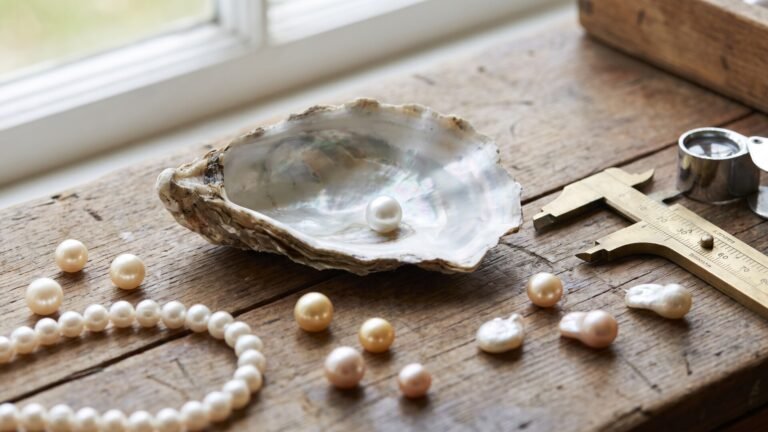
The story begins when an irritant—a tiny grain of sand, a fragment of shell, a parasite—finds its way inside a mollusk’s shell. The mollusk, in self-defense, begins secreting a substance called nacre (pronounced NAY-ker) to coat the intruder.
Nacre is the same material that lines the inside of the mollusk’s shell—mother-of-pearl. It’s composed primarily of aragonite (a form of calcium carbonate) and a small amount of conchiolin, a hornlike organic protein. The mollusk deposits this nacre in concentric layers, thousands upon thousands of them, building up around the irritant until—years later—a pearl is born.
This is why pearls have that soft, inner glow. Light enters the layers of nacre and is reflected back in a complex interplay of refraction and diffraction. The more layers, the deeper the luster.
Natural vs cultured pearls
This is the most important distinction in the pearl world.
Natural pearls form entirely by chance, without any human intervention. A wild oyster encounters an irritant and produces a pearl. These are extraordinarily rare and valuable—the stuff of museum collections and million-dollar auctions.
Cultured pearls are formed with human assistance. A technician deliberately introduces an irritant (usually a tiny bead or a piece of mantle tissue) into the mollusk, which then coats it with nacre just as it would in nature. The pearl is still real—it’s still nacre, still organic, still created by a living creature—but the process is initiated by people.
More than 99% of pearls sold today are cultured. This isn’t deception; it’s sustainability. Natural pearls were harvested to near-extinction in the early 20th century. Culturing made pearls accessible to everyone while preserving wild oyster populations.
Freshwater vs saltwater pearls
Pearls are also classified by their origin:
- Freshwater pearls: Grown in mussels in lakes, rivers, and ponds. China produces the vast majority of the world’s freshwater pearls. These pearls are often smaller, more abundant, and more affordable. They can be nucleated with tissue only (creating all-nacre pearls) or with a bead.
- Saltwater pearls: Grown in oysters in oceans and seas. The main types are Akoya (Japan), South Sea (Australia, Indonesia, Philippines), and Tahitian (French Polynesia). Saltwater pearls are typically rounder, have deeper luster, and command higher prices.
Pearl Meaning & Symbolism
No gemstone carries more symbolic weight than the pearl. Its history stretches back millennia and spans every continent.
Ancient Greece: Tears of the Gods
The ancient Greeks believed that pearls were the tears of the gods. Aphrodite, the goddess of love and beauty, was said to have emerged from the sea foam wearing a string of pearls, which endowed her with divine beauty and magic.
Ancient Rome: Ultimate Status Symbol
In Rome, pearls were the ultimate symbol of wealth and social standing. So obsessed were the Romans that generals wore pearl earrings and the sumptuary laws attempted—unsuccessfully—to limit who could wear them. The historian Pliny the Elder wrote of pearls as “the highest rank of all precious things”.
The Legend of Cleopatra
Perhaps the most famous pearl story involves Cleopatra, who supposedly dissolved a single pearl in a glass of wine and drank it to win a wager with Mark Antony that she could consume the wealth of an entire nation in one meal. Whether true or apocryphal, the story captures the pearl’s ancient association with ultimate luxury.
Medieval Christianity: Purity and the Soul
In medieval Europe, pearls symbolized purity, virginity, and the Virgin Mary. A beautiful 14th-century poem simply called “Pearl” tells the story of a father mourning his lost daughter, who appears to him in a vision dressed in pearl-encrusted robes—revealing that the “pearl” he mourned was not a jewel but his child, now among the blessed in heaven.
Beyond purity, pearls also symbolized the soul itself. St. Augustine and St. Peter Damian both wrote of Christ referring to the soul as “the most splendid jewel”. And the round, white pearl was likened to the Eucharist—the bread of communion—making it a symbol of spiritual nourishment.
The East: Dragons and Wisdom
In ancient China, pearls were associated with wisdom and royalty. The first recorded pearl history dates to 2206 BCE, when pearls were offered to the royal family. Black pearls were especially prized and believed to be formed in the heads of dragons, representing wisdom.
Modern interpretations
Today, pearls symbolize:
- Purity and innocence: The traditional bridal gem
- Wisdom and experience: Acquired over time, like the layers of nacre
- Calmness and integrity: The serene glow of the pearl reflects a serene spirit
- Femininity and grace: The soft, luminous quality has long been associated with feminine beauty
For those born in June, pearl represents the gentle transition from spring to summer, the calm of the ocean, and the quiet wisdom that comes from patience.
Pearl Healing Properties
I am not a doctor, and gemstones are not medicine. But pearls have been attributed with healing properties for thousands of years across multiple cultures.
Ancient beliefs
In ancient India, pearls were ground into powders and used in traditional remedies. They were believed to cure mental illnesses, digestive disorders, and even tuberculosis. The Persians thought pearls had the power to cure epilepsy and mental disorders.
Astrological significance
In Vedic astrology, pearl is associated with the Moon. It is believed to bring peace, coolness, wisdom, and fortune to its wearer. The moon, cold and calming in nature, is thought to influence the mind and emotions—and pearl, as the moon’s gemstone, is said to balance those forces.
Astrologers recommend pearl for those suffering from:
- Mental depression or anxiety
- Insomnia and sleep disorders
- Emotional instability
- Relationship difficulties
- Lack of self-confidence
Emotional benefits
Modern crystal healers attribute to pearl:
- Emotional balance: Calms the mind and soothes turbulent feelings
- Self-confidence: Strengthens the wearer’s sense of worth
- Purity of intention: Encourages honesty and integrity
- Love and harmony: Strengthens relationships, particularly marriage
Chakra associations
Pearl is primarily associated with the sacral chakra (Svadhisthana) and the crown chakra (Sahasrara). It’s believed to balance emotions while connecting the wearer to higher wisdom.
Pearl Colors & Varieties
Pearls occur in an astonishing range of colors—far more than most people realize.
The color spectrum
Pearl color is determined by the mollusk species, the water chemistry, and the specific environment in which the pearl grows. The range includes :
- White and cream: The classic, most traditional pearl colors
- Pink and rose: Often called “rose” pearls, prized for their romantic hue
- Silver and gray: Cool, elegant, modern
- Gold: From pale champagne to deep, rich “South Sea” gold
- Blue: Rare and highly sought after, from pale sky to deep midnight
- Lavender and mauve: Subtle, sophisticated shades
- Green: Olive to peacock
- Black: From light gray to deep, iridescent black with green or purple overtones
Color components
Pearl color has three possible components, as defined by GIA :
- Bodycolor: The pearl’s dominant overall color
- Overtone: One or more translucent colors that lie over the bodycolor
- Orient: A shimmer of iridescent rainbow colors on or just below the pearl’s surface
All pearls have bodycolor. Only some have overtone, orient, or both.
The major pearl types
| Type | Origin | Typical Colors | Size Range | Characteristics |
|---|---|---|---|---|
| Akoya | Japan, China | White, cream with rose or silver overtones | 2–11mm | Classic round shape, high luster, the “traditional” pearl |
| South Sea | Australia, Indonesia, Philippines | White, silver, gold | 9–20mm | Large, satiny luster, thick nacre, extremely valuable |
| Tahitian | French Polynesia | Black, gray, green, peacock, aubergine | 8–18mm | Exotic dark colors, high luster, “peacock” most prized |
| Freshwater | China, USA | White, pink, lavender, peach, many pastels | 2–13mm | Wide variety, affordable, can be tissue-nucleated (all nacre) |
| Keshi | Various | Varies by host oyster | Small | Formed accidentally, all nacre, high luster |
| Mabe | Various | Varies | Large | Blister pearls, hemispherical, used in earrings and pendants |
The rarest colors
Natural-colored pearls in certain hues command extraordinary premiums:
- Natural blue: Exceptionally rare, found primarily in the Persian Gulf (now nearly depleted)
- Natural gold: The most valuable South Sea pearls, especially deep, even gold
- Peacock Tahitian: Green-black with purple-pink overtones, the most prized Tahitian color
- Natural pink: Rare and highly sought after
Is Pearl a Birthstone?
Yes—and pearl’s birthstone status is among the most ancient and beautiful.
June birthstone
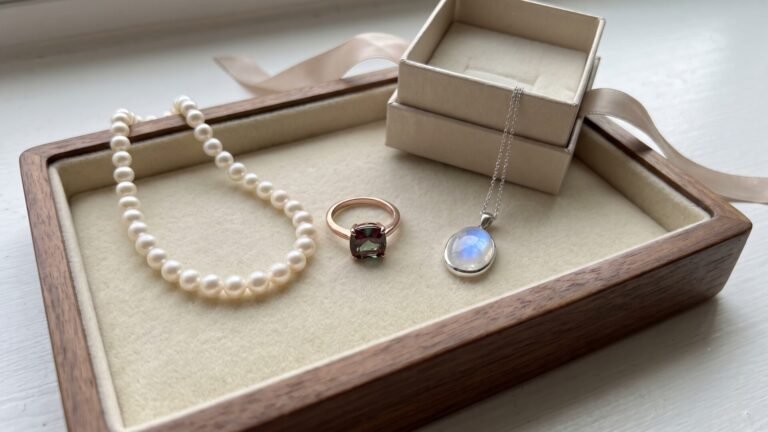
Pearl is the modern birthstone for June. It shares this distinction with alexandrite and moonstone, making June one of the few months with multiple birthstone options.
For those born in June—the month of summer solstice, of long days and warm nights, of weddings and roses—pearl represents purity, wisdom, and the calm beauty of the sea.
Why pearl is June’s traditional birthstone
The association likely comes from the pearl’s connection to the Moon, which governs emotions, intuition, and the tides. June’s zodiac signs—Gemini and Cancer—are both influenced by lunar and watery energies. Cancer, in particular, is ruled by the Moon and symbolized by the crab, a creature of the shoreline.
Wedding anniversaries
Pearl is the traditional gift for the 3rd and 30th wedding anniversaries. For the 3rd, it represents the early years of marriage, when the relationship is still forming its nacre of shared experience. For the 30th, it represents the deep, layered wisdom of three decades together.
Pearl Uses in Jewelry
Pearls have been used in jewelry for thousands of years, and their versatility remains unmatched.
Necklaces
The pearl necklace is the classic—from the single-strand choker to multi-strand opera-length ropes. Akoya pearls are the traditional choice for strand necklaces, with their perfectly round shape and high luster.
- Choker: 14–16 inches, sits at the base of the neck
- Princess: 17–19 inches, falls just below the collarbone
- Matinee: 20–24 inches, versatile length for work and evening
- Opera: 28–34 inches, can be worn long or doubled
- Rope: 35+ inches, can be knotted or wrapped multiple times
Earrings
Pearl earrings are perhaps the most versatile pearl jewelry. Studs are classic and timeless; drops add movement and elegance; hoops with pearl accents feel modern.
Rings
Pearl rings require more care than other pearl jewelry because of the stone’s softness, but they’re beloved for their romantic quality. Protective settings (bezel, halo) help shield the pearl from impact.
Bracelets
Pearl bracelets—single strands, multi-strand wraps, or tennis-style—add elegance to any wrist. The pearls should be knotted separately on silk thread to prevent loss if the strand breaks.
Bridal jewelry
Pearls have been traditional bridal jewelry for centuries, symbolizing purity and innocence. The “something old, something new, something borrowed, something blue” often includes pearls—old pearls from family, new pearls for the bride, and sometimes blue pearls for the “blue” element.
Brooches and pins
Pearl brooches were enormously popular in the Victorian and Edwardian eras and are experiencing a revival. A single large pearl or a cluster of smaller pearls makes a stunning statement.
Pearl Value & Price
Pearl pricing is complex, with seven factors determining value. The Gemological Institute of America (GIA) identifies these key quality factors :
1. Luster—The Most Important Factor
Luster is what gives a pearl its unique beauty—the sharpness and brightness of reflections on the surface. GIA grades luster from Excellent to Poor :
- Excellent: Reflections appear bright and sharp
- Very Good: Reflections appear bright and near sharp
- Good: Reflections are bright but not sharp, slightly hazy around edges
- Fair: Reflections are weak and blurred
- Poor: Reflections are dim and diffused
High luster commands the highest prices.
2. Surface Quality
Like colored stones, most pearls have surface characteristics—tiny blemishes, spots, bumps, or scratches. Pearls with clean, blemish-free surfaces are rare and valuable. Minor surface characteristics that can be hidden by a drill-hole or mounting have less effect on value.
3. Shape
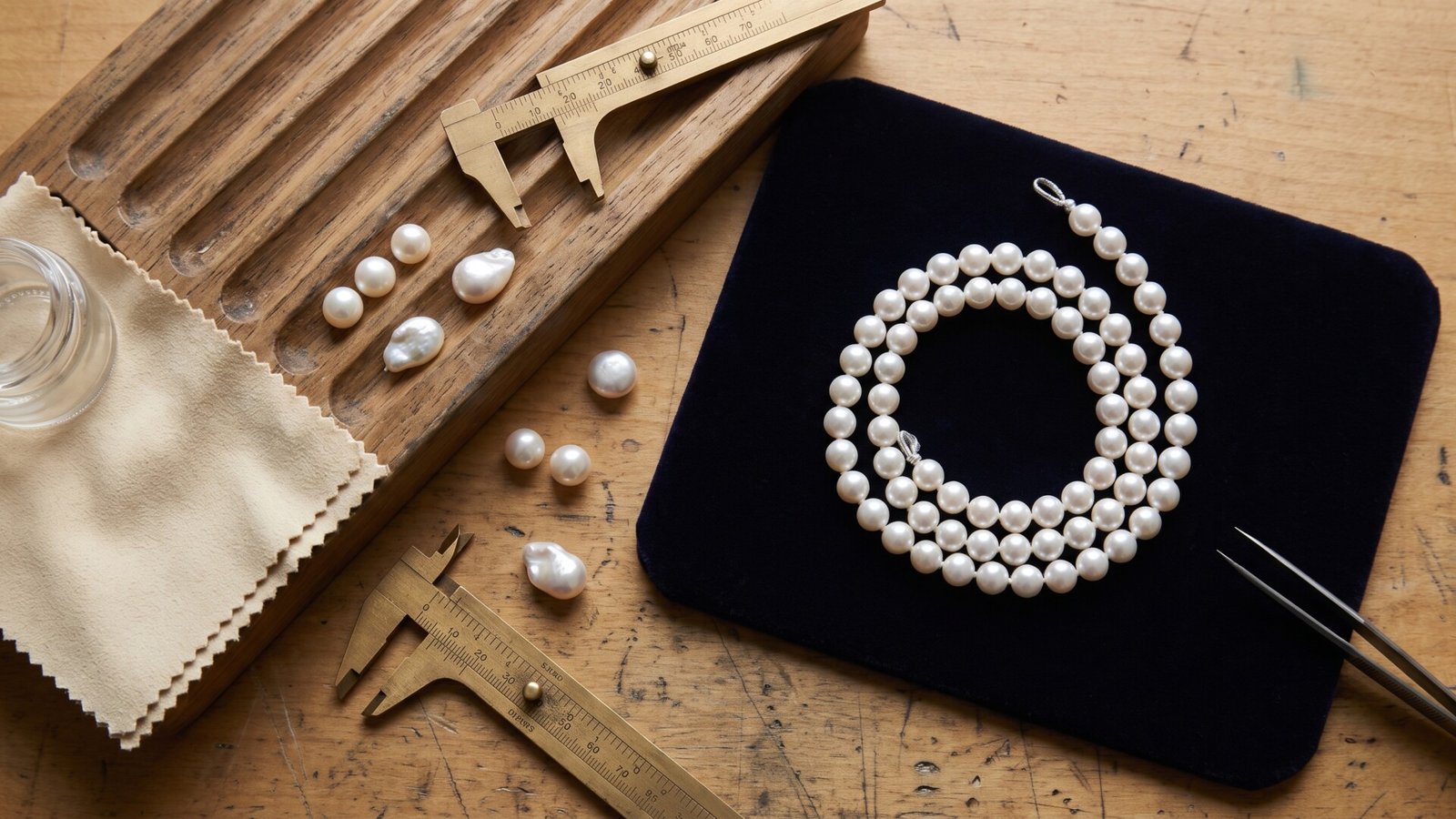
Round is the most difficult shape to culture and, all other factors being equal, the most valuable. However, well-formed symmetrical shapes (pear, oval, button) are also prized. Baroque (irregularly shaped) pearls have their own devoted following and can be extremely valuable if the luster and color are exceptional.
4. Color
Certain colors are rarer and more desirable than others :
- White with rose overtones: Classic, always in demand
- Cream with rose overtones: Warm, traditional
- Golden South Sea: Deep, even gold commands highest prices
- Peacock Tahitian: Green-black with purple-pink overtones, most prized Tahitian
- Natural blue: Extremely rare, museum-quality prices
Fashion trends and cultural traditions influence color preferences and, therefore, prices.
5. Size
When other factors are equal, larger pearls are rarer and more valuable than smaller pearls of the same type. South Sea pearls (9–20mm) command higher prices per millimeter than Akoya pearls (2–11mm) simply because large South Seas are rarer.
6. Nacre Quality
Nacre thickness affects both luster and durability. Pearls with thin nacre may appear dull or chalky and are more likely to wear thin over time. Thick nacre contributes to deep luster and ensures the pearl will last for generations.
7. Matching
For strands, earrings, or any jewelry with multiple pearls, the pearls must match in all quality factors. Well-matched strands command significant premiums over mismatched ones.
General affordability range
Note: These are approximate ranges for cultured pearls. Prices vary widely based on quality.
- Freshwater pearl stud earrings: $30–$200
- Freshwater pearl strand (16-18 inches): $100–$1,000
- Akoya pearl strand (16 inches): $500–$5,000
- Tahitian pearl strand (16 inches): $2,000–$15,000+
- South Sea pearl strand (16 inches): $5,000–$50,000+
- Natural pearl strand: $50,000–$1,000,000+ (museum quality)
How to Identify Real vs Fake Pearl
Fake pearls have been made for centuries, but they’re relatively easy to spot once you know what to look for.
The Tooth Test
Gently rub the pearl against the edge of your front tooth. Real pearl feels slightly gritty or sandy—like fine sandpaper. Fake pearl feels smooth, like glass or plastic. This test works because real nacre has a microscopic texture that fake materials lack.
Visual clues
- Surface texture: Real pearls have tiny surface irregularities, like fingerprints. Fakes are often too smooth and uniform.
- Luster: Real pearls have deep, complex luster—light seems to come from within. Fakes have surface shine only.
- Drill holes: Real pearls have crisp drill holes; fakes often have rough or flaking edges.
- Nacre edge: Look at the drill hole edge under magnification. Real pearls show distinct layers of nacre; fakes show a single material or a bead core.
Common imitations
- Glass pearls: Glass beads coated with pearlescent paint. They feel heavier than real pearls, are perfectly smooth, and the coating can chip.
- Plastic pearls: Lightweight, warm to the touch, often too perfectly round.
- Mother-of-pearl beads: Carved from shell, they lack the layered nacre structure of real pearls.
- Shell pearl: Ground shell mixed with binder and coated—convincing but not the same as solid nacre.
Laboratory tests
X-ray examination can definitively distinguish natural, cultured, and imitation pearls by revealing internal structure. Natural pearls have concentric growth layers; cultured pearls show the bead nucleus; imitations have uniform internal structure.
Care & Cleaning of Pearl
I learned this lesson the hard way, so you don’t have to. Pearls require more careful handling than any other gemstone.
The “Last On, First Off” Rule
This is the single most important rule of pearl care. Always put your pearls on last—after applying makeup, perfume, hairspray, and lotions. And take them off first when you return home.
Cosmetics, perfumes, and hairsprays contain alcohol and mild acids that attack nacre. They will dull the luster and eventually damage the pearl surface.
What to avoid
- Perfume and hairspray: Direct contact is deadly to pearls
- Sweat and body oils: Wipe pearls clean after wearing
- Chlorine and bleach: Remove pearls before swimming
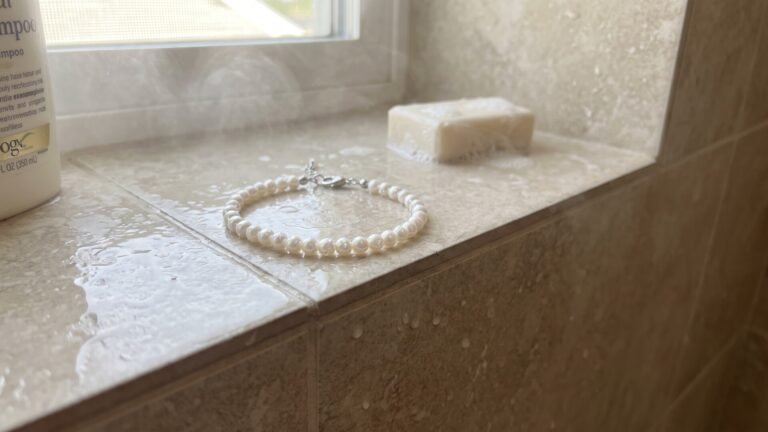
- Hot water and steam: Remove pearls before showers or hot tubs
- Abrasive surfaces: Pearls scratch easily—store separately
- Ultrasonic cleaners: Never use on pearls—they can shatter the nacre
- Steam cleaners: Heat damages both nacre and silk thread
- Airtight storage: Pearls need humidity to prevent drying and cracking
Cleaning methods
After each wear: Gently wipe the pearls with a soft, lint-free cloth (microfiber or chamois) to remove oils and residues. This simple habit is the most powerful thing you can do to maintain luster.
Deep cleaning (every few months):
- Use lukewarm water and one tiny drop of mild, pH-neutral soap (baby shampoo works)
- Dampen a soft cloth with the soapy solution—never submerge the strand
- Gently wipe each pearl individually, turning to clean all sides
- Use a second clean cloth dampened with plain water to remove any soap film
- Lay the pearls flat on a dry towel and air-dry completely—never use a blow-dryer or heat source
Storage
- Store pearls in a soft pouch (velvet or silk) away from metal chains and harder gemstones
- Lay strands flat—never hang them, as gravity stretches the silk thread
- Do not store in airtight containers or safes; pearls need ambient humidity to prevent dehydration
- If you live in a dry climate, place a small dish of water near the storage area (not inside the container) to maintain humidity
Professional care
Restringing: Silk thread stretches, weakens, and collects dirt over time. If you wear your pearls regularly, have them professionally restrung every one to three years. Always have knots tied between each pearl—if the strand breaks, you’ll lose only one pearl instead of all of them.
Annual inspection: Have a professional jeweler check the clasp, thread, and pearl condition annually.
FAQs About Pearl
Is pearl expensive?
Pearls range from very affordable (freshwater studs under $50) to extremely expensive (fine South Sea strands $50,000+). Quality factors—luster, surface, shape, color, size, nacre thickness, and matching—determine price.
Is pearl suitable for daily wear?
With careful habits, yes. Follow the “last on, first off” rule, wipe pearls after wearing, and avoid contact with chemicals and hard surfaces. Pearls that are worn often actually benefit from the natural oils of the skin, which help maintain moisture.
What does pearl symbolize?
Pearl symbolizes purity, wisdom, calmness, and integrity. Historically, it represented the soul, the Virgin Mary, and divine beauty.
Are pearls organic?
Yes. Pearls are the only gemstone created by a living creature. They are composed of nacre (calcium carbonate and conchiolin) secreted by mollusks.
What’s the difference between natural and cultured pearls?
Natural pearls form without human intervention; cultured pearls are initiated by humans who introduce an irritant into the mollusk. Both are real pearls made of nacre. More than 99% of pearls sold today are cultured.
How long do pearls last?
With proper care, pearls can last for generations. Many antique pearls are centuries old. Poor care—exposure to chemicals, heat, dryness—can damage pearls irreversibly.
Can pearls get wet?
Avoid prolonged water exposure. Chlorine, soap, and chemicals in water damage pearls. A quick rinse is acceptable, but never soak pearls or wear them swimming or showering.
Do pearls need to be worn to stay healthy?
Yes. The natural oils from your skin help maintain pearl moisture. Pearls stored for long periods without being worn can dry out and develop surface cracks. Wear your pearls!
What is the rarest pearl color?
Natural blue pearls from the Persian Gulf are among the rarest. Natural pink and deep golden South Sea pearls are also extremely rare and valuable.
Can pearls be restored?
Some surface damage can be professionally polished, but significant nacre loss cannot be replaced. Prevention is the only real protection.
I still have my grandmother’s necklace. It’s not what it was—the luster is softer now, the surface less sharp, a permanent reminder of my ignorance. But it’s still beautiful. Still hers. Still mine.
I wear it on special occasions now, always following the rules I learned too late. Last on, first off. Wipe after wearing. Store flat, not hanging. Never let perfume touch it.
When I put it on, I think about my grandmother, who wore it for fifty years without ever damaging it. I think about the oysters that created these pearls, somewhere in the waters off Japan, decades before I was born. I think about the generations of women who have treasured pearls before me, and the generations who will treasure them after I’m gone.
Pearls are different from other gems. They’re alive, in a way. They’re born in the sea, nurtured by living creatures, grown layer by layer over years. They carry the memory of water, of salt, of the slow patient work of creation. They ask only that we treat them with the same patience, the same care, the same respect.
Whether you’re buying your first pearl or adding to a collection that spans generations, whether you’re a June baby claiming your birthright or simply someone who fell in love with the soft glow of the sea at a jewelry counter—welcome to the pearl family.
The ocean has been waiting for you.
Ready to find your own pearl? Browse our collection below, organized by type, color, and style. Every pearl is genuine, responsibly sourced, and hand-selected for beauty.
[Shop Akoya Pearls]
[Shop South Sea Pearls]
[Shop Tahitian Pearls]
[Shop Freshwater Pearls]
[Shop Pearl Jewelry]
[Shop June Birthstone Collection]
Explore More Gemstones at Our Gemstones Hub