How to remove scratches from Amethyst jewelry at home
I have a confession to make. I once ruined a perfectly lovely amethyst ring trying to “fix” it.
I was new to gemstone care, and I’d read somewhere that toothpaste could polish scratches out of softer stones. So I grabbed the nearest tube—a gritty, whitening variety—and scrubbed my favorite deep-purple amethyst cabochon like I was scouring a baking dish. The result? A dull, hazy stone with a surface that looked frosted rather than glossy. I had traded a few visible scratches for a film of micro-abrasions.
That experience taught me something I want to put up front: no kitchen-cabinet product will truly polish a scratch out of amethyst. Amethyst is quartz, rated 7 on the Mohs scale. Real scratch removal means removing a thin layer of stone with very fine abrasives, which is lapidary work. What you can do at home is clean the stone, remove haze and residue, tell a real scratch from a dirty or worn-looking surface, and protect the stone from further damage.
This guide walks through the nature of the stone, how to assess damage, the safe home steps worth trying, the DIY tricks to skip, when a jeweler is the right call, and the habits that prevent scratches. It sits within our wider amethyst guide, and the broader gemstones hub has care guides for other stones.
Quick Answer: Can You Remove Scratches From Amethyst at Home?
| What you see | Likely cause | What to do |
|---|---|---|
| Dull, cloudy, or greasy look | Soap film, skin oils, lotion, or dust | Clean with mild soap, warm water and a soft brush |
| Faint hairline marks visible only at some angles | Light surface wear | Clean first; accept or have a jeweler re-polish |
| Marks you can feel with a fingernail | Deeper scratch or abrasion | Professional re-polish; do not DIY |
| Rounded or whitened facet edges | Long-term wear | Professional re-polish or recut |
| Chips, cracks, or a rough patch | Impact damage | See a jeweler; stop wearing the piece |
Understanding Amethyst
The Nature of Amethyst
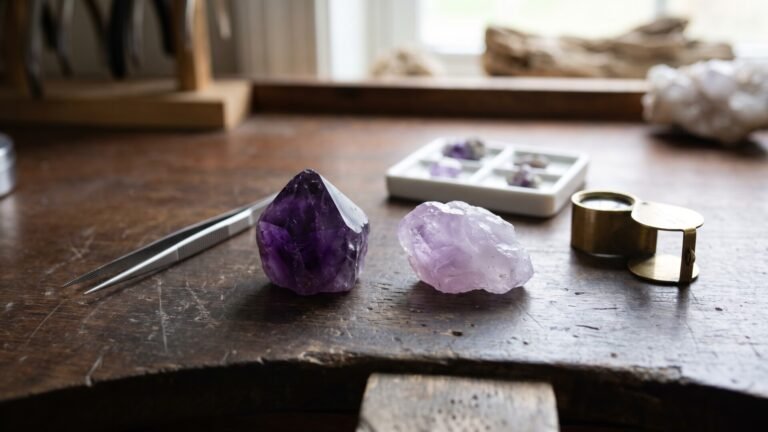
Amethyst is the violet variety of quartz (silicon dioxide), and its color comes from iron and natural irradiation within the crystal. It is February’s birthstone and has been used in jewelry since antiquity. Traditions such as the ancient Greek belief that amethyst prevented drunkenness, or modern beliefs about calm and clarity, are cultural symbolism rather than science; see our amethyst meaning guide for that side of the stone.
Here is the gemology that matters for scratches. Amethyst is a 7 on the Mohs scale, so it resists scratching from anything softer than 7, such as glass (about 5.5) and most metals, and is vulnerable to anything harder: topaz (8), sapphire and ruby (9), moissanite (about 9.25), and diamond (10). Quartz dust (also 7) can slowly dull a polished surface over years, but a soft cloth is not going to scratch it. A diamond ring knocking against an amethyst pendant absolutely can.
Hardness is not the same as toughness. Quartz has no cleavage, which helps, but it can still chip along edges and facet corners on a hard knock. Amethyst can also fade or change color with prolonged strong sunlight and with heat, so keep pieces away from windowsills, hot cars, and torch work during repairs.
Amethyst Facts That Affect Care
| Property | Amethyst | Why it matters for scratches |
|---|---|---|
| Mineral | Quartz (SiO₂) | Same chemistry as clear quartz, citrine, and rose quartz |
| Mohs hardness | 7 | Scratched by topaz, sapphire, ruby, moissanite, diamond |
| Cleavage | None | Breaks with a curved fracture, so edges can chip |
| Heat sensitivity | Color can fade or shift (heated amethyst can become yellow citrine or green prasiolite) | Avoid heat and torch work near the stone |
| Light sensitivity | Can fade with long strong sun exposure | Store out of direct light |
| Natural vs lab-grown | Both exist; lab-grown amethyst is real quartz with the same hardness | The same care and the same limits apply |
Common Causes of Scratches
Scratches rarely come from one dramatic event. They are usually the slow, cumulative effect of everyday life.
- Contact with harder gemstones: An amethyst ring worn beside a diamond or sapphire band is the classic case. The harder stone wins every time.
- Improper storage: Tossing all your jewelry into one box lets pieces rub against each other, and the harder stones scratch the softer ones.
- Everyday surfaces: Resting a hand on a stone countertop, brushing a pendant against a zipper, or cleaning with abrasive powders can wear the surface.
- Accidental impact: Dropping a piece or banging a ring against a metal rail can chip edges or leave deeper marks.
Compared with other gemstones, amethyst sits in a moderate-risk category: tougher than opal or tanzanite, but nowhere near as scratch-resistant as sapphire. Our guide to amethyst versus purple quartz explains what these stones share, and ring styles matter too: a bezel setting protects a stone far better than a high prong.
Assessing the Damage
Before you touch the stone with anything, take a long look at the damage. Rushing this step is how accidents happen.
Surface Haze, Light Scratches, and Deep Scratches
Haze or film is the most common complaint, and the most fixable. Skin oils, lotion, soap residue, and dust make a stone look dull. Cleaning fixes it, and many “scratched” stones turn out to be just dirty.
Superficial scratches are fine hairline marks that disturb the polish without cutting deep. You may only see them when light hits the surface at a certain angle. A jeweler can often polish these out in minutes.
Deep scratches are grooves you can feel with a fingernail. They may look like white or gray lines. If you have a deep scratch, a chip, or any kind of fracture, stop here. Home polishing will not fix it and may make it worse.
Tools Needed for Assessment
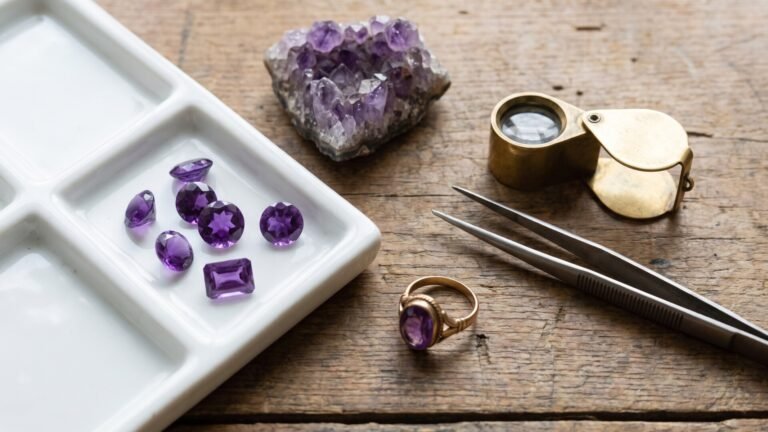
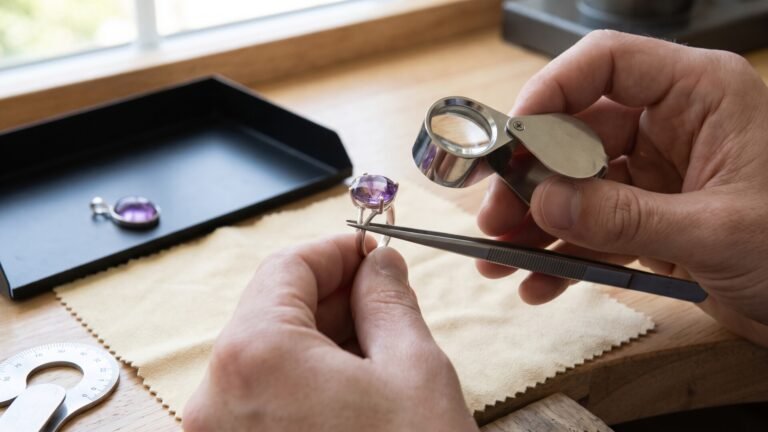
- A 10x jeweler’s loupe: The standard tool for examining gemstones. It lets you see whether a mark is a scratch, a chip, or just residue.
- A bright, angled light: A desk lamp or phone flashlight held at a low angle makes scratches visible.
- Your fingernail: Drag it gently across the mark. If it catches, the damage is deep. If it glides, the scratch is likely superficial.
If you are unsure, err on the side of caution. A quick jeweler consultation costs far less than a ruined stone.
What Actually Works at Home
Once you have confirmed there is no chip or deep groove, these are the home steps worth trying. They remove dirt, oils, and haze. They will not erase a true scratch.
Step 1: A Thorough Gentle Clean
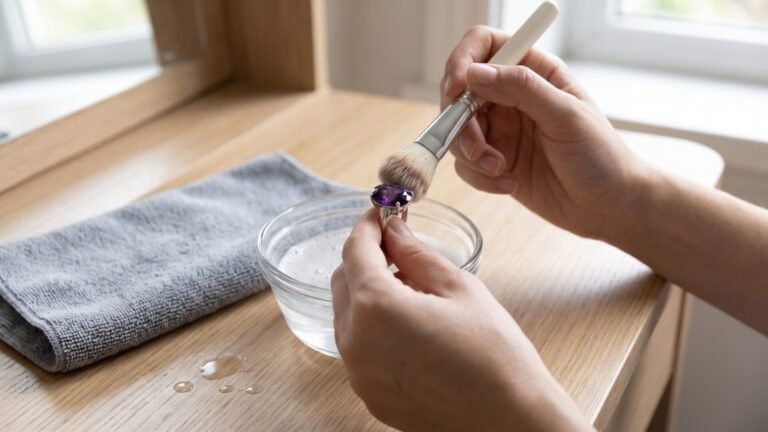
- Mix a few drops of mild dish soap into a bowl of warm (not hot) water.
- Soak the piece for a few minutes to loosen oils and grime.
- Use a soft-bristled brush, such as a baby toothbrush, to clean around the stone and under the prongs.
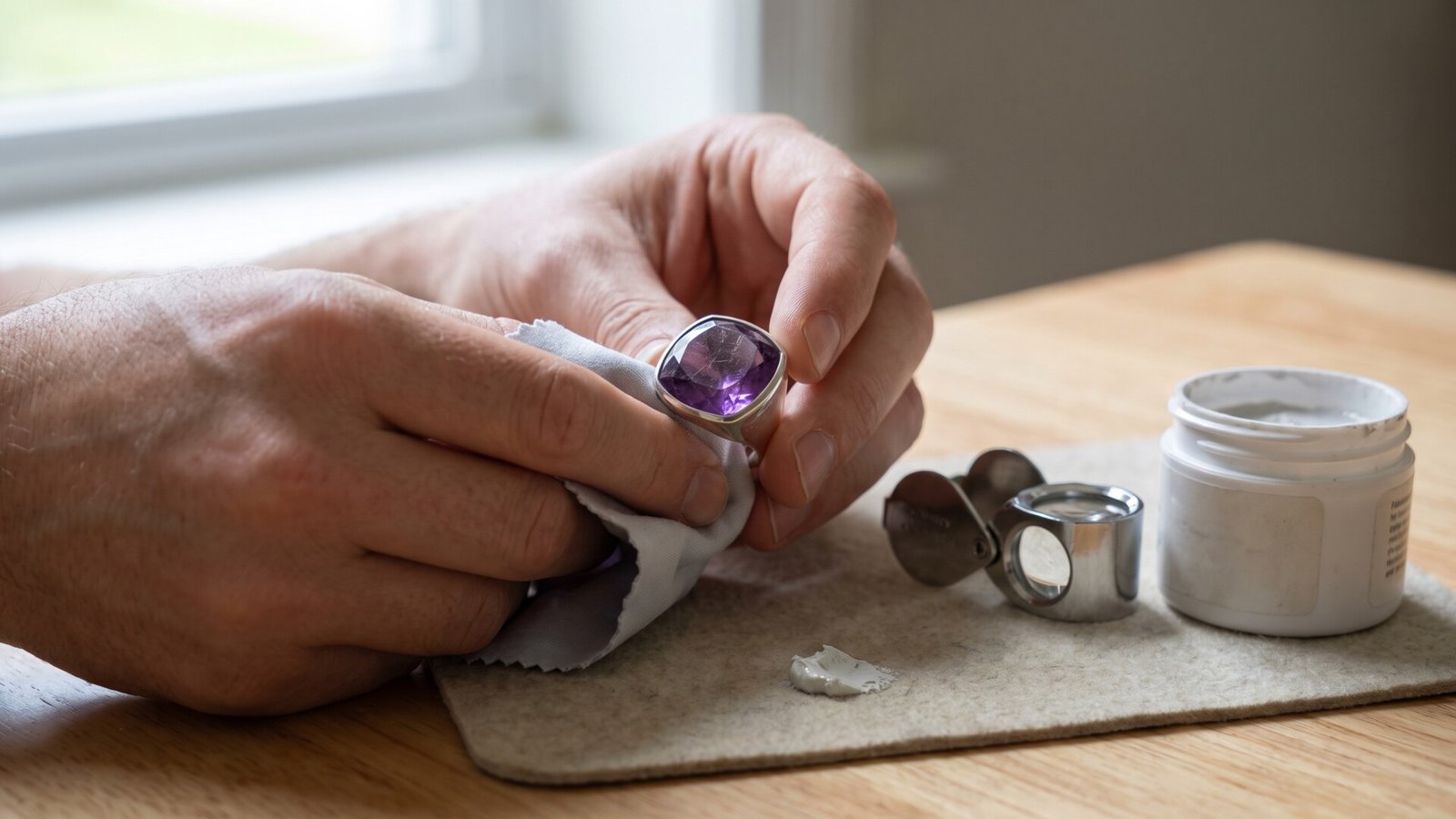
- Rinse in lukewarm water and dry with a lint-free microfiber cloth.
Re-inspect under a light. If the “scratches” disappeared, the problem was residue. For the full routine, see how to safely clean amethyst without damaging the polish.
Step 2: Dry Buff With a Clean Microfiber Cloth
A clean, dry microfiber cloth restores shine to a dull but unscratched stone. Do not use cloths pre-treated with metal polish, such as those sold for silver or gold, on gemstones; the chemical compound is meant for metal and can leave residue in settings. Buff metal and stone with separate cloths.
Step 3: Know When to Stop
If cleaning and buffing leave visible scratches, the remaining marks are real surface damage. This is the moment to stop, not to reach for stronger abrasives.
DIY Tricks to Avoid (Including the One That Ruined My Ring)
Toothpaste
Toothpaste is the most-shared internet fix, and it is also the one I now recommend against. Many toothpastes contain silica or other abrasives designed for enamel, which is much softer than quartz. They are not formulated to polish gemstones, and whitening or gritty formulas can leave a dull, uneven surface instead. The abrasive can also work into settings and wear soft metals such as gold. Some jewelers will say a very mild, plain paste is harmless on a hard stone, but it is not a reliable scratch remover, and the risk is mostly on the stone surface and the metal around it.
Baking Soda Paste
Baking soda is a much softer mineral than quartz, so it is unlikely to harm the stone. For the same reason it will not polish out a scratch. It can help lift dirt from a textured setting, but plain soap and a soft brush do the same job with less mess.
Other Things to Skip
- Sandpaper, nail files, and scouring powders: These cut deeper scratches into the surface.
- Power tools and rotary polishing at home: Heat from friction can fade amethyst, and it is easy to round off facet edges.
- Ultrasonic and steam cleaners: Heat and vibration can stress stones with internal fractures. Check with a jeweler first.
- Bleach and harsh household cleaners: These attack settings and any glue or filler.
Professional Scratch Removal
When to Seek Professional Help
Not all scratches can be removed at home, and most true scratches cannot. You need a professional if the scratch is deep, if there is a chip, if the stone has a fracture, or if cleaning did not help.
A jeweler or lapidary has the right equipment: fine diamond or cerium-oxide polishing compounds applied on a lap, and the experience to remove only as much material as needed. This is called re-polishing. It removes a thin layer of stone, so repeated re-polishing will gradually soften facet edges and reduce the stone’s size.
What to Expect and What It Costs
The jeweler will examine the stone, assess the damage, and recommend a course of action: a light re-polish, a re-polish of the affected facets, or, if damage is deep, recutting. Prices vary widely by region, stone size, and whether the stone must be removed from its setting. Many jewelers quote simple re-polishes at a modest per-stone fee, while recutting costs more and reduces carat weight, so call two or three local jewelers for quotes before committing. For a low-value stone, replacing it may cost about the same as repair.
Questions to Ask Before You Hand It Over
- Do you work on colored gemstones, and do you re-polish stones in house?
- Will the stone need to be removed from the setting, and does that carry any risk to the metal?
- How much material will you take off, and how will that change the cut or carat weight?
- Is the price quoted per stone, and does it include re-setting or prong checks?
Cabochon vs Faceted Amethyst
Smooth cabochons show a scratch differently than faceted stones. On a cabochon, the whole domed surface reflects light, so fine scratches show up as a hazy or frosted look. On a faceted stone, a scratch appears on an individual facet, and worn edges between facets show as whitish, rounded lines. Faceted stones are easier to spot-polish by facet; cabochons are re-polished as a whole surface. Either way, the same rule applies: cleaning is safe at home, abrasion is a job for a professional.
Prevention Tips for Amethyst Jewelry
Prevention beats repair every time. After my toothpaste mistake, I became careful about how I wear and store amethyst.
Proper Storage Techniques
- Separate compartments: Use a box with individual slots or a soft pouch for each piece.
- Soft lining: Velvet or felt prevents friction.
- Keep it away from harder stones: Store amethyst apart from diamonds, sapphires, rubies, topaz, and moissanite.
- Avoid direct sun: A closed drawer is better than a sunny windowsill.
Wearing Habits
- Remove before activity: Take off rings and bracelets before dishes, cleaning, gardening, gym sessions, or manual work.
- Avoid hard surfaces: Be mindful of where you rest your hands.
- Put it on last: Apply makeup, perfume, and hairspray first; chemicals can leave a film on the stone.
- Take it off before bed: Sleeping in jewelry is a common cause of scratches and bent prongs.
Choosing Pieces That Resist Scratches
If you are shopping rather than repairing, the piece style makes a difference. Earrings and pendants take far fewer knocks than rings or bracelets, and protective settings such as bezels or halos shield the stone’s edges. If you wear an amethyst ring daily, expect gradual wear over the years. Browse the best amethyst earrings and necklaces for lower-risk styles, or see 10 amethyst jewelry pieces for every budget.
Long-Term Care for Amethyst Jewelry
Regular Cleaning Regimen
Amethyst can be cleaned with mild soap and warm water, using the routine in Step 1 above. Clean worn pieces every few weeks and pieces you wear occasionally before putting them away. Avoid ultrasonic and steam cleaners unless a jeweler has confirmed the stone has no fractures.
Importance of Inspections
Inspect amethyst jewelry about once a month. Look for loose prongs, worn settings, and new scratches. Catching a loose stone early can prevent losing it. Many jewelers will check prongs for free or a small fee.
Things Most Scratch-Removal Guides Don’t Tell You
The Limits of DIY Methods
The biggest myth about DIY scratch removal is that it can make a stone look like new. Home methods can remove residue and light haze. They cannot restore the original factory polish, which is done with fine abrasives on a polishing wheel. If your car has a scratch, rubbing compound can reduce its visibility, but a hand-applied product will not replicate fresh paint. The same principle applies here: home care is for maintenance, not restoration.
Treatments and Fillers
Most amethyst on the market is natural color or lab-grown; heating can change amethyst to citrine or prasiolite, which is a deliberate treatment, not routine care. Fracture filling or dyeing is much less common for amethyst than for stones like emerald, but it does occur on low-priced material, and any resin or filler can be damaged by heat or solvents. If you are unsure whether your stone has been treated, ask a jeweler or a gem lab before polishing. Our guides to spotting fake amethyst jewelry and identifying fake amethyst explain how glass and dyed quartz differ from the real thing.
Glass imitations behave differently: glass is softer than quartz and scratches much more easily, which is one clue that a “scratch-prone” purple stone may not be amethyst at all.
How Amethyst Compares for Scratch Resistance
| Stone | Mohs hardness | Scratch behavior in daily wear |
|---|---|---|
| Diamond | 10 | Scratches almost everything else |
| Sapphire / ruby | 9 | Excellent; rarely shows wear |
| Topaz | 8 | Good, though it has cleavage |
| Amethyst / quartz | 7 | Moderate; fine wear marks over years |
| Peridot | 6.5–7 | Scratches more readily |
| Opal | 5.5–6.5 | Scratches easily and needs extra care |
Why a Scratch Feels So Personal
Why do we care so much about a scratch on a piece of jewelry? Often it is not about the money. It is about the memory. A scratch can feel like a blemish on a symbol of a moment or a person. When I damaged my own ring, I was upset that I had failed to protect something given to me with love. Caring for jewelry is one way of saying that the piece matters. For related gift ideas, see our guide to amethyst colors and symbolism and chevron amethyst.
Frequently Asked Questions About Removing Scratches From Amethyst
Can you really remove scratches from amethyst at home?
Not true scratches. At home you can remove dirt, oils, and haze with mild soap, warm water and a soft cloth. Scratches that you can feel with a fingernail need professional re-polishing.
Does toothpaste remove scratches from amethyst?
It is not a reliable fix. Toothpaste is designed for tooth enamel, not gemstones, and gritty or whitening formulas can leave a dull, uneven surface. Cleaning with mild soap and water is safer.
What can scratch amethyst jewelry?
Anything harder than 7 on the Mohs scale: topaz, sapphire, ruby, moissanite, and diamond. Contact with harder gemstones in storage or when worn together is the most common cause.
Can a jeweler polish amethyst scratches out?
Often yes. A lapidary or jeweler can re-polish a scratched surface with fine abrasives. Deep scratches or chips may require recutting, which reduces the stone’s size.
How much does it cost to repolish amethyst?
It varies by jeweler, stone size, and whether the stone must be removed from its setting. Get written quotes from two or three local jewelers, and compare against the stone’s replacement cost.
Is it safe to use an ultrasonic cleaner on amethyst?
It is risky. Vibration and heat can stress stones with internal fractures, so use mild soap, warm water, and a soft brush unless a jeweler has confirmed it is safe.
How do I stop my amethyst from getting scratched again?
Store it separately from harder gems, remove rings before manual work, put jewelry on last, and choose protective settings such as bezels. Earrings and pendants scratch far less than rings.
Does lab-grown amethyst scratch less than natural amethyst?
No. Lab-grown amethyst is real quartz with the same hardness of 7, so it scratches the same way and needs the same care.