How to Safely Clean Amethyst Without Damaging the Polish
A complete gem-care guide for jewelry wearers, collectors, and crystal keepers. It covers rings, pendants, beads, raw stones, and clusters, with the reasoning behind each rule so you can adapt it to your own piece.
Amethyst Looks Tough, But the Wrong Cleaning Habits Can Dull the Polish
Amethyst is a variety of quartz, and it ranks 7 on the Mohs scale. According to the Gemological Institute of America (GIA), it also has good toughness and suits all jewelry types, including rings. That makes it one of the easier colored gemstones to live with. Still, hardness is only part of the story: amethyst can scratch, it is sensitive to heat and abrupt temperature changes, and some stones lose color after prolonged exposure to intense light.
In practice, polish is more often lost to abrasion and neglect than to dramatic accidents. Dust and grit are largely quartz themselves, so a gritty cloth, a drawer full of loose jewelry, or a scrubby cleaner will slowly haze a faceted surface. The result is a stone that looks cloudy or streaky even though it was never dropped. If you are new to the stone, our main guide to amethyst meaning, properties, uses, and value covers the basics.
This guide explains what to use, what to skip, how to handle set jewelry versus raw stones, how to tell residue from real damage, and when to hand a piece to a jeweler.
Amethyst at a Glance: Facts That Shape How You Clean It
| Property | What to know |
|---|---|
| Mineral | Quartz (silicon dioxide); amethyst is the purple variety |
| Mohs hardness | 7. Resists most household wear but can be scratched by harder materials and by quartz-rich dust and grit |
| Toughness / cleavage | Good toughness; no cleavage, but included or fractured stones are more vulnerable to knocks and vibration |
| Heat | Avoid heat exposure; abrupt temperature changes can fracture a stone. Heating amethyst can also change its color, which is how some citrine is produced |
| Light | Color in some stones can fade with prolonged exposure to intense light |
| Common treatments | Heat treatment is sometimes used; some material is dyed or fracture-filled, which changes the care rules (see below) |
| Safest cleaning | Lukewarm water, a drop of mild dish soap, a soft brush, and a lint-free cloth |
Facts in the table follow GIA’s published care guidance for amethyst. Always follow the care rules of the most delicate material in a piece, whether that is another gemstone, a pearl, or the stringing on a bracelet.
What Makes Amethyst Sensitive to Cleaning
The first step is understanding what you are actually protecting. The polish is the ultra-smooth surface created during cutting. When you use the wrong method, you are not “dirtying” the stone; you are roughening that surface at a microscopic level. That is why a stone can look dull even though it is chemically unchanged.
Amethyst is:
- a variety of quartz, colored by iron within the crystal structure (the purple comes from iron-related color centers)
- sensitive to heat and abrupt temperature change
- scratched by abrasion from harder grit and dust
- affected by prolonged intense light in some stones
- less durable when included, fractured, or fracture-filled
The polish is most at risk from:
- gritty scrubs, toothpaste, and baking soda pastes (abrasive)
- rough cloths and paper towels
- steam cleaners and boiling water
- sudden hot and cold water changes
- ultrasonic cleaners, if the stone is fractured, filled, or dyed
- strong household chemicals that can harm the setting or neighboring gems
The Safest Cleaning Method: Warm Water and Mild Soap
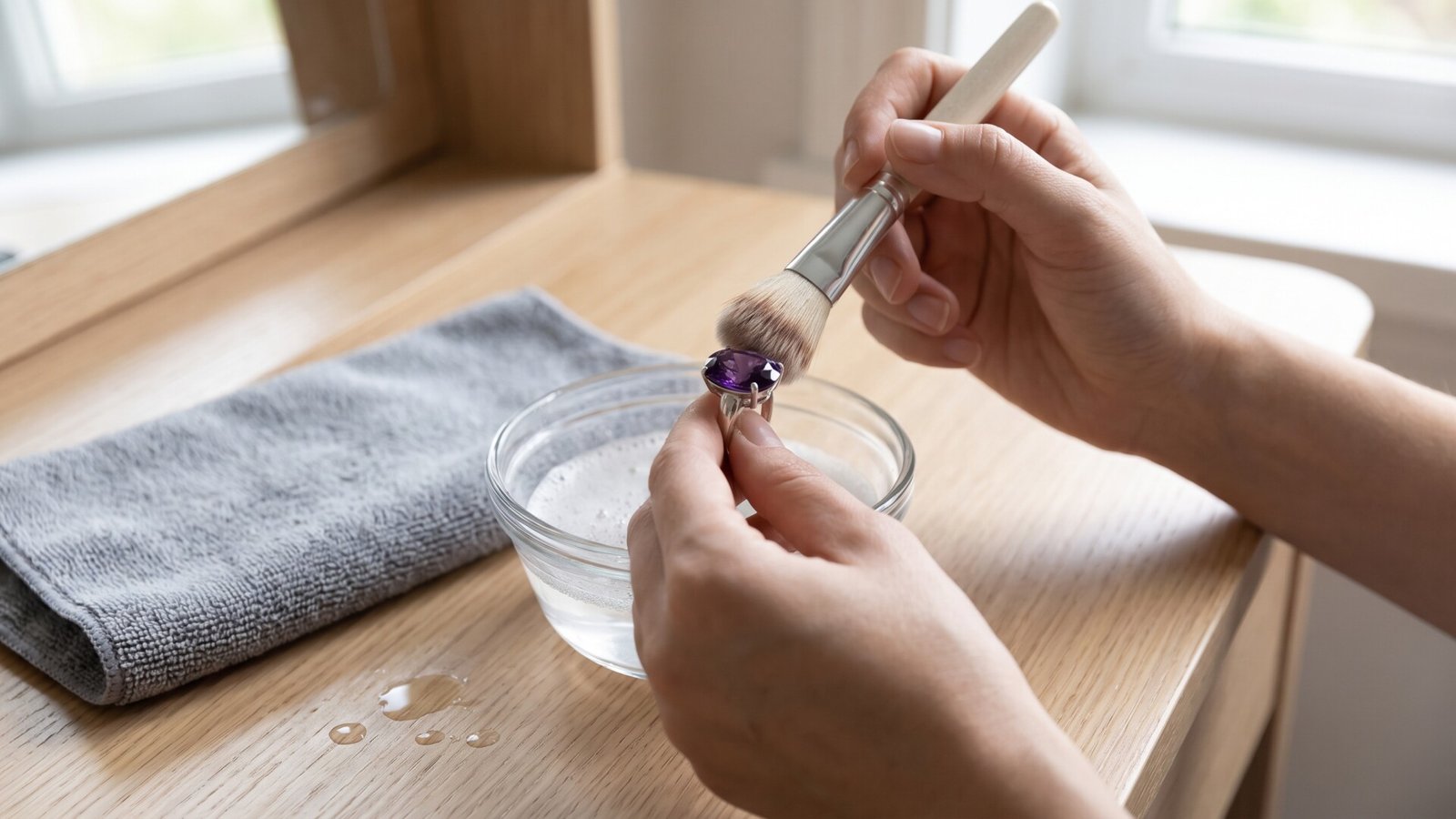
This method works for practically all amethyst: faceted stones, cabochons, beads, pendants, rings, earrings, and clusters with minimal matrix. GIA also lists warm soapy water as safe for amethyst.
What You Need
- a bowl of warm (not hot) water
- mild dish soap, free of additives, perfumes, and degreasers
- a soft microfiber or lint-free cloth
- a soft toothbrush (a baby toothbrush works well)
- a clean towel
Step-by-Step
- Prepare your soapy water. Add one or two drops of mild soap. You want barely-there suds, not a bubble bath.
- Soak briefly. Five to ten minutes is plenty. Not hours, and not overnight.
- Brush gently. Use the soft toothbrush around prongs, settings, and behind the stone, with light pressure.
- Rinse with lukewarm water. Avoid temperature shock, since sudden changes can fracture a stone.
- Dry with a microfiber cloth. This prevents water spots.
- Air-dry fully, especially rings with hollow or enclosed settings.
This is the routine most jewelers would call the baseline: simple, cheap, and safe for the stone.
Cleaning Amethyst Clusters and Geodes
Clusters are trickier because dust builds up in crevices, and the cavities hold water. The principles are the same, but the soak should be even shorter.
Do not
- soak clusters for long periods
- use hot water or pressure sprays
- use abrasive brushes
- use vinegar or acidic cleaners, since host rock (matrix) can react or crumble
How to clean a cluster safely
- Place the cluster face-down in lukewarm soapy water briefly.
- Use a very soft brush to lift dust from the tips.
- Rinse under a gentle stream of lukewarm water.
- Blot dry with a soft towel.
- Allow it to air-dry completely, because cavities trap water.
If your cluster includes matrix, test a small hidden area first, since some host rock dissolves or flakes easily.
Cleaning Amethyst Jewelry With Metal Settings
Two things need protecting at once: the stone and the metal. Gold and platinum tolerate gentle cleaning well. Sterling silver tarnishes, and that can tempt people toward harsher products.
Amethyst in silver settings
Skip commercial silver dips. They are strong chemical baths that can damage the setting, stain neighboring porous gems, and leave residue in the stone’s crevices. Use mild soap, warm water, a microfiber cloth, and a soft toothbrush. If the silver still needs polishing, clean the stone first, then use a silver polishing cloth on the metal only, keeping it off the amethyst surface.
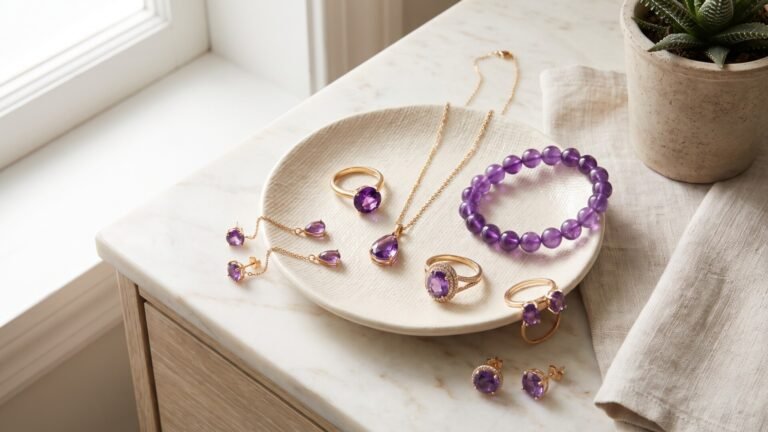
Wondering which pieces to wear daily? Our roundups of amethyst earrings and necklaces and amethyst jewelry pieces for every budget show which styles pair well with simple care.
Cleaning Methods to Avoid
This is where most polish damage happens. The list below separates methods that are genuinely risky from products that are simply unnecessary.
Avoid because they scratch or abrade
- toothpaste and baking soda
- abrasive cloths, rough sponges, and paper towels
- toothpicks and metal tools
- jewelry cloths impregnated with polishing compounds, unless labeled safe for gemstones
Avoid because of heat or shock
- steam cleaners (GIA does not recommend steam cleaning amethyst)
- boiling water, or very hot or freezing water
- sun drying, window sills, and car dashboards
Avoid because they can harm the setting or other gems
- bleach, ammonia, and household or glass cleaners
- vinegar and lemon juice
- acetone and alcohol-based products
- dips and wipes not labeled safe for quartz gemstones
A note on accuracy: quartz itself is chemically resistant to most household acids and alcohols (hydrofluoric acid is the notable exception). The reason to avoid vinegar, bleach, and solvents is mainly the metal, the prongs, any glued or filled areas, and softer gems in the same piece, not that they dissolve amethyst. When in doubt, soap and water does the job without the risk.
Why Ultrasonic Cleaners Deserve Caution
GIA notes that ultrasonic cleaners are usually safe for amethyst, except for stones that are dyed or fracture-filled. Even so, they are a gamble at home because you often cannot see what is inside a stone or how secure the prongs are. Vibration can:
- enlarge existing internal fractures
- loosen prongs and bezels
- disturb fracture fillers or dye
- dislodge stones in older or worn settings
Jewelers use ultrasonic machines under controlled conditions after inspecting the piece. Unless you know your stone is clean, untreated, and securely set, stick with hand cleaning.
Steam Cleaners: Skip Them
Steam works for some diamonds, but amethyst is heat-sensitive. Steam and abrupt temperature change can fracture the stone or affect its color, and GIA specifically advises against steam cleaning amethyst.
Removing Tough Dirt, Lotion Buildup, and Body Oils
Rings and necklaces collect oils, lotion, and skin cells that form a dull film, especially on the underside of the stone where light enters. To remove it:
- Soak in warm soapy water.
- Brush the underside of the stone and the setting with a soft brush.
- Rinse with lukewarm water.
- Dry fully and check again in good light.
If residue remains, repeat the process rather than escalating to harsh products. Several gentle rounds are safer than one aggressive one.
How to Deal With Cloudy Amethyst
If the stone looks cloudy, work out which of three causes you are dealing with:
Cloudiness from residue
Regular warm soap-and-water care usually fixes it.
Cloudiness from scratches or worn polish
This needs professional repolishing by a lapidary or experienced jeweler. It cannot be fixed at home. If you are curious about the limits of DIY, read how to remove scratches from amethyst jewelry at home before you try anything.
Cloudiness from internal fractures or inclusions
Cleaning will not change it, because it is structural. If a crack looks new, have the piece inspected, particularly before using any ultrasonic cleaner.
Removing Stains Without Killing the Polish
Amethyst does not stain easily, but dirt can lodge in micro-pits, facet junctions, and gallery wires. Safe tools are warm soapy water, repeated gentle brushing, and a soft microfiber cloth. Avoid acetone, toothpaste, and baking soda pastes, since abrasion is the real danger to the polish.
Handling Heat-Treated, Dyed, or Fracture-Filled Amethyst
Heat treatment is a known practice in the amethyst and citrine trade, and some quartz is dyed or fracture-filled to improve its appearance. Treated stones are more sensitive to ultrasonic vibration, heat, and chemicals, and they should be cleaned with the gentlest method only. Because treatment is not always visible or disclosed on lower-priced pieces, the practical rule is to treat all amethyst as heat-sensitive:
- use lukewarm water only
- skip steam and ultrasonic cleaners if you are unsure
- dry away from direct sun and heaters
If you are buying and want to know what is natural, our guides to spotting fake amethyst jewelry and amethyst versus purple quartz explain treatments and look-alikes in more detail.
How to Clean Carved Amethyst and Cabochons
Faceted stones are easy. Carvings and cabochons catch grime in grooves, so they need a little more time but the same gentle tools: a soft brush, mild soap, lukewarm water, a microfiber cloth, and complete air drying. Avoid toothpicks and metal picks, which scratch instantly.
How to Clean Raw Amethyst
Raw amethyst is not polished, but it is still sensitive. Use a brief soak, gentle brushing, and air drying. Avoid repeated soaking, cleaning chemicals, and hot water. If the specimen contains matrix, test a small area first.
Cleaning Amethyst Beads in Necklaces and Bracelets
Beads are often strung on silk, nylon, or elastic that should not be soaked. Use a cloth dampened with mild soapy water, wipe each bead, and dry immediately. Avoid submerging beaded jewelry, which can weaken the stringing and trap moisture in the bead holes.
Cleaning Amethyst Set With Softer Gems
If your piece includes opal, pearl, turquoise, amber, or coral, follow the rules for the most sensitive material. Many of these cannot tolerate soaking, brushes, or chemicals at all. In that case use a lightly damp microfiber cloth, avoid soaking, and avoid brushes. Our broader gemstones guide covers how different stones compare on hardness and care.
Can You Use Jewelry Wipes?
Most jewelry wipes are formulated for metal, not gems, and some leave a film. Avoid them unless the label says they are safe for quartz and gemstones.
How to Protect Amethyst’s Polish Long-Term
Preventing damage is easier than repairing it.
Store it correctly
- keep each piece in its own soft pouch or lined compartment
- keep it away from harder stones such as sapphire, ruby, and diamond, which can scratch it
- avoid sun exposure and warm spots
- store in a cool, dry place
Wear it smart
Amethyst is durable but not invincible. Remove rings and bracelets for workouts, household cleaning, gardening, swimming, and sunbathing. Put jewelry on after perfume, hairspray, and lotion rather than before.
Clean it regularly
The more often you clean gently, the less deep cleaning you will ever need.
Fixing Dull Polish: What You Can and Cannot Do at Home
You can fix
- residue buildup
- fingerprints
- lotion film
- dust
- minor grime
You cannot fix
- surface scratches
- worn or dull polish
- abrasion
- frosted appearance
- facet wear
These need an experienced lapidary. Do not try to buff amethyst at home: you can round off facet edges and distort symmetry, which lowers both sparkle and value.
Light, Heat, and Storage: Avoiding Color Loss
Some amethyst fades with prolonged exposure to intense light, and heat can fracture or change the color of the stone. Keep display pieces out of direct sun, avoid window sills and car dashboards, and always use lukewarm water.
Crystal keepers sometimes place stones in sunlight or moonlight as part of a cleansing ritual. That is a spiritual tradition rather than a gemological requirement, and from a care standpoint, moonlight or a quiet shelf is far safer than hours of strong sun. If you enjoy the symbolism, see our amethyst meaning guide and healing properties overview, which present these ideas as traditions and beliefs rather than medical advice.
A Weekly Quick-Clean Routine
If you wear amethyst often, especially rings, try this:
- Mix warm water with a drop of mild soap.
- Dip a soft cloth and wipe the stone and setting.
- Rinse lightly.
- Dry with microfiber.
- Air-dry thoroughly.
This keeps oils and grime from building up and dulling the polish.
A Monthly Deep Clean Routine
- Full soak for 5 to 10 minutes.
- Soft brushing around the setting.
- Lukewarm rinse.
- Microfiber drying.
- Air-dry overnight.
A monthly deep clean is also a good moment to check for loose prongs by gently tapping the piece near your ear: a rattle means it should see a jeweler.
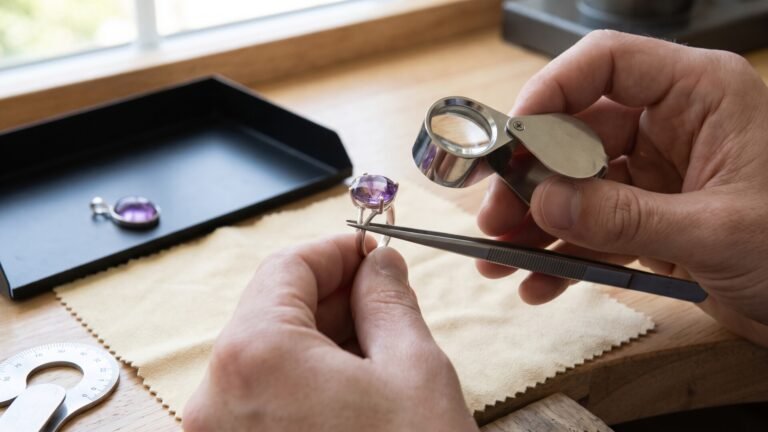
Professional Care: When to See a Jeweler
Bring your amethyst to a professional if you notice:
- dull polish or scratches
- chips
- loose settings or wobbling prongs
- internal crack lines that look new
- persistent cloudiness
A jeweler or lapidary can repolish, recut facets, or secure the setting safely. Ask before agreeing to any recutting, since it removes material and can reduce carat weight.
Frequently Asked Questions About Cleaning Amethyst
Frequently Asked Questions About Cleaning Amethyst
Can I clean amethyst with soap and water?
Yes. Lukewarm water with a drop of mild dish soap, a soft brush, and a microfiber cloth is the safest routine for amethyst and is the method GIA lists as safe.
Is it safe to put amethyst in an ultrasonic cleaner?
GIA says ultrasonic cleaners are usually safe for amethyst, except for dyed or fracture-filled stones. At home it is still a risk, because you cannot always see internal fractures or loose prongs, so gentle hand cleaning is the better default.
Can I steam clean amethyst jewelry?
No. Amethyst is heat-sensitive, and abrupt temperature changes can fracture it, so steam cleaning is not recommended.
Why does my amethyst look cloudy?
Most often it is a film of lotion, soap, or body oil, which soap and water will remove. If it stays cloudy after cleaning, the cause is probably surface wear or internal fractures, which only a jeweler can assess.
Will sunlight fade my amethyst?
It can. Some amethyst loses color after prolonged exposure to intense light, so avoid leaving it on sunny window sills or dashboards.
Can I use vinegar, toothpaste, or baking soda to clean amethyst?
It is best not to. Toothpaste and baking soda are abrasive and can dull the polish, while vinegar can harm metal settings and softer gems in the same piece. Soap and water is both safer and effective.
How often should I clean amethyst jewelry?
A quick wipe weekly for pieces you wear often, and a gentle soak and brush about once a month, is enough for most people.
Can I polish scratched amethyst at home?
Not safely. Scratches and worn polish need repolishing by an experienced lapidary, and home buffing can round off facet edges.
Amethyst Is Easy to Clean If You Keep It Gentle
Amethyst is a quartz, and it is durable enough for everyday jewelry, but it rewards gentle care. Lukewarm water, mild soap, a soft brush, and a microfiber cloth will keep most pieces bright for years, while heat, abrasives, and shortcuts are what cost you the polish.
For more, explore our full amethyst guide, learn about amethyst color grades, or browse the wider gemstones hub.