Amethyst: Meaning, Properties, Uses & Value
Amethyst is the purple variety of quartz and the February birthstone. It is widely available, comfortably priced, and tough enough for everyday jewelry, which makes it one of the most popular colored gemstones in the world. It also has some quirks that catch new owners out: quartz dust can slowly dull it, strong light and heat can fade it, and much of the “citrine” on the market is really heated amethyst.
This guide covers what amethyst is, how it gets its color, what it has meant to people over time, how to wear and care for it, what it costs, and how to tell it from imitations. It is the central page of our amethyst cluster, so you will find links to deeper guides on amethyst meaning, safe cleaning, amethyst vs. purple quartz, and more.
Quick Facts Box
Gemstone Overview
| Category | Details |
|---|---|
| Mineral / composition: | Quartz (silicon dioxide, SiO₂), purple variety |
| Color(s): | Pale lilac to deep violet; color zoning is common |
| Hardness (Mohs): | 7 |
| Toughness / cleavage: | No cleavage; good toughness, but can chip if struck hard |
| Crystal system: | Hexagonal (trigonal) |
| Transparency: | Transparent to translucent |
| Sensitivities: | Color can fade with prolonged strong light or heat; heating can turn it yellow or orange |
| Common treatments: | Most amethyst is untreated; heat treatment is used to lighten dark stones or to make citrine and prasiolite. Synthetic amethyst also exists |
| Common uses: | Jewelry, carvings and decorative objects, meditation tools, collector specimens |
| Birthstone month(s): | February |
| Zodiac association: | Aquarius and Pisces in many lists; zodiac lists vary by source |
What Is Amethyst?
Amethyst is a variety of quartz, one of the most abundant minerals in the Earth’s continental crust. Its chemistry is plain silicon dioxide, but a small amount of iron in the crystal structure, combined with natural radiation over geological time, produces the purple color.
How amethyst gets its color
Trace iron in quartz, exposed to natural irradiation, forms color centers that absorb parts of visible light and leave the violet we see. Because the iron and radiation are not distributed evenly, color is often concentrated in zones, which is why a stone may show bands or patches. The same color centers are also why amethyst can fade if exposed to strong light or heat for long periods.
Where amethyst is found
Amethyst is found on every continent. Notable sources include:
- Brazil: Very large deposits, including the big geodes used for decoration and carving
- Uruguay: Known for deeply colored material, often with reddish flashes, though crystals are typically smaller
- Zambia: Produces deep, saturated purple stones that rival the best historic material
- Russia: The Ural Mountains gave rise to the term “Siberian” amethyst for the finest deep purple with red and blue flashes; those classic sources are largely exhausted
- Other sources: Bolivia, India, Madagascar, Mexico, Namibia, Sri Lanka, Tanzania, and the United States
Natural, treated, and synthetic amethyst
Most amethyst sold is untreated, but there are three things worth knowing.
- Heat turns it into other gems. When amethyst is heated to roughly 400 to 500°C, the iron-related color changes and the stone turns yellow, orange, or brownish. Most of the citrine on the market was produced this way, and some amethyst turns green (prasiolite). If you see bright, uniform orange-yellow “citrine” at a low price, it is probably heated amethyst. That is a normal trade practice if disclosed. Natural citrine is usually paler. See our citrine guide.
- Heat and irradiation may be used to adjust color. Pale or overly dark stones are sometimes treated, and undisclosed treatment is an issue.
- Synthetic amethyst exists. Lab-grown amethyst has the same chemistry as natural amethyst and is often very clean and evenly colored. It should be sold and labeled as lab-grown.
Amethyst can also occur with citrine in the same crystal, a bicolor stone called ametrine, found mainly in Bolivia.
Amethyst Meaning & Symbolism
The notes below describe history and tradition, not scientific effects. For a fuller treatment, see our amethyst meaning guide.
The name comes from the Greek amethystos, meaning “not intoxicated.” Ancient Greeks and Romans believed that wearing amethyst or drinking from amethyst cups would protect against drunkenness, and the idea persisted in medieval writing, including by Albertus Magnus. That belief has no scientific support, but it explains why amethyst is often linked with clear-headedness and sobriety.
Religious associations
Amethyst is among the stones named in the Bible’s description of the foundations of the New Jerusalem in the Book of Revelation. In Christian tradition it has long been associated with bishops, whose ceremonial rings were often set with amethyst, and the stone’s violet color has been read as a symbol of humility and spiritual authority. In some Buddhist traditions amethyst is also regarded as a sacred stone.
Modern interpretations
Today amethyst is commonly associated with clarity, calm, and balance. For people born in February, it is read as a symbol of wisdom and sobriety. Purple’s long link with royalty means amethyst also carries a sense of dignity, and it is accessible enough that anyone can wear it.
Amethyst Healing Properties
These are beliefs and traditions, not medical advice. Gemstones do not diagnose, treat, or cure any condition, including anxiety, sleep problems, or pain, and they are not a substitute for professional care.
Traditional beliefs
Beyond preventing intoxication, historical writers credited amethyst with calming the mind and protecting travelers. In some medieval accounts, soldiers carried amethyst as a protective charm.
Modern crystal-healing associations
In modern crystal healing practice, many people use amethyst as a focus object for relaxation and meditation. They describe it as a calming, intuition-linked stone and associate it with the third eye and crown chakras. You can read more about these beliefs in our guides to the healing properties of amethyst crystals, the healing properties of amethyst, and the role of amethyst in meditation. These associations come from modern spiritual practice, not from gemology.
Amethyst Colors & Varieties
Amethyst ranges from the palest lilac to deep violet that can look almost black in dim light. The most prized color is a medium to dark, saturated purple with flashes of red or blue, traded as “Siberian” color. Our guide to amethyst color variations ranked from best to worst goes into more detail.
Color zoning
Many amethysts show zones where purple is stronger or weaker. Good cutters orient the stone to hide zoning, but in less expensive stones you may see bands or patches.
Trade names you will see
- Siberian: Deep purple with red and blue flashes. Originally from Russia, now used as a color description for fine stones from anywhere.
- Rose de France: Pale, delicate lavender-pink amethyst, popular in vintage jewelry and enjoying a revival.
- Uruguayan and Zambian: Names used for deeply saturated material from those countries.
- Chevron (banded) amethyst: Amethyst with white quartz bands in a V-shaped pattern. See what is chevron amethyst and is it valuable.
Geodes and clusters
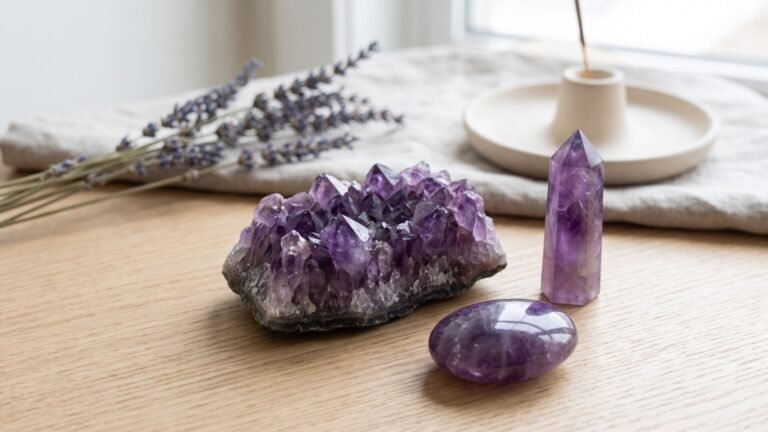
Amethyst also forms in geodes, hollow rocks lined with purple crystals. Brazil and Uruguay are famous sources, and geodes are popular as decorative pieces and collector specimens. If you are comparing similar stones, our guide to amethyst vs. purple quartz explains the terms.
Is Amethyst a Birthstone?
Yes. Amethyst is the birthstone for February in the major modern lists. Birthstone lists can differ by country and organization, so check which one your jeweler follows.
Zodiac and anniversary associations
Amethyst is associated with Aquarius (January 20 to February 18) and, in some lists, Pisces (February 19 to March 20). Zodiac stone lists vary by source. It is also used as a gemstone for the 6th wedding anniversary in common anniversary lists.
Amethyst Uses in Jewelry
At hardness 7, amethyst is suitable for most jewelry, with a few caveats. It is the same hardness as quartz, so airborne quartz dust (a common component of household and outdoor dust) can slowly abrade the polish on a ring worn constantly, and harder gems such as sapphire and diamond can scratch it. Ring wear shows first as a slightly hazy surface and rounded facet edges, which a jeweler can repolish.
| Jewelry type | Suitability | Tips |
|---|---|---|
| Rings | Good for regular wear with care | Remove for heavy work, gardening, and sports; a bezel or low-profile setting protects edges |
| Necklaces and pendants | Excellent | Fewer knocks than rings |
| Earrings | Excellent | Even pale shades such as Rose de France are safe |
| Bracelets | Good | Exposed to knocks, so choose secure settings |
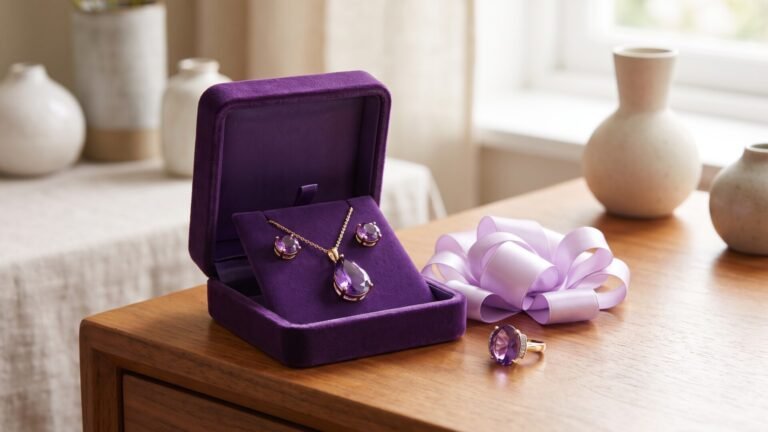
Amethyst is commonly cut as brilliant-style ovals, rounds, and cushions, as step cuts that show color, and as cabochons. Our guide to gemstone shapes and cuts explains the differences. For gift ideas, see gift ideas for February birthdays, the best amethyst earrings and necklaces, and 10 amethyst jewelry pieces for every budget. To compare stores, read our guide to online stores for authentic birthstone jewelry.
Settings and metals
Amethyst looks good in yellow gold, white gold, rose gold, and silver. Lighter stones often look best in white metals, while deep stones can look rich in yellow gold.
Carved objects
Because large amethyst crystals are relatively common, amethyst is also used for carvings, spheres, and decorative objects.
Amethyst Value & Price
Amethyst was once ranked among the most valuable gems and sometimes grouped with ruby, sapphire, and emerald as a “cardinal gem.” After large deposits were found in Brazil in the 1800s, it became far more common and far cheaper. It is now an accessible gem whose beauty did not change, only its scarcity.
What affects price today
Color is the main driver. Medium to dark, saturated purple with red or blue flashes is the most valuable. Very pale stones and stones so dark they look black are worth less.
Clarity: Amethyst is usually eye-clean, so visible inclusions reduce value.
Cut: A well-cut stone shows even color and brightness. A poorly cut stone may look darker or have dead zones.
Size: Price per carat rises with size, but less steeply than for rarer stones, because large amethysts are not especially scarce.
Treatment and origin: Undisclosed treatment lowers trust, and collectors may pay more for documented fine material from classic sources.
Approximate retail price per carat (USD, faceted loose stones)
Note: These are rounded ranges from 2026 retail guides, which do not always agree. Treat them as a starting point and compare listings.
| Quality | Approximate price per carat |
|---|---|
| Pale to light purple, commercial grade | $5 to $20 |
| Medium purple, eye-clean | $10 to $50 |
| Deep “Siberian” color, well cut | $40 to $150 |
| Exceptional large stones and collector material | Higher; varies widely |
How to Identify Real vs. Fake Amethyst
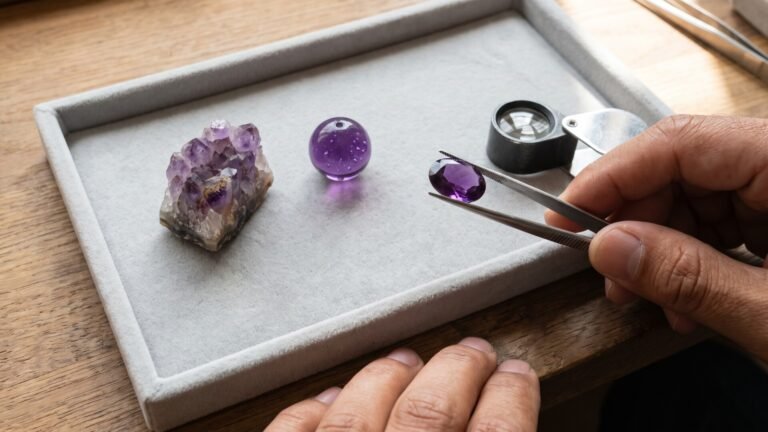
Our guides to how to spot fake amethyst jewelry and how to spot fake amethyst go step by step. In short:
- Glass: Often shows gas bubbles or swirl marks, and typically has softer, less sharp facet edges.
- Dyed quartz or coated stones: Color may concentrate in cracks or wear at the edges of a coated stone.
- Synthetic amethyst: Chemically the same as natural, usually very clean and evenly colored. It can be hard to separate from natural stones without lab equipment, so ask for disclosure.
- Other purple stones: Purple fluorite (much softer, about 4), purple spinel (harder, about 8), cubic zirconia (heavier), and iolite or tanzanite can resemble amethyst.
We do not recommend scratch tests or temperature tests at home. They can damage the stone and are not reliable. For valuable pieces, ask for a report from a recognized gemological laboratory, and for lower-priced pieces buy from sellers with clear return policies.
Care & Cleaning of Amethyst
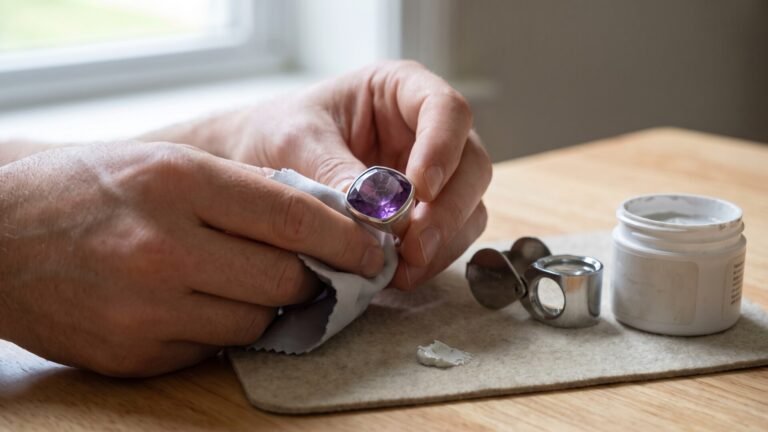
For a longer walkthrough, see how to safely clean amethyst without damaging the polish. If the polish has already dulled, our guide to removing scratches from amethyst jewelry explains what is realistic.
Cleaning
Warm soapy water and a soft brush are the safe default. Rinse well and dry with a soft cloth. Ultrasonic cleaners can be used on some untreated stones without fractures but are best avoided if the stone has inclusions, fractures, or a coating, or if you are unsure. Steam cleaning is not recommended.
Storage
Store amethyst separately from harder stones such as diamond, sapphire, and ruby. A soft pouch or compartmentalized box works well.
What to avoid
- Prolonged strong light: Months on a sunny windowsill can fade amethyst, especially paler stones. Everyday wear is fine.
- Heat: Avoid hot tubs, saunas, jeweler’s torches, and sudden temperature changes, which can crack stones or alter color.
- Chemicals and cosmetics: Bleach, ammonia, and strong cleaners can damage settings; put on perfume and hairspray before jewelry.
- Hard knocks and abrasion: Remove rings for sports, gardening, and heavy manual work, and wipe the stone gently instead of rubbing it on clothing.
Amethyst Cluster: Go Deeper
- Amethyst Meaning: History, Symbolism, Spiritual Properties & Modern Uses
- Amethyst vs. Purple Quartz
- The Role of Amethyst in Meditation
- How to Spot Fake Amethyst Jewelry
- How to Remove Scratches from Amethyst Jewelry at Home
- How to Safely Clean Amethyst Without Damaging the Polish
- What Is a Chevron Amethyst and Is It Valuable?
- Amethyst Color Variations and Symbolism
- Amethyst Color Variations Ranked from Best to Worst
- Best Amethyst Earrings and Necklaces of 2026
- 10 Amethyst Jewelry Pieces for Every Budget
- Healing Properties of Amethyst Crystals: A Complete Guide
Frequently Asked Questions About Amethyst
Is amethyst expensive?
Not compared with most precious gemstones. Pale to medium faceted amethyst commonly sells for roughly $5 to $50 per carat, and fine deep purple stones for roughly $40 to $150 per carat, though exceptional large stones can cost more. Prices vary by seller.
Is amethyst suitable for daily wear?
Yes, with reasonable care. At Mohs hardness 7 it suits rings, pendants, and earrings. Quartz dust and harder gems can dull or scratch it over time, so remove rings for heavy work and store it separately.
What does amethyst symbolize?
Traditionally it symbolizes clarity, sobriety, calm, and spiritual wisdom. The name means ‘not intoxicated’ in Greek. These are cultural meanings, not scientific properties.
Is citrine just heated amethyst?
Much of the citrine on the market is. Heating amethyst to roughly 400 to 500 degrees Celsius turns it yellow or orange. Natural citrine exists but is usually paler and costs more. A reputable seller should disclose which you are buying.
Does amethyst fade in sunlight?
It can. Prolonged exposure to strong light, and heat, can fade amethyst, and paler stones are affected first. Normal wear is fine, but avoid leaving jewelry on a sunny windowsill for long periods.
How can you tell real amethyst from glass?
Glass often shows gas bubbles or swirl marks and has softer facet edges, while natural amethyst typically has small natural inclusions and subtle color zoning. A gemologist can confirm. Synthetic amethyst looks like natural, so ask for disclosure.
What is Siberian amethyst?
It originally meant amethyst from Russia’s Ural Mountains and now describes the finest deep purple color with red and blue flashes, regardless of where the stone was mined.
Is amethyst a birthstone?
Yes. Amethyst is the February birthstone and is also associated with Aquarius and Pisces.
Can I remove scratches from amethyst?
Light surface dulling can sometimes be improved by a professional repolish. Avoid DIY abrasives that may damage the stone or setting. See our guide on removing scratches from amethyst jewelry for details.
Shop Amethyst
Ready to find your own amethyst? Browse below, and ask any seller to confirm whether the stone is natural, treated, or lab-grown.
[Shop Amethyst Jewelry]
[Shop February Birthstone Collection]
[Shop Purple Gemstones]
Explore More Gemstones
Return to our Gemstones hub, or explore other gemstone guides: citrine, tanzanite, garnet, diamond, sapphire, ruby, emerald, aquamarine, peridot, tourmaline, topaz, opal, pearl, moonstone, alexandrite, turquoise, and zircon.
Sources and further reading: 2026 retail amethyst price guides from Rock Chasing and AJ Luxe.