Is Moissanite a Suitable Alternative to the April Birthstone Diamond?
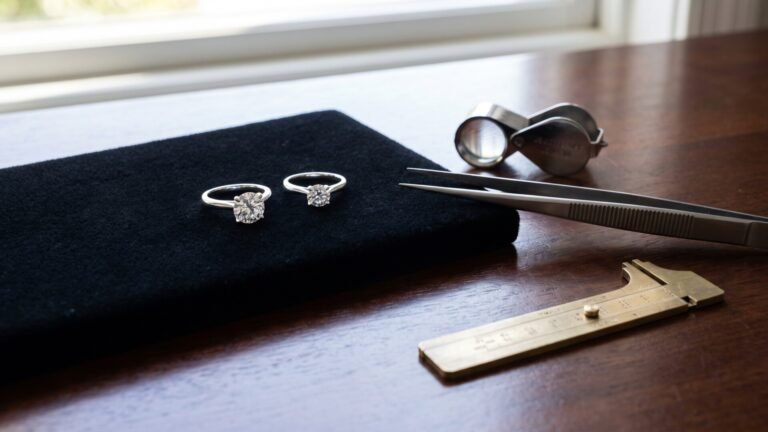
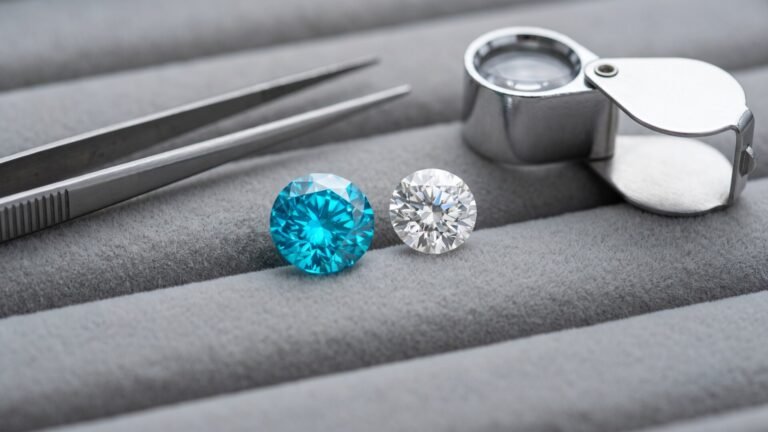
April’s birthstone is the diamond, the stone people think of first for rings, earrings and pendants for April birthdays. But moissanite has become one of the most popular alternatives, and buyers often ask the same question: is moissanite a suitable alternative to the April birthstone diamond?
Short answer: it can be, depending on what you want from the stone. Moissanite is a separate mineral, not a diamond, so it will never be a “real diamond” in the strict sense. It is, however, very hard, very sparkly and usually much less expensive. This guide compares the two honestly, covers durability, appearance, ethics, cost and care, and points you to our in-depth comparisons, including moissanite vs lab diamond for April birthdays and moissanite vs white topaz vs diamond.
What Makes Diamond the Classic April Birthstone
- Hardness: Diamond is 10 on the Mohs scale, the hardest known natural material, so it resists scratching better than any other gem.
- Tradition and symbolism: Diamond has long been associated with love, strength and commitment. That symbolism comes from cultural tradition and marketing history, not from any property of the stone.
- Light performance: A well-cut diamond returns light as bright white sparkle with subtle flashes of color.
Its drawbacks for some buyers are cost, and the ethical and environmental questions around mining. For the full diamond profile, see Diamond: Meaning, Properties, Uses & Value, and for how diamonds are graded, The 4 Cs of Diamonds Explained.
Moissanite 101
Moissanite is silicon carbide (SiC). It was first identified in 1893 by the French chemist Henri Moissan, who found tiny crystals in rock from a meteorite crater in Arizona. Natural moissanite is extremely rare, so the moissanite used in jewelry is grown in a laboratory. In practical terms:
- It is its own mineral. Moissanite is a real gemstone with its own chemistry and properties, but it is a different material from diamond (it is often classed as a diamond simulant), so it must be sold as moissanite.
- It is not mined, so it avoids the supply-chain concerns of mining, although its production still uses energy.
- It is typically much less expensive than a diamond of similar size and appearance.
| Property | Diamond | Moissanite |
|---|---|---|
| Composition | Carbon | Silicon carbide |
| Mohs hardness | 10 | About 9.25 |
| Refractive index | About 2.42 | About 2.65-2.69 |
| Dispersion (“fire”) | About 0.044 | About 0.104 |
| Density (specific gravity) | About 3.52 | About 3.22 |
| Optical character | Singly refractive | Doubly refractive |
| Cleavage | Yes, in four directions | No distinct cleavage |
Values are standard reference figures. Individual stones and cuts vary.
Comparing Brilliance and Fire
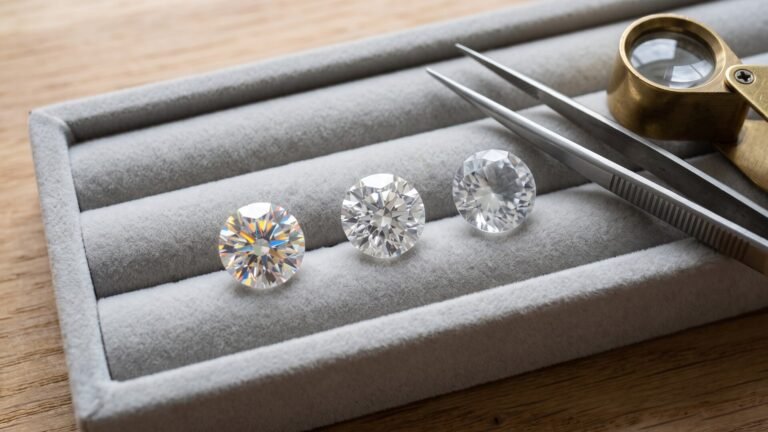
Brilliance is the white light returned to the eye; fire is the flashes of spectral color. Moissanite has a higher refractive index and more than twice the dispersion of diamond, so it shows stronger rainbow flashes, especially in direct light. Because moissanite is doubly refractive, facets can also appear to “double” slightly when you look through the stone, which gives it a different, more flashy character than diamond. Some people love that, and some find it less natural.
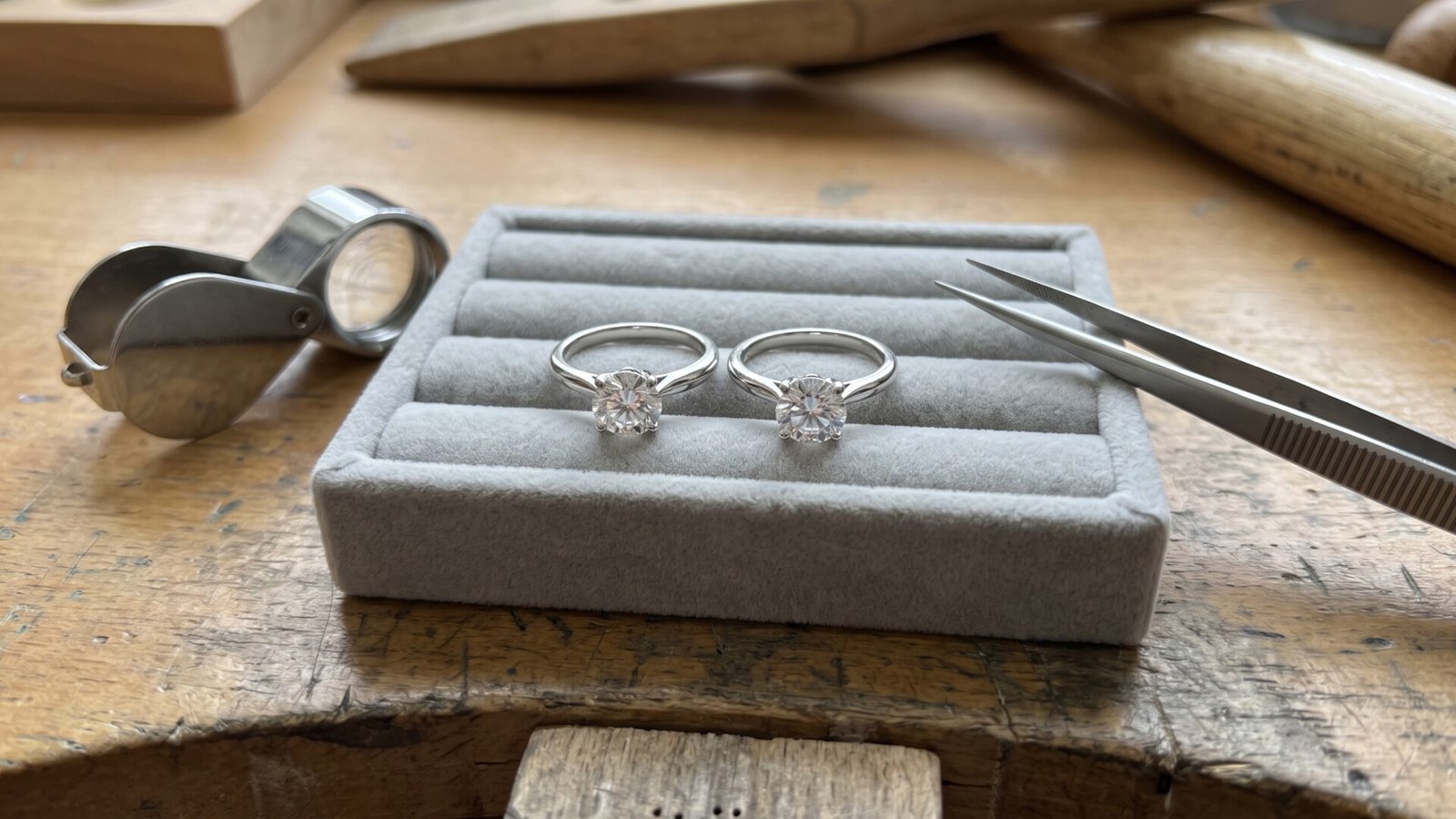
Takeaway: do not expect moissanite to look identical to a diamond. Look at both side by side, in daylight and indoor light, before you decide. Cut quality matters at least as much as the material; see Gemstone Shapes and Cuts Explained.
Durability: Will Moissanite Last?
- Diamond: Mohs 10. It is the hardest, but it has cleavage planes, so a sharp blow in the wrong direction can chip it.
- Moissanite: About 9.25 on the Mohs scale, which is harder than ruby and sapphire (9) and more than enough for daily wear. It has no distinct cleavage and is generally considered tough, and it tolerates heat well.
Both are excellent for everyday rings. Moissanite can still be chipped by a hard knock, and its facet edges can wear over many years, so protective settings such as bezels, halos or well-made prongs are sensible for either stone. Moissanite is also easy to clean with warm water, mild soap and a soft brush, and a professional ultrasonic clean is usually safe for a clean stone in a sturdy setting.
One buyer caution: because moissanite and diamond conduct heat similarly, a basic thermal diamond tester can mistake moissanite for diamond. If authenticity matters, rely on an independent laboratory report rather than a quick test.
Ethical and Environmental Considerations
- Natural diamonds: Programs such as the Kimberley Process aim to keep conflict diamonds out of the supply chain, but critics say the scheme has gaps. Some brands offer traceable diamonds with their own documentation. See How to Buy Ethical Diamonds.
- Moissanite: No mining is involved, so it avoids mining’s conflict and land-use concerns. Lab growth uses energy, so any claim that it is “eco-friendly” should be backed by the maker’s own disclosures.
For broader guidance, see Ethical Gemstones: How to Shop Sustainably.
Cost Comparison
Moissanite is generally priced well below diamond, and below most lab-grown diamonds, at comparable size. We do not quote current price ranges because they vary by retailer, cut and color grade, and change often. The practical effect is that the same budget buys a noticeably larger or higher-quality moissanite. Moissanite is also about 9 percent less dense than diamond, so a one-carat moissanite looks slightly larger than a one-carat diamond; compare millimeter dimensions rather than carat weight alone.
Examples of listings that illustrate the style options (check the seller for current availability and details):
- 1.30 ct Kite Hidden-Halo Moissanite Ring (Loosemoissanite) shows how a halo can add sparkle and protect the center stone.
- 1.50 ct Portrait-Cut Moissanite Solitaire (Loosemoissanite) is a bold solitaire style.
- 2 ct Two-Stone Moissanite Bridge Set (Loosemoissanite) is a larger-looking set at a lower price point.
Color and Appearance
- Diamond: Colorless (D-F on the GIA scale) is the most valued, and a tint of yellow or brown reduces the price.
- Moissanite: Sold in a range of grades from colorless to near-colorless. Lower grades can show a faint yellow or greenish tint, especially in larger stones and under certain lighting. Ask which color grade you are buying.
Setting style affects how the stone looks. The Round Cut Wavy Pavé Moissanite Ring (Jeulia Europe) shows how a pavé band can complement a near-colorless stone, while the Oval Moissanite “Vineyard” Ring (Eden Garden Jewelry) shows how a warm-metal vine design pairs with a slightly warmer tone. These are style examples, not recommendations; check the seller and current listing.
Moissanite vs Diamond at a Glance
| Feature | Diamond | Moissanite |
|---|---|---|
| Look | Bright white sparkle with subtle fire | Strong rainbow flashes, different character |
| Hardness | 10 | About 9.25 |
| Toughness | Good, but has cleavage | Good, no distinct cleavage |
| Ethics | Varies by supply chain and documentation | Not mined; lab production uses energy |
| Price | Higher | Typically much lower |
| Resale | Natural diamonds usually resell for less than retail; lab-grown and moissanite resale is typically low | Typically low |
| Tradition | The official April birthstone | An alternative; not on traditional birthstone lists |
Moissanite Jewelry Options and Retailers
Several well-known sellers offer moissanite jewelry. We list them for orientation, not as an endorsement. Always check the stone’s color grade, setting metal and return policy.
- Charles & Colvard: The company that first brought gem-quality moissanite to the jewelry market, selling rings, earrings and pendants.
- Brilliant Earth: Sells moissanite rings alongside recycled-metal settings. Read its own sourcing disclosures for details.
- James Allen: Known for high-resolution imagery and 360-degree views, useful for judging sparkle online.
- Etsy sellers: Independent makers offering halo, vintage and pendant styles; vet each seller and read reviews.
Practical Buying Tips
- View in different lighting. Check the stone in daylight and indoor light, since moissanite’s fire is more obvious in some conditions.
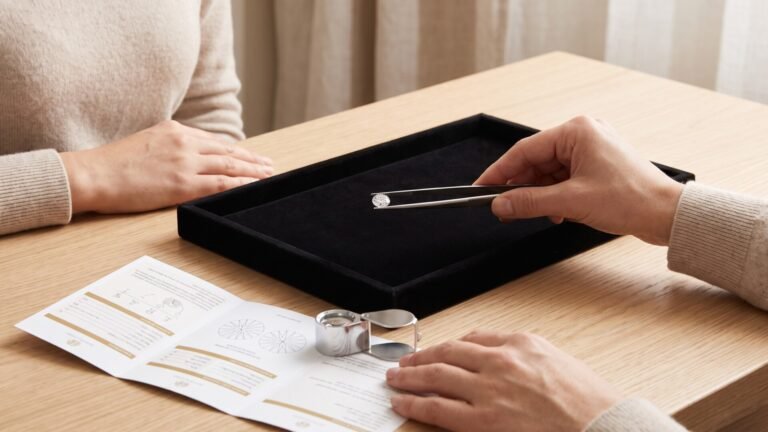
- Ask for documentation. Request a report or certificate and confirm that the stone is sold as moissanite.
- Choose a protective setting. Halo, bezel and secure prongs protect edges.
- Pick the metal for the look you want. White gold or platinum keeps a cool look; yellow or rose gold gives a warmer one.
- Compare to lab-grown diamond. If you want a stone that is chemically a diamond, a lab-grown diamond may fit; see Natural vs. Lab-Grown Diamonds and Natural vs. Lab-Grown Birthstones.
Who Should Consider Moissanite
- Budget-conscious buyers who want a larger stone for the money.
- Buyers who want to avoid mined stones.
- People who love sparkle and strong fire, and are happy with a different look from diamond.
- Gift buyers looking for earrings, pendants or rings with visual impact.
Who Might Prefer a Diamond
- Traditionalists who want the official April birthstone and its symbolism.
- Buyers who want the classic white sparkle and no rainbow flashes.
- Heirloom shoppers who want a stone with a long cultural track record. Do not buy diamonds as an investment, because resale prices are usually well below retail.
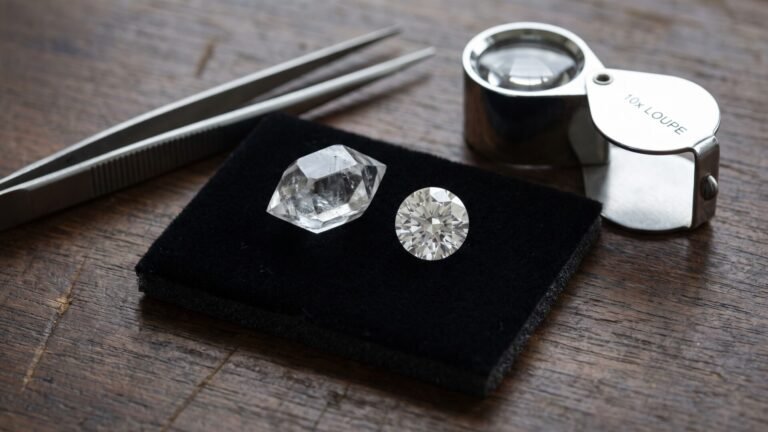
If you also want to explore other diamond alternatives or lookalikes, see Herkimer Diamond vs Regular Diamond and Opal vs Moissanite for Fire and Shine.
Beyond Rings: Moissanite Earrings, Pendants and Bracelets
Most buyers think of engagement rings first, but moissanite suits other April birthday gifts too. Studs and pendants take far fewer knocks than rings, so even simple settings are fine, and a sparkly stone at an accessible price makes them popular gifts. Moissanite is lab-grown and sold in standard cuts and sizes, so matching pairs for earrings are easy to find. Check the stone’s millimeter size rather than the carat weight, since moissanite is less dense than diamond. If you are shopping for a necklace, our guide to choosing a birthstone necklace covers chain length and pendant style.
Moissanite vs Lab-Grown Diamond vs Natural Diamond: Which Questions to Ask
The three options sit on a spectrum. A natural diamond carries tradition and, for many people, the romance of an ancient origin. A lab-grown diamond is chemically and structurally a diamond, grown in a factory, and generally costs less than a natural stone of similar quality. Moissanite is a different material that costs less again and sparkles differently. Before buying, ask yourself:
- Does it need to be a diamond? If tradition matters, choose natural or lab-grown diamond. If you simply love sparkle, moissanite is a reasonable fit.
- How will it be worn? Daily-wear rings benefit from a protective setting whichever stone you choose.
- What will you do about resale? Treat any of these as a purchase to enjoy, not an investment.
For a detailed side-by-side, read Moissanite vs Lab Diamond for April Birthdays and Natural vs. Lab-Grown Diamonds.
Caring for Moissanite Jewelry
Moissanite is low-maintenance, but it still collects skin oils, lotion and soap film, which dull its sparkle. Clean it regularly with warm water, a few drops of mild dish soap and a soft brush, then rinse and dry with a lint-free cloth. Store pieces separately so harder stones do not scratch the metal, and have prongs checked about once a year. The metal setting is usually the weak point, not the stone. For comparison with other stones’ care needs, see our gemstone hardness scale guide.
Other April Birthstone Alternatives Worth Seeing
If moissanite is not quite right, other colorless stones are sometimes considered for April: white sapphire, which is hard (Mohs 9) and softer in sparkle; white topaz, which is much cheaper but softer and more easily scratched; and Herkimer diamond, which is actually a quartz crystal. See Moissanite vs White Topaz vs Diamond and Herkimer Diamond vs Regular Diamond for honest trade-offs.
Frequently Asked Questions About Moissanite As An April Birthstone
Is moissanite a real diamond?
No. Moissanite is silicon carbide, a different mineral from diamond, which is carbon. A lab-grown diamond is chemically a diamond; moissanite is not.
Is moissanite the same as cubic zirconia?
No. Cubic zirconia is a softer, cheaper material, around 8 to 8.5 on the Mohs scale. Moissanite is harder, at about 9.25, and has a higher refractive index and more fire.
Will moissanite pass a diamond tester?
Some basic thermal diamond testers can read moissanite as diamond. Use an independent laboratory report if authenticity matters.
Is moissanite durable enough for an everyday ring?
Yes. At about 9.25 on the Mohs scale with no distinct cleavage, it is a durable choice for daily wear, especially in a protective setting.
Does moissanite cloud or fade over time?
Moissanite does not fade, but it can look dull when it is covered in oils or residue. Regular cleaning with warm soapy water restores its sparkle.
Is moissanite an official April birthstone?
No. Diamond is the traditional and modern April birthstone. Moissanite is a popular alternative, not part of the official birthstone lists.
Is moissanite better than lab-grown diamond?
It depends on your priorities. Moissanite is usually cheaper and shows more fire. A lab-grown diamond is chemically a diamond and looks more like a natural one. See our comparison guide for details.
Conclusion
Moissanite is a strong, durable and affordable alternative to diamond for an April birthstone piece, as long as you are comfortable with a different kind of sparkle and with a stone that is not a diamond. If you want tradition and a classic white look, stay with diamond, natural or lab-grown. If you want size, strong fire and a lower price, moissanite is worth seeing in person or in good video. Whichever you pick, ask for documentation, choose a protective setting, and read the return policy. For more on the stone behind the date, see our Diamond Meaning guide, and explore the Gemstones hub for other months.