Diamond: Meaning, Properties, Uses & Value
Diamond is the most famous gemstone on earth, the April birthstone, and the default choice for engagement rings. It is also widely misunderstood: people assume it cannot be damaged, that all diamonds are mined, or that the “fog test” can tell a real one from a fake. This guide covers what a diamond actually is, how it forms, what the traditions around it say, how the 4 Cs work, what natural and lab-grown diamonds cost, how to spot imitations, and how to look after the stone once you own it.
It is the central page of our diamond cluster, so you will find links below to deeper guides on diamond meaning and symbolism, the 4 Cs, buying ethical diamonds, natural vs. lab-grown diamonds, and several diamond alternatives.
Quick Facts Box
Gemstone Overview
| Category | Details |
|---|---|
| Mineral / composition: | Diamond; pure carbon (C), with trace impurities that cause color |
| Color(s): | Colorless to light yellow/brown; also fancy colors: blue, pink, green, red, orange, purple, black |
| Hardness (Mohs): | 10 (the hardest natural material; this measures scratch resistance, not toughness) |
| Toughness / cleavage: | Perfect cleavage in four directions; can chip or split if struck sharply |
| Refractive index: | About 2.42 |
| Crystal system: | Isometric (cubic) |
| Transparency: | Transparent to opaque |
| Common treatments: | Laser drilling, fracture filling, HPHT and irradiation color treatment (should be disclosed) |
| Common uses: | Jewelry (engagement rings, earrings, necklaces, bracelets), industrial cutting tools, abrasives, heat sinks, semiconductors |
| Birthstone month(s): | April; also the traditional stone for the 60th wedding anniversary |
| Zodiac association: | Aries (March 21 to April 19) in many modern lists; zodiac lists vary by source |
What Is Diamond?
Diamond is pure carbon. Its chemical formula is simply C, the same element found in graphite and charcoal. What separates a diamond from pencil lead is structure, not chemistry: in diamond, each carbon atom bonds strongly to four others in a rigid three-dimensional lattice.
How diamonds form
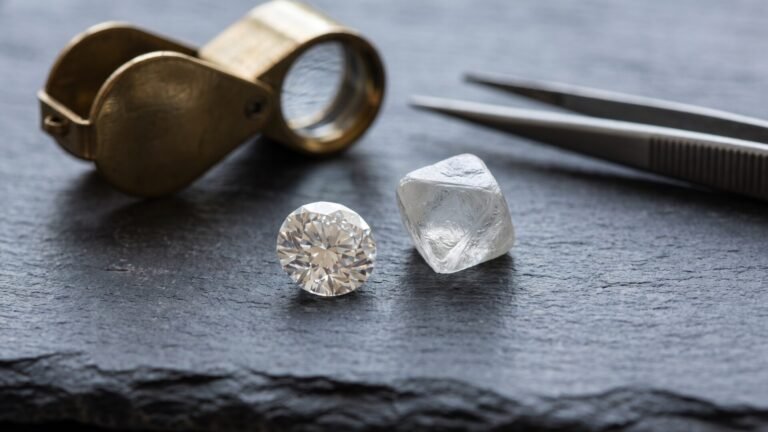
Most gem diamonds crystallized deep in the Earth’s mantle, roughly 150 kilometers or more below the surface, under very high pressure and temperatures of around 1,000°C or more, over a period of billions of years. They reached the surface through rare, deep-source volcanic eruptions that carried them upward quickly enough to preserve the diamond structure. The rock formations created by those eruptions, called kimberlites and lamproites, are the primary sources of mined diamonds.
The name
“Diamond” is generally traced to the Greek adamas, meaning “unconquerable” or “untameable,” a reference to its hardness.
Where diamonds are found
Russia and Botswana are the two largest rough-diamond producers. According to Kimberley Process figures reported by Rapaport, Russia led in 2024 by both volume (about 37 million carats) and value, with Botswana close behind (about 28 million carats). Other notable sources include:
- Canada: Known for traceability programs and laser-inscribed stones
- Democratic Republic of Congo: Large volumes, mostly industrial and near-gem quality
- South Africa: Historic sources, including the Cullinan mine, where the 3,106-carat Cullinan rough was found in 1905
- Angola and Zimbabwe: Significant gem and near-gem production
- Australia: Famous for rare pink diamonds from the Argyle mine, which closed in 2020
- India and Brazil: Important historical sources
Natural vs. lab-grown diamonds
This is the most important distinction in today’s market. Natural diamonds formed in the Earth over very long periods and were mined. Lab-grown diamonds are real diamonds with the same chemistry, crystal structure, hardness, and optical properties, grown in a factory by one of two main methods:
- High Pressure High Temperature (HPHT): Mimics mantle conditions using large presses
- Chemical Vapor Deposition (CVD): Diamond grows layer by layer from a carbon-rich gas in a vacuum chamber
Lab-grown diamonds are not simulants such as cubic zirconia or moissanite; those only imitate the look. Telling lab-grown from natural requires laboratory equipment, which is why reputable sellers provide a grading report that states the origin. Lab-grown stones are also much cheaper, typically somewhere around 75 to 90 percent less than a comparable natural stone, though the gap has changed quickly in recent years. Our guide to natural vs. lab-grown diamonds and long-term value goes deeper.
Diamond Meaning & Symbolism
Diamond’s symbolism has changed over centuries, from talisman to status symbol to emblem of love. The notes below describe traditions and history, not scientific effects. For a fuller treatment, see our diamond meaning guide.
Ancient beliefs
Diamonds were collected in India for a very long time, and traditional sources describe them being used as talismans and in sacred objects. In some traditions they were believed to protect the wearer from harm. Historical sources also describe diamonds being used in medicine; there is no evidence that this worked, and it should not be attempted.
The first documented diamond engagement ring
In 1477, Archduke Maximilian of Austria is recorded as having given Mary of Burgundy a ring set with diamonds. It is often cited as the first documented diamond engagement ring and set a pattern for European nobility, though diamonds remained mostly a luxury of the wealthy for centuries afterward.
The De Beers campaign
The modern mass-market diamond engagement ring was shaped by a De Beers advertising campaign that began in 1938 with the N.W. Ayer agency. The slogan “A Diamond Is Forever” was written in 1947 by copywriter Frances Gerety. The campaign tied diamonds to romance and marriage and helped turn the diamond engagement ring from an upper-class custom into a cultural expectation in many countries.
Modern interpretations
Today, diamonds are commonly associated with:
- Enduring love: The stone’s hardness is often used as a metaphor for lasting commitment
- Commitment: The engagement ring tradition remains strong in many cultures
- Purity and clarity: Colorless diamonds are often linked with transparency and truth
- Strength: The name adamas still resonates
- Milestones: Diamonds mark anniversaries, graduations, and achievements
For people born in April, diamond is often read as a symbol of clarity, strength, and new beginnings.
Diamond Healing Properties
These are beliefs and traditions, not medical advice. Gemstones do not diagnose, treat, or cure any condition, and they are not a substitute for professional care.
Traditional beliefs
Traditional Indian gem texts associated diamonds with the social classes of the time and held that a diamond amplified the qualities of its wearer. Medieval European writers attributed protective powers to the stone as well.
Modern crystal-healing associations
In modern crystal-healing practice, some people say diamond is associated with:
- Clarity of thought: Used as a focus object in meditation
- Courage and resilience: A symbolic link to the stone’s hardness
- Purity of intention: A symbolic link to colorless diamonds
- Amplification: The idea that diamond magnifies the energy of other stones and the wearer’s intentions
Chakra associations
In chakra systems, colorless diamond is linked with the crown chakra (Sahasrara), associated with spiritual awareness. Colored diamonds are linked by color: blue with the throat, pink with the heart, and yellow with the solar plexus. These associations come from modern spiritual practice, not from gemology.
Diamond Colors & Varieties
Most people picture colorless diamonds, but diamonds occur in many colors. The 4 Cs below are the standard way to describe and compare them; our 4 Cs guide explains each one in depth.
The color scale (D to Z)
The GIA color scale for white diamonds runs from D (colorless) to Z (light yellow or brown). The less body color, the higher the grade.
| Grades | Description |
|---|---|
| D, E, F | Colorless. D is the highest grade and the most expensive. |
| G, H, I, J | Near colorless. Often look white to the unaided eye and are a popular value range. |
| K, L, M | Faint color. Noticeable warmth, which can look attractive in yellow gold. |
| N to R | Very light color. |
| S to Z | Light color. |
Fancy colored diamonds
Diamonds with strong color beyond the D-to-Z range are graded on a separate scale: Faint, Very Light, Light, Fancy Light, Fancy, Fancy Intense, Fancy Dark, Fancy Deep, and Fancy Vivid.
- Red: Among the rarest of all colors; only a small number of true red diamonds are known.
- Blue: Colored by boron. The 45.52-carat Hope Diamond, held by the Smithsonian, is the best-known example.
- Pink: The Argyle mine in Australia produced most of the world’s pink diamonds before closing in 2020.
- Green: Color is linked to natural radiation exposure over geological time.
- Orange and purple: Rare; valuable in strong, pure colors.
- Yellow: The most common fancy color, caused by nitrogen.
- Black: Opaque, with color from dark mineral inclusions.
Top-grade vivid pink, blue, and red diamonds have sold for well over $1 million per carat at auction. Many fancy-color stones on the market are color treated (by irradiation or HPHT), so ask for a report that states whether the color is natural.
Clarity
Clarity describes internal features (inclusions) and surface features (blemishes). The GIA scale is:
- Flawless (FL): No inclusions or blemishes visible under 10x magnification
- Internally Flawless (IF): No inclusions visible; only minor surface blemishes
- Very, Very Slightly Included (VVS1, VVS2): Minute inclusions that are very difficult to see under 10x
- Very Slightly Included (VS1, VS2): Minor inclusions, hard to see under 10x
- Slightly Included (SI1, SI2): Inclusions easy to see under 10x
- Included (I1, I2, I3): Inclusions obvious under 10x and often visible to the unaided eye
Many buyers find VS2 to SI1 a sensible range, because the stones can still look clean to the eye, but always inspect the individual stone, since two SI1 diamonds can look very different.
Cut
Cut describes how well a diamond handles light, and it is the one of the 4 Cs that depends on human craftsmanship. GIA grades the cut of standard round brilliant diamonds on this scale: Excellent, Very Good, Good, Fair, and Poor. Fancy shapes do not receive a GIA cut grade. Cut affects three optical effects:
- Brilliance: White light reflected from the stone
- Fire: The splitting of white light into spectral colors
- Scintillation: The play of light and dark as the stone moves
If you want to understand outline versus facet pattern, our guide to gemstone shapes and cuts covers it.
Carat
Carat measures weight, not size; one carat equals 200 milligrams. Prices step up at round numbers such as 0.50, 1.00, and 2.00 carats, so a 0.90 to 0.95 carat stone often costs noticeably less than a full carat while looking very similar in size.
Treatments and disclosure
Some diamonds are treated to improve appearance. Laser drilling removes dark inclusions, fracture filling hides cracks with a glass-like substance, and irradiation or HPHT processing can change color. Treated stones are usually priced lower and may need special care. A reputable seller discloses treatments, and a grading report from a lab such as GIA or IGI will note them.
Is Diamond a Birthstone?
Yes. Diamond is the April birthstone, and it appears in the major modern and traditional birthstone lists for that month. Birthstone lists can vary by country and organization, so it is worth checking which list a jeweler is following.
60th anniversary
Diamond is also the traditional gift for the 60th wedding anniversary, often called the diamond anniversary. Some modern anniversary lists use diamond for other milestones, such as the 10th, so check the list you are following.
Diamond Uses in Jewelry
Diamond’s hardness of 10 means it resists scratching better than any other gem, which makes it a practical choice for rings worn every day. That does not make it indestructible: diamond has perfect cleavage in four directions, so a sharp blow in the wrong spot can chip or split it, especially at pointed corners or thin edges. A protective setting still matters.
Engagement rings
Popular shapes for engagement rings:
- Round brilliant: The classic, with the most brilliance
- Princess: A square modified brilliant; its corners benefit from protective prongs
- Cushion: Rounded corners and a soft, vintage-leaning look
- Emerald cut: A step cut that shows off clarity and gives a clean, mirror-like look
- Oval: Elongated and flattering on the finger
- Pear and marquise: Distinctive pointed shapes; protect the tips
- Asscher: A square step cut with Art Deco character
- Radiant: A rectangular brilliant-faceted cut with trimmed corners
Round diamonds usually cost the most per carat because of demand and the amount of rough lost in cutting. Fancy shapes are generally cheaper per carat, though how much cheaper varies by shape and by the individual stone.
Other jewelry
- Earrings: Studs are a classic; drops add movement
- Necklaces and pendants: Solitaire pendants, station necklaces, and initial pendants
- Bracelets: Tennis bracelets, bangles, and chain bracelets with diamond accents
- Rings: Anniversary bands, cocktail rings, and stackable bands
Settings
Diamonds are normally set in platinum or 14k or 18k gold, which hold prongs securely. Sterling silver is generally too soft and tarnishes, so it is a poor choice for a diamond ring worn daily. If you are comparing retailers, see our guide to online stores for authentic birthstone jewelry.
Diamond Value & Price
Diamond pricing depends on the 4 Cs, treatments, fluorescence, origin documentation, the retailer, and market conditions. Natural diamond prices have fallen over the past couple of years, and lab-grown prices have fallen faster, so older price guides are often out of date.
What affects price
Carat weight has a strongly non-linear effect. A 2-carat diamond of the same quality as a 1-carat stone costs several times as much, not twice as much.
Color matters: the step between D and G may be hard to see, but the price difference can be substantial. Fancy colored diamonds sit on a separate and much higher price scale.
Clarity matters less to the eye than many buyers expect once a stone is eye-clean.
Cut has the biggest effect on how lively the stone looks. A well-cut stone with a modest color or clarity grade often looks better than a poorly cut stone with higher grades.
Fluorescence is a glow under ultraviolet light. Strong fluorescence can lower the price of high-color diamonds, and in some lower-color stones it can make the diamond look slightly whiter.
Approximate retail ranges, natural round diamonds (G to H color, VS2 to SI1 clarity, certified)
Note: These are rough, rounded ranges based on 2026 retail price guides, including a September 2026 analysis that put a 1.00 carat G/VS2/Excellent round at a median of about $5,350. Real prices vary widely by seller and stone, and they change often. Treat them as a starting point and compare listings.
| Size | Approximate total price (USD) |
|---|---|
| 1.00 carat | $4,500 to $7,500 |
| 2.00 carat | $15,000 to $25,000 |
| 3.00 carat | $35,000 to $50,000 |
Lab-grown diamond pricing
Comparable lab-grown diamonds cost much less. As a rough guide, a 1.00 carat lab-grown round with good color and clarity and an excellent cut might retail for somewhere between $400 and $1,500 depending on seller and certification. Resale values for lab-grown diamonds are generally low, so they are better thought of as a fashion or personal purchase than as an asset.
Buying Diamond Responsibly
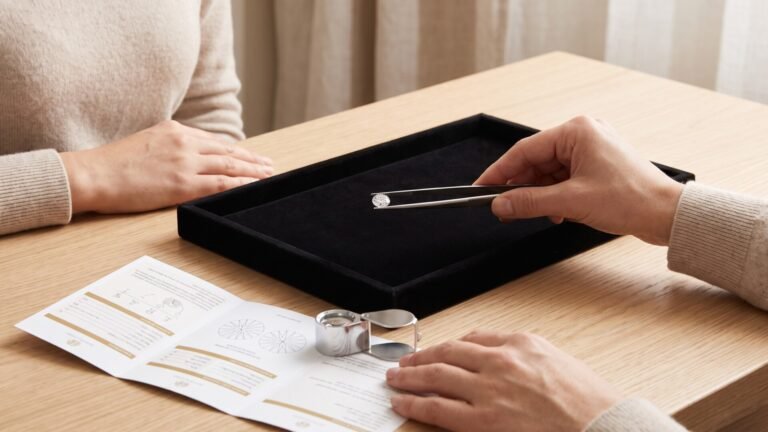
- Ask for a grading report: GIA and IGI are widely used laboratories. The report should state whether the diamond is natural or lab-grown and list any treatments.
- Know the sourcing claims: The Kimberley Process aims to keep “conflict diamonds” out of the legal trade, but it has well-known limits. For stronger assurances, ask a seller for documented traceability or recycled diamonds. Our guide to buying ethical diamonds explains the options.
- Check the return policy: Look at the stone in person or in high-quality video, and buy from a seller with a clear return window.
- Think of diamonds as a purchase, not a guaranteed investment: Retail prices are well above resale prices, and lab-grown stones in particular have lost value quickly.
Famous Diamonds
The Hope Diamond is a 45.52-carat deep-blue diamond on display at the Smithsonian’s National Museum of Natural History; its color comes from traces of boron. The Cullinan rough diamond, found at the Premier mine in South Africa in 1905, weighed 3,106 carats and was cut into several large stones that are part of the British Crown Jewels. These stones show how rare large, high-quality diamonds are, and why they are priced so differently from typical jewelry stones.
How to Identify Real vs. Fake Diamond
Common imitations (simulants)
- Cubic zirconia (CZ): Denser than diamond, less brilliant, and softer
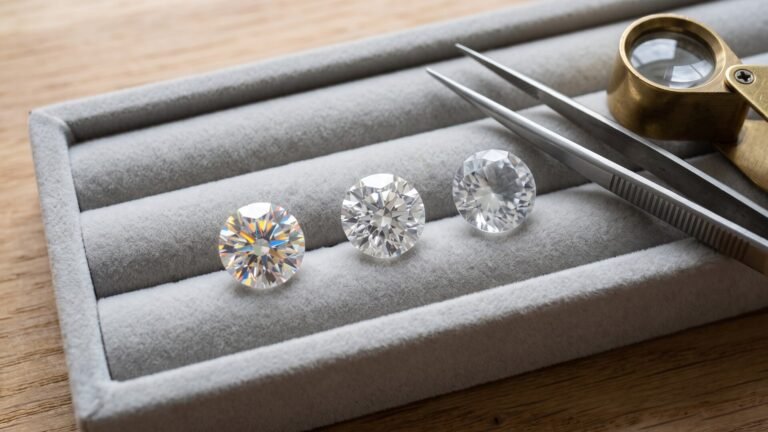
- Moissanite: A separate mineral with a lot of fire and a hardness of about 9.25; it is doubly refractive. Read our comparisons of moissanite as an April alternative and moissanite vs. lab diamond
- White sapphire: A real gemstone, but less brilliant and with a softer, more glassy sparkle
- Glass: Less brilliant and much softer, and may show bubbles under magnification
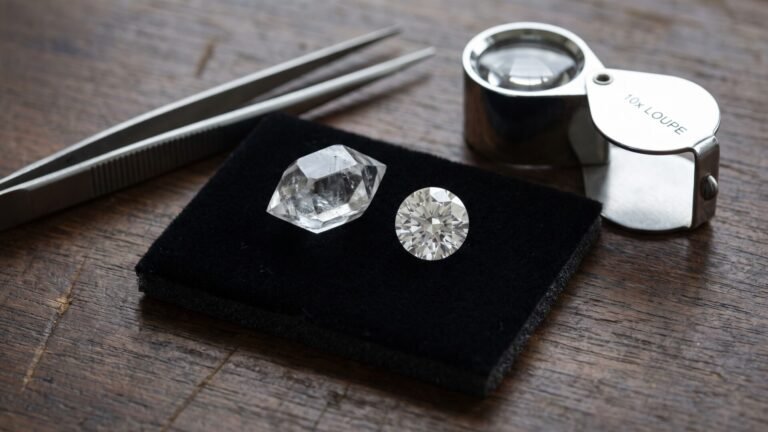
- Herkimer “diamond”: A type of quartz, not a diamond. See our Herkimer diamond vs. regular diamond comparison
At-home checks (unreliable on their own)
- The fog test: Breathe on the stone. A diamond usually clears almost immediately because it conducts heat well, while many imitations stay fogged longer. This is a rough indicator only.
- The newspaper test: Place the stone face down on printed text. If you can read through it clearly, it is probably not a diamond. This works better on loose stones than mounted ones.
- The loupe test: Under 10x magnification, look at the facet edges and finish. Real diamonds typically have sharp, crisp facet edges, but small inclusions and flaws can appear in both natural and lab-grown stones.
The best approach
The only definitive way to identify a diamond, and to separate natural from lab-grown, is professional gemological testing. Simple heat-based diamond testers can misidentify moissanite, which conducts heat in a similar way, so take a questionable stone to a gemologist or lab. A GIA or IGI report gives certified identification and grading.
Care & Cleaning of Diamond
Cleaning at home
Warm soapy water is the safe default for diamonds.
- Fill a bowl with warm water and a few drops of mild dish soap
- Soak the jewelry for 20 to 30 minutes to loosen dirt and oils
- Gently brush with a soft toothbrush, especially the back of the stone where grime collects
- Rinse under warm running water (put a strainer over the drain)
- Dry with a lint-free or microfiber cloth
Ultrasonic cleaners are generally fine for untreated diamonds in secure settings, but they can loosen weak prongs, and they are not suitable for fracture-filled or laser-drilled stones or for mixed pieces with softer gems. If you are unsure, ask your jeweler.
Storage
Store diamonds apart from other jewelry. Diamonds scratch other gems and metals, and a diamond can chip another diamond. Individual soft pouches or a compartmentalized box work well.
What to avoid
- Harsh chemicals: Bleach and chlorine can damage some metal alloys used in settings
- Abrasive cleaners: Scrubbing pads and gritty pastes can scratch metal
- Hard knocks: Diamonds can chip or cleave if struck sharply
- Extreme heat: Diamonds can burn at very high temperatures in air, and jeweler’s torches and sudden heat can damage included or treated stones
Daily habits
- Put jewelry on last, after makeup, hairspray, and lotions
- Remove rings before sports, heavy cleaning, and gardening
- Have prongs and settings checked by a jeweler about once a year
Diamond Cluster: Go Deeper
- Diamond Meaning: History, Symbolism, Spiritual Properties & Modern Uses
- The 4 Cs of Diamonds Explained
- How to Buy Ethical Diamonds
- Natural vs. Lab-Grown Diamonds: Which Is the Better Long-Term Value?
- Moissanite vs. Lab Diamond for April Birthdays
- Herkimer Diamond vs. Regular Diamond
- Is Moissanite a Suitable Alternative to the April Birthstone Diamond?
Frequently Asked Questions About Diamond
How much does a diamond cost?
Prices range from a few hundred dollars for small or lower-grade stones to millions for exceptional large or fancy-color diamonds. As a rough 2026 guide, a certified 1.00 carat natural round with G to H color and VS2 to SI1 clarity often lists at about $4,500 to $7,500, while a comparable lab-grown stone is often several hundred to around $1,500. Prices vary by seller and change frequently.
Is diamond suitable for daily wear?
Yes, it is one of the best gems for daily wear because its Mohs hardness of 10 resists scratching. It is not indestructible, though: diamond has cleavage and can chip if struck sharply, so protective settings matter, especially for pointed shapes.
What does diamond symbolize?
In tradition and modern culture, diamond is commonly associated with enduring love, commitment, purity, clarity, and strength. These are symbolic meanings, not scientific properties.
Are lab-grown diamonds real diamonds?
Yes. Lab-grown diamonds have the same chemistry, crystal structure, and hardness as natural diamonds. They are not simulants. A grading report or lab testing is needed to tell the two apart.
How can you tell diamond from moissanite?
Moissanite is doubly refractive, so under magnification you may see doubled back facet edges, and it often shows more colorful flashes. Basic heat-based diamond testers can mistake moissanite for diamond, so a gemologist or an electrical-conductivity moissanite tester gives a more reliable answer.
Can diamonds break or chip?
Yes. Diamond is very hard but it has perfect cleavage, so a sharp blow can chip or split it. Thin girdles, pointed tips, and corners, such as on pear, marquise, and princess cuts, are the most vulnerable.
What is the rarest diamond color?
Red is generally considered the rarest diamond color; only a small number of true red diamonds are known. Vivid pink and blue diamonds are also extremely rare.
Is diamond a birthstone?
Yes. Diamond is the April birthstone and the traditional gift for the 60th wedding anniversary.
Should I buy a natural or lab-grown diamond?
It depends on your priorities. Lab-grown diamonds give you a larger or higher-grade stone for the money and are chemically identical to natural ones, while natural diamonds appeal to people who value their geological origin and rarity. Neither type holds resale value well compared with retail price, so buy the one you will enjoy wearing.
Do diamonds make a good investment?
Retail diamonds usually sell for much less than their retail price on resale, and prices for both natural and lab-grown stones have fallen recently. It is wiser to buy a diamond because you want to wear and enjoy it than as a financial investment.
Shop Diamonds
Ready to look for a diamond? Browse by type below, and use a grading report from a recognized lab as your baseline when comparing stones.
[Shop Natural Diamonds]
[Shop Lab-Grown Diamonds]
[Shop Diamond Engagement Rings]
[Shop April Birthstone Collection]
Explore More Gemstones
Return to our Gemstones hub, or explore the other gemstone guides: sapphire, ruby, emerald, aquamarine, garnet, amethyst, topaz, citrine, peridot, opal, pearl, moonstone, alexandrite, tanzanite, tourmaline, turquoise, and zircon. Sapphire and white sapphire are also popular, more affordable alternatives to diamond for colored or alternative engagement rings.
Sources and further reading: GIA 4Cs; Rapaport reporting on Kimberley Process production statistics; The Diamond Guys price analysis (September 2026).