Gemstone Shapes and Cuts Explained: The Difference That Changes Everything
“Shape” and “cut” are used interchangeably in most jewelry shops and online listings, and that is exactly why so many buyers end up confused. Two round stones of the same size can look completely different: one throws sparkle in every direction, the other glows quietly. The shape is the same. The cut is not.
This guide explains the difference, walks through the main cutting styles (brilliant, step, mixed, rose and cabochon), covers the most common named cuts, and shows which cuts tend to suit which birthstones and which jewelry pieces. It also explains why a well-cut stone of modest quality will often look better than a poorly cut stone of higher grade. It is part of our wider education and buying guides for birthstones.
Shape Is Not Cut (And Why Everyone Gets This Wrong)
Here is the simplest way to understand it:
Shape is the outline. The silhouette you see when you look at the stone from above: round, oval, pear, square, cushion.
Cut is the arrangement of facets. The pattern of flat, polished surfaces on the stone, and the angles and proportions behind them. How those facets handle light determines the stone’s brilliance, fire, and scintillation.
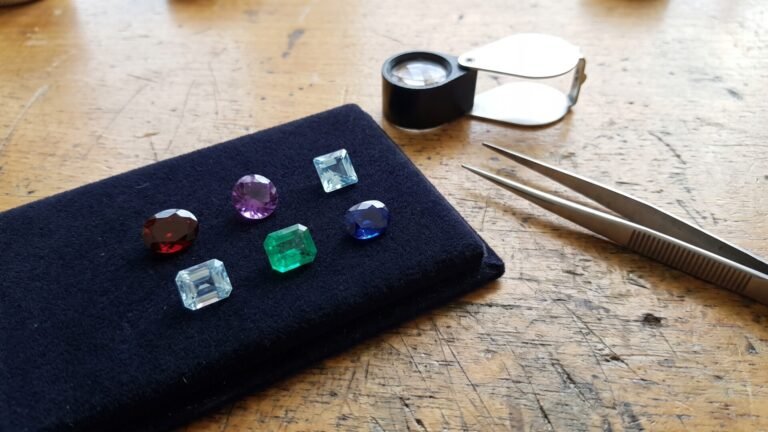
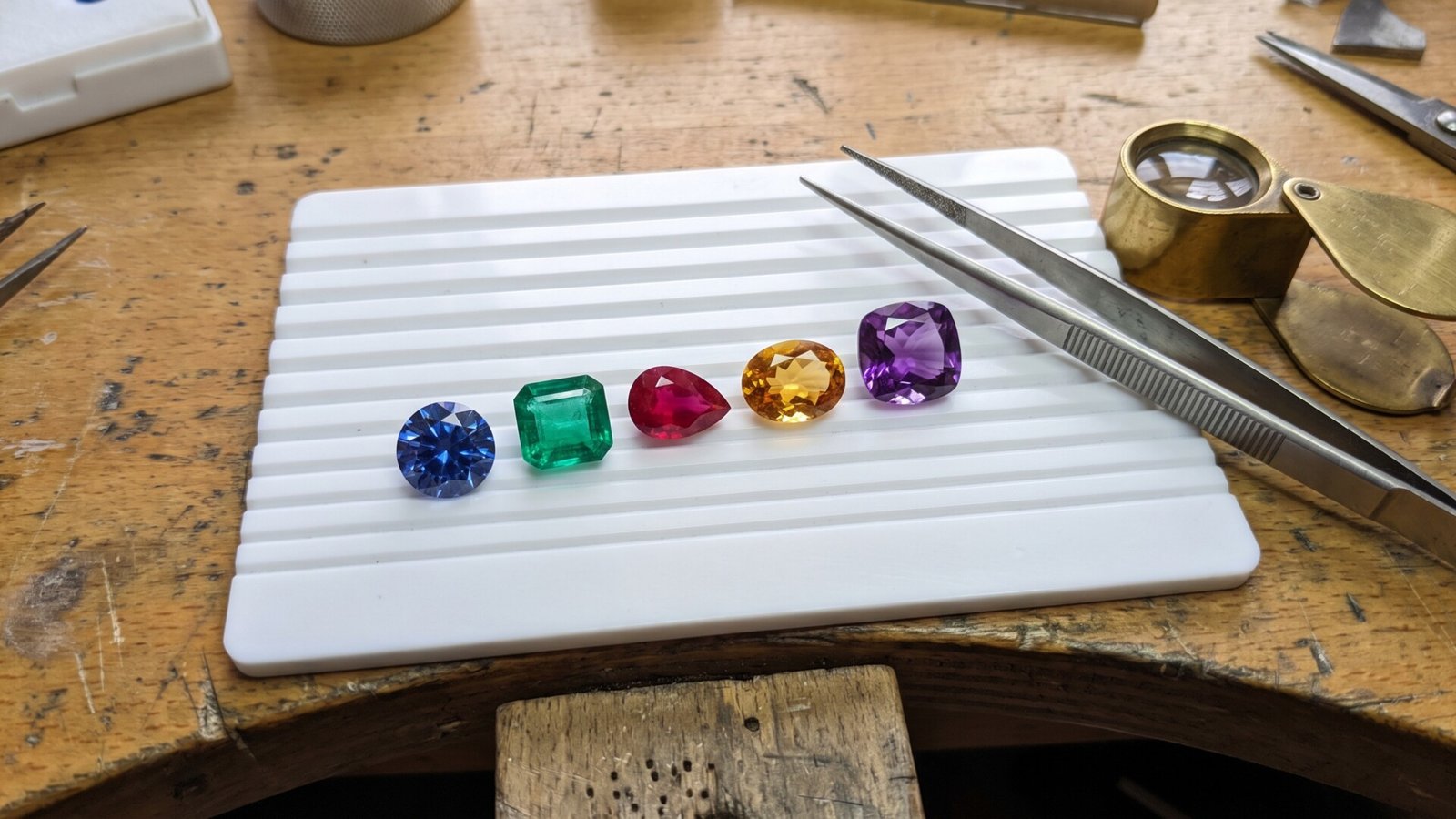
A round stone can have a brilliant cut, a step cut, a rose cut, or a mixed cut. A square stone can be a princess cut, an Asscher cut, or a radiant cut. The shape tells you what it looks like at a glance. The cut tells you how it handles light.
The confusion is understandable because we often name cuts after their shapes. A “round brilliant” is a round stone with a brilliant-style facet pattern. A “pear cut” usually means a pear-shaped stone with brilliant-style facets. The naming breaks down with square step cuts, which could be an Asscher, an emerald cut on a square outline, or something else depending on the facet pattern. Gemological educators such as the International Gem Society separate cut names that describe the face-up outline from cutting styles that describe the facet arrangement, and they treat brilliant, step, and mixed as the three basic styles.
| Term | What it describes | Examples |
|---|---|---|
| Shape | The outline seen from above | Round, oval, pear, cushion, square, marquise |
| Cutting style | How the facets are arranged | Brilliant, step, mixed, rose, cabochon (no facets) |
| Named cut | A specific shape plus facet pattern with its own name | Round brilliant, emerald cut, Asscher, radiant, Barion |
| Cut quality | How well proportioned and polished the stone is | Even brightness, good symmetry, no windowing |
So the first thing to do is to separate these ideas permanently: shape is outline, cut is facet arrangement, and cut quality is how well that arrangement was executed.
The Two Great Families: Faceted and Non-Faceted
Faceted gemstones are cut with multiple flat, polished surfaces called facets. The facets are set at specific angles to bounce light inside the stone and return it to the viewer’s eye. Faceting is used mostly for transparent to translucent material. If you can see through it, it is usually faceted.
Non-faceted gemstones are cut without facets. The most common non-faceted cut is the cabochon, a smooth, domed surface with no flat planes. Cabochons are used for opaque or translucent materials, for stones with optical effects such as stars (asterism) and cat’s eyes (chatoyancy), and often for softer materials.
Smooth shaping is much older than faceting. Early gem materials were polished smooth, drilled as beads, or shaped into domes long before cutters began putting flat facets on stones, which in Europe developed gradually over the Middle Ages. Today, a diamond or sapphire is almost always pictured as a faceted stone, and the cabochon is the specialty choice for star sapphires, opals, and moonstones.
The Brilliant Cut: Engineered for Light
The brilliant cut is the most famous faceting style in the world. Its defining feature is an arrangement of triangular and kite-shaped facets that radiate outward from the center of the stone, like petals or rays.
The goal is to maximize the light that returns to the viewer’s eye. Light enters through the crown, reflects off the pavilion facets, and exits back through the top. In a well-proportioned stone, most of that light is returned rather than leaking out through the bottom or sides. Brilliant cuts generally show more scintillation (the flashes of light and dark as the stone or the light moves) than step cuts.
The modern round brilliant developed over several centuries. Early forms of the brilliant appeared around 1700, and the Belgian mathematician and diamond-cutting family member Marcel Tolkowsky published calculations for an “ideal” round diamond in 1919. His proportions remain a reference point, though modern research has refined them. A standard round brilliant has 57 facets, or 58 if the bottom point (the culet) is faceted.
The brilliant style can be applied to almost any outline: oval, pear, marquise, cushion, and trillion brilliants all use adapted versions of the same pattern. The princess cut, a square or rectangular modified brilliant, is one of the most popular fancy diamond shapes. For more on how cut fits into diamond quality, see our guide to the 4 Cs of diamonds and our diamond birthstone guide.
The Step Cut: Color and Clarity Over Sparkle
The step cut is the brilliant cut’s quieter relative. Instead of radiating triangles and kites, it uses long, rectangular facets arranged in parallel rows that step up the crown and down the pavilion, with their long edges running parallel to the girdle.
Step cuts do not scintillate like brilliant cuts. They produce a clean, mirror-like flash and broad reflections rather than sparkle. Because the facets are larger and fewer, they act like wide windows into the stone. That makes inclusions easier to see, so step cuts reward cleaner material, but it also shows off even, saturated color very well. Fine emeralds, aquamarines, and sapphires are often step cut for this reason.
The best-known step cut is the emerald cut, a rectangle with truncated corners that was developed with emerald in mind. The cut suits a material that often contains inclusions and can be brittle: the clipped corners reduce the risk of chipping, and the large facets show off color. (Emerald’s Mohs hardness is 7.5 to 8, but fractures inside the stone make it more fragile than that number suggests.)
The baguette is a small, narrow rectangular step cut, named after the French loaf. It is used mostly as accent stones along the sides of a center stone or in geometric Art Deco-style designs. The Asscher cut is a square step cut with cropped corners, developed by the Asscher brothers of the Netherlands in 1902, and is known for the “hall of mirrors” look through the table. The carré cut is a square step cut without clipped corners and is less common.
The Mixed Cut: Brilliant and Step Combined
Mixed cuts combine brilliant and step facets in the same stone. A common arrangement for colored gemstones is a brilliant-style crown over a step-cut pavilion, which can add sparkle while keeping weight and color depth. The oval mixed cut is a typical example and is popular for sapphires and tourmalines. Other combinations exist, and cutters choose them to suit the shape of the rough and the color of the material.
The radiant cut is often listed alongside mixed cuts, but strictly speaking it is a modified brilliant. Created by Henry Grossbard in 1977, it uses brilliant-style facets on both the crown and the pavilion (typically around 70 facets) inside a rectangular or square outline with trimmed corners. It was designed to bring round-brilliant sparkle to a rectangular shape, with the corner protection of an emerald cut.
The Barion cut is a true mixed design. Developed by the South African cutter Basil Watermeyer in the early 1970s, it places a round-brilliant-style pavilion under a fancy-shaped, step-cut crown. Small crescent-shaped “quarter-moon” facets just below the girdle are meant to reduce the bowtie, the dark butterfly-shaped area that often shows in elongated brilliants. Barion-style cuts tend to be deeper than standard cuts, which can help cutters concentrate color, and they are used mostly on colored gemstones such as aquamarine and tourmaline.
The Rose Cut: A Vintage Style Returns
The rose cut was developed in Europe in the 1500s. It has a flat base and a domed crown covered with triangular facets that meet at a point at the top, like a rosebud. The number of facets varies, and there is no large table.
Rose cuts were widely used in Georgian and Victorian jewelry. When brilliant cuts became dominant, many rose-cut stones were recut, and the style came to be seen as old-fashioned. It has since made a comeback, especially for vintage-inspired engagement rings and everyday jewelry. Its soft, candlelit glow is more subdued than a brilliant’s sparkle, and its flat profile sits low in a setting. Today you will find rose cuts in diamonds and in colored stones such as sapphire, garnet, and tourmaline. Our guide to rare gemstone cuts including old mine, marquise, and rose cuts covers the style in more detail.
The Cabochon: Smooth, Domed, and Often Misunderstood
A cabochon, or “cab,” is a gemstone cut with a smooth, domed top and no facets. The word comes from the Old French caboche, meaning “head.” Cabochons are not failed faceted stones. They are the right choice for entire categories of gems.
Why choose a cabochon?
- Optical effects: Stars in star sapphires and star rubies, and the moving band of light in cat’s-eye stones, show best on a domed surface. Opal’s play-of-color is commonly displayed in cabochons too.
- Opaque and translucent materials: Turquoise, lapis lazuli, jade, and malachite gain little from faceting because their appeal lies in color, pattern, and luster.
- Softer materials: A smooth dome has no sharp facet edges to wear down. That helps somewhat with softer stones such as opal, but it does not make them hard: opal is only about 5.5 to 6.5 on the Mohs scale, so it still needs gentle wear and care.
- Style: Many people simply prefer the look of a smooth, glowing dome. The sugarloaf cabochon, with its steep, pyramid-like dome, is a more architectural variation.
Common cabochon variations:
- Simple cab: Rounded top, flat bottom. The most common form.
- Double cab: Rounded top and bottom.
- High cab: A steeper dome, often used for star stones.
- Hollow (concave-back) cab: The back is hollowed out, sometimes to lighten a very dark stone’s appearance. Ask a seller to disclose it, because the hollow can also be filled or backed in ways that change the look.
Cameos and intaglios are carved gems, usually made from shell, agate, or other layered material, and are separate from standard cabochon cutting.
The Named Cuts: A Quick Lexicon
Beyond the basic styles is a long list of named cuts. These are the ones you are most likely to meet.
Princess cut: A square or rectangular modified brilliant. It keeps a good deal of the rough crystal’s weight, but its sharp corners are exposed and need protective prongs.
Cushion cut: A square or rectangular stone with rounded corners and softly curved sides, like a pillow. It can be cut in brilliant, step, or mixed styles and has been popular for a very long time. The rounded corners make it a practical choice for rings.
Oval cut: A brilliant-style oval that elongates the finger line and tends to look larger than a round stone of the same weight. Like other elongated shapes, it can show a bowtie.
Marquise cut: An elongated oval with pointed ends. Legend says it was commissioned by King Louis XV to resemble the smile of the Marquise de Pompadour, though that story is tradition rather than documented fact. The shape gives a large face-up appearance for its weight, but the points are vulnerable to chipping.
Pear cut: A teardrop-shaped brilliant combining a rounded end and a single point. Symmetry matters, and the tip should be protected with a V-shaped prong.
Trillion cut: A triangular brilliant, with straight or slightly curved sides, used as a center stone or as side stones.
Briolette: A teardrop faceted all the way around, usually drilled so it can hang from a wire or chain. Common in earrings and pendants.
Portuguese cut: A multi-tiered cut with many facets on both crown and pavilion, designed for exceptional sparkle. It requires deep rough and extra labor, so it is rarely seen.
Checkerboard cut: A crown cut as a grid of small square facets. It is used on some translucent stones to spread light across the surface.
Fantasy and designer cuts: Modern custom designs, sometimes with curved or concave facets, made possible by computer-aided design and specialized equipment. Treat trademarked or brand-specific cut names with some caution: they are marketing names, and their claims about added sparkle or color improvement are the seller’s, not independently established.
Which Cuts Suit Which Birthstones?
The best cut depends on how a stone handles light and how durable it is. This table lists common matches for popular birthstones. Birthstone lists differ by country and organization, so months are shown as commonly cited, not as the only possible assignment. Hardness is on the Mohs scale, which measures scratch resistance and not toughness.
| Stone (common birthstone month) | Mohs hardness | Cuts commonly used | Notes for wear |
|---|---|---|---|
| Garnet (January) | 6.5 to 7.5, by variety | Round, oval, cushion brilliant | Fine for rings with sensible care; see our garnet guide |
| Amethyst (February) | 7 | Oval, cushion, emerald, mixed cuts | Good for everyday jewelry; can fade with prolonged strong light or heat. See our amethyst guide |
| Aquamarine (March) | 7.5 to 8 | Emerald, oval, Barion-style, cushion | Step cuts show its clean color well |
| Diamond (April) | 10 | Round brilliant, princess, cushion, emerald, radiant | Very hard, but can still chip along edges and corners |
| Emerald (May) | 7.5 to 8 | Emerald cut, oval, cabochon | Often included and brittle; protective settings recommended |
| Ruby (July) | 9 | Oval, cushion, mixed cuts, cabochon (star ruby) | Durable for daily wear |
| Peridot (August) | 6.5 to 7 | Oval, cushion, emerald | Better in pendants and earrings than hard-wearing rings |
| Sapphire (September) | 9 | Oval, cushion, round, cabochon (star sapphire) | Durable for daily wear |
| Opal (October) | About 5.5 to 6.5 | Cabochon | Soft and sensitive to knocks and dryness; gentle wear |
| Topaz (November, in many lists) | 8 | Oval, pear, cushion, emerald | Hard but has perfect cleavage, so a hard knock can split it |
Treatments matter too. Many sapphires and rubies are heat treated, many emeralds are oil or resin filled, and the color of most blue topaz is produced by irradiation and heat. A cut can look excellent while the stone still needs gentle care, so ask what has been done to a stone before you buy. Our guide to natural vs. lab-grown birthstones explains how lab-grown stones fit in.
Choosing a Cut for Different Types of Jewelry
Cut and shape affect how well a stone survives daily wear, not just how it looks.
- Everyday rings: Round, oval, cushion, and emerald cuts have no sharp points, so there is less to chip. Pointed shapes (marquise, pear, princess corners) need protective prongs or a bezel.
- Softer or brittle stones: A bezel or halo setting, and a lower-profile cut, protects edges. This matters especially for emerald, opal, and topaz.
- Earrings and pendants: These take less impact than rings, so they are a good home for more delicate stones and shapes, including briolettes and rose cuts.
- Visible inclusions: Step cuts show inclusions more readily than brilliant cuts. If you are buying a step-cut stone, look for good clarity for its type.
If you are shopping for pieces, our guide to online stores for authentic birthstone jewelry and our birthstone jewelry gift ideas by relationship are good next steps.
The Anatomy of a Faceted Stone
These terms appear in almost every gemstone description, and knowing them helps you read a listing or a lab report.
Table: The large, flat top facet. It is the main window into the stone.
Crown: The upper portion of the stone, above the girdle.
Girdle: The narrow outer edge where the crown meets the pavilion. This is where the setting grips the stone. It may be polished, frosted, or faceted.
Pavilion: The lower portion of the stone, below the girdle. Its facets act like mirrors that send light back up through the crown. If the pavilion is too shallow, light leaks out the bottom (windowing). If it is too deep, light can escape through the sides and the center can look dark.
Culet: The tiny facet or point at the bottom of the pavilion. In many colored gemstones it is simply a point, and in step cuts the bottom often ends in a line instead.
Facet: Any flat, polished surface on the stone. Facets have specific names depending on where they sit, such as star facets around the table, crown mains (the large kite-shaped facets), and upper and lower girdle facets.
The Cutter’s Dilemma: Beauty Versus Weight
Every cutter works against the same tension. The rough crystal has a fixed weight, and cutting it into a finished gem removes material, often more than half of the original rough. Each decision is a compromise between optical performance and the weight kept.
A deeper pavilion, a thicker girdle, or a slightly off-center culet keeps more carat weight but can reduce brightness. This is one reason two stones of the same species, size, and color can be priced differently. A well-cut stone can look noticeably better than a poorly cut stone with a higher color or clarity grade.
For colored gemstones there are extra challenges. Color is often unevenly distributed in the rough, so the cutter must orient the stone so the best color shows through the table. Many gems also show different colors in different directions (pleochroism), which affects how the stone must be positioned. The aim is the best compromise between appearance and size.
How Cut Quality Is Judged
Diamonds and colored stones are assessed differently.
Diamonds: According to GIA, cut grades are given only to round brilliant diamonds, on a scale from Excellent to Poor, because that cut has standardized proportions. Other shapes are called fancy shapes, and they are described by their measurements, polish, and symmetry instead. If you are buying a fancy-shape diamond, judge the cut by eye and in person or via high-quality video, and ask a reputable seller for guidance. You can read more on GIA’s diamond cut page.
Colored gemstones: There is no universal cut-grade system for colored stones in everyday retail. Most are judged by eye, based on the checks below.
What good cutting looks like
- Brightness: Under a single light, a well-cut stone returns light across most of its face. A stone that looks dark, glassy, or “dead” in places is usually poorly proportioned.
- Symmetry: Check that the outline is even, the table is centered, and facets look balanced.
- Facet junctions: In a carefully cut stone, facet edges meet crisply. Poorly aligned or rounded edges suggest rushed work.
- Windowing: If you can look through the table and see the surface under the stone, the pavilion is likely too shallow.
- Extinction and bowtie: Some dark areas are normal and add contrast, but large black patches or a heavy bowtie in an oval, pear, or marquise reduce the stone’s appeal.
- Your own eye: If you like how a stone looks in person, that matters. Buy from a seller with a clear return policy so you can check.
How Technology Changed Gem Cutting
Three developments have reshaped cutting in recent decades. Computer-aided design software, such as GemCad, lets cutters design and test facet patterns virtually before touching the rough. Precision faceting machines hold angles very consistently. And newer equipment can produce curved or concave facets that were impractical to cut by hand. For buyers this means that well-cut stones are easier to find than they once were, though the quality still varies widely by cutter and by the price point at which the stone was made.
The Emotional Cut: Why We Love What We Love
The technical points above affect value, durability, and beauty. They are not the whole story, though.
People choose gemstones for reasons that go beyond technical quality. A rose cut may be less brilliant than a round brilliant, but it carries the look of antique jewelry. A cabochon may not sparkle, but its smooth dome invites touch. A stone with a little extinction might feel moody and distinctive. Those are valid reasons to choose a stone, and you can make them with your eyes open: know the difference between shape and cut, learn to spot good faceting, and then let personal taste decide.
Browse by Shape and Cutting Style
Ready to look for a stone with the cut you want? Use the lists below to browse by shape or cutting style.
[Shop by Shape]
- [Round]
- [Oval]
- [Cushion]
- [Emerald]
- [Princess]
- [Pear]
- [Marquise]
- [Trillion]
- [Asscher]
- [Radiant]
[Shop by Cutting Style]
- [Brilliant Cut]
- [Step Cut]
- [Mixed Cut]
- [Rose Cut]
- [Cabochon]
[Shop Designer Cuts]
- [Barion Cut]
- [Portuguese Cut]
- [Checkerboard Cut]
- [Fantasy Cut]
Related Guides
- What Are Birthstones? The Complete Beginner’s Guide
- The Science Behind Gemstone Colors
- The History of Birthstones: From Ancient Times to Today
- Zodiac Birthstones vs. Monthly Birthstones
Frequently Asked Questions About Gemstone Shapes And Cuts
What is the difference between a gemstone's shape and its cut?
Shape is the outline you see from above, such as round, oval, or pear. Cut is the arrangement of facets and the proportions behind them, which determine how the stone handles light. Two stones can share a shape and look very different because of their cut.
What are the three basic cutting styles?
Brilliant, step, and mixed. Brilliant cuts use triangular and kite-shaped facets for sparkle. Step cuts use long rectangular facets for a clean, mirror-like look that shows color. Mixed cuts combine both styles in one stone.
Is a radiant cut a step cut?
No. The radiant cut, created by Henry Grossbard in 1977, uses brilliant-style facets on the crown and pavilion inside a rectangular or square outline with trimmed corners. It is closer to a modified brilliant than a step cut.
Which cut is best for an everyday birthstone ring?
Rounded shapes with no sharp points, such as round, oval, cushion, and emerald cuts, are generally more practical for daily wear. Pointed shapes like marquise and pear, and square corners like princess, need protective prongs or a bezel. The stone’s own hardness and cleavage matter just as much as its cut.
Why are emeralds usually cut as emerald cuts?
The emerald cut was developed with emerald in mind. Emeralds often contain inclusions and can be brittle, so the clipped corners reduce chipping risk and the large step facets show off the stone’s color. Emeralds are still best protected in a careful setting.
Why are opals cut as cabochons?
Opal’s play-of-color is typically shown best on a smooth dome, and a domed surface has no sharp facet edges to wear down. Opal is still relatively soft, at about 5.5 to 6.5 on the Mohs scale, so it needs gentle wear and care.
Do colored gemstones have cut grades like diamonds?
GIA assigns cut grades only to round brilliant diamonds. Colored stones and fancy-shape diamonds do not have a universal grade in everyday retail, so judge them by brightness, symmetry, and the absence of windowing and heavy extinction, and buy from a seller with a clear return policy.
What is windowing in a gemstone?
Windowing happens when the pavilion is too shallow, so light leaks out the bottom and you can see through the middle of the stone. It makes the center look washed out or see-through and is considered a cutting flaw in most faceted stones.
What is the bowtie effect?
A bowtie is a dark, butterfly-shaped area across the center of some elongated stones such as ovals, pears, and marquises. A mild bowtie is common, but a strong one reduces brilliance. Some cuts, such as the Barion, are designed to reduce it.