Peridot: Meaning, Properties, Uses & Value
Peridot is the warm yellowish-green birthstone for August. It is the gem variety of the mineral olivine, it forms deep in the Earth and rides to the surface in volcanic rock, and it has occasionally turned up in meteorites. It is also one of the most affordable colored gemstones, and it comes in only one color family: green. This guide covers what peridot is, where it comes from, what it traditionally symbolizes, how durable it is, what it costs, how to tell real from imitation, and how to care for it.
Throughout, gemological facts are kept separate from folklore and spiritual belief. Meanings and healing associations described here are cultural traditions and personal beliefs, not scientific claims or medical advice.
Peridot Quick Facts
| Category | Details |
|---|---|
| Mineral | Gem variety of olivine, a magnesium-iron silicate, (Mg,Fe)2SiO4 |
| Color | Brownish-green through yellowish-green to pure green; iron is part of its chemistry, so it is always green |
| Mohs hardness | 6.5 to 7 |
| Toughness | Fair to good; can chip or fracture with a sharp knock |
| Crystal system | Orthorhombic |
| Treatments | Generally untreated; ask the seller to confirm |
| Birthstone | August (modern); sardonyx is the traditional alternative and spinel was added in 2016 |
| Anniversary | Listed for the 15th or 16th wedding anniversary, depending on the list |
| Zodiac link | Often paired with Leo and Virgo; astrological lists vary |
| Care | Warm soapy water only; avoid ultrasonic and steam cleaners |
What Is Peridot?
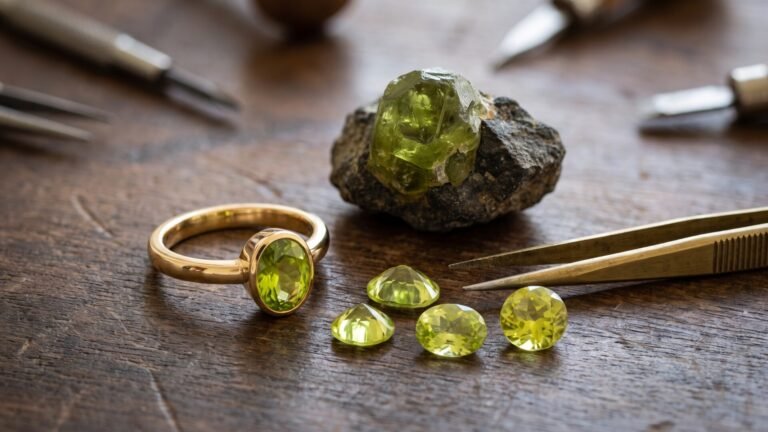
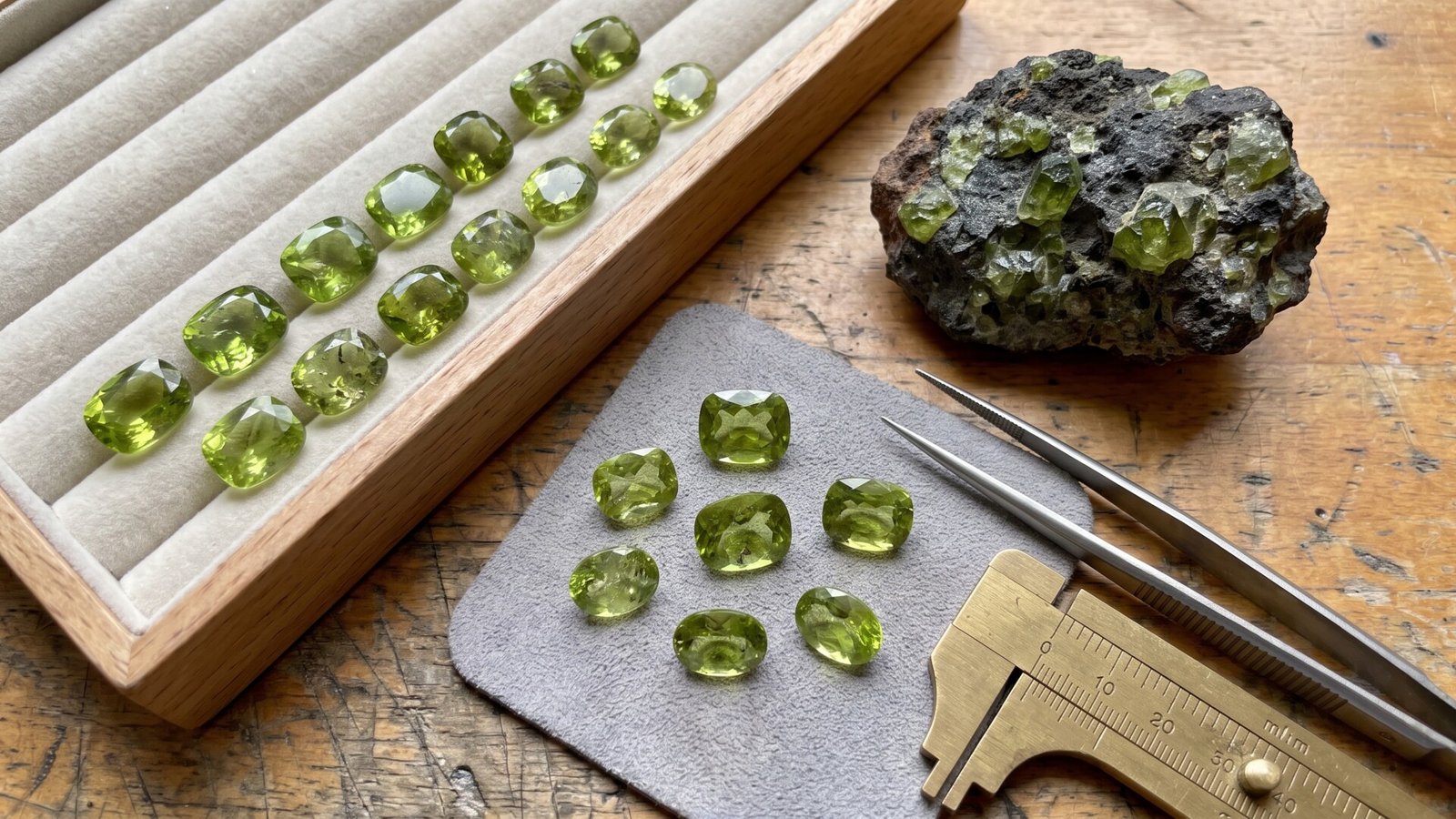
Peridot is the gem variety of olivine, a common mineral in the Earth’s upper mantle. Gem-quality crystals are brought to the surface when volcanic activity carries mantle rock upward, which is why peridot is often found in basalt. GIA describes peridot occurring as irregular nodules in some lava flows (in the United States, China and Vietnam) and, rarely, as large crystals in veins or pockets in solidified rock (in places such as Pakistan, Myanmar and Zabargad Island). Geologists link both types of deposit to seafloor spreading, when the crust splits and mantle rock rises. Olivine has also been found in some meteorites called pallasites, and in comet dust returned by NASA’s Stardust mission, which is why peridot is sometimes nicknamed a “space gem”. Cut gems from meteorites exist but are exceptionally rare.
Why Peridot Is Always Green
Most colored gems get their color from small amounts of impurities. Peridot is different: iron is part of its basic chemical makeup, so the stone is green no matter what. Gemologists call such stones idiochromatic. The shade depends on how much iron is present and the surrounding chemistry. More iron tends to push the color toward deeper green or brownish green. The most valued stones are a pure, saturated green with little yellow or brown.
Peridot, Olivine and Chrysolite
- Olivine: the mineral species name.
- Peridot: the gem-quality variety and the preferred trade name.
- Chrysolite: an older name, from Greek roots meaning “gold stone”, sometimes applied to yellowish-green stones.
Where Peridot Comes From
- United States (Arizona): The San Carlos Apache Reservation is the largest source of peridot. Some references say roughly 90 percent of the world’s peridot comes from there, although the figure is cited from a single author and varies by source. Arizona material is usually abundant and affordable, and is often slightly more olive.
- Pakistan: Deposits in the Kohistan region of the Pakistani Himalayas, including the Sapat (Sappat) area, produce large, richly colored crystals. Pakistani stones are often the benchmark for fine large peridot.
- Myanmar (Burma): Known for fine, deeply colored peridot.
- Zabargad (St. John’s Island), Red Sea: The historic source. Sources say the ancient world mined peridot there, then called topazios, beginning around 300 BCE. Access today is restricted.
- China, Vietnam, Finland, Hawaii and others: Smaller or specialized sources. In Hawaii, olivine crystals form the green sand of Papakolea Beach, one of only a few green-sand beaches in the world.
Peridot History and Folklore
Peridot has been used in jewelry for thousands of years, though early records mix it up with other green stones.
- Ancient Egypt: Peridot from Zabargad is often described as the Egyptians’ “gem of the sun”, and a popular tradition says it was thought to ward off the terrors of night. These ideas come from later writers and traditions, so treat them as folklore rather than documented belief.
- Mistaken identity: Peridot has long been confused with emerald. Some writers have suggested that certain famous “emeralds”, including in medieval church treasures, may have been peridot. The scholar George Frederick Kunz discussed such confusion between beryl and peridot in church treasuries, but specific identifications are debated, so we avoid naming individual objects. For emerald history, see The History of Emerald in Royal Jewelry.
- Roman era: A frequently repeated tradition says peridot kept its color in lamplight, earning it a reputation as an “evening emerald”. Peridot does look good in artificial light, but the nickname is a trade tradition.
- Hawaii: Olivine-bearing volcanic material is associated in local lore with Pele, the goddess of volcanoes, and the term “Pele’s tears” is used for droplets of volcanic glass. Peridot is sometimes called the “Hawaiian diamond”.
- Medieval Europe: A tradition held that peridot set in gold could dispel fears and enchantments.
For a deeper dive into cultural history and modern meanings, read Peridot Meaning: History, Symbolism, Spiritual Significance & Modern Uses.
Peridot Meaning and Symbolism
Today peridot is commonly associated with warmth, renewal, positivity and protection. In crystal and astrological traditions it is linked to the heart chakra and to the signs Leo and Virgo. These associations come from folklore and modern spiritual practice. They are not proven effects, and peridot is not a substitute for medical or mental-health care. If you are interested in the practice side, see our introduction to crystal healing basics.
Peridot as the August Birthstone
Peridot is the modern birthstone for August. The 1912 list from the National Association of Jewelers named sardonyx and peridot for the month, and spinel was added in 2016. Sardonyx remains a traditional alternative on some lists. For the full picture, see our August birthstone guide and our overview of birthstones by month.
Peridot is also given for the 15th or 16th wedding anniversary depending on the list, so you may see both numbers. Zodiac pairings vary between sources, so see Zodiac Birthstones vs. Monthly Birthstones for how to choose.
Colors, Clarity and Optical Features
- Yellowish-green: The most common shade in jewelry.
- Olive and deep green: Richer tones that many buyers prefer.
- Brownish-green: Generally less valued, reflecting more iron.
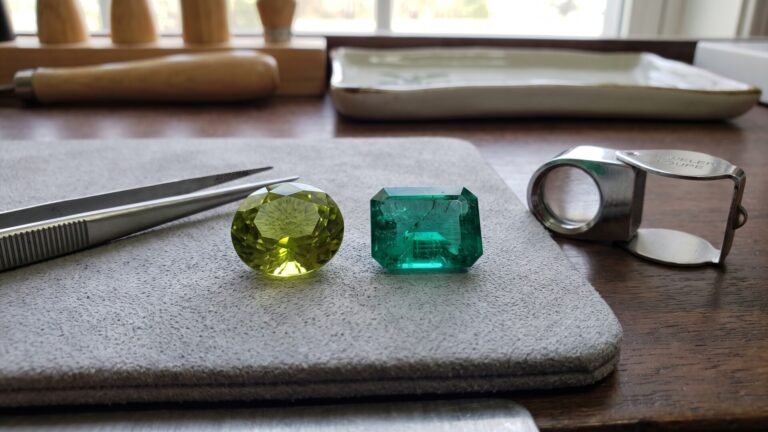
Most gem peridot is clean enough to look eye-clean. Gemologists look for characteristic “lily pad” disc-like fractures and tiny dark crystals as signs of natural origin. Peridot also has strong double refraction, so facets on the far side of a stone can appear doubled when viewed through the top under magnification. Very rarely, peridot shows a star effect as a cabochon.
Peridot in Jewelry: What Suits Which Piece
At 6.5 to 7 on the Mohs scale, peridot is softer than sapphire, ruby or topaz, and it has only fair to good toughness. Everyday dust contains quartz at hardness 7, so peridot can pick up fine scratches over time. A guide to the scale is in our Mohs hardness explainer.
| Piece | Suitability | Advice |
|---|---|---|
| Earrings | Excellent | Low impact, ideal for daily wear |
| Pendants and necklaces | Excellent | Protected from knocks |
| Brooches | Excellent | Protected by clothing |
| Rings | Occasional or careful wear | Choose a bezel or halo setting; remove for gardening, sports and heavy work |
| Bracelets | Use caution | Bracelets knock against surfaces more often |
Peridot suits yellow gold, white gold, platinum and rose gold. Yellow gold warms the stone’s color, while white metals make the green look cooler. Popular designs include solitaires, halos, three-stone rings and vintage-style settings. If you are considering a ring on a daily basis, read Is Peridot Safe to Wear While Showering or Sleeping? for practical habits.
Peridot Value and Price
Peridot is generally affordable compared with other green gems such as emerald or tsavorite garnet. Price depends on:
- Color: Pure, saturated green with little brown or yellow is most valued.
- Clarity: Eye-clean stones cost more than visibly included ones.
- Cut: Good cutting maximizes color and avoids dull or dark zones.
- Size: Large, fine-colored stones are scarcer, so price per carat rises with size.
- Origin: Pakistani and Burmese stones are often more highly valued than commercial Arizona material, but origin should be documented rather than assumed.
Price guides vary. One 2026 price guide reports roughly $50 to $500 per carat for good-quality peridot, and small commercial stones can cost less than that, while exceptional large stones can cost more. Treat these as rough orientation only, and compare several sellers. The largest cut peridot on record is a 310-carat stone in the Smithsonian Institution collection.
Real vs. Imitation Peridot
| Material | What to look for |
|---|---|
| Natural peridot | Warm yellowish to olive green; doubled back facets under magnification; “lily pad” fractures or tiny crystals |
| Green glass | Softer; may show bubbles or swirl marks; no doubling |
| Green cubic zirconia | Heavier for its size; looks unusually brilliant |
| Green tourmaline | Often more bluish-green; different optical behavior |
| Synthetic spinel or other lab-created stones | May match the color, but lack peridot’s doubling |
For valuable pieces, buy from a seller with a clear return policy and ask for lab identification. A lab-grown peridot would be real peridot chemically, so ask whether a stone is natural or lab-grown. Our guide to natural vs. lab-grown birthstones explains the difference.
Care and Cleaning
GIA’s guidance is to clean peridot with warm soapy water. Use lukewarm water with mild dish soap, a soft brush, a thorough rinse and a soft lint-free cloth.
- Avoid ultrasonic and steam cleaners, since vibration and heat can fracture peridot.
- Avoid acids; peridot is attacked by sulfuric and hydrochloric acids, and household cleaners should be kept away.
- Avoid sudden temperature changes and sharp knocks.
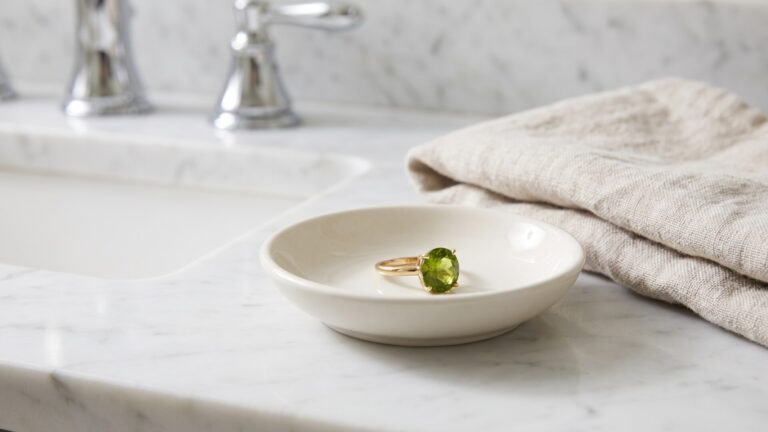
- Wipe it after wear, because prolonged contact with perspiration and cosmetics can dull the surface.
- Store it separately from harder stones such as quartz, topaz, sapphire and diamond, in a soft pouch or lined box.
- Have settings checked by a jeweler about once a year, or more often for a ring worn regularly.
Peridot Alternatives for August and Other Green Gems
| Stone | Hardness | Why consider it |
|---|---|---|
| Spinel (August) | 8 | Tougher for rings; available in many colors |
| Sardonyx (traditional August) | 6.5 to 7 | Opaque banded stone with a long tradition |
| Emerald | 7.5 to 8 | Richer green but often treated and more fragile; see the emerald guide |
| Garnet (tsavorite) | about 7 to 7.5 | Vivid green; see the garnet guide |
| Green tourmaline | 7 to 7.5 | Wide color range; see the tourmaline guide |
Other gemstone guides in our collection include sapphire, ruby, topaz, aquamarine, opal and alexandrite.
Frequently Asked Questions About Peridot
Is peridot expensive?
Generally not. Peridot is one of the more affordable colored gemstones. Price guides vary, with one 2026 guide citing roughly $50 to $500 per carat for good-quality stones, while small commercial stones can cost less and exceptional large stones can cost more.
Is peridot suitable for daily wear?
It is best in earrings and pendants for daily wear. Rings are possible with a protective setting and sensible habits, but peridot is 6.5 to 7 on the Mohs scale and can chip, so remove rings for heavy work and sports.
What does peridot symbolize?
Traditionally it is associated with warmth, renewal, positivity and protection. These meanings are cultural and spiritual beliefs, not proven effects.
Is peridot a birthstone?
Yes. Peridot is the modern birthstone for August, with spinel added in 2016 and sardonyx as a traditional alternative.
Where does peridot come from?
The largest supply comes from the San Carlos Apache Reservation in Arizona. Fine large crystals come from Pakistan and Myanmar, and the historic source is Zabargad Island in the Red Sea.
Is peridot found in meteorites?
Yes. Olivine, the mineral peridot belongs to, occurs in pallasite meteorites. Cut gems from meteorites are very rare.
How can you tell real peridot from glass?
Real peridot shows strong double refraction, so back facets look doubled under magnification, and it often contains lily-pad fractures. Glass is single refractive and may show bubbles. For valuable pieces, ask for lab identification.
Is peridot treated?
Peridot is generally not treated, but you should still ask the seller to confirm whether a stone is natural, treated or lab-grown.
What is the difference between peridot and olivine?
Olivine is the mineral species and peridot is its gem-quality variety. All peridot is olivine, but not all olivine is gem quality.
How do I clean peridot?
Use lukewarm water, mild soap and a soft brush, then rinse and dry gently. Avoid ultrasonic and steam cleaners and acids.
Ready to find your own peridot? Browse the collections below.
[Shop Peridot Jewelry]
[Shop August Birthstone Collection]
[Shop Green Gemstones]
Explore More Gemstones at Our Gemstones Hub