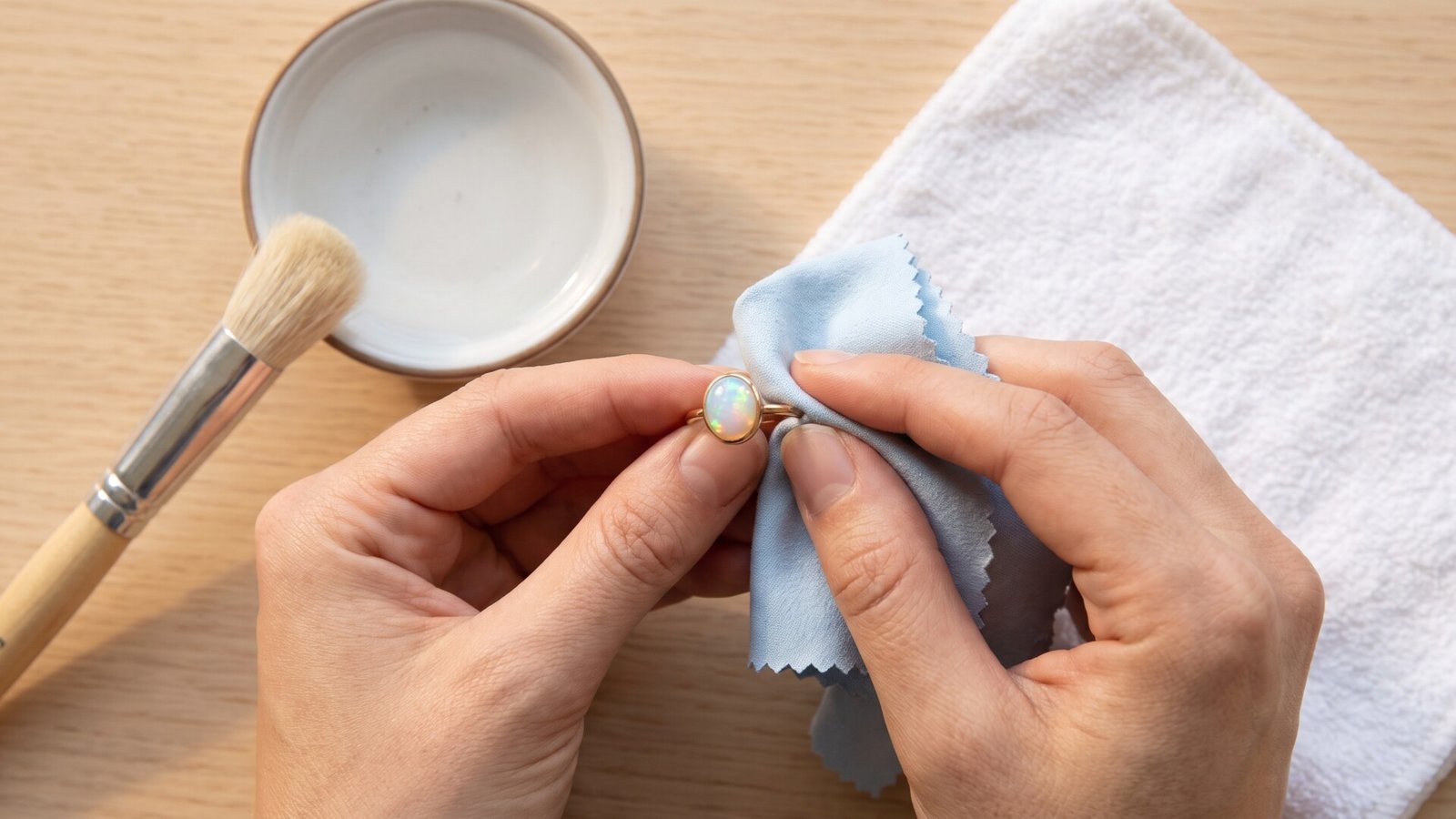
Safest Way to Clean an Opal Birthstone Ring With Crazing Risk
Opal is one of the two modern October birthstones, and it is also one of the easiest gems to damage by cleaning it the wrong way. The stone is a form of hydrated silica, it is softer than most gems used in rings, and some opals can develop a network of fine surface cracks called crazing. If you own an opal ring, the safest approach is also the simplest: warm water, a drop of mild soap, a soft cloth, and a quick dry.
This guide explains how to clean an opal ring step by step, which common jewelry-cleaning habits to skip, how to recognize crazing, how care differs for solid opals, doublets and triplets, and when to hand the ring to a jeweler. For the stone itself, see our main opal guide.
Quick Answer: The Safest Way to Clean an Opal Ring
The Gemological Institute of America (GIA) says the only safe way to clean opal at home is warm, soapy water. In practice that means:
- Mix a few drops of mild, fragrance-free dish soap into a bowl of lukewarm (not hot, not cold) water.
- Dip a soft cloth or a very soft brush in the solution and wipe the stone and setting gently.
- Rinse briefly under lukewarm running water, with the stone facing away from a plugged drain.
- Pat dry right away with a soft, lint-free cloth and let it air-dry for a few minutes before storing it.
Skip the ultrasonic machine, the steam cleaner, jewelry dips, ammonia, and anything abrasive. The rest of this guide explains why.
Opal Facts That Shape How You Clean It
Care advice makes more sense once you know what opal is made of. Opal is not a crystal; it is amorphous hydrated silica (SiO₂·nH₂O) with water held inside its structure. Published figures put the water content at roughly 3% to 21% by weight, and many opals sit around 6–10%.
| Property | Opal | Why it matters for cleaning |
|---|---|---|
| Composition | Hydrated silica, SiO₂·nH₂O | Water is part of the stone, so heat, dryness and sudden changes can stress it |
| Structure | Amorphous (no crystal lattice) | No cleavage planes, but it can still fracture or craze |
| Mohs hardness | About 5.5–6.5 (some references give 5–6.5) | Softer than quartz grit and household dust, so abrasion scratches it |
| Toughness | Rated very poor to fair by GIA | Knocks and vibration can chip or crack it |
| Common treatments | Oil, wax or resin impregnation; sugar and smoke treatment on some matrix opal | Solvents and harsh cleaners can disturb treated surfaces |
| Sensitive to | Heat, sudden temperature change, strong light, acids, caustic alkalis | Rules out steam, hot water, bleach and most cleaning dips |
Hardness and toughness are not the same thing. Hardness describes resistance to scratching; toughness describes resistance to breaking and chipping. Opal is weak on both counts, which is why a protective setting and gentle handling matter. Our gemstone hardness scale explainer covers the difference in more detail.
What Is Crazing, and Can You Prevent It?
Crazing is a web of fine cracks in the surface of an opal. It is generally linked to the stone losing water too quickly or being stressed by sudden temperature change. GIA also notes that intense light and high heat can cause fracture lines. Some opals are more prone to it than others, and a stone that has been stable for years is less likely to suddenly craze than one that is newly cut or has been through a dramatic change in conditions.
Signs of crazing
- Spiderweb-like hairline cracks you can see at an angle under a bright light
- A cloudy or frosted patch where the play-of-color used to flash
- A rough or uneven feel on the dome of the stone
Crazing cannot be reversed at home. If you notice it, stop soaking the ring, avoid water beyond a damp-cloth wipe, and ask a jeweler who works with opal to look at it. Some cracks can be stabilized or the stone re-polished, but that is a professional decision and sometimes not worth the cost.
How to lower the risk
- Avoid heat: hot cars, radiators, sauna rooms, hot tubs, and the sunny windowsill are all poor places for an opal ring.
- Avoid sudden swings: do not take an opal from a very cold place straight into a warm one, or rinse it under hot water.
- Limit strong light: do not leave opal jewelry in direct sun for long stretches.
- Keep chemicals away: take the ring off for dishes, cleaning products, perfume, hairspray, lotions, and pool or hot-tub water.
You will sometimes read that wearing opal keeps it hydrated because of skin moisture, or that you should store it in a glass of water. We could not confirm either claim from gemological sources, so we do not recommend them. If you are worried about dryness, ask the seller or a jeweler about your specific stone.
Step-by-Step: Cleaning a Solid Opal Ring
A solid opal is a single piece of natural opal. It is the most forgiving type, though still delicate by gemstone standards.
- Inspect first. Check the stone and the prongs or bezel under good light. If you see cracks, loose metal, or a wobble, skip the water and see a jeweler.
- Dry-wipe. A clean microfiber or soft cotton cloth removes skin oils and dust without moisture. For a ring you wear lightly, this is often enough.
- Wash briefly. Use lukewarm water with a few drops of mild soap. A very soft brush, such as a baby toothbrush, helps with grime under the stone, but use light pressure.
- Rinse and dry. Rinse quickly in lukewarm water and pat dry with a lint-free cloth. Do not leave the ring to soak for long periods; a quick wash of a minute or two is plenty.
- Store safely. Once fully dry, put the ring in a soft pouch or its own compartment.
Doublets, Triplets and Ethiopian Opal: Extra Caution
Not every opal ring holds a solid stone, and the construction changes how you should clean it.
| Type | What it is | Cleaning approach |
|---|---|---|
| Solid opal | One piece of natural opal | Quick wash in lukewarm soapy water, then dry |
| Doublet | A thin slice of opal glued to a dark backing | Do not soak; wipe with a damp cloth so water does not reach the glue line |
| Triplet | Opal slice, backing, and a clear cap (often quartz or glass) glued on top | Do not soak; wipe the surface only |
| Boulder opal | A thin vein of opal left attached to its natural ironstone host rock | Same as solid opal; the backing makes it somewhat sturdier, but it is still a soft stone |
| Ethiopian (Welo) opal | Often a hydrophane opal that absorbs water | Avoid soaking; it can soak up liquid and temporarily change appearance |
| Lab-created opal | Made in a lab; can be very similar to natural opal | Treat as natural opal unless the seller advises otherwise |
If you are not sure what you own, ask the seller or a jeweler. A thin line between the colorful layer and the dark base, or a glassy dome over the top, usually means a doublet or triplet. Our guide to natural versus lab-grown birthstones explains why the type of stone also matters when you buy.
What Not to Do
| Common method | Risk for opal |
|---|---|
| Ultrasonic cleaner | Vibration and heat can crack the stone or loosen a treatment or glue line |
| Steam cleaner | Heat and sudden moisture change can cause crazing or damage doublets and triplets |
| Hot water | Temperature shock |
| Jewelry cleaning dips and baking soda or toothpaste pastes | Chemicals or abrasives can etch or scratch the surface |
| Bleach, ammonia, acetone, alcohol | Can attack opal, treatments or adhesives; GIA specifically names caustic alkaline solutions and hydrofluoric acid as harmful |
| Rough cloths or stiff brushes | Scratches a stone with a Mohs hardness around 5.5–6.5 |
| Prolonged soaking | Can stress the stone and loosen glued layers |
How Ring Settings Affect Cleaning and Safety
- Bezel settings: metal surrounds the edge of the stone, which protects against knocks. Dirt can still collect under the rim, so use a soft brush there.
- Halo settings: small stones around the opal take some of the impact, but the opal itself is still exposed at the top.
- Prong settings: show more of the stone but leave edges exposed. Check prongs regularly, since a loose prong risks losing or chipping the stone.
- Low, domed cabochons: the usual cut for opal. A smooth dome is easier to wipe than a faceted stone, but it can scratch visibly.
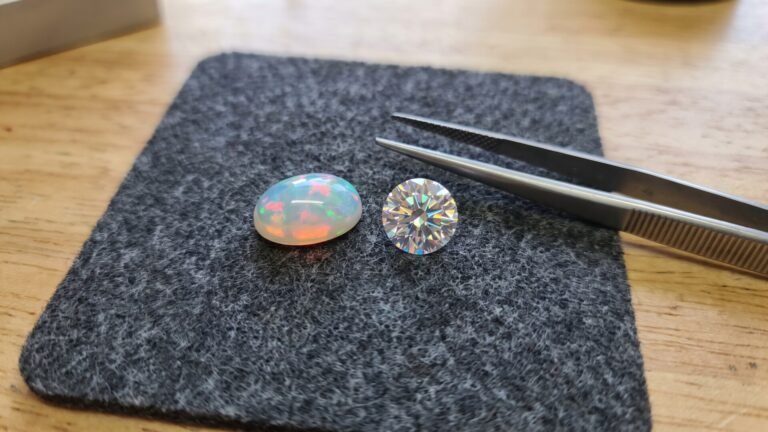
Because of its softness, opal is better suited to occasional wear or to pendants and earrings than to an everyday ring that takes daily knocks. If you want a ring that tolerates hard use, see how it compares with a tougher look-alike in opal vs moissanite for fire and shine.
Understanding Precious Opal and Why Color Flashes Are Fragile
GIA divides opal into precious opal, which shows play-of-color, and common opal, which does not. Play-of-color comes from sub-microscopic silica spheres stacked in a regular grid that diffract light, with sphere size determining the colors you see. That orderly internal structure is part of what makes the stone special, and it is also a reason to be gentle: scratches, crazing and surface damage interrupt how light reaches and leaves the stone, so a damaged opal looks duller than a damaged hard gem. Australia, including Lightning Ridge and Coober Pedy, is named by GIA as the main source of opal. The main varieties you will meet in rings are white (light), black, fire, boulder and crystal opal, and all of them follow the same care rules in this guide.
Cleaning Opal Earrings, Pendants and Bracelets
The same rules apply to every opal piece, but the risks differ. Pendants and earrings take fewer knocks than rings, so they often stay in better shape, yet they collect hairspray, perfume and skin products at the clasp and back. Put them on after styling products have dried, wipe with a soft dry cloth after wear, and use the lukewarm soapy-water method only on solid stones. Chains with opal charms should be cleaned separately so a brush does not catch the stone. For a gift, remember that opal is also one of the more delicate options in our children’s birthstone gifts guide, and small jewelry can be a choking hazard for young children.
Opal vs. Tourmaline: Which October Stone Is Easier to Wear?
October has two modern birthstones, and they could hardly differ more in care. Opal is soft, water-bearing and sensitive to heat and chemicals. Tourmaline is generally harder and tougher and tolerates everyday wear far better, although its care still depends on the specific stone. If you love opal’s color play but want a ring for daily use, tourmaline, or a tougher look-alike such as the ones in opal vs moissanite, is the practical option. You can compare both October stones in the October birthstone guide.
Everyday Habits That Protect an Opal Ring
- Put the ring on last when getting dressed and take it off first when you get home.
- Remove it for the gym, gardening, swimming, saunas and hot tubs.
- Do not wear it while applying hand cream or sanitizer; let products dry first.
- Avoid wearing it for tasks where the stone could hit a hard surface, such as carrying shopping bags or typing for long periods on a hard desk edge.
- Keep a short note of the purchase receipt and any lab or seller documentation, since it helps a jeweler identify whether the stone is solid, a doublet or a triplet.
How Often Should You Clean an Opal Ring?
| Task | Suggested frequency |
|---|---|
| Dry wipe with a soft cloth | After wearing, or weekly if worn often |
| Lukewarm soapy-water wash (solid opals) | Occasionally, when it looks dull or after lotion or sweat build-up |
| Damp-cloth wipe only (doublets, triplets, crazed stones) | As needed |
| Check of prongs, bezel and stone by a jeweler | About once a year if you wear the ring regularly |
These intervals are our practical suggestions, not a laboratory standard. A ring you wear only a few times a year needs far less attention than one you wear weekly.
Storing an Opal Ring
- Keep it in a padded box or soft pouch, away from harder stones such as diamond, sapphire and quartz, which can scratch it.
- Store it somewhere with stable temperature, away from radiators, windows and car glove boxes.
- Make sure it is completely dry before it goes in the box.
- If you travel with it, use a small, hard-sided case so nothing presses on the stone.
Some collectors keep opals with a damp cotton ball. We do not recommend this for doublets and triplets, where moisture can harm the glue, and we could not confirm that it is needed for stable jewelry opals, so ask your jeweler if you are tempted.
When to See a Jeweler
- You see crazing, a crack, or a chip.
- The stone looks cloudy or has changed color after getting wet.
- A prong, bezel edge or the band feels loose.
- It is an antique ring, a doublet or triplet that has been soaked, or a stone you cannot identify.
Look for a jeweler or gemologist who works with opal regularly and ask how they clean it. A reputable professional should be able to explain why they would not use ultrasonic or steam equipment on your stone.
Choosing an Opal Ring That Is Easier to Look After
If you are shopping rather than cleaning, a few choices make life with opal easier. We are not recommending specific products here; these are general buying points.
| Ring style | Good for | Care note |
|---|---|---|
| Solid opal in a full bezel | Best protection for a ring that will be worn | Brush gently around the rim |
| Opal with a halo of smaller stones | A classic gift look with some edge protection | Check the small stones for looseness |
| Boulder opal band or ring | Natural ironstone backing adds some strength | Still soft; avoid knocks |
| Fire opal ring | Warm orange to red body color, with or without play-of-color | Avoid heat and chemicals |
| Doublet or triplet ring | Lower cost and thin opal layers | Never soak; surface wipe only |
Opal prices vary enormously with body color, brightness, pattern and size. Published dealer guides put approximate per-carat prices in US dollars at about $5–$500 for white (light) opal, $5–$300 for Ethiopian opal, $30–$3,500 for boulder opal, $30–$3,000+ for crystal opal and $500–$50,000+ for black opal. These are loose orientation ranges only, so compare real listings before buying, and ask for written disclosure of whether a stone is solid, a doublet or a triplet, and whether it has been treated.
For more on styles and settings, browse our birthstone jewelry guide, or read the October birthstone guide to see how opal sits alongside tourmaline.
Beyond Care: Opal’s Meaning and Stories
Many people choose opal because of what it represents in tradition, not just how it looks. If you want the symbolic side, our opal meaning guide covers history, symbolism and modern uses, and The Fire of Opal: Myths and Legends separates documented history from folklore. Those associations are cultural beliefs, not medical advice, and they have no bearing on how the stone should be cleaned. You can explore more stones in our gemstones hub.
Final Thoughts
Opal rewards a light touch. Keep it away from heat, chemicals and hard knocks, clean it only with lukewarm soapy water and a soft cloth, never soak a doublet or triplet, and have a jeweler look at it if you see crazing or loose metal. Do that, and an opal ring can stay colorful for many years.
Frequently Asked Questions About Cleaning Opal Rings
Can I clean an opal ring with water?
Yes, for a solid opal. GIA says warm, soapy water is the only safe way to clean opal at home. Use lukewarm water, a few drops of mild soap and a soft cloth, rinse quickly and dry right away. Do not soak doublets, triplets or stones that already show crazing.
Can I use an ultrasonic or steam cleaner on opal?
No. Vibration, heat and sudden moisture change can crack opal, cause crazing, or loosen the glue in doublets and triplets.
What does a crazed opal look like?
Crazing shows up as a web of fine cracks, a cloudy or frosted area where the color flash has dulled, or a rough surface. A jeweler can assess whether it can be stabilized or re-polished.
Can crazing be fixed?
It cannot be reversed at home. A jeweler may be able to polish or stabilize the surface, but results depend on the stone and the damage, and some crazed stones are not worth repairing.
How do I clean a doublet or triplet opal ring?
Wipe the surface with a slightly damp soft cloth and dry it immediately. Do not soak it, because water can reach the glued layers and weaken them.
Can I wear an opal ring every day?
You can, but opal is soft and has low toughness, so a daily-wear ring will meet more knocks and chemicals than a pendant or earrings. A bezel setting and removing the ring for chores reduce the risk.
Should I store opal in water or with a damp cloth?
We do not recommend it. We could not confirm from gemological sources that it is needed for jewelry opals, and moisture can harm doublets and triplets. Ask a jeweler about your specific stone.
Is opal the October birthstone?
Opal is one of the two modern October birthstones, along with tourmaline. Birthstone lists vary by country and organization.
Can I wear my opal ring in the shower or while swimming?
It is better not to. Hot water, chlorine, salt water and soaps can stress the stone, and doublets, triplets and Ethiopian hydrophane opals are especially sensitive to soaking. Remove the ring before bathing, swimming or using a hot tub.
How often should a jeweler check my opal ring?
About once a year is a sensible suggestion for a ring you wear regularly, mainly to check the prongs or bezel and the stone for cracks.