October Birthstone: Meaning, Symbolism, and Jewelry Guide
The October Birthstone at a Glance
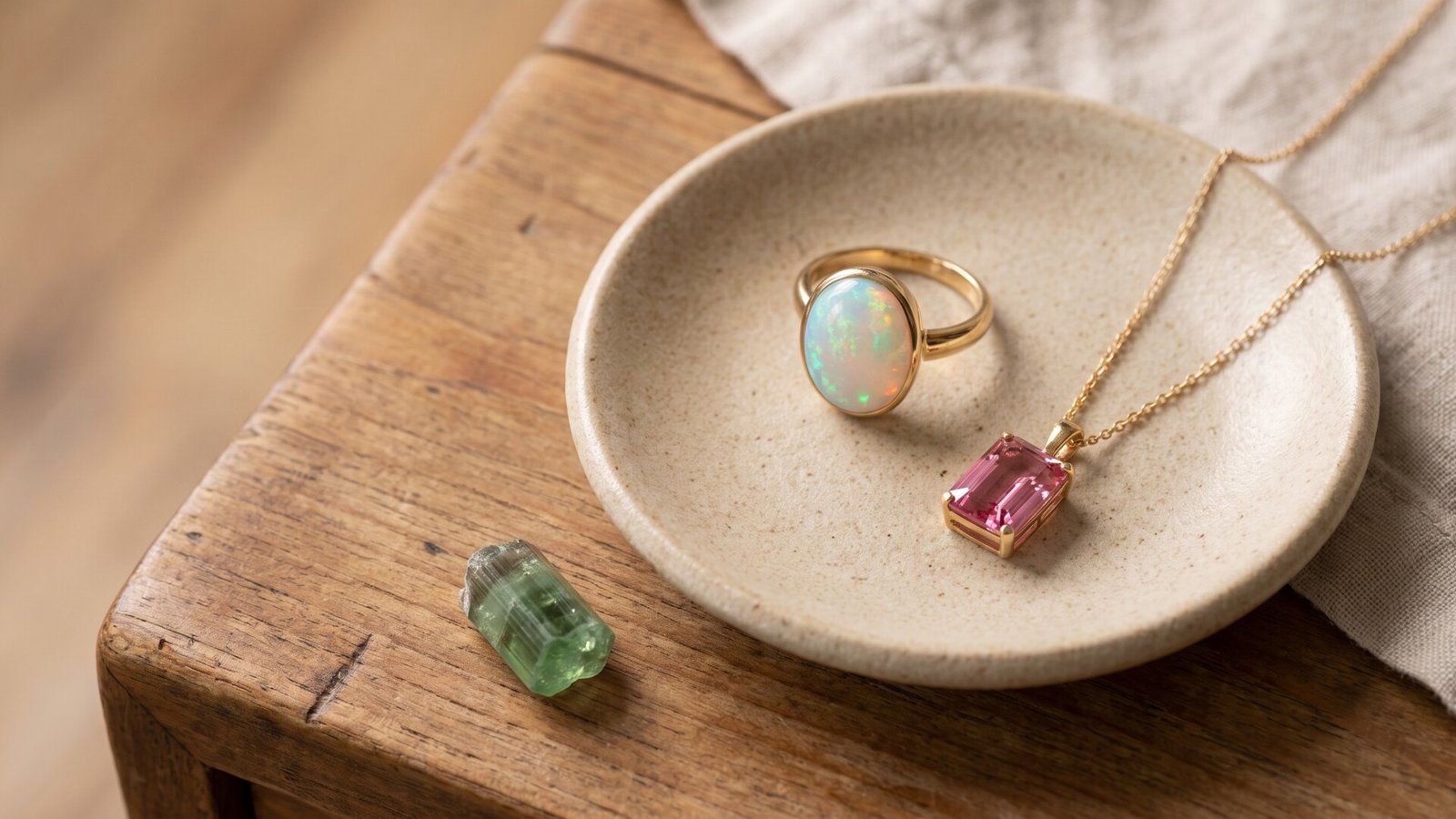
October is a month of colorful change, and its two birthstones match it. Opal is the traditional October birthstone, prized for its shifting rainbow “play-of-color”. Tourmaline is the newer addition, available in nearly every color. They are very different stones to wear: tourmaline is comparatively durable, while opal is delicate and needs careful handling.
| Opal | Tourmaline | |
|---|---|---|
| Role | Traditional October birthstone | Newer October birthstone |
| Look | Often shows play-of-color (flashes of rainbow hues) | Nearly every color, including pink, green, blue and black |
| Mohs hardness | 5 to 6.5 | 7 to 7.5 |
| Durability notes | Sensitive to heat and sudden temperature change; layered stones are sensitive to water | Suitable for everyday wear; heat can damage it |
| Best for | Pendants, earrings, occasional rings | Rings, pendants, earrings, bracelets |
This guide covers both stones: their history, meaning, types, jewelry ideas, zodiac links and care. Symbolism and spiritual meaning here are traditions and beliefs, not scientific or medical claims. You can compare every month in our Birthstones by Month hub and read about the wider meanings and symbolism of birthstones.
What Are the October Birthstones?
October has two widely recognized birthstones. The same two apply to every date in the month, including October 23 and the rest of the Libra and Scorpio boundary:
- Opal (traditional): known for play-of-color and traditionally linked with creativity and inspiration.
- Tourmaline (newer): a group of colorful gems traditionally linked with balance and protection.
For the full story of how lists evolved, see the history of birthstones and what birthstones are. For deeper stone profiles, read our opal guide and tourmaline guide.
What Is My Birthstone if I Was Born on October 23?
If you were born on October 23, your birthstones are still opal and tourmaline, because monthly birthstones depend on the month only. October 23 is also around the start of Scorpio season, so you may want to look at the zodiac side as well. Our Scorpio birthstone guide and Libra birthstone guide cover the zodiac lists, and zodiac vs monthly birthstones explains how to choose.
Why These Stones Represent October
Opal: Creativity and Emotional Depth
Opal’s changing flashes of color are easy to link with imagination and with autumn’s shifting palette. In tradition it stands for creativity, inspiration and intuition. Read the folklore in the fire of opal: myths and legends and the opal meaning guide.
Tourmaline: Protection and Balance
Tourmaline’s name comes from a Sinhalese word meaning “stone with mixed colors”, which fits a gem that appears in so many shades. In tradition, tourmaline is associated with balance, vitality and protection, and each color has its own symbolic associations. See the tourmaline meaning guide for details.
Opal Types Explained
Opal is not one single look. GIA describes several well-known types:
- White opal: light body color with play-of-color, associated with New South Wales and South Australia.
- Black opal: dark body color that makes the colors stand out, famously from Lightning Ridge in Australia.
- Boulder opal: opal that forms in thin veins on ironstone and is cut with the host rock; found in Queensland, Australia.
- Fire opal: warm orange-red stones, known from Querétaro, Mexico.
Australia is the most productive source of opal, and Ethiopia, Mexico and Brazil are also important. Opal may be impregnated with oil, wax or plastic, and some opal is sold as doublets or triplets, where a thin slice of opal is layered on a base (and sometimes capped with a quartz dome). Ask the seller exactly what you are buying. Our opal vs moissanite comparison is useful if you are weighing a more durable alternative.
Tourmaline Varieties Explained
- Rubellite: pink to red tourmaline. Compare it with the real thing in pink tourmaline vs ruby.
- Chrome tourmaline: emerald-green; see emerald vs green tourmaline for durability.
- Paraiba-type tourmaline: neon green and blue-to-violet shades colored by trace copper, found in Brazil and also in Mozambique and Nigeria. It is a high-end stone; read why Paraiba tourmaline is so expensive.
- Multicolor stones: watermelon-style pieces and other bi-color crystals are popular in jewelry.
Tourmaline comes mainly from Brazil, with other sources including Afghanistan, Pakistan, Kenya, Madagascar and Mozambique, and historic localities in California and Maine. Compare red-toned stones in ruby vs garnet vs tourmaline.
Historical and Cultural Significance
Opal
Opal has been treasured across many cultures. Ancient Romans are said to have seen it as a symbol of hope and purity, and in the Middle Ages some believed it brought good luck and protection. Opal’s play-of-color made it highly prized, and these stories are part of its folklore rather than documented effects.
Tourmaline
Tourmaline was often mistaken for other gems until the 1800s, and some stones once described as rubies or emeralds were later identified as tourmaline. Its color variety later made it a favorite in jewelry, and in crystal practice each color is given symbolic meaning. Those meanings are cultural beliefs, not medical claims.
For more context, see our Birthstone Meanings & Symbolism hub.
Meaning and Symbolism of the October Birthstones
- Opal: traditionally linked with creativity, emotional depth, inspiration and intuition
- Tourmaline: traditionally linked with protection, balance, vitality and resilience
Both stones suit a month of transition and reflection. Enjoy these meanings as symbolism; they are not a substitute for medical or professional advice.
Which October Birthstone Should You Choose?
- For everyday jewelry: tourmaline (Mohs 7 to 7.5) is the more practical stone, particularly for rings and bracelets.
- For a traditional or special-occasion piece: opal has the strongest link to October and the most dramatic color, but it is best in pendants and earrings or in rings worn with care and kept in a protective setting.
- For a color match: tourmaline comes in the widest range, so you can choose pink, green, blue or multicolor to suit the recipient.
- For a durable opal look: moissanite is not an opal, but if you want fire and shine in a harder stone, see the comparison linked above.
October Birthstone Jewelry Ideas
Find more ideas in our Birthstone Jewelry Guide.
Opal Jewelry
- Rings: choose a bezel or other protective setting and wear for occasions rather than daily tasks.
- Necklaces & pendants: the safest way to show opal’s color.
- Earrings: studs and drops are low-risk and eye-catching.
- Bracelets: best for occasional wear because they are exposed to knocks.
Tourmaline Jewelry
- Rings: available in many colors and suitable for regular wear.
- Necklaces & pendants: bold, colorful statement pieces.
- Earrings: colorful accents that suit seasonal fashion.
- Bracelets: multicolor or single-color designs for versatile wear.
Gift hunting? See birthstone gift ideas by relationship and birthstone gifts for kids by month. Small stones can be a choking hazard for young children, so choose age-appropriate designs. For birthday ideas aimed at children, see children’s birthstone gifts and birthday ideas.
How the October Birthstone List Evolved
Opal was the October stone on the first standardized American list, published in 1912 by the American National Retail Jeweler’s Association (now Jewelers of America). According to National Jeweler’s history of the list, tourmaline was added for October in 1952, alongside alexandrite for June, citrine for November and zircon for December. That is why October has a traditional stone and a newer one, and why older jewelry and older books often mention only opal. For more, read the history of birthstones from ancient times to today.
What Opal Costs and What Drives the Price
Opal prices span an enormous range because quality varies so much. A published price guide lists black opal at roughly $10 to $20,000 per carat, white opal at about $10 to $6,000 per carat, and fire opal at about $10 to $300 per carat. The top of each range is for exceptional stones. What moves a stone up the scale is body tone (dark bodies show color more strongly), the brightness and pattern of the play-of-color, clarity and transparency, size, cut and origin. Solid opal costs more than a doublet or triplet, and a layered stone should be priced and described as such.
We could not verify current per-carat ranges for tourmaline from a reliable source, so none is quoted here. As a general rule, common pink and green tourmaline is far more affordable than rare Paraiba-type stones, which sit at the expensive end of the market. See our ranking of the most expensive birthstones for how opal compares with other months’ stones.
How to Buy Opal and Tourmaline
- Know what you are buying. Ask whether an opal is solid, a doublet or a triplet, and whether it is natural or lab-created. Lab-created opal exists and should be labeled clearly.
- Judge opal in several lights. Play-of-color can look different in daylight, indoor light and shade, so look at the stone from several angles.
- Ask about treatments. Opal can be impregnated with oil, wax or plastic, and some tourmaline is heated or irradiated to improve color. These are accepted when disclosed.
- Choose the setting for the stone. A bezel or other protective setting is wise for opal. Tourmaline is more forgiving but should still avoid heat and hard knocks.
- Ask for a lab report on expensive stones. For rare tourmaline such as Paraiba-type, an independent report is the best way to confirm identity and origin claims.
Our natural vs lab-grown birthstones guide and the education and buying guides go further. If you are deciding between opal and a gem for another month, see pearl vs opal.
Opal or Tourmaline: Choosing by Lifestyle
If you work with your hands, travel often or want a ring you never take off, tourmaline is the safer October pick. If you love one-of-a-kind color and will mostly wear the piece for dinners, events and weekends, opal rewards that attention. Many people choose both: a tourmaline ring for daily use and an opal pendant for special days. Pendants and earrings keep opal out of harm’s way, and a necklace guide such as how to choose the perfect birthstone necklace can help you pick a style. Stackable and pinky designs are another option; see pinky rings with birthstones and where to find birthstone bracelets.
October Birthday Gift Ideas
- A small opal pendant is a classic and low-risk gift because it avoids the knocks a ring would take.
- Pink or green tourmaline studs are durable and easy to wear every day.
- A multicolor tourmaline ring suits someone who likes bold color and wants a stone that can handle regular wear.
- A pairing of both stones in a necklace or bracelet covers both October birthstones in one gift.
More inspiration is in birthstone jewelry gift ideas by relationship. Check each seller’s return policy and confirm whether the stone is natural, treated or lab-created before you buy.
Zodiac Connections
October spans Libra (about September 23 to October 22) and Scorpio (about October 23 to November 21). Exact dates shift slightly each year, and zodiac stone lists vary by source, so these pairings are one popular tradition, not a fixed rule:
- Libra: opal is often linked with creativity and balance; tourmaline with harmony and protection.
- Scorpio: opal is sometimes linked with emotional depth and reflection; tourmaline with resilience and vitality.
Explore the complete zodiac birthstones guide for other signs.
Caring for October Birthstone Jewelry
Opal Care
- Clean with warm, soapy water and a soft cloth, and dry gently.
- Do not soak doublets or triplets: prolonged water exposure can weaken the adhesive.
- Avoid heat and sudden temperature changes, which can cause fractures, and avoid ultrasonic cleaners and harsh chemicals.
- Store opal apart from harder stones, which can scratch it (opal is Mohs 5 to 6.5). Opal can also develop fine surface cracks called crazing if it dries out or is stressed; see the safest way to clean an opal ring with crazing risk.
Tourmaline Care
- Generally durable, but heat can damage it, so keep it away from extreme heat.
- Clean with warm, soapy water and a soft brush.
- GIA does not recommend ultrasonic or steam cleaners for tourmaline.
- Store in a padded box or soft pouch.
For more care basics, browse the Education & Buying Guides and the Gemstones hub. Our hardness scale guide explains why a high Mohs number is not the whole story.
Fun Facts About October Birthstones
- Opal’s play-of-color is what makes each opal one of a kind; Australia is the largest source.
- Tourmaline appears in almost every color, and its name means “stone with mixed colors”.
- Boulder opal forms only in Queensland, according to GIA.
- Paraiba-type tourmaline gets its neon glow from trace copper.
- Tourmaline was often confused with other gems until the 1800s.
Frequently Asked Questions About The October Birthstone
What are the October birthstones?
Opal is the traditional October birthstone, and tourmaline is the newer one. Both are recognized by gem organizations and jewelers.
What is the birthstone for October 23?
October 23 has the same monthly birthstones as the rest of October: opal and tourmaline. It is also near the start of Scorpio season, so you can look at the Scorpio zodiac stones too.
Is opal durable enough for an engagement ring?
Opal is Mohs 5 to 6.5 and sensitive to heat and sudden temperature changes, so it is a delicate choice for a ring worn every day. If you choose one, use a protective setting and remove it for rough activities. Tourmaline is the more practical October stone for daily wear.
Which October birthstone is more durable?
Tourmaline, with a Mohs hardness of 7 to 7.5, is more durable than opal, which is 5 to 6.5.
Can I clean opal with an ultrasonic cleaner?
No. Avoid ultrasonic cleaners, heat and harsh chemicals for opal. Use warm soapy water and a soft cloth, and do not soak doublets or triplets.
What colors does tourmaline come in?
Nearly every color, including pink to red (rubellite), emerald green (chrome tourmaline) and neon green or blue (Paraiba-type), as well as multicolor stones.
Are opal and tourmaline treated?
Opal may be impregnated with oil, wax or plastic, and some opal is sold as layered doublets or triplets. Always ask the seller about treatments and whether a stone is natural or lab-created.
How much does opal cost?
Prices vary widely. A published price guide lists black opal at about $10 to $20,000 per carat, white opal at about $10 to $6,000 and fire opal at about $10 to $300. Body tone, brightness and pattern of the play-of-color, and whether the stone is solid or layered all affect the price.
Is opal unlucky as a birthstone?
An old superstition says opal is unlucky for people not born in October, but it is folklore with no basis in the stone itself. Opal is the traditional October birthstone, and many people wear it for its color.
Is tourmaline treated?
Some tourmaline is heated or irradiated to improve its color, and treatments should be disclosed. Ask the seller, and request a lab report for expensive stones such as Paraiba-type tourmaline.
Which October birthstone is better for a ring?
Tourmaline (Mohs 7 to 7.5) is the more practical ring stone. Opal (Mohs 5 to 6.5) can be worn in a protective setting for special occasions, but it is better suited to pendants and earrings.
Related Articles and Resources
- Opal: Meaning, Properties, Uses & Value
- Tourmaline: Meaning, Properties, Uses & Value
- Birthstone Jewelry Guide
- Birthstone Meanings & Symbolism
- September Birthstone
- November Birthstone
Explore More Birthstones
October is one part of a larger calendar. Visit our Birthstones by Month hub, or browse each month: January, February, March, April, May, June, July, August, September, November and December.
Final Thoughts
The October birthstones give you a real choice: opal for its one-of-a-kind play of color and long tradition, or tourmaline for variety and everyday durability. Match the stone to how often the jewelry will be worn, ask about treatments, and follow the care steps above. To keep going, read the November birthstone guide or return to the Birthstones by Month hub.