Ethically Sourced Emeralds: The Top 5 Brands for Sustainable Luxury
“Ethical emerald” is a phrase that deserves some skepticism. Emerald mining has a troubled history of opaque supply chains, environmental damage, and dangerous artisanal working conditions, and the words “ethically sourced” are not regulated in jewelry. The good news is that the picture is changing: a few mine operators, houses, and independent jewelers now publish real documentation about where their emeralds come from, how they were mined, and what treatments they carry.
This guide explains what ethical sourcing can and cannot mean for an emerald, how traceability works, and five names worth knowing: Chopard, Muzo, Brilliant Earth, Gemfields, and Bario Neal. Each is described from the company’s own published claims, which we attribute rather than endorse as independently verified. Whether you are shopping for an engagement ring, a collector’s piece, or a gift for a May birthday, you will come away with questions to ask any seller. For the full background on the stone, start with our emerald guide, and see our wider eco-friendly jewelry brands roundup.
What Makes an Emerald “Ethically Sourced”?
“Ethically sourced” is not a single checkbox. It is a set of practices, and a trustworthy seller can show evidence for each one.
The challenges of emerald mining
The emerald trade has historically struggled with limited supply-chain transparency, multiple intermediaries, environmental damage, and difficult working conditions in small-scale or artisanal operations. Because fine emeralds are valuable and easy to move, smuggling and fraud have also been problems in some regions.
Key elements of ethical sourcing
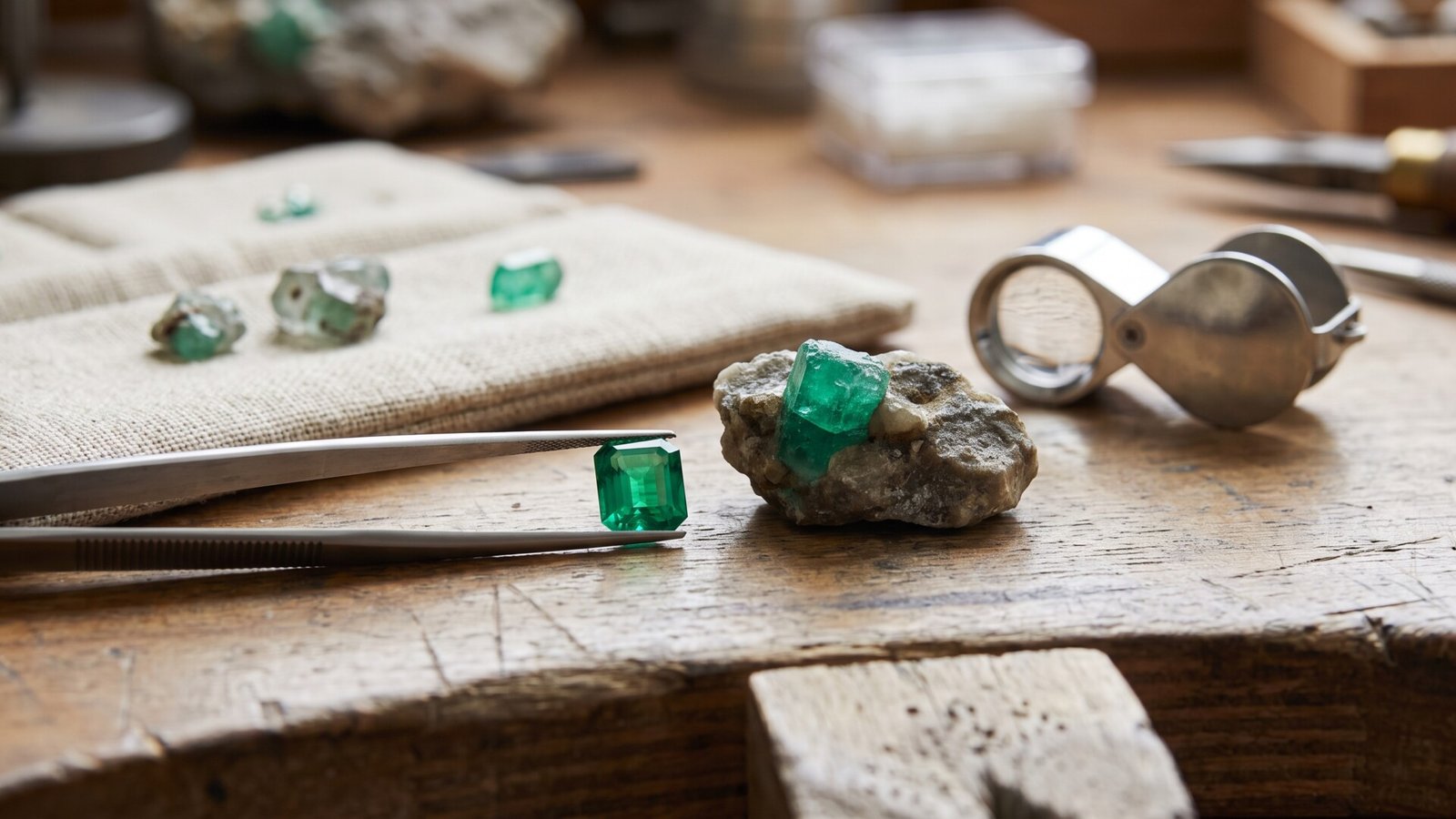
- Traceability: the ability to follow a stone from mine to market through certificates, digital records, or physical markers. It helps reduce fraud and makes claims checkable.
- Fair labor practices: safe conditions, fair pay, and no child labor. Standards such as Fairmined (for gold) and the Responsible Jewellery Council address these.
- Environmental stewardship: water management, waste handling, land rehabilitation, and biodiversity protection.
- Community investment: taxes, local employment, and projects such as schools, health care, and agriculture.
- Responsible cutting and manufacturing: the supply chain does not end at the mine. Recycled or Fairmined metals and accountable workshops matter as much as the stone.
Why transparency matters
When a brand can tell you where a gemstone came from, how it was extracted, and who handled it, you can judge the claim for yourself. The Responsible Jewellery Council’s Code of Practices is an industry standard for responsible business from mine to retail, covering diamonds, colored gemstones, and precious metals, and certification involves independent third-party audits. It is a useful benchmark, though a certificate for a company is not the same as proof about a specific stone. Our guide to buying ethical diamonds covers the same audit concepts, and our Ethical Gemstone Guide goes broader.
The Evolution of Sustainable Emerald Jewelry
Colombia, home of the Muzo and Chivor mining districts, has long been the benchmark source for fine emerald, and its reputation has had to recover from decades of violence and informal trade. Zambia has become a major producer, and its largest operation, the Kagem mine, is operated by Gemfields in partnership with the Zambian government. Brazil, Ethiopia, and Afghanistan also produce emeralds, with very different levels of oversight.
Buyers are now more likely to ask about recycled metals, lab-grown alternatives, and traceable supply chains, and some houses have responded with documentation and public reporting. Our overview of gemstone jewelry brands that give back shows how widespread that shift has become.
How We Chose These Brands
We looked at five criteria, based on what each company publishes:
- Supply chain transparency: can they trace emeralds from mine to market?
- Mining partnerships: do they work with, or run, responsible mining operations?
- Sustainability reporting: do they publish reports on environmental and social impact?
- Third-party standards: RJC, Fairmined, ISO, or comparable independent verification.
- Product quality: the emeralds and settings meet the standard expected at their price level.
This is an editorial selection, not a laboratory audit. We have not visited these companies or tested their stones, and the claims below are attributed to the companies themselves. For a second perspective, see our companion piece, Top 5 Ethically Sourced Emerald Brands: Sustainable Luxury Review.
The Top 5 Brands for Ethically Sourced Emerald Jewelry
1. Chopard
Why it made the list: a long-running sustainability program and a high-jewelry collection built around a single traceable Zambian emerald.
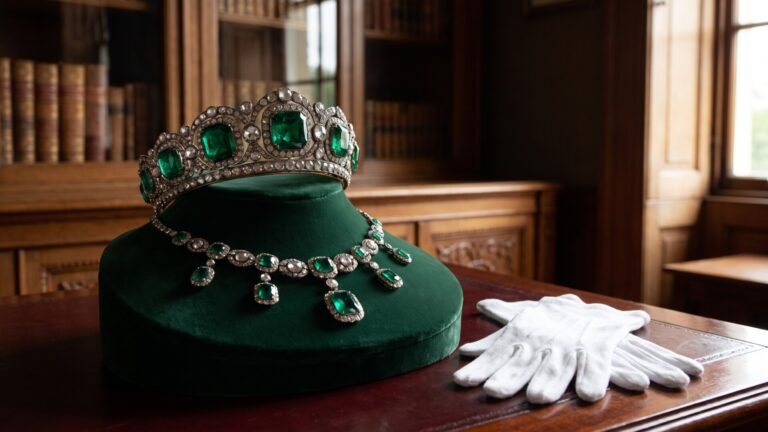
Chopard launched its “Journey to Sustainable Luxury” program in 2013 and announced in 2018 that it would use only ethically sourced gold, with Fairmined gold from artisanal mines among its sources. Its emerald statement is the Insofu collection, 15 high-jewelry pieces unveiled in 2025 and cut from a 6,225-carat rough emerald found at the Kagem mine in Zambia. “Insofu” is the Bemba word for elephant, a nod to the rough crystal’s trunk-like shape. Chopard has said the emeralds taken from the rough total about 850 carats.
Sustainability highlights:
- Ethical gold: Chopard says all gold in its collections has been ethically sourced since 2018.
- DNA-based traceability: working with Gübelin Gem Lab, nanoparticles are placed in the stones’ natural fissures so the origin can be verified later, an approach Gübelin calls the Emerald Paternity Test.
- Conservation: Chopard has said a portion of proceeds from the collection supports conservation efforts.
Best for: high-jewelry buyers and collectors. These are one-of-a-kind pieces sold through the house, and pricing is by inquiry, so we do not quote a range.
Explore Chopard emerald pieces at authorized retailers.
2. Muzo Emerald Colombia
Why it made the list: a direct link to the Muzo mining region and a certificate system that documents a stone’s journey from rough to polished.
Muzo is associated with one of the world’s most historic emerald sources. Rather than buying only on the open market, the company controls extraction and sales of its own production, which gives it unusual oversight of its supply chain.
What the company says: Muzo states that it has held ISO 9001 quality-management certification from Bureau Veritas since 2018, and describes itself as the first and only Colombian emerald producer with that certification. Each Muzo emerald comes with a unique certificate documenting its path from extraction to final cut and polish, which Muzo says aligns with Responsible Jewellery Council standards. In October 2025 Muzo announced an online search on its website that lets buyers check the authenticity and provenance of stones covered by recent certificates and auction records. These are company statements; ISO 9001 certifies a quality-management system, not ethical outcomes on its own.
Best for: emerald purists who want a Colombian stone with documented provenance. Prices vary enormously with size, color, and clarity, so compare against our guide to birthstone price per carat.
Browse Muzo emerald jewelry at select luxury retailers.
3. Brilliant Earth
Why it made the list: an established ethical-jewelry retailer with public impact reporting and a broad range of emerald engagement rings and jewelry.
Founded in 2005, Brilliant Earth positions itself around responsibly sourced gemstones and recycled precious metals and publishes mission and impact reports. It sells natural and lab-grown emerald options, so read each listing carefully to see which you are buying.
Sustainability highlights (company claims, verify on its current pages):
- Climate targets: the company reports setting science-based emissions targets.
- Metals: it emphasizes recycled and responsibly sourced precious metals.
- Choice of origin type: natural and lab-grown stones are both offered, with different environmental profiles.
Best for: engagement-ring shoppers who want a large selection, online customization, and published sustainability reporting. Ask for the specific stone’s origin, treatment, and return terms before you buy.
Shop Brilliant Earth’s emerald collection [affiliate link placeholder].
4. Gemfields
Why it made the list: as the operator of the Kagem mine in Zambia, Gemfields influences how a large share of the world’s emeralds are mined and sold.
Gemfields owns 75 percent of the Kagem emerald mine, with the Zambian government holding the remaining 25 percent. GIA describes Kagem as now considered the world’s single largest emerald mine. Gemfields sells rough stones by auction to manufacturers and brands rather than to consumers, which is why you will see its emeralds in other companies’ jewelry, including in collections such as Chopard’s.
What the company says: Gemfields describes responsible mining as having published policies, a transparent auction sales process, an active role in industry working groups, and community investment, including farming cooperatives intended to provide alternatives to illegal mining, plus charitable work through the Gemfields Foundation in health, education, and conservation. Check its latest sustainability reports for current figures.
Best for: buyers who care about mine-level transparency. Because Gemfields does not sell retail, ask a jeweler whether a stone is documented as Gemfields or Kagem origin.
Look for “Gemfields emeralds” in the supply chains of other luxury brands.
5. Bario Neal
Why it made the list: an independent ethical jeweler that publishes its sourcing approach and makes much of its jewelry in-house or with American makers.
Bario Neal says its metals are 100 percent recycled or Fairmined, that it was among the first jewelry companies to take part in the Fairmined Assurance label, and that its colored gemstones are fully traceable. On its ethics page the company says its emeralds come from a mine in Zambia whose supplier upholds environmental and ethical commitments. It publishes a sustainability report and offers a service for remaking older family jewelry with ethically sourced materials.
Best for: contemporary design lovers and sustainability-focused shoppers who value artisan craftsmanship and a smaller brand. Confirm current emerald availability, since boutique inventory changes.
Shop Bario Neal’s ethical emerald designs [affiliate link placeholder].
Brand Comparison Table
| Brand | Traceability approach | Sustainability focus | Type | Best for |
|---|---|---|---|---|
| Chopard | Gübelin DNA nanoparticle marking on Insofu emeralds | Ethical gold program, conservation giving | High jewelry | Collectors |
| Muzo Emerald Colombia | Stone certificates, ISO 9001, online verification | Control of its own mining and sales | Mine-owned brand | Colombian emerald purists |
| Brilliant Earth | Impact and mission reporting | Recycled metals, climate targets | Online retailer | Engagement rings |
| Gemfields | Auction transparency, mine-level reporting | Community and conservation programs | Mine operator (B2B) | Origin-focused buyers |
| Bario Neal | Traceable colored gemstones, in-house making | Recycled and Fairmined metals | Independent jeweler | Design-led, eco-conscious shoppers |
Colombian vs. Zambian Emeralds
Colombian emeralds are prized for a distinctive vivid green and a long history, and the country has a few well-documented producers such as Muzo. The supply chain beyond those names can be complex, so buyers should verify the origin of the specific stone rather than assume it.
Zambian emeralds tend toward a slightly bluish, deeper green, and the country’s industrial-scale operations such as Kagem offer formal oversight and government partnership. Smaller artisanal workings may have less oversight.
| Factor | Colombia | Zambia |
|---|---|---|
| Reputation | Benchmark for fine color and historic provenance | Major, growing supplier |
| Documented producers | Muzo, others | Gemfields (Kagem) |
| Oversight varies by | Specific mine and seller | Specific mine and seller |
| What to ask | Certificate of origin and treatment level | Certificate of origin and treatment level |
Neither country is automatically more ethical. Judge the specific producer and seller.
Emerald Basics Every Ethical Buyer Should Know
Ethics is only one part of buying an emerald well. The stone itself has quirks that affect value and care.
| Property | Emerald facts |
|---|---|
| Mineral | Beryl, colored green by chromium and sometimes vanadium |
| Mohs hardness | 7.5 to 8 |
| Toughness | Brittle; natural inclusions (called jardin) make chipping and cracking more likely than the hardness number suggests |
| Common treatment | Clarity enhancement with oil or resin is routine and should be disclosed |
| Care | Avoid ultrasonic and steam cleaners; use mild soap, lukewarm water, and a soft brush |
| Best jewelry types | Pendants and earrings, or rings in protective settings such as bezels |
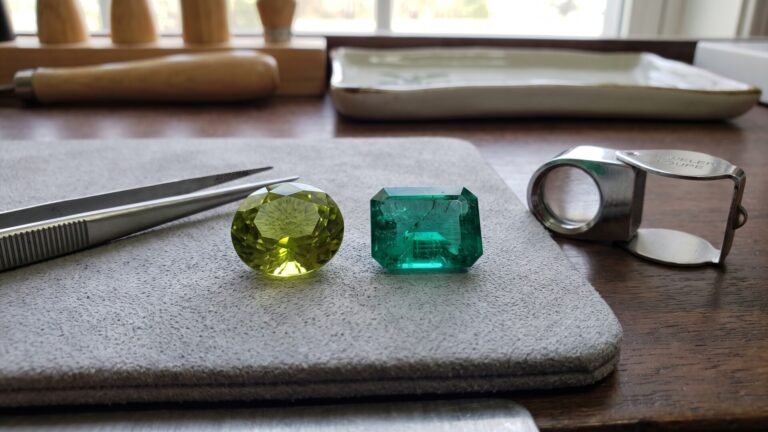
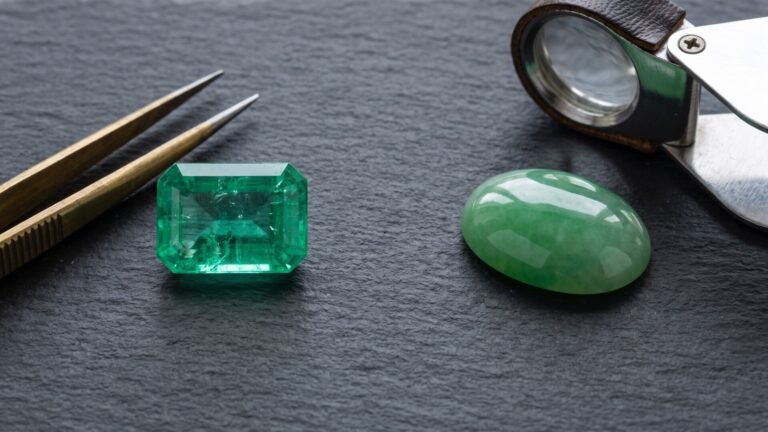
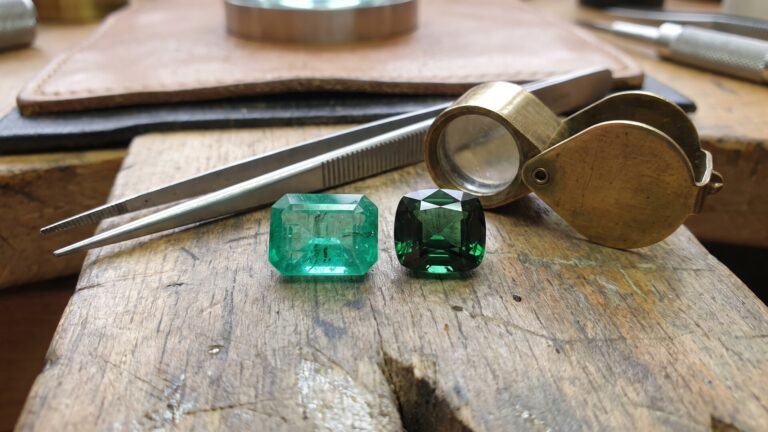
If you are comparing options for durability, our guides to emerald vs green tourmaline and emerald vs jade explain the trade-offs, and our peridot vs emerald comparison covers a budget alternative. For the meaning behind the stone, read about emerald meaning and symbolism.
Natural vs Lab-Grown Emerald
Lab-grown emeralds have the same chemistry and crystal structure as natural ones, grown under controlled conditions rather than mined. They avoid mining impacts and tend to be cleaner and cheaper, but they use energy and do not carry the geological rarity or provenance of natural stones. A simulant is something else entirely: a glass or other material that only imitates emerald. Whichever you choose, the seller should label it clearly. Our guide to natural vs lab-grown birthstones walks through how to decide.
Red Flags to Watch for When Buying Emerald Jewelry
- Vague sourcing claims: “ethically sourced” with no documentation is a marketing phrase, not evidence.
- No origin information: if the seller cannot say which country or mine, ask why.
- Missing treatment disclosure: most emeralds are clarity-enhanced. That is acceptable when disclosed, and a problem when it is not.
- No independent report: for valuable stones, ask for a report from a recognized laboratory such as GIA, SSEF, or Gübelin stating species, origin where determinable, and treatment level.
- Unusually low prices: a fine natural emerald is rarely cheap. Rock-bottom prices often indicate glass-filled, synthetic, or misrepresented stones.
- Greenwashing: be wary of green imagery or “eco” language without published standards, audits, or reports.
Questions to Ask Before You Buy
- Which country and mine did this stone come from, and how is that documented?
- What treatment does it have, and is it on an independent laboratory report?
- Is the metal recycled or certified, and by whom?
- Does the company publish a sustainability report I can read?
- What are the return, resizing, and warranty terms?
Is Ethical Emerald Jewelry Worth Paying More For?
Often, though not always. Documented provenance, independent testing, and responsible metals cost money, and a traceable stone from a named producer is usually priced above an anonymous one of similar appearance. We have not verified a specific premium, so treat any percentage you read elsewhere with caution. What you are paying for is the ability to check the claim: peace of mind, verifiable origin, and support for operations that publish what they do. For an engagement ring or heirloom, that documentation is worth prioritizing. For fashion jewelry, you may reasonably balance budget against ethics, for example by choosing a lab-grown stone or a smaller natural one. Provenance can add to a collector’s interest in a stone, but no emerald should be bought for guaranteed resale value.
Final Verdict
- Best for high jewelry: Chopard, for a documented single-stone collection and a long-running sustainability program.
- Best for Colombian provenance: Muzo Emerald Colombia, for its own-mine certificates and online verification.
- Best for engagement rings: Brilliant Earth, for selection and published reporting.
- Best for mine-level transparency: Gemfields, which supplies the trade rather than consumers.
- Best boutique choice: Bario Neal, for artisan design and openly stated metal sourcing.
No single brand is right for everyone, and every claim above should be checked against the company’s current published information. What the best sellers have in common is willingness to answer specific questions with documents rather than slogans.
Frequently Asked Questions About Ethically Sourced Emeralds
Are ethically sourced emeralds more expensive?
Often yes, because traceability, audits, and responsible metals add cost, but the premium varies by seller and we have not verified a standard percentage. Compare stones with similar size, color, clarity, and treatment.
How can I verify an emerald's origin?
Ask for a report from a reputable gemological laboratory such as GIA, SSEF, or Gübelin, or for a producer’s own traceability certificate. Some producers, such as Muzo, offer online verification for stones covered by their certificates.
Are Colombian emeralds more ethical than Zambian emeralds?
Not automatically. Both countries have documented producers and less transparent operations. Check the specific mine or brand rather than relying on the country.
What certifications should ethical jewelry brands provide?
Look for Responsible Jewellery Council certification for the company, Fairmined or recycled certification for gold, and for the emerald itself a laboratory report and a certificate of origin with full treatment disclosure.
Does ethical sourcing affect emerald quality?
Not in itself. Ethical sourcing describes how the stone was obtained, not its color or clarity. Quality still depends on the stone’s color, clarity, cut, and treatment.
Is Brilliant Earth a good choice for emerald engagement rings?
It offers a wide range of emerald rings, both natural and lab-grown, with published sustainability reporting. Ask for the specific stone’s origin and treatment details and read the return policy before buying.
Are emeralds good for engagement rings?
They can be, with care. Emerald is brittle despite its Mohs hardness of 7.5 to 8, so a protective setting and gentle wear help. Our guide on whether an emerald engagement ring is practical covers this in detail.
Are lab-grown emeralds more sustainable than natural emeralds?
They avoid mining impacts and are a lower-cost option, but they use energy and lack the rarity and provenance of natural stones. Both can have a place in an ethical jewelry wardrobe. See our natural vs lab-grown birthstones guide.
Ready to explore ethically sourced emerald jewelry? Browse the collections below.
[Shop Emerald Engagement Rings at Brilliant Earth]
[Explore Bario Neal’s Ethical Collections]
[Learn More About Muzo Emeralds]
[Discover Chopard’s Sustainable Luxury]
[Explore More Ethical Gemstone Guides]