Is an Emerald Engagement Ring Practical?
Is an emerald engagement ring practical? The honest answer is: it can be, if you choose the stone, the setting and your habits with care. Emerald is beautiful and meaningful, but it is also one of the more fragile choices for a ring worn every day. This guide explains what makes emerald different from a diamond or sapphire, what daily wear really involves, what it costs, and which alternatives suit people who love green but want less worry.
A quick note on sources: the gemstone facts below follow the Gemological Institute of America (GIA) and standard gemology references. Traditions and symbolism are labeled as such, and nothing here is financial or medical advice. For the full profile of the stone, see our main guide to emerald meaning, properties, uses and value.
Quick Answer: Emerald Engagement Ring Pros and Cons
| Question | Short answer |
|---|---|
| Is emerald hard enough for a ring? | Emerald is 7.5 to 8 on the Mohs scale, so it resists most everyday scratching, though it is softer than sapphire, ruby and diamond. |
| Is it tough? | No. Emerald is usually full of natural fractures and inclusions, so it can chip or crack from a knock even though it is fairly hard. |
| Can you wear it daily? | Many people do, with a protective setting and some habits (below). It needs more care than a sapphire or diamond. |
| Is it usually treated? | Yes. Most emeralds have fractures filled with oil or resin. This is accepted in the trade when disclosed. |
| Cleaning | Warm soapy water and a soft brush. No ultrasonic or steam cleaners. |
| Best for | Someone who loves the color, works with their hands little, and is happy to take the ring off for rough tasks. |
| Consider something else if | You are hard on your hands, want zero maintenance, or want a stone that stays pristine for decades. |
Understanding Emerald Engagement Rings
What Is an Emerald?
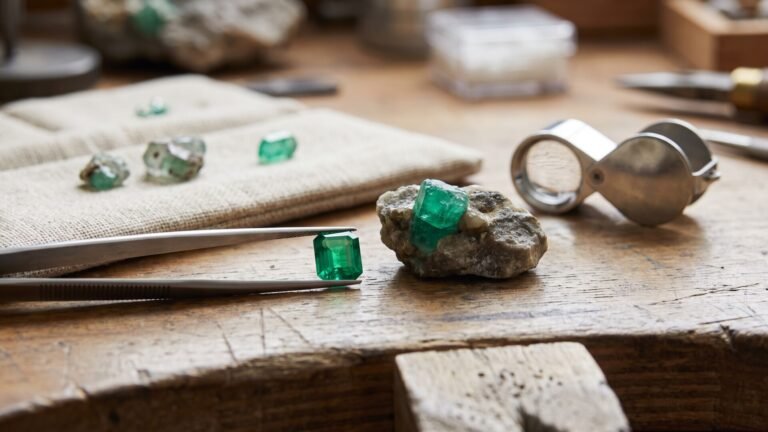
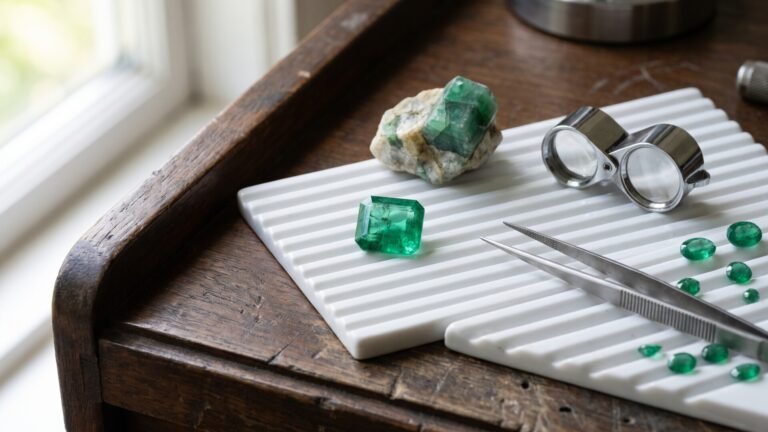
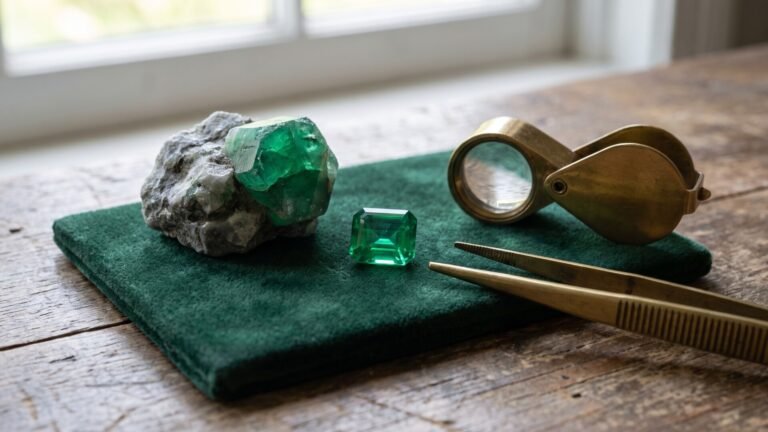
Emerald is the green to bluish green variety of the mineral beryl (the same mineral species as aquamarine and morganite). Its color comes mainly from trace chromium, and in some stones vanadium. GIA notes that experts disagree about how green a beryl must be to be called emerald, and its laboratory compares stones against reference samples to decide. A paler green beryl may be labeled simply green beryl rather than emerald.
Emerald is the traditional May birthstone in the modern list used in the United States. Some anniversary lists also name it for the 20th and 35th wedding anniversaries, so an emerald ring can double as a meaningful gift later on. Lists vary between countries and organizations, so treat these as traditions rather than rules.
Why Emeralds Are Cut the Way They Are
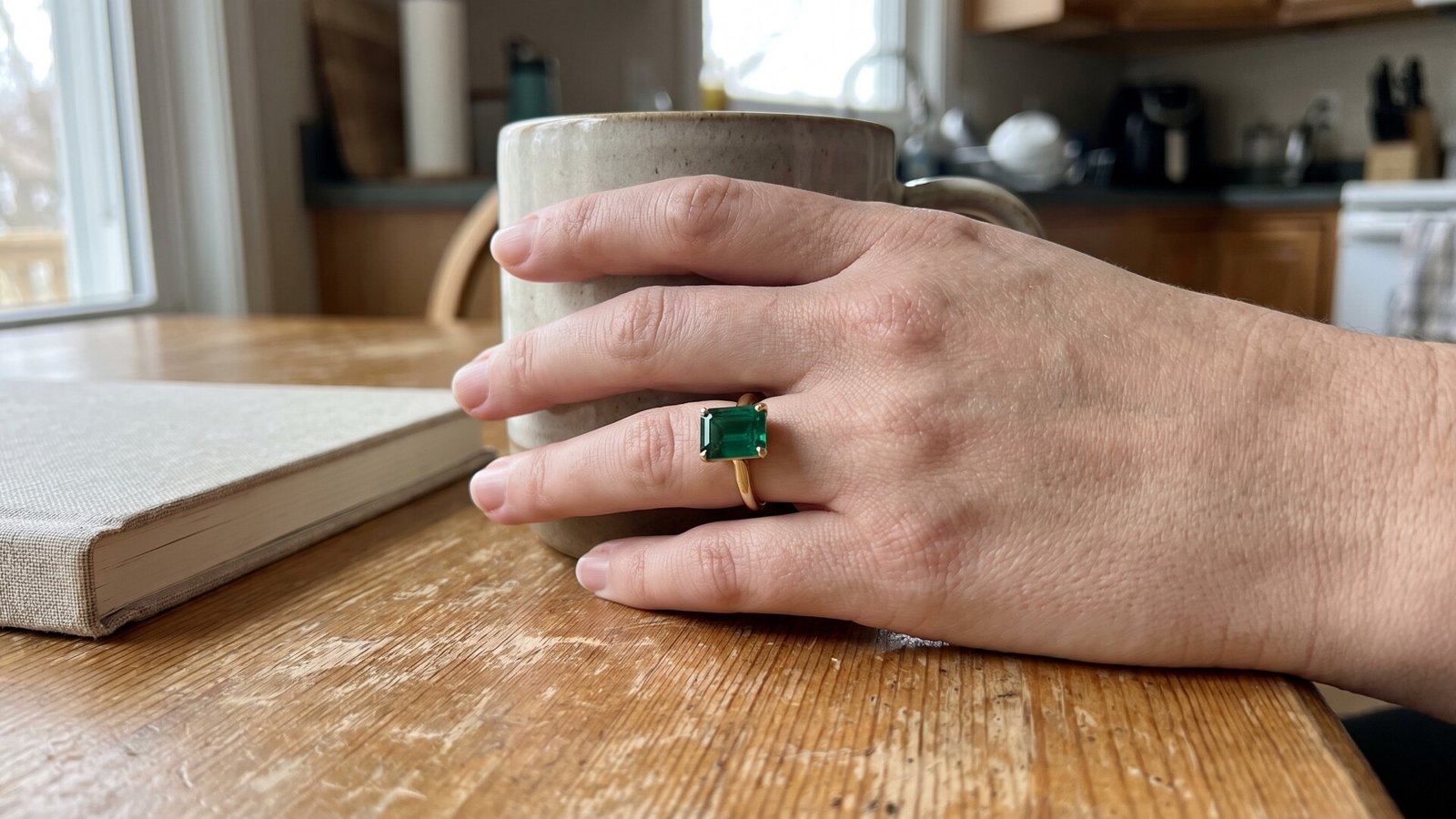
The classic emerald cut is a rectangular step cut with trimmed corners. GIA explains that it follows the shape of the original crystal and, when well done, shows off the color and limits the effect of fractures. Step cuts show clear, mirror-like flashes rather than the sparkle of a brilliant cut, which is why emerald is often described as a stone of color rather than fire. The trimmed corners also take some strain off the places most likely to chip. Ovals, cushions, rounds and pears are all available but have more exposed points or edges, so setting choice matters even more.
Popularity and Style
Colored-stone engagement rings have become far more common as couples look for something personal. Emerald suits vintage-inspired designs, yellow gold and platinum, and three-stone or halo styles with diamonds. Do not confuse an emerald-cut diamond, which is a colorless diamond with that rectangular outline, with a ring set with an actual green emerald. Retail listings use “emerald cut” for both, so read the stone type carefully.
Durability: Hardness Is Not Toughness
How Emerald Compares
| Gem | Mohs hardness | Toughness / weak points | Typical suitability for daily ring |
|---|---|---|---|
| Diamond | 10 | Good, but has cleavage and can chip with a hard blow | Excellent |
| Sapphire / ruby (corundum) | 9 | Very good, no cleavage | Excellent |
| Moissanite | About 9.25 | Very good | Excellent |
| Emerald | 7.5 to 8 | Poor: brittle, fractures and inclusions | Possible with care and protection |
| Tsavorite garnet | About 7 to 7.5 | Good, no cleavage | Good |
| Green tourmaline | 7 to 7.5 | Fair, can be brittle | Good with moderate care |
| Peridot | 6.5 to 7 | Fair, can have cleavage and is sensitive to acids and heat | Better as earrings or pendants |
Hardness describes resistance to scratching. Toughness describes resistance to breaking. Emerald scores well on the first and poorly on the second because of the many internal fractures that form as the crystal grows. A hard knock against a door frame or counter can chip the edge or extend a fracture even though everyday dust (which is largely quartz, about 7) will not scratch it quickly. Our comparison of emerald vs green tourmaline for durability goes deeper on this trade-off.
Treatments and What They Mean for Durability
Most emeralds are fracture-filled. Traditional fillers are colorless oils such as cedar oil, and modern fillers include resins. The filler makes fractures less visible. It does not repair the stone and it is not permanent: oil can dry out or leach over time, and some resins can discolor or be damaged by heat and solvents. GIA reports for emeralds describe the amount of clarity enhancement, and the trade also uses degree terms such as minor or moderate. Untreated emeralds exist and can be confirmed by a laboratory, but they are uncommon and expensive.
- Ask for disclosure in writing: whether the emerald is filled, with what, and to what degree.
- Ask for a lab report from an independent laboratory such as GIA for any significant purchase.
- Avoid heat and harsh chemicals around the stone, including some jeweler procedures (see care below).
Lab-Grown Emerald
Lab-grown emeralds have the same chemical composition and crystal structure as natural ones, so they are real emerald, not simulants. Makers use methods such as flux and hydrothermal growth. They usually have fewer or different-looking inclusions, which can make them somewhat more resilient than a heavily fractured natural stone, though they are not indestructible and are still brittle compared with sapphire. Reputable sellers must disclose that a stone is lab-grown, and independent reports can distinguish the two. A simulant (such as green glass or cubic zirconia) only imitates the look and is a different material entirely. Prices vary widely, so compare similar size and color rather than relying on a general rule of thumb.
Practical Daily Wear Tips
Choose a Protective Setting
| Setting | Protection level | Notes |
|---|---|---|
| Full bezel | High | Metal wraps the edge of the stone, shielding girdle and corners. |
| Partial bezel / half bezel | Medium-high | Good compromise for visibility and protection on the exposed sides. |
| Halo | Medium | Surrounding stones or metal can cushion the sides, but the corners still need care. |
| Prongs with V-tips | Medium | V-shaped prongs guard the corners of an emerald cut; check them regularly for wear. |
| Low, flush profile | Higher | A lower stone is less likely to catch on fabric and hit surfaces. |
| High, thin prongs | Low | Exposes the stone and loosens easily with knocks. |
Lifestyle Questions
- Hands-on work: If you garden, lift weights, climb, cook a lot, or work in a trade or healthcare, plan to remove the ring often, or choose a tougher stone.
- Desk and teaching jobs: An emerald can work well day to day, but keep it away from keyboards’ edges and bag zippers.
- Take it off for: exercise, cleaning, swimming pools and hot tubs (chemicals and heat), applying lotion, perfume or hairspray, and sleeping.
- Sudden temperature changes: Avoid hot-to-cold shocks, which can stress fractures.
- Jeweler work: Tell any jeweler it is an emerald before resizing or retipping. Heat, ultrasonic cleaning and steam can damage filled stones.
Many people wear emerald rings for years; others chip them quickly. The difference usually comes down to setting design, how the ring is worn, and how heavily fractured the stone was to begin with. A stone with fractures that reach the surface is a bigger risk than a cleaner one.
Care and Maintenance
How to Clean an Emerald Ring
- Fill a small bowl with lukewarm water and a few drops of mild dish soap.
- Soak briefly (a few minutes at most) to loosen dirt. Do not leave the ring soaking for hours, since prolonged soaking may affect filler.
- Gently brush with a soft toothbrush, concentrating on the underside of the stone.
- Rinse in lukewarm water, then pat dry with a soft lint-free cloth.
Do not use ultrasonic or steam cleaners, and avoid household chemicals, bleach, acetone and ammonia-based jewelry dips. These can dislodge or dissolve filler and aggravate fractures. Use a bowl, not an open drain.
Check-ups and Insurance
Have a jeweler inspect the prongs and the stone every six to twelve months, especially if you wear it daily. They can tighten prongs, spot early chips and, if needed, refill fractures. Whether re-filling is needed depends on the stone and the filler. Insuring an engagement ring through a jewelry or home policy is common practice, and a recent appraisal helps document the stone as an emerald, its treatment, and its weight.
Value, Quality Factors and Price Expectations
What Affects the Price of an Emerald
- Color: The main driver. GIA identifies bluish green to pure green with vivid saturation and a medium to medium-dark tone as the most desirable. Pale, grayish or very yellowish stones are worth less.
- Clarity: Almost all emeralds contain inclusions, often called jardin (French for garden). The trade accepts this, and eye-clean stones are rare and priced accordingly. Fractures that reach the surface affect both durability and value.
- Cut: A good cut balances color, shape and protection of vulnerable areas.
- Carat weight: At equal quality, price per carat climbs sharply as size increases.
- Treatment: Heavier fracture filling lowers value compared with a lightly treated or untreated stone of similar appearance.
- Origin: Colombia (for example the Muzo, Chivor and Coscuez mines), Zambia, Brazil and Afghanistan are among the known sources. A laboratory origin opinion can add to the value of exceptional stones, but origin should never be assumed without documentation.
Price Ranges
Emerald pricing is not standardized like the diamond 4Cs. GIA states that emerald value can range from a few dollars to tens or even hundreds of thousands of dollars per carat depending on quality. For ring shoppers, that means:
| Segment | Typical per-carat pricing (USD) | What to expect |
|---|---|---|
| Entry-level / commercial | Roughly tens to a few hundred USD per carat | Paler or more included stones, often heavily filled or lab-grown. |
| Mid-range | Roughly several hundred to a few thousand USD per carat | Better color, moderate clarity enhancement. |
| Fine quality | Several thousand USD per carat and up | Vivid color and good transparency; documented treatment and sometimes origin reports. |
These brackets are indicative only. Retailers set prices differently, and finished ring price depends on metal, setting and any side stones. Compare at least a few reputable sellers, and make sure two quotes describe the same weight, color and treatment before comparing them.
One caution: a deep green stone at a very low price is more likely to be heavily treated, dyed, lab-grown, or not emerald at all. If you cannot verify what it is, treat the low price as a warning rather than a bargain.
Resale and Investment
An engagement ring is a purchase to wear and cherish, not an investment. Resale markets for colored stones are less developed than for diamonds, and retail buyers generally receive less than they paid when selling. We do not offer financial advice, and we would suggest buying an emerald only because you love it.
Alternatives If You Love Green but Want More Durability
| Alternative | Why consider it | Trade-off |
|---|---|---|
| Green sapphire | Corundum, Mohs 9, tough and no cleavage | Often more yellow-green or teal than emerald; commonly heat-treated |
| Tsavorite garnet | A vivid green grossular garnet with good toughness | Rarely found in large sizes; price rises quickly for fine stones |
| Green tourmaline | Wide range of greens and available at lower prices | Less saturated than fine emerald; more brittle than sapphire |
| Lab-grown emerald | Same material as natural emerald, usually cleaner | Still brittle; check disclosure and independent reports |
| Moissanite (colorless) | Very durable, diamond-like fire | Not green; a different look entirely |
| Peridot | Fresh yellow-green | Softer, better for earrings or pendants than a daily ring |
Our comparisons of peridot vs emerald and emerald vs jade can help if you are still deciding between green stones.
Emerald vs Diamond: Side by Side
| Factor | Emerald | Diamond |
|---|---|---|
| Mineral | Beryl (green variety) | Carbon |
| Mohs hardness | 7.5 to 8 | 10 |
| Toughness | Poor; brittle with natural fractures | Good, though it can still chip along cleavage |
| Typical treatment | Oil or resin fracture filling is common | Usually untreated (some are laser drilled or fracture filled) |
| Grading | No single universal scale; labs describe color, clarity and treatment | Standardized 4Cs (GIA) |
| Appearance | Deep color, soft glow, visible inclusions accepted | Colorless brilliance and fire |
| Care | Gentle cleaning only; no ultrasonic or steam | More tolerant; many diamonds tolerate ultrasonic but check the setting |
| Maintenance | Regular checks and possible re-filling | Occasional prong checks |
Understanding Lab Reports and Disclosure
A laboratory report is the best way to confirm what you are buying. For emeralds, a good report identifies the stone as natural or lab-grown, states its weight and measurements, and describes the clarity enhancement found. GIA says it quantifies the amount of filler rather than naming the filler material. Some laboratories also offer an origin opinion for an extra fee, which matters mostly for larger, finer stones.
- Natural or lab-grown? It should be stated clearly.
- Treatment: look for “none” or a stated degree of clarity enhancement.
- Weight and dimensions: compare with what the seller advertises.
- Origin: if the seller claims Colombian, Zambian or another source, ask to see documentation, not just a description.
If a seller cannot or will not answer these questions, that alone is a reason to look elsewhere. Written descriptions on the receipt matter too, since they support insurance claims and resale or trade-in discussions later.
Common Mistakes to Avoid
- Assuming hardness 7.5 to 8 means the stone is as safe as sapphire.
- Buying on color photos alone; emerald can look very different in daylight, indoors, and under store lighting.
- Choosing a very large stone with a thin, high setting.
- Cleaning with an ultrasonic machine at a mall kiosk. Always ask staff to skip it.
- Skipping insurance and the appraisal.
- Paying an origin premium without paperwork.
- Trusting “AAA” or similar letter grades: these are marketing terms, not a standard used by gemological laboratories.
Buying Checklist
- Ask whether the stone is natural or lab-grown, and get it in writing.
- Ask about treatment type and degree, and request a laboratory report for important stones.
- Look at the stone in daylight and indoor light; emerald color can change noticeably.
- Inspect the setting for sturdy prongs or bezel and a smooth finish where fabric might catch.
- Check the return, resizing and repair policy; ask whether the jeweler is comfortable working with emeralds.
- Keep the paperwork for insurance and future repairs.
If ethical sourcing matters to you, read our guides to ethically sourced emeralds and the top ethically sourced emerald brands. Words such as “conflict-free” or “ethically sourced” should be tied to a specific policy or standard; ask the seller which one they follow.
Where to Shop
The retailers below are shown as examples of online jewelers offering emerald rings. Selection, policies and availability change, so check current details on each site. Some links on this page may earn us a commission at no extra cost to you, as explained in our affiliate disclosure.
- Affiliate: Blue Nile — An online jeweler with a range of engagement rings. Ask for treatment and certification details on any colored stone.
- Affiliate: Brilliant Earth — Offers natural and lab-grown gemstone options; read their sourcing statements and ask what standards they follow.
- Affiliate: James Allen — Known for detailed stone imaging. Note that Signet announced in March 2026 that James Allen would stop operating as a standalone site and continue as a collection within Blue Nile, so check where the link leads.
Our gemstones hub and the main emerald guide are good next steps for engagement ring styles and care. For the stone’s symbolism, see emerald meaning, and for its royal history, the history of emerald in royal jewelry.
Meaning and Tradition
Emerald has long been associated in tradition with spring, renewal and love. Ancient sources, including stories about Egyptian emerald mines and Cleopatra’s fondness for the stone, are part of its lore, and some cultures link emerald with the planet Venus in astrology. Many couples like the idea of a stone traditionally tied to loyalty and growth. These are beliefs and traditions rather than scientific facts, and they do not mean the stone affects health or relationships; they are not medical advice.
Decision Guide: Is Emerald Right for You?
Instead of a formula, ask yourself these practical questions:
- How do you use your hands? More impact means a tougher stone or a protective bezel.
- Are you comfortable with routine? Removing the ring for chores and checking it twice a year is part of emerald ownership.
- What do you value most? If saturated color matters more than sparkle, emerald wins. If you want carefree wear, sapphire or moissanite fits better.
- What is your total budget? Include setting, insurance and upkeep.
- Do you want a natural origin story? Natural emerald has geological history; lab-grown offers a cleaner stone, often at a different price. Either is a valid choice when clearly disclosed.
A common compromise is to wear the emerald ring most days with a bezel setting and keep a simple band for gym or garden days. Another is to choose an emerald for a right-hand ring or a pendant and a sapphire for a daily engagement ring.
For engagement ring styles and general care, see the emerald guide and the gemstone hub.
Frequently Asked Questions About Emerald Engagement Rings
Is an emerald a good choice for an engagement ring?
It can be, but it needs more care than sapphire or diamond. Emerald is fairly hard (7.5 to 8) but brittle, so a protective setting and careful habits matter.
What is the hardness of emerald compared to diamond?
Emerald is 7.5 to 8 on the Mohs scale and diamond is 10. Hardness is not toughness: emerald is more likely to chip or crack from impact because of natural fractures.
Can I wear an emerald ring every day?
Many people do. Choose a bezel or other protective setting, take the ring off for exercise, cleaning and gardening, and have it checked by a jeweler once or twice a year.
How do I clean an emerald ring safely?
Use lukewarm water, mild soap and a soft brush, then dry with a soft cloth. Avoid ultrasonic cleaners, steam cleaners and harsh chemicals, which can damage filled fractures.
Are emeralds treated?
Most are. Fracture filling with oil or resin is common and accepted when disclosed. Ask for a lab report that states the treatment and its degree.
Are emerald engagement rings more expensive than diamond rings?
It depends on quality and size. Emerald pricing is not standardized: GIA says values range from a few dollars to hundreds of thousands of dollars per carat. Compare similar stones and sellers.
Is a lab-grown emerald real?
Yes. It has the same chemistry and crystal structure as natural emerald. It should be disclosed as lab-grown, and it differs from a simulant, which only imitates emerald.
What are good alternatives to emerald for a green engagement ring?
Green sapphire, tsavorite garnet and green tourmaline are tougher options. Lab-grown emerald offers the same material, often with fewer inclusions. See the comparison table above.
What setting is best for an emerald ring?
A full or partial bezel gives the most protection. V-shaped prongs help protect the corners of an emerald cut.
Is an emerald ring a good investment?
We do not recommend buying one as an investment. Resale values vary and are usually lower than retail prices, so buy it because you love it.