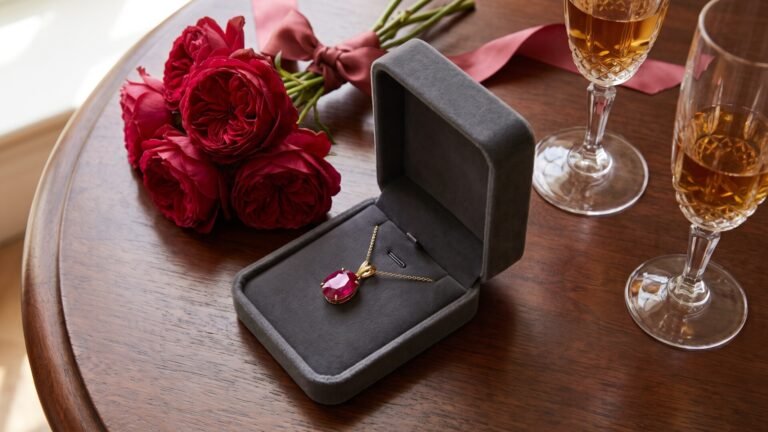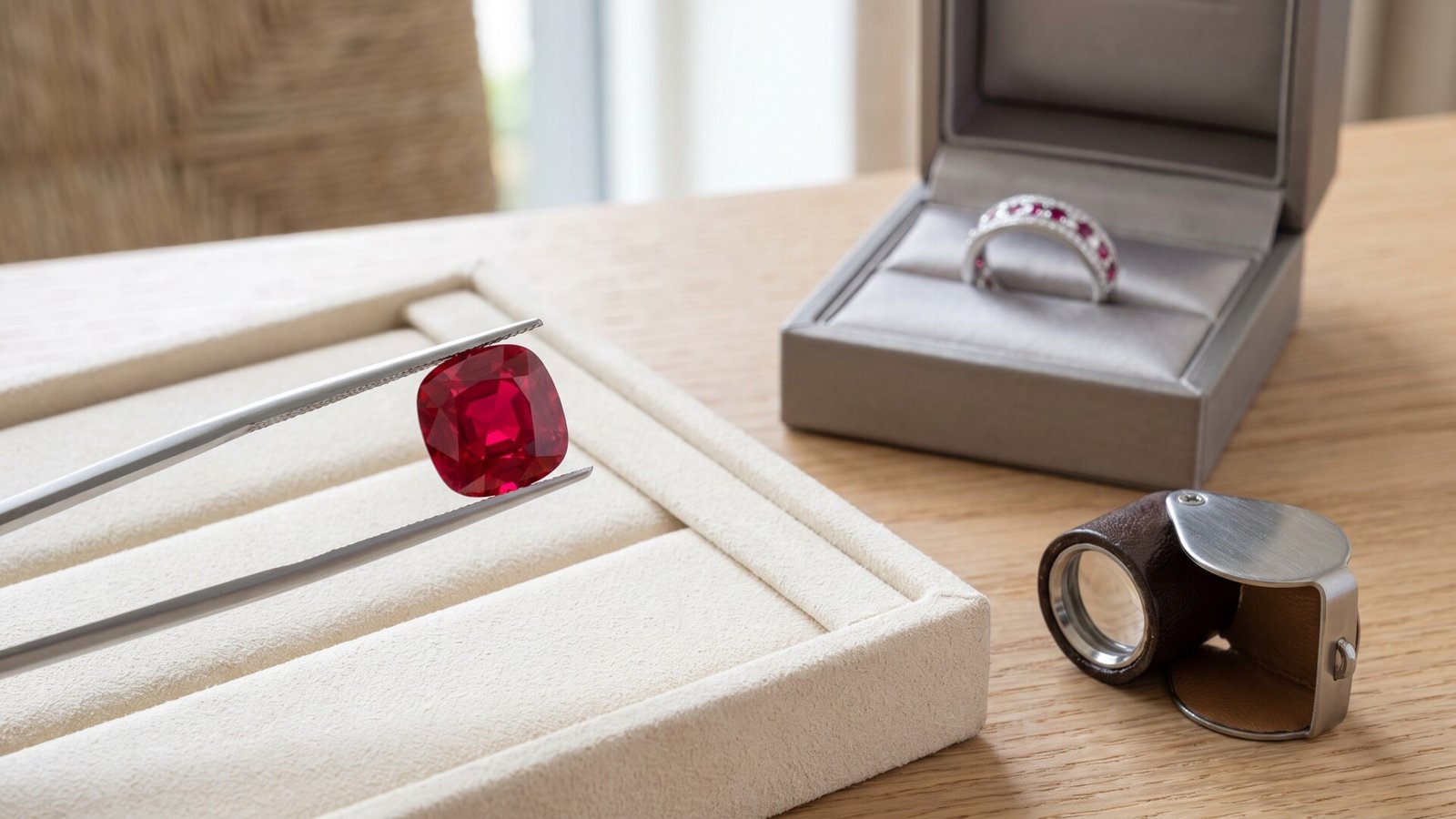
The 40th Anniversary Ruby Guide: Buying the Perfect Red Stone
The ruby is the traditional gemstone for a 40th wedding anniversary, and it is easy to see why people choose it: a deep red stone for a long marriage. But ruby is also one of the most heavily treated colored gemstones, and quality varies enormously, so it pays to know what you are looking at before you buy. This guide covers what a ruby actually is, how to judge one, which treatments are routine and which are a warning sign, what to ask a jeweler, and how to care for the finished piece. Where something is tradition or belief rather than gemology, I have said so.
Some of the older versions of this page were written in a very personal voice. Please treat everything below as general buying guidance based on gemological references rather than personal experience, and always confirm the details of any specific stone with the seller and a laboratory report.
Ruby at a Glance
| Property | Ruby |
|---|---|
| Mineral | Corundum (aluminum oxide); ruby is the red variety, and every other color of corundum is called sapphire |
| Cause of color | Trace chromium. More chromium generally means a stronger red, and chromium also makes many rubies glow red under UV light and sunlight |
| Mohs hardness | 9, so it resists scratching well. Only diamond (10) and a few rare materials are harder |
| Toughness | Good in a clean, unfilled stone, but fractures and fillings reduce it. Corundum has no true cleavage, though it can break along weak planes called parting |
| Common treatments | Heat (very common), lead-glass filling of fractures, and in some cases diffusion treatment |
| Lab-grown version | Widely available, with the same chemistry and structure as natural ruby |
| Anniversary | 40th wedding anniversary in the traditional lists; ruby is also a July birthstone in the modern list |
For more on the stone itself, see our main page on ruby: meaning, properties, uses and value.
Why Ruby for a 40th Anniversary?
Anniversary stone lists are a mix of old custom and relatively modern convention, and they differ between countries and publishers. Ruby is the stone most commonly given for the 40th year in the traditional lists, which is why it appears in most gift guides. You can read more about the tradition in our ruby anniversary significance and gift guide and our 40th anniversary gift guide.
History and tradition
Ruby has a long cultural history. In Sanskrit it is called ratnaraj, often translated as the king of gems. Traditional accounts from Burma (now Myanmar) say that ruby was believed to protect its wearer, and there are stories of warriors wearing the stones for protection; these are folklore, not documented fact. Some English Bible translations also mention rubies as a measure of great value, for example in Proverbs, although scholars are not certain which gem the original Hebrew word meant. In Europe, rubies were associated with royalty and passion for centuries, and the red color made them a natural symbol of love and the heart.
Those associations are the reason the stone feels right for a long marriage. They are symbolism, not a property of the mineral. If you want to explore the meanings in more depth, see Ruby Meaning: history, symbolism, spiritual properties and modern uses and the symbolism of ruby in ancient India. Compared with other stones in the anniversary lists, ruby is usually described as the stone of passion and devotion, while diamond is linked to lasting strength. These are cultural readings, and plenty of couples simply choose ruby because they love red.
A note on beliefs: some crystal-healing traditions say ruby boosts vitality or courage. These are beliefs, not medical advice, and no gemstone treats or cures any condition.
How to Judge a Ruby: the 4Cs and Beyond
The four Cs (color, clarity, cut, carat weight) apply to rubies, but they do not carry equal weight, and two more factors, treatment and origin, often affect price as much as any of them.
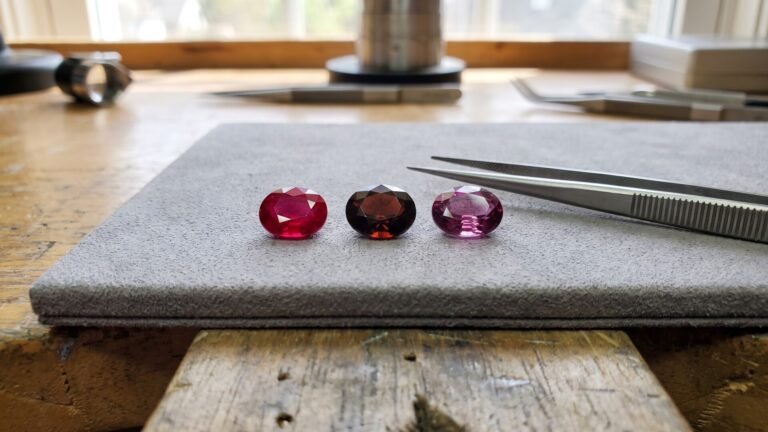
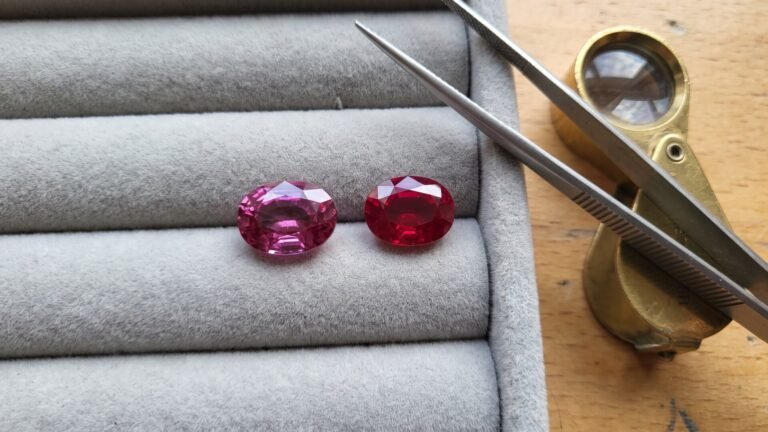
- Color: Color is the main driver of a ruby’s appeal and price. The most sought-after rubies are a vivid, saturated red, often with a slight blue or purple undertone in the trade’s favorite description, sometimes called pigeon’s blood. That phrase is a trade term, not a formal grade, and a lab report will not guarantee it. Rubies can range from orangy red to purplish red; stones that lean pink may be sold as pink sapphire instead, and the dividing line between the two is a matter of lab judgment.
- Clarity: Almost all rubies have inclusions, so expect to see some. Fine needle-like rutile inclusions (called silk) are common and can soften the stone’s look, and they are also one of the clues gemologists use to separate natural from synthetic stones. What matters for a ring is whether inclusions are visible to the eye, and whether they run to the surface as fractures that weaken the stone.
- Cut: Rubies are often cut to keep as much weight as possible from the rough, so proportions are not always ideal. A good cut shows even color without dark patches or a washed-out window in the middle.
- Carat weight: Fine ruby gets expensive quickly as size increases, because large, clean, well-colored rubies are uncommon. Stones are priced per carat, and the per-carat price tends to climb as the stone gets bigger.
Quality tiers in plain terms
Ruby prices span an enormous range, and published per-carat figures go out of date quickly and vary by dealer, so I have not listed specific numbers here. The table below shows how the main factors move the price instead. Always get a written quote and compare similar stones with the same treatment and the same lab report.
| Type of ruby | What to expect | Typical use |
|---|---|---|
| Glass-filled or composite | Lowest price per carat. Fractures are filled, so the stone is more fragile and needs careful handling | Occasional-wear pieces; buy only if the seller states the filling clearly |
| Heat-treated, unfilled | The bulk of the market. Good durability and color for the price | Everyday and occasional jewelry |
| Heat-treated, fine color and clarity | Higher price, noticeably more vivid and cleaner | Anniversary rings and pendants |
| Unheated (no heat treatment) | Much rarer and priced at a clear premium for comparable appearance; requires a lab report to prove | Special pieces for buyers who value natural, untreated stones |
Because rubies are so variable, a smaller stone with strong, even color usually looks better than a larger, dull or heavily included one. If you are choosing between size and color, put color first.
Ruby Treatments: What Is Normal and What to Avoid
The Gemological Institute of America (GIA) and other laboratories treat heat treatment as a long-established practice for ruby, and most rubies on the market have been heated. Heat can improve color and clarity, and the result is generally stable. It is accepted in the trade as long as it is disclosed, but a heated stone should cost less than a comparable unheated one. For a closer look at how labs tell the difference, read how to tell if a ruby is heat treated or natural.
| Treatment | What it does | What it means for you |
|---|---|---|
| Heat | Improves color and clarity; can melt away silk | Common and stable. Must be disclosed. Price lower than comparable unheated stones |
| Lead-glass filling | Glass fills surface-reaching fractures to improve transparency | Much more fragile. Can be damaged by acids, household cleaners, and the heat of jewelry repair. Value is low, and the stone is not the best choice for a daily-wear ring |
| Flux healing | Heat with a flux that partly heals fractures | Should be disclosed by the lab; ask for the details in the report |
| Diffusion | Chemicals diffused into the surface to alter color | Color may be shallow; this is less common in ruby and should be disclosed |
| Dyeing or coating | Surface color added | Not acceptable without disclosure; a red flag |
A very low price for a large, vivid ruby is most often explained by glass filling, or by the stone being a different gem altogether. If the seller cannot tell you the treatment in writing, move on.
Natural, Lab-Grown, and Look-Alike Rubies
These three terms are often mixed up, so here they are separately:
- Natural ruby: formed in the earth and mined. It may be heated or otherwise treated.
- Lab-grown (synthetic) ruby: real ruby, made in a laboratory with the same chemistry, crystal structure, and hardness as natural ruby. It is not fake. Laboratory-grown stones should be sold as lab-grown or synthetic, and they generally cost a small fraction of a natural stone of similar appearance. Lab-grown rubies suit buyers on a budget or who prefer a man-made source, but they are not rare in the way natural stones are, so do not buy one expecting it to be a rare natural gem.
- Simulant: a different material that only looks like ruby, such as red glass, red spinel, or garnet. A simulant is not ruby and should not be priced like ruby.
Origin and Ethical Sourcing
Rubies from certain regions, especially Myanmar, have a long reputation and often attract higher prices. Origin (such as Burmese or Mozambican) can only be established by a gemological laboratory, which compares the stone’s inclusions and trace elements with known sources, and even then it is an opinion rather than a certainty. A seller’s say-so is not documentation, so treat any origin claim without a lab report as unconfirmed.
Ethics are a separate question from quality. Reports have linked parts of the gem trade in several ruby-producing regions to conflict, labor, or human-rights concerns, and the situation changes over time, so I cannot say that any one country is simply good or bad. Some governments also restrict imports of Burmese gems, so check the rules in your country. If sourcing matters to you:
- Ask the seller what they can document: the mine or country, the chain of custody, and any standard they follow.
- Treat terms like conflict-free or ethically sourced as claims to verify, not guarantees, and look for the specific standard or audit behind them.
- Consider a lab-grown ruby, an older (estate) piece, or a recycled-metal setting as alternatives.
Certification: What to Ask For
For a ruby of any real value, ask for a report from an independent gemological laboratory. GIA is the best-known name in the United States. Other respected colored-stone laboratories include SSEF, Gubelin, and American Gemological Laboratories (AGL). A good report should state:
- That the stone is natural or synthetic.
- Whether and how it has been treated (heat, filling, diffusion).
- Its weight, measurements, shape, and color description.
- Origin, only if you requested an origin opinion, which usually costs extra.
Small ruby accents in jewelry normally do not come with their own report. In that case, rely on the seller’s written disclosure, a clear return policy, and a reputable retailer. For more depth on higher-end pieces, see the guide to high-end ruby jewelry.
Choosing the Right Ruby Jewelry
Ruby’s hardness makes it a sound choice for daily wear, but how the piece is made and how often it is worn matter just as much as the stone.
| Jewelry type | Suitability | Tips |
|---|---|---|
| Rings | Good, with some care. Hands take knocks, and a ruby’s toughness is lower if it is fracture-filled | Choose a bezel or protective halo setting for daily wear. Avoid glass-filled stones in rings |
| Pendants and necklaces | Excellent. Low impact, so a good option if your partner does not wear rings | Check the bail and chain are strong |
| Earrings (studs, drops) | Excellent. Low risk of knocks | Secure backs on studs; drops suit special occasions |
| Bracelets | Fair. Frequent contact with surfaces | Better for occasional wear |
Popular styles include a solitaire ruby, a ruby with a diamond halo (the diamonds frame the stone and add protection), and three-stone rings, which are often described as standing for past, present, and future. That meaning is a modern design tradition, not an ancient one. Heart-shaped or oval rubies are common for romantic gifts. High-end houses such as Cartier and Van Cleef and Arpels have long included rubies in their collections.
Where to shop
The retailers below offer different styles and approaches. I have not tested their products, and I have not listed prices because they change often; please check each retailer’s current listings, treatment disclosure, and return policy. Their claims about sourcing are the retailers’ own and are worth confirming against the standards they cite.
- James Allen: an online retailer known for high-resolution 360-degree stone videos, which help you inspect the exact stone, and for customizable settings.
- [Explore James Allen Ruby Rings]
- Brilliant Earth: a retailer that publishes sourcing and traceability information for its gemstones and recycled metals. Read the details of its sourcing statements to see what is and is not covered for the stone you choose.
- [Shop Brilliant Earth Ruby Pendants]
- Blue Nile: a long-established online jeweler with a range of classic designs, including earrings and pendants. Check each listing for the stone’s treatment.
- [View Blue Nile Ruby Earrings]
- Etsy: a marketplace where independent makers offer custom and handmade pieces, including settings for a family stone. Quality and disclosure vary by seller, so read reviews, ask about treatment and return terms, and request photos or a report.
- [Discover Handmade Ruby Jewelry on Etsy]
Ruby Alternatives and Look-Alikes
If a natural, certified ruby stretches your budget, there are honest alternatives, each with trade-offs.
| Option | Mohs hardness | Pros | Trade-offs |
|---|---|---|---|
| Lab-grown ruby | 9 | Same material as natural ruby; strong color at a lower price | Not rare; should be labelled lab-grown |
| Red spinel | 8 | Vivid red, often untreated | Not ruby; a different mineral |
| Garnet (such as pyrope or rhodolite) | About 7 to 7.5 | Affordable red; see garnet vs ruby | Softer, lacks ruby’s glow |
| Pink sapphire | 9 | Same mineral as ruby; durable | Pink rather than red |
| Pink or red tourmaline | 7 to 7.5 | Colorful and affordable; see pink tourmaline vs ruby | Brittle edges; less durable |
If you are weighing ruby against blue sapphire, our comparison pigeon blood rubies vs royal blue sapphires shows how the two corundum varieties differ in color and pricing.
Common Mistakes to Avoid
- Buying on price alone: A large ruby at an unusually low price is typically heavily treated, glass-filled, or not ruby at all.
- Confusing hardness with toughness: Mohs 9 means scratch resistance. A ruby with deep fractures, or one filled with glass, can still chip or be damaged.
- Accepting an origin claim without a report: Burmese and similar labels affect price and need a lab opinion.
- Treating a ruby as a financial investment: See the next section.
- Skipping the return policy: Make sure you can return the piece if an independent appraisal disagrees with the description.
A Note on Value and Resale
Exceptional rubies have sold for very large sums at auction. The best-known example is the Sunrise Ruby, a ring set with a 25.59-carat Burmese ruby, which Sotheby’s sold in Geneva in May 2015 for about US$30 million. That is an extraordinary stone, not a guide to what a jewelry-store ruby will fetch. Most retail ruby jewelry sells for much less on resale than it cost new, because retail prices include the maker’s and retailer’s margin. This article does not suggest buying a ruby as a financial investment; buy it because you love it, and treat any resale value as a bonus. If you want to insure the piece, get a written appraisal for insurance purposes.
Caring for Your Ruby Jewelry
A ruby is hard and generally durable, but it is not indestructible, and care depends on whether the stone is treated or filled.
| Method | Untreated or heated ruby (no filling) | Fracture-filled or glass-filled ruby |
|---|---|---|
| Warm soapy water and soft brush | Safe | Safe, and the best option |
| Ultrasonic cleaner | Usually safe if there are no deep fractures; ask your jeweler | Avoid |
| Steam cleaner | Generally safe with caution, but ask your jeweler | Avoid |
| Acids, bleach, jewelry dips | Avoid | Avoid; can damage glass filling |
- Cleaning: Use warm water, mild dish soap, and a soft brush, especially behind the stone where dirt collects. Rinse well and dry with a soft cloth.
- Storage: Keep ruby jewelry in a soft pouch or a compartment of its own. Ruby is harder than most gems and can scratch softer ones, while diamond can scratch ruby.
- Daily wear: Take off a ruby ring for heavy work, gym sessions, and gardening, and before using household cleaners.
- Professional check: Having a jeweler look over prongs and the setting once a year or so is good practice to catch a loose stone early. Tell the jeweler if the ruby is filled, because the heat of repair work can damage it.
How to Choose: a Simple Guide
The right ruby is the one that suits your partner, your budget, and your priorities. This table matches common priorities to the route that usually fits. It is a simple guide, not a scoring system.
| Your priority | Focus on | Where to look |
|---|---|---|
| Personal meaning | A design that fits your partner’s style, perhaps using a family stone | A custom piece from an independent maker, with treatment disclosed |
| Quality you can verify | A stone with a lab report showing treatment | A reputable jeweler or an online retailer that supplies reports |
| Documented sourcing | Written sourcing information and the standard behind it | Retailers that publish sourcing details, or a lab-grown or estate ruby |
| Classic and simple | Good color, solid setting, timeless design | Studs, a solitaire, or a pendant |
| Tight budget | Lab-grown ruby or an alternative gem | Retailers that clearly label lab-grown stones |
A few final practical points. Ask for the treatment in writing, view the stone in daylight as well as indoor light because a ruby’s red glows differently under different lighting, and keep the receipt and any report together with the piece.
Frequently Asked Questions About 40th Anniversary Rubies
How much does a ruby for a 40th anniversary cost?
Ruby prices range from affordable lab-grown or commercial-quality stones in simple settings to very high prices for fine, unheated, certified stones. Because per-carat prices vary widely and change over time, set a budget first, then compare stones with the same treatment and lab report. Lab-grown rubies and alternative gems offer lower-cost routes.
How can I tell if a ruby is genuine?
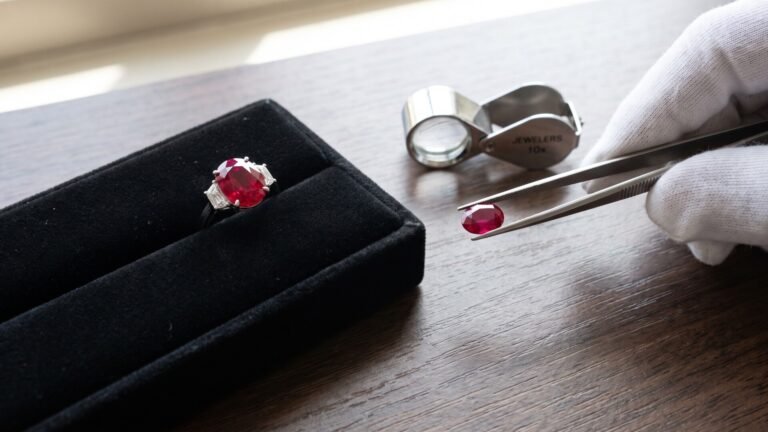
Home tests are unreliable. A jeweler with a loupe can spot clues such as natural inclusions, but the dependable answer is a report from an independent gemological laboratory such as GIA, which states whether the stone is natural or synthetic and discloses treatment.
Is a heat-treated ruby worth buying?
Yes, heat treatment is a long-accepted practice for ruby and is generally stable. It should be disclosed, and a heated ruby should cost less than an unheated stone of similar appearance.
What shapes of rubies are popular for anniversary gifts?
Oval and cushion cuts are common because they show color well. Round, pear, and heart shapes are also popular for pendants and earrings.
Are lab-grown rubies a good alternative?
They are real ruby, with the same chemistry and hardness as natural stones, and usually cost much less. They should be labelled lab-grown. They are not rare, so they are best bought for appearance and budget rather than rarity.
Is a glass-filled ruby safe to wear?
It can be worn with care, but the filling makes it more fragile and sensitive to acids, cleaners, and heat. It is better suited to earrings or pendants than everyday rings, and should not be cleaned in an ultrasonic or steam cleaner.
Should I buy a ruby as an investment?
This site does not recommend buying jewelry as a financial investment. Retail jewelry typically resells for less than its purchase price. Buy a ruby because you love it.
What should I consider when buying ruby jewelry as a gift?
Think about your partner’s style and metal preference, whether they wear rings daily, and your budget. Ask for the treatment in writing, check the return policy, and choose a protective setting for rings.
Forty years together is worth marking, and a well-chosen ruby is a lasting way to do it. Ready to find the perfect symbol of your forty-year journey? [Explore our curated collection of anniversary jewelry] or visit our Gemstones Hub to learn more about the stones that tell your story.
Meanings, symbolism, and properties described on this site are based on cultural traditions and beliefs. They are not medical, financial, or professional advice.