How to tell if a Ruby is heat treated or natural
Almost every ruby you will see for sale has been heated. That is not a scandal: heat treatment is a long-standing, widely accepted practice that improves a ruby’s color and clarity. The real issue is disclosure. A heated ruby and an unheated ruby of similar appearance can differ in price by many multiples, so knowing which one you are buying matters. This guide explains what heat treatment is, what clues point to it, why a gemological lab report is the only reliable answer, and what you should expect to pay.
Short version: you cannot reliably tell by eye, or even with a loupe. Look for honest disclosure, ask for a report from an established lab, and be skeptical of any ruby sold as “untreated” without one. For the full picture of the stone, start with our complete ruby guide, and for more stones see the Gemstones hub.
Understanding Ruby
A Quick Gemological Profile
Ruby is the red variety of corundum (aluminum oxide), the same mineral as sapphire. Its red color comes from trace amounts of chromium. It rates 9 on the Mohs scale and has excellent toughness with no true cleavage, which makes it one of the best colored stones for everyday jewelry. Ruby is the July birthstone on both the modern and traditional lists, and the stone for the 40th wedding anniversary; see our guides to the ruby anniversary and the 40th anniversary ruby.
| Property | Ruby |
|---|---|
| Mineral species | Corundum (aluminum oxide, Al₂O₃) |
| Cause of red color | Trace chromium |
| Hardness (Mohs) | 9 (scratch resistance) |
| Toughness | Excellent; no true cleavage, though some stones show parting |
| Most common treatment | Heating |
| Other treatments seen | Flux-assisted heating, lead-glass filling, dyeing, diffusion |
| Lab-grown version | Yes: same chemistry and structure as natural ruby |
| Common look-alikes | Red spinel, red garnet, rubellite tourmaline, glass |
History and Origin
Rubies have been prized for thousands of years. In Sanskrit literature the ruby is called ratnaraj, “king of gems,” and the Roman writer Pliny the Elder described glowing red gems, which he grouped as carbunculus, in his Natural History. Read more in our article on the symbolism of ruby in ancient India and the ruby meaning guide.
Myanmar (Burma), and especially the Mogok region, is the classic source of fine ruby and the benchmark for the legendary “pigeon’s blood” red. Rubies are also found in Thailand, Sri Lanka, Madagascar, Mozambique, Tanzania, Vietnam and elsewhere. Mozambique has become a major source of rubies in recent years. Origin influences value, but it is a gemological judgment that only a lab can make, so a seller’s claim of origin should be backed by a report.
What Natural Rubies Look Like
Almost all natural rubies contain inclusions: tiny crystals, fine needles of rutile known as silk, and fractures. Those features are not necessarily flaws; they are evidence of how the stone grew, and they are exactly what gemologists study to separate natural from synthetic and treated from untreated stones. A completely clean, untreated natural ruby of good size is extremely rare and priced accordingly.
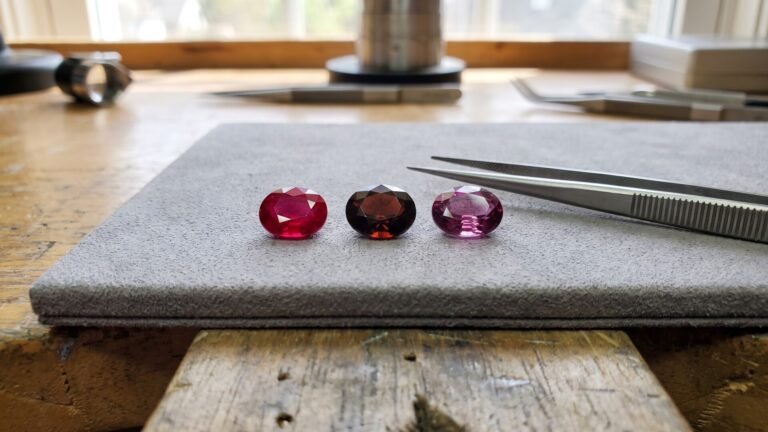
Color is the biggest value factor. The ideal is a vivid red with a slight blue undertone, though top stones often carry secondary hues of purple or orange. Clarity comes next, then cut and carat weight. A pink-red stone may be classified as pink sapphire rather than ruby, depending on color depth; our pink tourmaline vs ruby comparison helps with the red-versus-pink question.
Heat Treatment Explained
What Is Heat Treatment?
Heat treatment means heating a ruby in a furnace under controlled conditions, then cooling it. Conventional heating runs at very high temperatures, around 1,300°C according to GIA, but some rubies are heated at much lower temperatures (discussed below). The aim is to improve appearance. Heat treatment has a long history in the trade, although modern furnaces give much more control over temperature and atmosphere.
Depending on the stone, heating can:
- Dissolve or reduce the fine rutile needles (silk) that can make a ruby look hazy
- Improve color, for example by reducing a purplish tint and strengthening red
- Alter some inclusions and make internal features less visible
A dull or hazy stone can become a clear, vivid red. The result is stable under normal wear, though extreme heat such as a jeweler’s torch during repair can damage a treated stone.
Heat Treatment Is Not the Only Treatment
It is worth separating standard heating from more aggressive enhancements. Some heating uses a flux such as borax that can leave residues in surface-reaching fractures, and some low-quality rubies are fracture-filled with lead glass. Glass-filled rubies are worth much less than heat-treated ones, the filling is not as durable, and it can be damaged by acids, heat and jewelry repair. Always ask a seller whether a ruby has been heated, fracture-filled or glass-filled.
The table below puts the main categories side by side. It is a simplified guide: a lab report describes the specific stone, and the wording differs from lab to lab.
| Category | What was done | Durability | Relative value |
|---|---|---|---|
| Unheated (no indications of heating) | Nothing beyond cutting and polishing | Excellent | Highest for comparable quality |
| Heated only | Heated to improve color and clarity | Excellent; stable in normal wear | Standard market price |
| Heated with flux residues | Heated with a flux that partly heals fractures and can leave glassy residue | Very good; the amount of residue matters | Usually below heat-only stones; more residue lowers value |
| Lead-glass filled (often called composite ruby) | Fractures filled with high-lead glass | Poor to fair; glass can be damaged by heat and acids | Lowest category of natural ruby |
| Diffusion-treated | Color-causing elements (such as beryllium) introduced by heating; more common in sapphire but reported in ruby | Color can be shallow in some types; recutting can remove it | Low; must be disclosed |
| Dyed | Color added to fractures in low-grade material | Poor; dye can fade or leach | Very low |
| Lab-grown (synthetic) | Grown in a laboratory, not mined | Excellent; same material as natural ruby | A fraction of natural prices |
Why Heat Treatment Is So Common
Most rubies that come out of the ground need improvement to reach a salable color and clarity, so the large majority of rubies on the market have been heated. Heating makes attractive rubies available at accessible prices, which is why many jewelers treat it as an accepted part of the supply chain. Untreated rubies of fine quality are rare and carry large premiums. The problem arises only when a heated stone is sold as untreated, or when the buyer is not told.
Low-Temperature Heating: Why Detection Keeps Getting Harder
Not all heating is done at extreme temperatures. Since Mozambique became a major ruby source, labs have studied rubies heated at much lower temperatures to reduce a bluish or purplish tint. In experiments published in 2015, GIA heated Mozambique rubies at roughly 550–750°C, compared with about 1,300°C for conventional heating. Because the changes are subtle, the usual signs of heating can be weak or absent: GIA found that many, though not all, inclusions were affected, and trace-element chemistry did not change in a meaningful way.
Labs can still detect this treatment in many stones by looking closely at inclusions under high magnification (for example, new tension fractures around mica or feldspar crystals) and by infrared spectroscopy (FTIR), which can show small changes in specific absorption peaks. The practical lesson for buyers is simple: if experienced lab gemologists need a microscope and a spectrometer to tell, no one can confirm “unheated” by looking at a stone in a shop window.
Identifying Heat-Treated vs Natural Rubies
Clues a Gemologist Looks For
Honest advice first: visual identification is difficult, and even experienced gemologists often need lab equipment. Some features suggest heating, but none are definitive on their own.
- Altered silk: Unheated rubies often show intact, fine rutile needles. Silk that looks broken up, dotted or partly dissolved can indicate heating.
- Halos around crystals: Small crystal inclusions surrounded by a disc-like halo of fractures (sometimes called tension halos) are a typical sign that a stone has been heated.
- Melted or altered inclusions: Crystals with rounded, glassy or “melted” edges suggest heat exposure.
- Healed or filled fractures: Flux-healed fractures can look like glassy, flowing or fingerprint-like patterns, and gas bubbles in a fracture can signal glass or flux filling.
- Color that looks very even: Some heated rubies are more uniform in color, while many unheated stones show zoning. This is only a hint, because some natural stones are very even.
Treat these as reasons to ask more questions, not as proof. A gemologist can read these features properly under a microscope; a buyer with a loupe cannot.
Professional Assessment: Lab Reports
The only reliable answer comes from a laboratory with the right equipment: microscopes, spectrometers and, for some stones, advanced trace-element analysis. Well-known laboratories for colored stones include:
- GIA (Gemological Institute of America)
- SSEF (Swiss Gemmological Institute)
- Gübelin Gem Lab
- AGL (American Gemological Laboratories)
- GRS (GemResearch Swisslab)
- Lotus Gemology
A report from a reputable lab states whether a ruby is natural or synthetic and whether it shows indications of heating or other treatment. Some reports also comment on origin. Reports use careful wording such as “no indications of heating” or “indications of heating,” because the lab is describing what it can detect. If a seller of a high-value ruby cannot provide a report, be very cautious.
How to Read the Treatment Section of a Ruby Report
Each lab uses its own terminology, so read the report itself rather than a seller’s summary of it. These are the phrases you are most likely to meet and what they generally mean:
- “No indications of heating” / “No indications of thermal treatment”: the lab found no evidence of heating. This is the wording that supports a higher, unheated price.
- “Indications of heating” / “Heated”: the stone has been heat-treated. On its own, this usually describes a standard, stable treatment.
- Heating with residues (some labs grade the amount, using terms such as minor, moderate or significant): the stone was heated and fractures contain foreign material, such as flux residue. Less residue is better; stones with significant residue are priced well below heat-only rubies.
- Lead-glass filled, glass-filled or “composite ruby”: fractures are filled with glass. Some labs and trade bodies treat heavily filled material as a manufactured product rather than a standard ruby, and it should be priced and cared for very differently.
- Origin opinion: some reports add a geographic origin, such as Myanmar or Mozambique. This is an expert opinion, not a certainty, and not every lab offers it.
Check that the weight, measurements and shape on the report match the stone in front of you, and remember that a report describes the stone at the time it was tested. For expensive purchases, many lab websites let you verify the report number online.
What You Can Do at Home
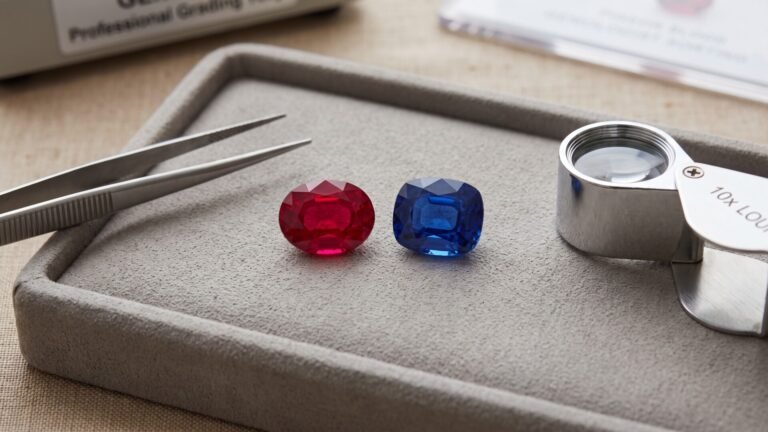
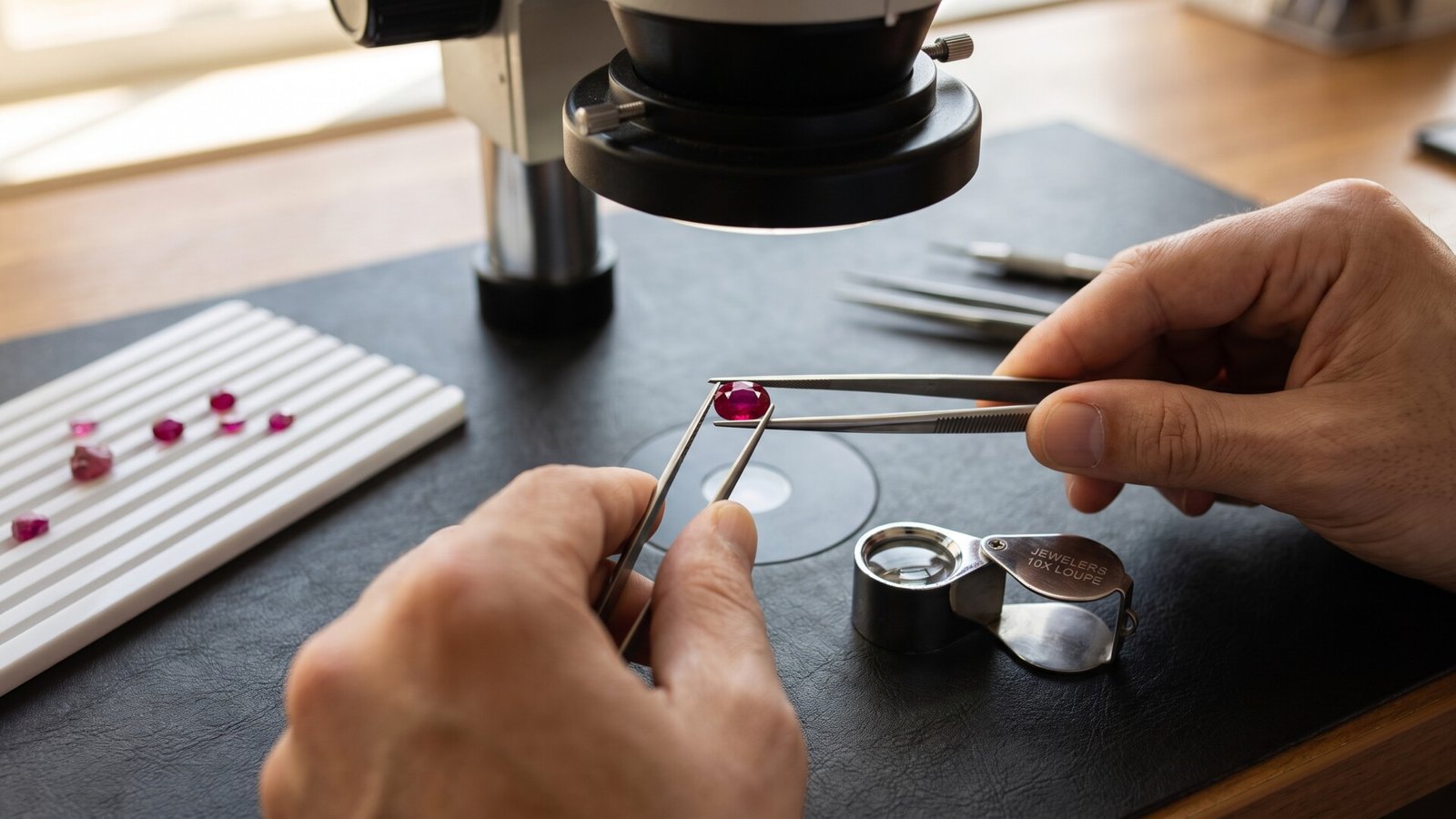
A 10x loupe is useful for spotting obvious problems such as chips, glassy fillings, or bubbles in fractures, and a loupe is a reasonable low-cost tool for anyone who handles gemstones. But it will not give you a definitive treatment answer. Laboratory refractometers, for example, measure refractive index and help identify the stone, but they do not directly detect heating. Use your own checks to raise questions, then rely on a report to settle them.
Natural, Lab-Grown or Imitation? A Different Question
Many people who ask whether a ruby is “natural” actually want to know whether it was mined or made in a lab. That is a separate question from heat treatment. A mined ruby can be heated or unheated; a lab-grown ruby is not “fake,” because it has the same chemistry and crystal structure as natural ruby. An imitation (simulant) is a different material, such as glass or red garnet, that only looks like ruby.
Lab-grown ruby has been produced commercially for more than a century. Common growth methods include:
- Flame fusion (Verneuil): the oldest and cheapest method, developed in the early 1900s. Under magnification these stones can show curved growth lines and round gas bubbles, which natural rubies do not have.
- Flux growth: a slower process that produces stones with inclusions that can look more natural, so they are harder to separate without lab testing.
- Hydrothermal growth: crystals grown from a hot, pressurized solution, again requiring expert identification.
Because ruby and sapphire are the same mineral, the methods for spotting synthetic stones overlap; our guide on how to spot real vs synthetic sapphire explains the same clues in more detail. For red look-alikes such as garnet and rubellite, see our ruby vs garnet vs tourmaline comparison.
Caring for Heated, Unheated and Filled Rubies
Treatment affects care, which is another reason to know what you own. GIA’s care guidance breaks down roughly like this:
| Ruby type | Warm soapy water | Ultrasonic / steam | Extra caution |
|---|---|---|---|
| Unheated or heated only | Safe | Usually safe | Tell a jeweler before any repair involving a torch |
| Lead-glass filled | Safe, gently | Not recommended; use a damp cloth | Avoid chemicals and even mild acids such as lemon juice |
| Dyed | Safe, gently | Not recommended; use a damp cloth | Mild acids and solvents can remove dye |
If you are unsure how a ruby has been treated, use the cautious default: a soft brush, lukewarm water and mild soap, then dry with a soft cloth. Ruby’s toughness makes it a good choice for everyday rings, but a glass-filled stone is better kept for occasional wear and protective settings such as a bezel. Before resizing, retipping prongs or any repair, tell the jeweler whether the stone is heated, filled or untested, because torch heat and pickling solutions can damage filled stones.
Common Misconceptions About Heat Treatment
Myth 1: Heat treatment is always bad. No. It is widely accepted in the trade when disclosed, and many people happily own heated rubies.
Myth 2: Heat-treated rubies have no value. They can be beautiful, durable and valuable. They are simply priced below comparable unheated stones.
Myth 3: You can always tell by looking. You cannot. Some heated stones show few clues even under a microscope.
Myth 4: All rubies are heated. No. Unheated rubies exist but are rare and expensive. If a stone is sold as unheated, ask for a report that says so.
Myth 5: “Natural” means “untreated.” It does not. “Natural” usually means the stone formed in the earth rather than a lab; it says nothing about heating.
Buying Considerations
What to Look for When Buying a Ruby
Certification. For any ruby of significant value, ask for a report from a reputable lab. Make sure the report number matches the stone.
Price. If a deal seems too good to be true, it probably is. A flawless, vividly colored ruby at a bargain price is more likely to be synthetic, glass-filled or misrepresented than a find.
Seller reputation. Buy from established jewelers with clear return policies, and be especially careful with auctions and unverified marketplace sellers.
Questions to ask. “Has this ruby been heated?” “Is it fracture-filled or glass-filled?” “Is it natural or lab-grown?” “Can I see a report, and from which lab?”
Common Mistakes to Avoid
- Buying a valuable ruby without a report. A seller’s verbal assurance is not documentation.
- Trusting visual inspection alone. Even experts can be fooled without equipment.
- Assuming “natural” means “untreated.”
- Ignoring lab-grown rubies. Lab-grown rubies have the same chemistry as natural ones and can be a fine, affordable choice if clearly labeled.
- Mixing up look-alikes. Red spinel, red garnet, rubellite tourmaline and glass can resemble ruby; see our ruby, garnet and tourmaline color guide.
Price Expectations
Ruby prices vary enormously with color, clarity, size, origin and treatment. As a rough, retail-level guide from dealer pricing sources (all USD per carat, for good-quality faceted stones):
- Heat-treated, good to very good quality: roughly $1,000 – $10,000 per carat
- Unheated, very good quality: roughly $8,000 – $40,000 or more per carat, with exceptional unheated Burmese stones far higher
- Fracture- or lead-glass-filled: the lowest-priced category, because the treatment affects durability
- Lab-grown ruby: typically a small fraction of natural prices; price varies widely by seller and quality
These are ballpark ranges, not quotes, and prices change with the market. To see how ruby compares with other birthstones on price, read what is the most expensive birthstone. See our high-end ruby jewelry guide for more on what to look for in finished pieces, and our education and buying guides for general advice.
Should You Pay Extra for Unheated?
There is no single right answer, but your priorities usually point one way:
- A heated ruby suits you if you want the best color and size for your budget in a ring or pendant you will wear often. Heat-only stones are just as hard and tough as unheated ones.
- An unheated ruby suits you if rarity matters to you, you are buying a significant stone for a milestone such as a 40th anniversary, and you are prepared to pay for a recent report from a top lab.
- A lab-grown ruby suits you if you want vivid color and clean clarity at a low price and do not mind that the stone was not mined. Make sure it is labeled as lab-grown.
- Avoid glass-filled rubies for fine jewelry unless the price clearly reflects the treatment and you accept the care limits.
If you are open to other red stones, red spinel is often sold untreated and is a respected alternative, while garnet offers deep red at a lower price but is softer than ruby. Our pink tourmaline vs ruby guide covers a pinker option.
Heated vs Unheated: The Market Today
Collectors continue to pay a premium for unheated rubies with a lab report, and fine Burmese stones in particular have become scarce and expensive. For most buyers, a well-cut heated ruby of good color is the practical choice, offering the same hardness and durability at a far lower price.
A Note on Value and Investment
Unheated, high-quality rubies have historically been sought after by collectors, as discussed in our pigeon blood ruby vs royal blue sapphire comparison. But no gemstone is a guaranteed investment: markets are thin, resale can be slow, and retail markups are high. Buy a ruby because you want to wear it. If you are buying a high-value stone for the long term, insist on a lab report and independent valuation.
Conclusion
The ruby market is full of beautiful stones, both heated and unheated. What matters is knowing what you are buying. Ask whether the ruby is natural or lab-grown, heated or unheated, filled or unfilled, and ask for a report from a reputable lab. Heat treatment is not a flaw, but silence about it is.
Ready to explore more? Return to our ruby hub, read about why rubies are the 40th anniversary choice, or browse the Birthstone Jewelry Guide.
[Affiliate: Shop certified rubies at James Allen]
[Affiliate: Buy a gemologist’s loupe on Amazon]
Frequently Asked Questions About Heat Treated Ruby
How can I tell if my ruby is natural or heat treated?
The most reliable way is to have it examined by a reputable gemological laboratory. A trained gemologist can see clues such as altered silk, halos around crystals or healed fractures, but only a lab report gives a dependable answer.
Does heat treatment affect the value of a ruby?
Yes. A heated ruby is generally worth considerably less than a comparable unheated one, although heat treatment is so common that it is accepted in the market when disclosed.
What certifications should I look for?
Look for reports from established laboratories such as GIA, SSEF, Gübelin, AGL, GRS or Lotus Gemology. Make sure the report number matches the stone and that it states whether there are indications of heating or other treatment.
Are all rubies heat treated?
No, but the large majority are. Unheated rubies of good quality are rare and command a premium.
What is the difference between a heated ruby and a glass-filled ruby?
Heating changes the stone with temperature and is widely accepted. Glass-filled rubies have fractures filled with lead glass to improve their appearance; they are worth much less, less durable and should be clearly disclosed.
Can heat-treated rubies be considered valuable?
Yes. A well-treated ruby with good color and clarity can be a worthwhile purchase, though its value is lower than an unheated stone of similar quality.
Is a lab-grown ruby the same as a heat-treated ruby?
No. A heat-treated ruby is a mined, natural ruby that was heated to improve its appearance. A lab-grown ruby was made in a laboratory; it has the same chemistry as natural ruby but did not form in the earth. Both should be disclosed by the seller.
Can I clean a heat-treated ruby in an ultrasonic cleaner?
According to GIA, ultrasonic and steam cleaners are usually safe for unheated and heat-only rubies. They are not recommended for lead-glass filled or dyed rubies, which should be cleaned only with a damp cloth. If you do not know how your ruby was treated, use warm soapy water and a soft brush.