Aquamarine vs Topaz for durability and color
Aquamarine and blue topaz look alike at a glance, and both are often shown side by side in jewelry cases. Underneath, they behave very differently. One is a beryl that is usually valued for its natural color; the other is a silicate mineral whose popular blues almost always come from treatment, and which has a cleavage plane that makes it vulnerable to hard knocks. This guide compares durability, color, treatments, price, care and jewelry use so you can choose with confidence, whether you are buying for a March or November birthday or just want the blue stone that suits your lifestyle.
Quick answer: for a ring that gets worn often, a well-set aquamarine is generally the more forgiving choice, because topaz splits along a perfect cleavage plane. If you want a bold, saturated blue on a budget, treated blue topaz is hard to beat on price. You can browse every stone on the site in our Gemstones hub, or go straight to the full stone guides for aquamarine and topaz.
| Aquamarine | Blue topaz | |
|---|---|---|
| Mineral | Beryl (beryllium aluminum silicate) | Topaz (aluminum fluorosilicate) |
| Mohs hardness | 7.5–8 | 8 |
| Cleavage | Poor | Perfect, in one direction |
| Typical color origin | Natural iron-related blue, often gently heated | Colorless topaz irradiated and heated |
| Typical price per carat (faceted, USD) | About $5–$600, depending on color and size | About $1–$30 for common commercial colors |
| Birth month | March | November (blue topaz is also listed for December on many lists) |
Prices vary by seller, size, cut and quality, so treat the figures above as ballpark ranges rather than quotes.
Understanding Aquamarine
What Is Aquamarine?
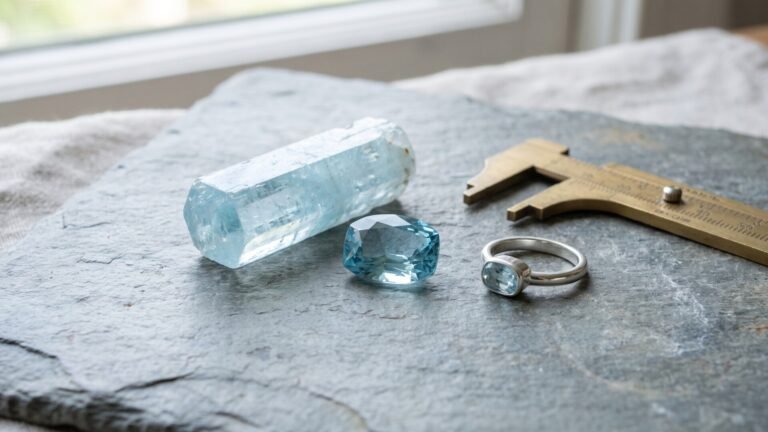
Aquamarine is the blue to blue-green variety of the mineral beryl, the same mineral family as emerald and morganite. Its name comes from the Latin aqua marina, meaning “seawater.” Chemically it is beryllium aluminum silicate, and trace amounts of iron give it its signature color. Major sources include Brazil and several African countries.
Folklore has long tied aquamarine to sailors and the sea. Ancient traditions held that it protected travelers on the water, and legends call it the treasure of mermaids. These stories are cultural lore rather than fact, but they are a big part of why aquamarine feels so romantic. For the traditions and symbolism in depth, see our guides to aquamarine meaning and aquamarine in mythology and history.
Color Characteristics of Aquamarine
Aquamarine typically ranges from pale blue through greenish blue to a deeper, more saturated blue. The most prized stones show a pure, medium to medium-dark blue with little or no green. Most aquamarine is relatively light in tone, and many stones are gently heat treated to remove a greenish tinge and leave a cleaner blue. This treatment is widely accepted and stable, but a seller should still disclose it. Our aquamarine color chart shows the full spectrum.
Value is driven mainly by color saturation, followed by clarity and size. Aquamarine is usually found with few inclusions, so eye-clean stones are the norm, and the best colors command a clear premium.
Durability of Aquamarine
Aquamarine rates 7.5 to 8 on the Mohs scale, harder than quartz and softer than sapphire (9). Unlike topaz, beryl has only poor cleavage, so aquamarine is not prone to splitting cleanly along a plane. It can still chip or fracture if struck hard, particularly at sharp corners or if it contains fractures or inclusions, so it is hard enough for daily wear in the right setting but not indestructible. If you are new to the scale, our hardness scale explainer shows why hardness and toughness are different things.
Understanding Topaz
What Is Topaz?
Topaz is a silicate mineral of aluminum and fluorine with the formula Al₂SiO₄(F,OH)₂. In its purest form it is colorless, and impurities or defects in the crystal create its colors. Historically, topaz was said to calm tempers and ward off harm, though as with other gem folklore these are traditions rather than established effects. Our topaz guide goes into its history and uses.
Color Characteristics of Topaz
Topaz occurs in blue, yellow, orange, pink, red, brown and colorless. The most valuable are the rare orange-to-pink and red stones sold as imperial topaz, a trade term with no official standard (dealers use it differently). When people compare topaz with aquamarine, they are usually talking about blue topaz.
Natural blue topaz is rare and usually pale. Nearly all blue topaz on the market starts as colorless topaz that is irradiated and then heated, producing shades the trade calls Sky Blue, Swiss Blue and London Blue. The treatment is considered stable and permanent, and irradiated stones sold commercially go through safety regulation before release. Even so, you should expect to be told that blue topaz is treated.
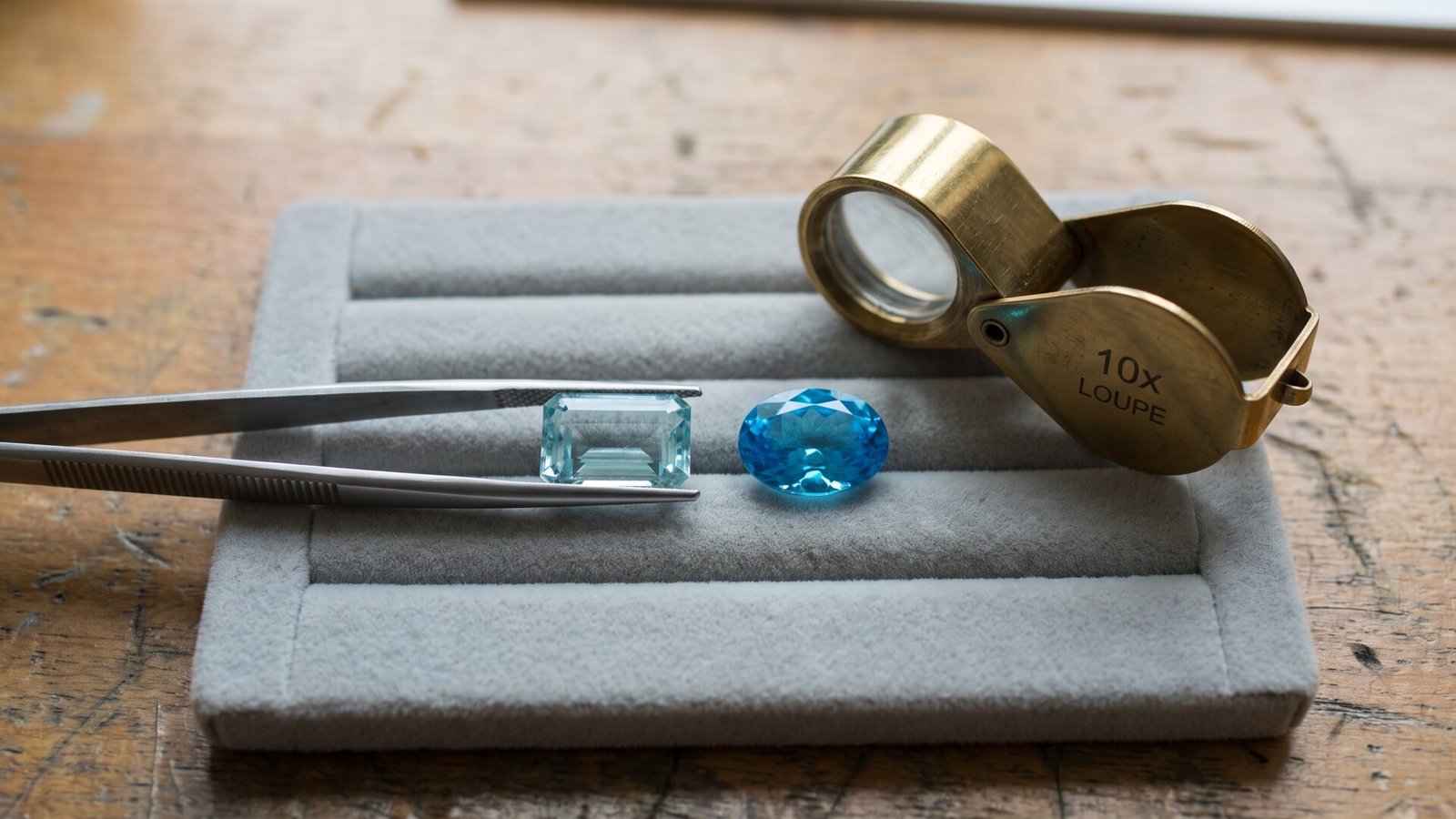
Sky Blue is the lightest, Swiss Blue is a bright, vivid medium blue, and London Blue is a deep, darker blue with a slightly steely tone. Saturation drives price within blue topaz, but even the deepest colors remain affordable compared with aquamarine of similar size.
Durability of Topaz
Topaz rates 8 on the Mohs scale, slightly harder than aquamarine, so it resists scratches well. But topaz has perfect cleavage in one direction. GIA notes that because of cleavage, extreme pressure or sharp temperature changes can cause topaz to break. A knock against a doorframe or hard counter at the wrong angle can split a stone cleanly, and facet edges and corners can chip in rings that take regular abuse.
The practical takeaway: topaz is technically harder, but it can be more fragile in everyday use. Natural, untreated topaz in other colors is far rarer and costs more than treated blue; our sapphire vs blue topaz comparison explains how both compare with a much tougher blue stone.
Durability Comparison
Mohs Hardness, Cleavage and Toughness
| Gemstone | Mohs Hardness | Cleavage | Practical toughness |
|---|---|---|---|
| Aquamarine | 7.5 – 8 | Poor | Fair to good; can chip at corners or along fractures |
| Topaz | 8 | Perfect, one direction | Fair; can split from a sharp knock or thermal shock |
On paper, topaz wins by a hair on hardness. In daily use the difference in scratch resistance is small, and the cleavage plane is the bigger risk. Setting also matters: a protective bezel or halo shields either stone far better than a high, open prong setting.
Scratch and Chip Resistance
Both stones are harder than quartz dust, so ordinary household grit is unlikely to scratch them quickly, though sand and some harder materials will. Chip resistance is where they diverge: aquamarine tends to chip rather than split, while topaz can cleave. For a ring worn every day, choose a protective setting for either stone.
Everyday Hazards
- Chemicals: Harsh detergents, bleach and some jewelry cleaners can damage metals and settings. Remove rings before cleaning.
- Heat: Sudden temperature changes can cause thermal shock, especially in topaz. Avoid steam cleaning.
- Impact: Remove rings for sports, gardening and heavy manual work.
If you need something that can truly take a beating, sapphire is the better blue; see our tanzanite vs sapphire review and sapphire color guide for alternatives.
Color Comparison
How Colored Gemstones Are Graded
Color grading for colored stones is less standardized than for diamonds. Laboratories describe color by three attributes:
- Hue: The primary color (blue, green, etc.)
- Tone: How light or dark the stone is
- Saturation: The intensity or purity of the color
For both stones, the most desirable blues are a pure blue hue with medium to medium-dark tone and strong saturation.
Aquamarine Color Variations
| Color Shade | Description | Market Demand |
|---|---|---|
| Pale blue | Light, watery blue | Moderate |
| Greenish blue | Visible green undertone | Lower |
| Deep teal | Dark blue-green | Niche |
| Pure medium to dark blue | Ideal, no green modifier | High; commands a premium |
In general terms, light aquamarine is affordable, while saturated, clean, larger stones sit at the top of the range (see the price section below).
Topaz Color Variations
| Color Shade | Description | Market Demand |
|---|---|---|
| Sky Blue | Light, airy blue | Common, very affordable |
| Swiss Blue | Bright, vivid medium blue | Very popular |
| London Blue | Deep, dark blue | Strong demand, higher end of topaz pricing |
| Imperial (non-blue) | Golden-orange to pink | Rare; far more valuable than blue topaz |
London Blue is often compared with aquamarine, but it is far darker and more saturated, and in some lighting can be mistaken for a darker blue stone such as sapphire.
Side-by-Side Look
- Aquamarine: Soft, calm, watery blue with a subtle glow. Best for people who like understated elegance.
- Topaz: Brighter and often more saturated, from airy Sky Blue to dramatic London Blue. Best for a bolder look.
Lighting changes how both stones look, so always view a stone in daylight and indoor light before you buy.
Applications in Jewelry
Aquamarine Jewelry Styles
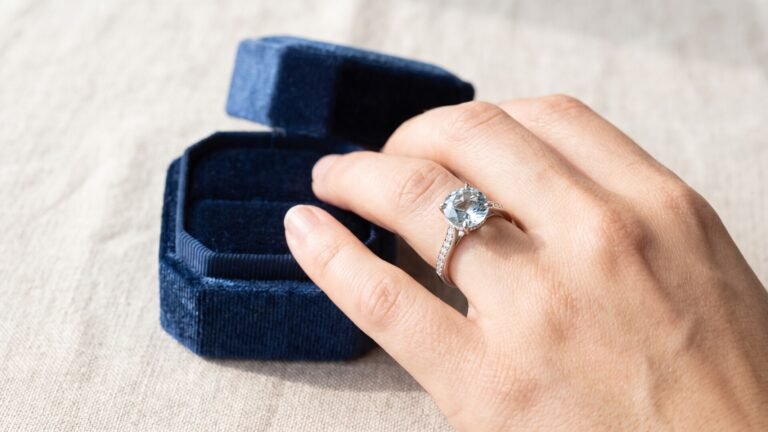
- Engagement rings: A popular alternative to diamond and especially fitting for March birthdays. Its pale blue pairs well with white gold, platinum and rose gold. See 10 stunning aquamarine engagement rings for ideas.
- Pendants and necklaces: Clarity and transparency shine in solitaire pendants.
- Earrings: Drop and pear shapes are elegant and low-risk for knocks.
- Bracelets: Bezel-set stones hold up better than open prong settings. Love the look of older pieces? Read about vintage aquamarine jewelry trends.
Topaz Jewelry Styles
- Cocktail rings: Large faceted London Blue or Swiss Blue stones in statement settings, best for occasional rather than daily wear.
- Stud earrings: Swiss Blue topaz is a popular budget-friendly alternative to blue sapphire, and earrings face less impact than rings.
- Pendants: Especially with diamond halos.
- Birthstone jewelry: A natural gift for November birthdays.
Because topaz is plentiful and per-carat prices rise little with size, large stones are affordable. That makes bigger sizes accessible but doesn’t change the cleavage risk.
Choosing Between Aquamarine and Topaz
- Daily-wear ring: Aquamarine in a protective setting is generally the safer pick because it lacks topaz’s perfect cleavage.
- Statement piece or large stone on a budget: Blue topaz gives a lot of color for the price.
- Keepsake or heirloom: Natural, well-colored aquamarine is the more traditional choice. Don’t buy either stone expecting its price to rise.
- March birthday: Aquamarine is the birthstone.
- November birthday: Topaz is the birthstone, alongside citrine.
For more ideas by piece and budget, browse our Birthstone Jewelry Guide.
Price and Value
What You Can Expect to Pay
- Aquamarine: Light, pale stones can cost as little as about $5–$50 per carat, medium colors roughly $80–$400, and top-color dark stones about $200–$600 per carat. Larger stones with exceptional color can cost more.
- Blue topaz: Commercial Sky, Swiss and London Blue stones typically run about $1–$30 per carat, and price rises little as size increases.
These are retail ballpark ranges and vary with seller, cut, setting and quality. Finished jewelry costs more than loose stones because of the metal and workmanship. If you are curious how gem prices have moved recently, see the 2026 gemstone price audit.
Think of It as Jewelry, Not an Investment
Neither stone should be bought as a financial investment. Colored gemstone prices are hard to track, resale markets are thin and retail markups are large. Treated blue topaz is abundant and mass produced, so it is not expected to gain value. Natural, well-colored aquamarine holds its appeal better, but there is no guarantee of appreciation. Buy what you will enjoy wearing.
Certification and Disclosure
For higher-value stones, ask for a report from an established gemological laboratory, such as GIA, AGS or IGI. A report can confirm that a stone is natural and describe treatments and color. For aquamarine, ask whether the stone has been heat treated; for blue topaz, assume irradiation and heating unless you are told otherwise. Certification matters most for aquamarine of any significant size and for rare imperial topaz. For more buying advice, see our education and buying guides.
Care and Maintenance
General Care for Both Stones
- Clean with warm water, mild soap and a soft brush.
- Avoid steam cleaners. Ultrasonic cleaners are best avoided too, particularly for topaz or any stone with fractures or inclusions.
- Store pieces separately so harder stones do not scratch them.
- Remove jewelry before swimming, cleaning or exercising.
Aquamarine
- Avoid sudden temperature changes.
- Don’t use abrasive cloths or cleaners.
- Have prongs checked regularly; loose settings increase the risk of chipping.
Our full aquamarine care guide covers this in more detail.
Topaz
- Do not use ultrasonic cleaners; vibration and heat can aggravate cleavage.
- Be careful with prong settings, since corners and edges can chip.
- Keep away from bleach and harsh chemicals, and avoid sudden temperature changes.
Final Recommendations
Choose Aquamarine If…
- You want a timeless, calm blue with natural color.
- You prefer subtle elegance over bold saturation.
- You need a ring you will wear often, in a protective setting.
- You’re buying for a March birthday.
Choose Topaz If…
- You want a vivid, dramatic blue.
- You’re on a budget but want a large stone.
- You love the deep color of London Blue and will treat the piece with care.
- You’re buying for a November birthday.
Frequently Asked Questions About Aquamarine Vs Topaz
What are the main differences between aquamarine and topaz?
Aquamarine is a beryl with a soft sea-blue color, a Mohs hardness of 7.5–8 and poor cleavage. Topaz is a different mineral with a wider color range, a hardness of 8 and perfect cleavage. Aquamarine’s blue is usually natural, while nearly all blue topaz is irradiated and heated.
Which gemstone is more durable for everyday wear?
Neither is indestructible. Topaz is slightly harder, but its perfect cleavage means a sharp knock can split it, so a well-set aquamarine is generally the safer choice for a daily ring. For either stone, choose a protective bezel or halo setting.
How do I care for aquamarine or topaz jewelry?
Clean with warm water, mild soap and a soft brush. Avoid steam cleaners and, especially for topaz, ultrasonic cleaners. Store pieces separately and remove them before sports or heavy work.
Is blue topaz natural?
Blue topaz is a natural mineral, but the blue color in nearly all commercial stones comes from irradiation and heat treatment of colorless topaz. The treatment is considered stable, and it should be disclosed.
Which is more expensive, aquamarine or blue topaz?
Aquamarine usually costs more. As a rough guide, faceted aquamarine runs from about $5 to $600 per carat depending on color and size, while common blue topaz runs from about $1 to $30 per carat.
Which should I choose as a gift?
Consider the recipient’s birth month, preferred color intensity and lifestyle. Aquamarine suits a March birthday and a delicate, calm look; topaz suits November birthdays and a bolder, more vivid color.