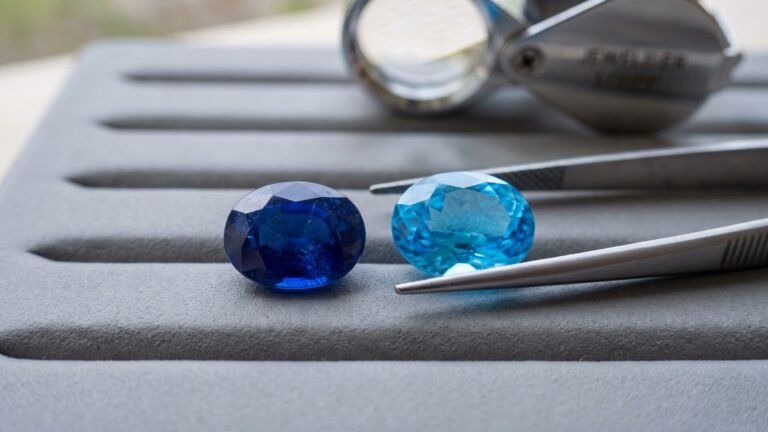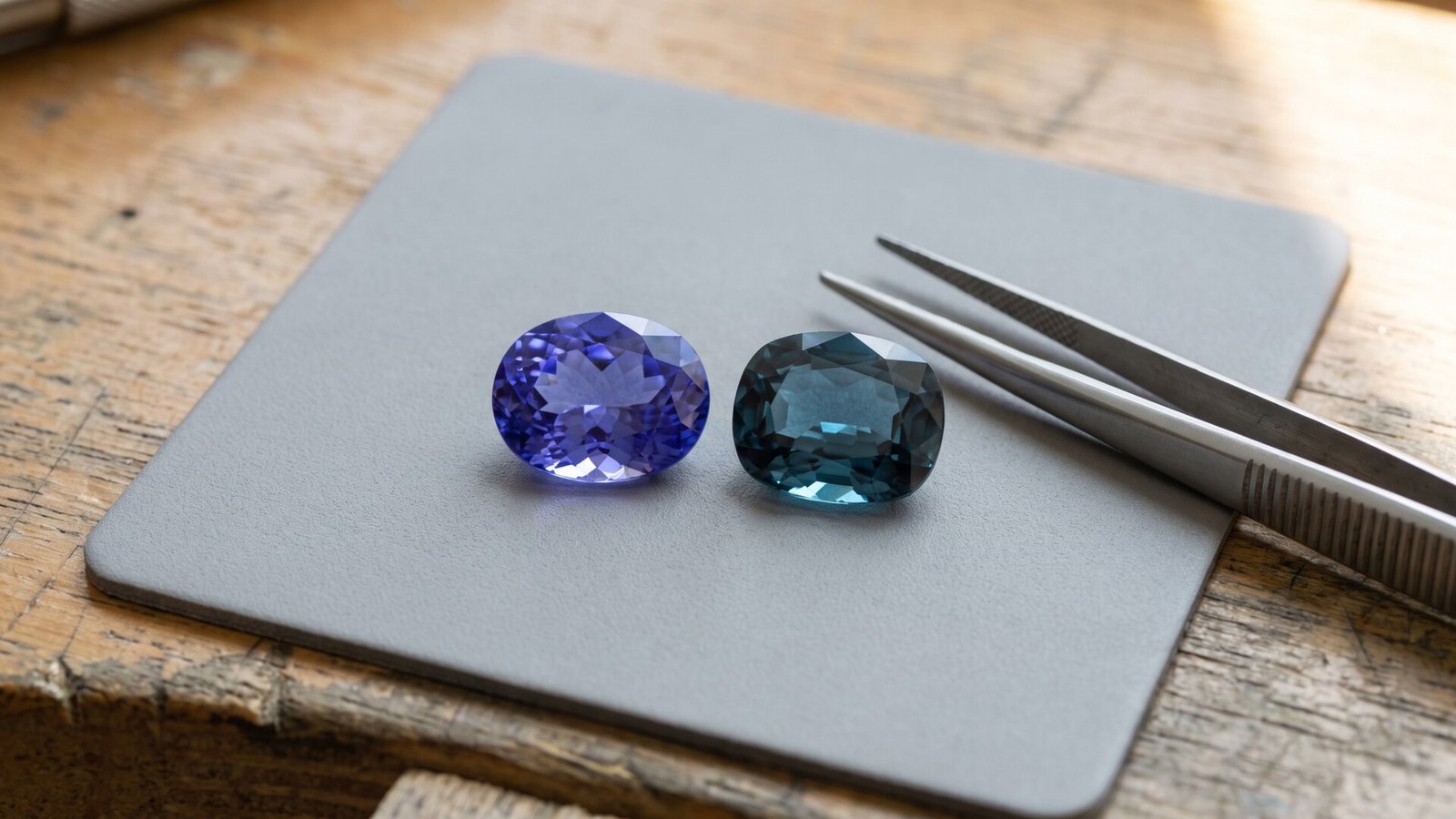
Tanzanite vs London Blue Topaz — Price Difference & Durability (Mohs, Rarity, and Buying Guide)
When you are picking a blue stone for a ring, two names come up again and again: tanzanite and London Blue topaz. Both give you a deep, desirable blue, but they are very different gems in how hard they are, how easily they break, and how much they cost. This guide covers exact Mohs hardness numbers, what those numbers actually mean for everyday wear, why prices diverge so widely, and realistic ring examples across price tiers.
We break down the gemology (hardness, cleavage, toughness, treatments) and the market realities (rarity and pricing), then show example rings at budget, mid and premium levels. A note on how we write: we have not bought or worn every piece mentioned, so descriptions rely on public gemological sources and retailer listings. Prices and stock change often; check each listing. Read our affiliate disclosure for how this site is funded.
Quick Preview: The Headline Comparison
| Tanzanite | London Blue topaz | |
|---|---|---|
| Mineral | Zoisite (blue to violet variety) | Topaz |
| Mohs hardness | 6 to 7 (GIA) | 8 (GIA) |
| Toughness | Fair to poor; cleavage means it can break if struck | Poor, because of perfect basal cleavage; a hard blow can split it |
| Color origin | Natural color, usually heat-treated to remove brown tones | Colorless topaz, typically irradiated and heated to a deep blue |
| Source | Merelani Hills, northern Tanzania | Many countries; the base topaz is abundant |
| Birthstone month | December (with turquoise and zircon, per GIA) | November (topaz, with citrine) |
| Relative price | Higher per carat; rises steeply with color and size | Far lower per carat; large sizes are affordable |
| Ultrasonic or steam cleaning | Not recommended (GIA) | Avoid (GIA) |
- Mohs hardness: tanzanite about 6 to 7; topaz (including London Blue) 8.
- Durability in practice: topaz is harder and more scratch-resistant, but both stones have cleavage, so neither is indestructible. Tanzanite is softer and more prone to chips and scratches in daily wear; topaz can split if struck at the wrong angle.
- Rarity and price: tanzanite is a single-source gem (Merelani, Tanzania) and is generally rarer and pricier per carat for similar visual quality. London Blue topaz is abundant, made by treating colorless topaz, and far more affordable at similar sizes.
- Bottom line: if you want a more scratch-resistant, budget-friendly stone for frequent wear in a protective setting, London Blue topaz is the practical pick. If you want rarity and a distinct violet-blue color, and you will wear the piece with a bit more care, tanzanite is the prize.
Both stones sit in the wider topaz family of November and December options, and our gemstones guide shows where they fit among other gems.
What the Mohs Scale Actually Tells You (and What It Does Not)
The Mohs scale ranks minerals by their resistance to being scratched by other minerals. It is simple and useful, but it is only one part of the durability story.
- Mohs = scratch resistance. A higher number means greater scratch resistance. Topaz at 8 resists common scratches better than tanzanite at 6 to 7. The scale is not evenly spaced, so each step is a bigger jump than it looks.
- Toughness is not hardness. Toughness measures how well a stone resists breaking, chipping, or cleaving. A gem can be hard but brittle. That matters for rings, because knocking a hard but cleavable stone against metal or tile can chip it even if it would never scratch.
- Cleavage matters. Some gems split cleanly along crystallographic planes. GIA rates tanzanite’s toughness as fair to poor and notes that it can break when struck, and describes topaz as having poor toughness because of its basal cleavage. Cutters orient topaz so the cleavage plane is angled away from the table, which helps but does not remove the risk.
So Mohs gives you a baseline: expect topaz to resist scratches better. But both gems need thoughtful settings and care to last. If you want to see how other stones compare, read our aquamarine vs topaz and sapphire vs blue topaz comparisons.
Tanzanite: Rarity, Durability, and Why It Costs More
Rarity and supply
Tanzanite is mined in only one place on Earth, the Merelani Hills in northern Tanzania. That single-source reality creates natural scarcity and, over time, a market positioning that is closer to rare colored gems than to widely available semi-precious stones. Scarcity supports demand and price, especially for stones with saturated, vivid blue-violet color. Supply and prices can change as mines change, so treat any price as a snapshot.
Optical and structural traits
Tanzanite’s color range (blue to violet) and its trichroism (showing different colors from different angles) give pieces a lively look in the right cut. Structurally, it is softer and less tough than many jewelry staples:
- Mohs hardness: about 6 to 7, well below classic everyday stones like sapphire (9) and topaz (8).
- Cleavage and toughness: tanzanite can chip or fracture under impact. GIA says it can be worn in all jewelry styles with precautions against rough wear and hard blows, and jewelers often recommend protective settings (bezel, halo) for rings worn often.
Treatments and pricing impact
Most tanzanite on the market has been heat-treated to remove brownish undertones and bring out the blue-violet color. GIA describes this treatment as routine and stable with no added durability concerns. Untreated stones are extremely rare and more valuable. Coatings and fracture filling are uncommon but exist; ask the seller to confirm neither is present.
Price behavior
Tanzanite prices scale steeply with color saturation and size. As a snapshot, one retailer’s published retail chart (Tanzanite Jewelry Designs, assuming good cut and SI1 to VS clarity) lists roughly $70 to $200 per carat for lower grades up to about $200 to $650 per carat for top-grade stones, with per-carat prices rising as stones get larger. On that basis a good 1 to 2 carat loose stone would sit roughly in the low hundreds to under $1,000, before setting costs; exceptional stones cost far more. Finished rings add metal, diamonds and design, which is why they often run well beyond the loose-stone price.
Example tanzanite ring (mid to premium): Blue Nile lists a cushion-cut tanzanite and diamond halo ring in 14k white gold, a representative premium-style piece with a protective halo setting. Check the current listing for stone size and price. Blue Nile
Example budget tanzanite options: Smaller or sterling-silver tanzanite rings appear on marketplaces like Etsy. Quality varies by seller, so read reviews and ask about heat treatment, origin and return terms. Etsy
London Blue Topaz: Why It Is Affordable and Durable
Origins and treatment
Topaz occurs naturally in a range of colors; natural blue topaz is rare and usually pale. The London Blue color is generally created by treating colorless topaz, typically by irradiation followed by heat, to reach a deep, slightly grayish-blue tone. Irradiated stones are held until any residual radioactivity has decayed to safe levels before sale, according to gem dealers. Because the base material is abundant, London Blue topaz is available at a fraction of tanzanite’s price. A blue topaz priced like London Blue is almost certainly treated, and that is normal when disclosed.
Shades are sold as Sky Blue (light), Swiss Blue (medium bright) and London Blue (deep). Many cocktail rings pair two or three shades for contrast.
Durability basics
- Mohs hardness: 8. That is a practical advantage for rings: it resists scratches from most household materials and holds polish well.
- Toughness and cleavage: topaz has perfect basal cleavage, and GIA rates its toughness as poor. A hard knock, strong pressure or a sudden temperature change can split it, so a protective setting still matters, particularly for a ring worn every day.
Price behavior
Because supply is stable and treatments are standard, topaz prices stay relatively low. A visually impressive London Blue topaz of 3 to 5 carats typically costs far less per carat than a tanzanite of comparable color depth. That makes London Blue a go-to for larger visual impact on a budget.
Example London Blue topaz (mid-range): Blue Nile lists a London Blue and Swiss Blue topaz cocktail ring with diamond accents in 14k yellow gold. Check the current listing for the price. Blue Nile
Example value pick: many independent sellers offer 10×8 mm London Blue topaz solitaires in gold or sterling silver at lower prices. Etsy
Side-by-Side: How Durability Affects Ring Choices
When you pick a ring, the stone’s hardness and toughness should inform the setting, metal and intended use.
| Your situation | Better fit | Why |
|---|---|---|
| Daily wear with some risk of knocks | London Blue topaz in a bezel or protective prong setting, or a harder stone such as sapphire | Higher scratch resistance; still needs protection from blows |
| Special occasions or careful daily wear | Tanzanite in a bezel, halo or three-stone setting | Rarity and color, with the stone shielded from impact |
| Large look on a small budget | London Blue topaz | Bigger carat sizes for far less money |
| Active hands (sports, manual work) | Neither in a ring; consider a pendant or earrings | Both have cleavage and can chip or split |
| Gift for a December birthday | Tanzanite | December birthstone (with turquoise and zircon) |
| Gift for a November birthday | London Blue topaz | Topaz is a November birthstone |
If You Want Everyday Wear
Choose London Blue topaz in a secure setting (prongs or bezel). At Mohs 8 it resists scratches better than tanzanite, though its cleavage means you should avoid hard knocks. Consider 14k or 18k gold or platinum for the setting, and a low-profile bezel if you want extra protection.
If You Want Special-Occasion or Careful Daily Wear
Choose tanzanite for rarity and color. Use a protective setting such as a halo, bezel or three-stone design that lowers the risk of direct impact on the main stone, and avoid activities that put blunt force on the finger, such as sports or heavy manual work.
If You Want Large Visual Impact for a Low Price
Choose London Blue topaz. You can buy bigger carat sizes at a much lower price and get a dramatic presence on the hand.
Alternatives Worth Considering
If neither stone fits, a few honest alternatives, each with trade-offs:
- Blue sapphire (Mohs 9, no cleavage): far tougher for a daily ring, but typically costs more than either stone at the same size. See sapphire vs blue topaz.
- Iolite: a violet-blue gem often suggested as a lower-cost look-alike for tanzanite (GIA lists it at Mohs 7 to 7.5); it also needs care and is not as saturated.
- Aquamarine: a lighter, greener blue that is a March birthstone and more durable than tanzanite; see aquamarine vs topaz.
- Swiss Blue or Sky Blue topaz: the same durability as London Blue in a lighter, brighter shade.
How to Judge Quality Before You Buy
Two stones with the same name can look and wear very differently. These are the points worth checking on each listing.
Tanzanite
- Color first: the most prized stones show a saturated blue to violet-blue. Very pale or grayish stones cost much less. Because tanzanite is trichroic, it can look bluer or more purple depending on the cut and the light, so look at photos and video in more than one lighting.
- Cut quality: a well-cut stone shows even color and lively brilliance; a poorly cut one can look dark or washed out in the center.
- Clarity: look for stones described as eye-clean. Visible fractures matter more in a stone that already has cleavage.
- Disclosure: ask whether the stone is heat-treated (normal), and whether it has any coating or filling. A GIA or comparable lab report adds confidence on higher-value stones.
- Setting fit: check that the stone sits low and is well protected; thin, tall prongs are a poor match for tanzanite.
London Blue topaz
- Color depth: London Blue is the deepest, slightly steely blue. If a listing calls a very light stone London Blue, treat it with caution; lighter shades are normally sold as Sky Blue or Swiss Blue.
- Cut and polish: topaz takes a very good polish; look for symmetrical facets and clean corners, which are also less likely to chip.
- Clarity: most topaz is eye-clean at this price level, so visible inclusions are a reason to ask questions.
- Disclosure: reputable sellers state that the color is the result of irradiation and heat treatment. Be wary of listings that call the color natural.
- Size honesty: compare millimeter dimensions, not only carat weight, because stones of the same carat weight can look different in size depending on cut.
Common Mistakes to Avoid
- Buying tanzanite for a high solitaire ring that will be worn through daily knocks.
- Assuming topaz cannot chip because it is Mohs 8. Hardness is scratch resistance, not toughness.
- Cleaning either stone in an ultrasonic or steam cleaner at the jeweler or at home without checking; both are best cleaned with warm, soapy water.
- Judging color only from a single photo. Screens and lighting change how blue and violet stones look.
- Paying a tanzanite price for a stone that is pale, heavily included or described vaguely, or paying more for London Blue topaz because of a vague rarity claim.
- Skipping the return policy. Color is personal, and a stone can look different in your hand than on screen.
Price Tiers and Real Product Examples
Below are realistic example price bands for both stones. Links go to representative product pages, not recommendations of a specific quality level; check each listing for current stone size, treatment and return policy, since stock and prices change.
Tanzanite: Budget / Entry-Level (under about $200 to $300)
- Etsy and small sellers: sterling-silver or lower-carat tanzanite rings in this bracket usually have modest clarity and color. They suit shoppers on a tight budget who want the look without a big outlay. Etsy
Tanzanite: Midrange (about $500 to $2,500)
- Blue Nile and Brilliant Earth mid-range pieces: here you find 0.7 to 2.0 ct stones, sometimes with diamond accents or better color. Blue Nile
Tanzanite: Premium (over $2,500)
- Large, vivid, high-clarity stones or designer settings: because tanzanite’s value jumps quickly with color saturation and size, premium pieces can reach several thousand dollars. Blue Nile
London Blue Topaz: Budget / Entry-Level (under about $300)
- Etsy and mass-market sterling rings: a 10×8 mm oval or emerald-cut London Blue topaz set in sterling can cost well under $300. Etsy
London Blue Topaz: Midrange (about $300 to $1,500)
- Retailer cocktail rings: 2 to 5 ct London Blue topaz with diamond accents in gold settings typically sits in this bracket. Blue Nile
London Blue Topaz: Premium (over $1,500)
- Large fine jewelry settings and designer pieces: with high-karat gold or significant diamond accents, a London Blue topaz ring can reach $1,500 to $3,000 or more depending on metal and design. Maddaloni Jewelers
Setting and Metal Recommendations for Longevity
Given their durability profiles, these setting choices help protect your purchase.
For tanzanite
- Best settings: bezel, halo with protective prongs, or lower-profile three-stone settings. These reduce exposure to side impact.
- Metal: 14k or 18k gold or platinum all work; the metal choice matters less than protecting the stone.
- Avoid: high solitaires, thin prongs or exposed cathedral settings if the wearer is active.
For London Blue topaz
- Best settings: prongs work, but bezel or partial-bezel is a good choice for a ring worn daily because of topaz’s cleavage.
- Metal: 14k or 18k gold, or sterling silver for budget pieces. Topaz pairs well with most metals.
Care and Long-Term Maintenance
Tanzanite care
- Gentle cleaning only: warm, soapy water and a soft brush. GIA says ultrasonic and steam cleaning are never recommended for tanzanite.
- Storage: keep tanzanite separate from harder gems (sapphires, diamonds) to avoid scratching.
- Insurance: for higher-value tanzanite rings, consider insuring the piece and having the setting checked periodically.
London Blue topaz care
- Cleaning: warm water and mild soap with a soft brush. GIA advises avoiding both steam and ultrasonic cleaning for topaz. Also avoid harsh chemicals and abrasive cleaners.
- Heat and light: avoid high heat and sudden temperature changes, which can crack topaz.
- Storage: store separately to avoid scratches from harder stones.
For more on caring for your blue gemstone jewelry, see our topaz meaning and history guide and the broader topaz guide.
Resale and Value Notes
- Tanzanite has collectible appeal because of its rarity and single-source status, but the market is niche and resale is not as easy as for diamonds or sapphires. Nobody can promise gemstones will hold or gain value; buy because you like the stone.
- London Blue topaz is mainstream and affordable. It is a good choice for style and size, not for value growth.
Final Buying Checklist
- Want more scratch resistance on a budget? Pick London Blue topaz (Mohs 8) and protect it from knocks.
- Want rare color and collectability? Pick tanzanite (Mohs 6 to 7) and use a protected setting such as a bezel or halo.
- If choosing tanzanite, avoid high-profile solitaires unless you are comfortable with careful wear and occasional professional maintenance.
- If choosing topaz, you can go larger for less money, which is great for bold cocktail rings. Blue Nile
- Always verify treatments and return policies before purchase. For tanzanite, confirm heat treatment and no coating or filling; for topaz, confirm that the color is a disclosed irradiation and heat treatment.
- Ask for a gem report on higher-value tanzanite from a recognized lab such as GIA.
Frequently Asked Questions About Tanzanite Vs London Blue Topaz
Is tanzanite harder than London Blue topaz?
No. GIA lists tanzanite at 6 to 7 on the Mohs scale and topaz at 8, so London Blue topaz resists scratches better. Both have cleavage and can chip or split if struck hard.
Why is tanzanite more expensive than London Blue topaz?
Tanzanite comes from a single location (the Merelani Hills of Tanzania) and fine color is scarce. London Blue topaz is made by treating abundant colorless topaz, so it costs far less per carat.
Is London Blue topaz natural?
The topaz is a natural mineral, but its deep blue color is created by irradiation and heat treatment. This is standard and should be disclosed.
Is tanzanite good for an engagement ring or daily wear?
It can be worn, but GIA advises precautions against rough wear and hard blows. Choose a protective setting such as a bezel or halo, and consider a pendant or earrings if you want lower risk.
Can I clean tanzanite or topaz in an ultrasonic cleaner?
GIA does not recommend ultrasonic or steam cleaning for either stone. Use warm, soapy water and a soft brush.
Which is the better birthstone gift?
Tanzanite is a December birthstone and topaz is a November birthstone, so match the stone to the recipient’s birth month where that matters.
Quick Summary: When to Pick Which Stone
- Pick London Blue topaz when you want big size for the price, better scratch resistance and a budget-friendly choice, as long as you protect it from hard knocks.
- Pick tanzanite when you want rarity, the violet-blue signature and a more collectible piece, and you are willing to protect it and accept a smaller carat size for the same budget.