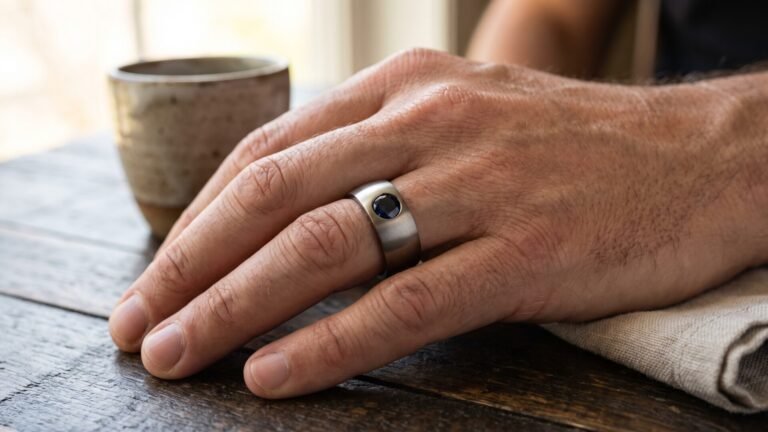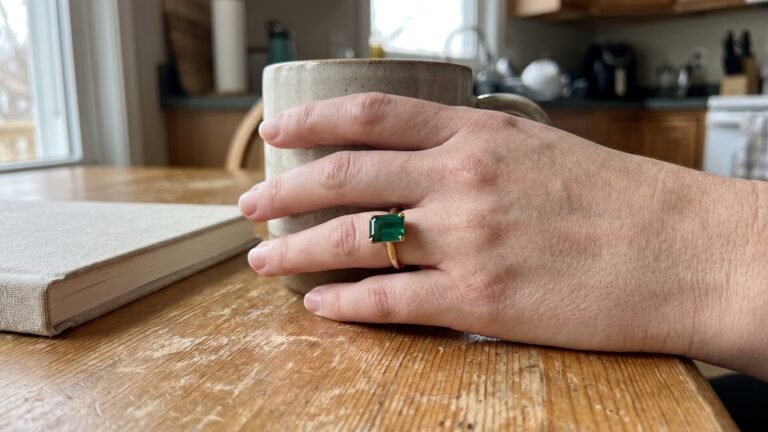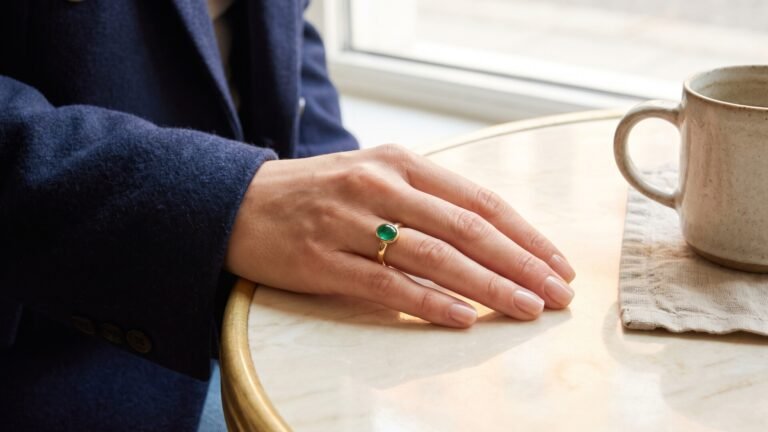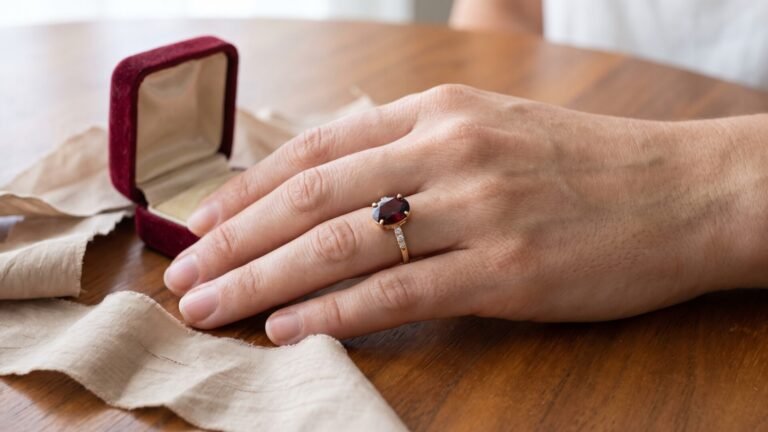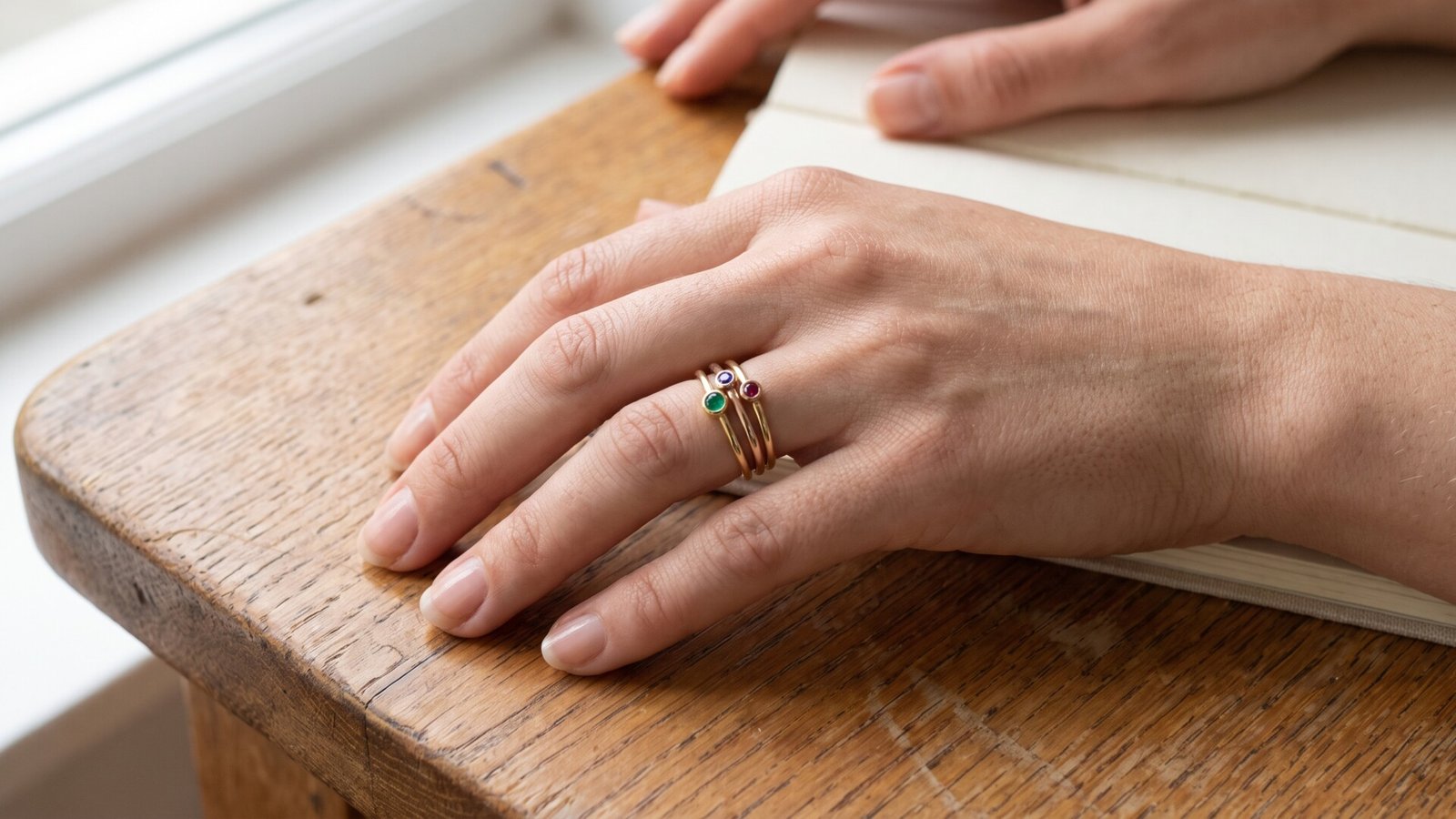
How to Build a “Family Stack” Ring: Choosing Birthstones for Your Kids
A traditional mother’s ring, with several stones crowded onto one band, can feel bulky or dated. A family stack ring solves that: a handful of thin bands worn together on one finger, each carrying a birthstone for a child, a grandchild, or yourself. The stack catches light as you move, layers with a wedding set, and tells your family’s story without a word. Best of all, it grows: add a band when a new baby arrives.
This guide covers how family stack rings work, which birthstone belongs to each month, how to design a stack step by step, which stones are tough enough for daily wear, how to shop at retailers such as Blue Nile, James Allen, and Brilliant Earth, and how to care for the finished set. It is part of our Birthstone Jewelry Guide.
What Is a Family Stack Ring?
A family stack ring is a set of thin, stackable rings worn together on the same finger, often the right ring finger or alongside a wedding set. Each ring can represent one child, or a single wider band can hold several birthstones in a row. Jewelers sometimes call the single-band version a mother’s ring.
Why they are so popular
- Personal: each stone stands for a specific person.
- Flexible in style: you can mix metals, textures, and finishes.
- Expandable: add a new band for each child, milestone, or anniversary.
- Comfortable: thin bands are easier to wear every day than one bulky multi-stone ring.
Who wears them
- Moms: one ring per child is the classic approach.
- Grandmothers: a stack featuring each grandchild’s birthstone.
- New parents: a single birthstone band to mark a first child, with room to add more.
- Blended families: a way to represent children from different partnerships equally.
- Anyone who wants a wearable family portrait, including dads and partners who prefer a simple band.
Retailers describe mother’s rings as holding anywhere from one to several birthstones, in layouts ranging from a straight row to clusters and stackable bands. If you are shopping for a man, see our guide to custom birthstone rings for men.
Why Birthstones Work So Well in a Stack
Meaning. Each child is represented not with initials but with a gemstone that has long cultural associations. Traditionally, garnet is linked with protection and constancy and ruby with passion and vitality. These are traditions and symbolism, not scientific properties, but they give each ring a story. Some families prefer the stone for the month; others look to the zodiac, which is why we compare zodiac and monthly birthstones.
Color. Birthstones come in distinct colors, so a stack becomes a small palette. Purple amethyst beside light-blue aquamarine and lime-green peridot gives a multicolor effect that shifts as your hand moves.
Practicality. Thin, simple bands are designed to sit snugly against each other, and a stack is generally more comfortable for typing, cooking, and childcare than a single wide cluster ring.
Birthstone Guide for Every Month
The table lists the modern U.S. birthstone for each month with a common alternative, the traditional associations people connect with it, and its typical color. Lists vary by country and organization, and the American list has been updated since 1912 (alexandrite, pink tourmaline, citrine and zircon were added in 1952, tanzanite in 2002, and spinel in 2016). Our beginner’s guide to birthstones covers the history.
| Month | Birthstone | Traditional associations | Typical color |
|---|---|---|---|
| January | Garnet | protection, strength, trust | Deep red |
| February | Amethyst | calm, wisdom, sincerity | Purple |
| March | Aquamarine | serenity, courage, clarity | Light blue |
| April | Diamond | love, resilience, purity | Colorless |
| May | Emerald | growth, renewal, success | Green |
| June | Pearl, moonstone, or alexandrite | purity, intuition, new beginnings | White, iridescent, or color-change |
| July | Ruby | passion, vitality, courage | Red |
| August | Peridot or spinel | happiness, energy, positivity | Lime green (peridot); many colors (spinel) |
| September | Sapphire | loyalty, wisdom, truth | Blue |
| October | Opal or pink tourmaline | creativity, hope | Multicolor (opal); pink (tourmaline) |
| November | Topaz or citrine | joy, warmth, abundance | Golden, yellow, or blue (treated topaz) |
| December | Turquoise, tanzanite, or zircon | protection, peace, good fortune | Blue |
Some months offer more than one option: June has pearl, moonstone, and alexandrite, August has peridot or spinel, October has opal or tourmaline, and December has turquoise, tanzanite, or zircon. Pick the stone that suits your child’s personality, your budget, and how tough the ring needs to be.
For a deeper look at an individual month, our November birthstone guide explains the topaz and citrine choice, and the main gemstones guide covers the rest.
How to Design the Perfect Family Stack Ring
Step 1: Decide how many rings you want
- One ring per child: each child gets a thin band with their stone. This suits growing families best.
- Multi-stone band: one wider ring with several stones in a row, usually best for two to four children.
- Expandable stack: start with one ring and add bands over time. Good for new parents.
Step 2: Choose a metal
- Yellow gold: warm and classic, flattering with warm stones such as citrine, garnet, and ruby.
- White gold: cool and modern. It is commonly rhodium-plated, so expect occasional re-plating to keep the bright white finish.
- Rose gold: soft and warm, pairing well with pink stones such as morganite and tourmaline.
- Platinum: dense, durable, and neutral. It costs more than gold.
- Sterling silver: affordable, but softer and prone to tarnish, so it is less ideal for daily wear.
You do not have to choose one metal. Mixing yellow, white, and rose gold is a popular way to give a stack a layered look. Gold purity also matters: 14k is harder and more everyday-friendly than 18k, though 18k has a richer color.
Step 3: Choose stone shapes
- Round: timeless, stack-friendly, and the most widely available.
- Oval: elegant and slightly elongating.
- Pear: distinctive and sentimental.
- Princess: square, modern, and geometric. Corners can chip, so a protective setting helps.
- Cushion: a rounded square with vintage charm.
Step 4: Choose a setting
The setting affects both the look and how well a stone survives daily wear. A bezel setting wraps metal around the stone and protects the edges, which suits softer or more brittle gems. A flush (gypsy) setting sinks the stone into the band so nothing snags, and is very practical for a stack. Prong settings let in more light but expose the stone to knocks and can catch on neighboring bands.
Step 5: Decide on stack style
- Thin minimal bands: roughly 1.5 to 2.5 mm wide, the most comfortable for everyday wear.
- Mixed textures: combine polished bands with brushed or hammered finishes.
- Diamond accent bands: add small diamonds alongside the birthstones for extra sparkle.
- Alternating stones and plain bands: gives visual breathing room when a stack has three or more stones.
Stack Styles for Moms
Minimalist stacks. Thin bands with small stones set flush. Clean, modern, and comfortable for daily wear.
Statement stacks. Wider bands of roughly 4 to 6 mm with larger stones or diamond halos. Better for occasions than for hands-on days.
Mixed-metal stacks. White, yellow, and rose gold bands in one stack for a layered, modern look.
Open or adjustable stack rings. Handy when you are unsure of a ring size, which is useful for gifts. Because an adjustable band does not fit as precisely, it may shift more than a sized band.
Ideas by Family Size
One child. A single thin band with one small stone. Wear it alone or stacked against a wedding set.
Two children. Two matching bands side by side, either with contrasting stones (for example amethyst and aquamarine) or the same stone for twins born in one month. A single wider ring with two stones also works.
Three children. Three thin stacked bands in complementary colors, such as blue sapphire, green emerald, and red ruby, or one classic three-stone mother’s ring.
Four or more children. Keep a coordinated palette (all cool blues, or all warm reds and oranges), or split the stones across two fingers, for example the right ring finger and right middle finger. Stackable bands scale to larger families more easily than a single ring.
Which Birthstones Are Tough Enough for a Daily-Wear Stack?
Hardness on the Mohs scale measures scratch resistance, not overall toughness. Cleavage, brittleness, and sensitivity to heat or chemicals matter too. Our hardness scale guide explains the difference. For stack rings, which bump against each other and against everything you touch, this table is a useful starting point.
| Birthstone | Mohs hardness | Daily-wear verdict |
|---|---|---|
| Diamond | 10 | Excellent, though it can chip if struck hard along a cleavage plane |
| Ruby, sapphire | 9 | Excellent; tough corundum |
| Alexandrite | 8.5 | Very good |
| Spinel, topaz | 8 | Good; topaz has cleavage and can split if knocked |
| Aquamarine | 7.5 to 8 | Good with a protective setting |
| Emerald | 7.5 to 8 | Use with care; inclusions and oil or resin fillings make it brittle |
| Amethyst, citrine | 7 | Good |
| Tourmaline | 7 to 7.5 | Good |
| Garnet | 6.5 to 7.5 (varies by type) | Good |
| Peridot, tanzanite | 6.5 to 7 | Fair; better for occasional wear, tanzanite has cleavage |
| Moonstone | 6 to 6.5 | Fair; can chip along cleavage |
| Opal | 5.5 to 6.5 | Delicate; avoid for everyday rings |
| Turquoise | 5 to 6 | Delicate and porous |
| Pearl | 2.5 to 4.5 | Delicate; avoid for everyday rings |
If a child’s month falls on a soft stone, you have options. You can choose an alternative birthstone (spinel for August, tourmaline for October), wear the stack on days with less hand work, place the soft stone in a bezel or flush setting, or move it to a pendant. A lab-grown version is also a legitimate choice (see natural vs. lab-grown birthstones): lab-grown ruby, sapphire, emerald, and spinel have the same chemistry as natural stones at lower prices, so long as the seller labels them clearly. A simulant such as cubic zirconia only imitates a stone’s look.
Stack by Hardness, Not Just Color
Rings in a stack rub against each other every time your hand moves, and a harder stone will scratch a softer one it touches. Sapphire, ruby and diamond (9 to 10 on the Mohs scale) can abrade opal, pearl, turquoise and moonstone, and even peridot or tanzanite, if they sit directly against them.
So build the stack in groups. Keep the 9-and-up stones together, and separate any soft stone from its neighbors with a plain metal band. Put a soft stone in the middle of the stack between two plain bands rather than on the outer edge, where it takes the most knocks, and choose a bezel or flush setting so the stone sits below the surface of the band. If most of your children’s months fall on soft stones, a pendant for those stones can keep the ring stack tougher.
Where to Shop for Stack Rings
Product ranges, prices, and customization options change frequently, so check each retailer’s current listings rather than relying on a fixed price list. What follows describes what each retailer is known for and what to look for.
Blue Nile: mother’s rings and birthstone jewelry
Blue Nile publishes a mother’s ring guide and sells birthstone rings, gemstone bands and a stackable-ring collection, plus personalized rings where you choose the birthstones. Its site also carries a James Allen collection, so the same style can appear in both places. Read the fine print on personalized rings: the listings reviewed in November 2026 said resizing was not available and the ring was not eligible for return. Confirm the stone type (natural, lab-grown, or created) on each listing.
[Shop Stackable Birthstone Band at Blue Nile]
James Allen: diamond-accent and gemstone rings
James Allen is best known for diamonds but also lists birthstone, gemstone and multi-gemstone rings. One example is an oval ruby and diamond birthstone ring in 14k yellow gold, listed at roughly $350 to $550 depending on the sale. It suits a stack where you want a small diamond beside or between birthstones. Some of its birthstone rings are marked as not resizable, so check the listing and the band width so the ring stacks flat against neighbors.
[Shop Diamond Accent Birthstone at James Allen]
Brilliant Earth: stacking guidance and custom design
Brilliant Earth has a design-your-own ring stack tool, and its stackable sets can combine up to four rings in mixed metals and widths. Resizing is usually possible through a jewelry specialist but depends on the design. Ask the retailer to confirm any sourcing claims for the exact piece instead of assuming them. A multi-stone ring holds several birthstones in one band; a thin stacking band can be added on top for a layered look.
[Shop Multi-Stone Family Ring at Brilliant Earth]
Anchor rings and rose gold sets
An “anchor” ring is a wider band with a larger center stone (for example a sapphire with diamond accents) worn as the base of a stack, with thinner birthstone bands layered above it. Rose gold sets, where several thin bands share a finish, give a coordinated look from the start.
[Shop Rose Gold Stack Set at Blue Nile]
[Shop Sapphire & Diamond Stack at James Allen]
Comparison Table: Family Stack Ring Styles
| Style | Best for | Look | Things to check |
|---|---|---|---|
| Minimal birthstone band | Everyday wear, new moms | Delicate, 1.5 to 2.5 mm | Stone hardness and setting |
| Diamond accent stack | Luxury layering | Sparkly, slim | Diamond grading report for larger accents |
| Multi-stone ring | Two to four children in one ring | Wider band, personalized | Hard to expand later |
| Mixed-metal stack | Fashion-forward wearers | Modern, layered | Consistent band profiles |
| Anchor plus thin bands | Milestones, heirloom feel | Premium base layer | Anchor must sit flat with thin bands |
Ways to Make Your Stack More Meaningful
Add engravings. Names, birthdates, initials, or coordinates inside the band keep the personalization private. Ask the seller about character limits.
Include an anniversary stone. Traditional anniversary gifts include ruby for the 40th and diamond for the 60th, so you can add your marriage to the stack as a center or base ring.
Mix birthstones with diamonds. A small diamond next to each birthstone adds sparkle and a nod to enduring bonds.
Plan for expansion. Start with rings for the children you have and leave room on your finger for more. Each new ring becomes another chapter.
Sizing and Fit Tips
- Fingers swell with heat and in the evening, so size in the afternoon rather than first thing in the morning.
- A stack of several bands feels tighter than one ring. If you wear four or more, many people size up slightly, or buy a half size larger for the widest band.
- Check the policy for resizing before you buy. Some eternity-style or channel-set bands cannot be resized easily.
- Try the combination of bands together, not one at a time, so you see how they sit.
Common Mistakes to Avoid
Clashing colors. A rainbow of all twelve stones can look chaotic. Choose stones within a color family, or alternate with diamond or plain metal bands for breathing room.
A stack that is too bulky. If the stack is wide enough to bunch up or restrict finger movement, it will shift and feel uncomfortable. Try the full stack on, and bend your finger, before you commit.
Ignoring durability. For rings worn through gym sessions, gardening, and cooking, choose sapphire, ruby, diamond, spinel, or topaz and avoid opal, pearl, and turquoise.
Non-stackable profiles. A high-domed cocktail ring will not sit flush against adjacent bands. Look for rings sold as stackable, with flat or gently curved profiles.
Forgetting about future children. A single multi-stone ring cannot easily gain a stone later. Thin stackable bands can be added one at a time.
Caring for Family Stack Rings
Cleaning. Warm water, mild soap, and a soft toothbrush, then rinse and dry with a lint-free cloth. Ultrasonic and steam cleaners can damage emerald, opal, pearl, turquoise, and tanzanite, so avoid them for softer or treated stones. See our guide to cleaning an opal ring safely for the cautious approach.
Storage. Store rings separately in a lined compartment so harder stones do not scratch softer ones or the metal.
Maintenance. Have prongs and settings checked by a jeweler about once a year if you wear the stack daily. A loose stone can be lost.
Daily wear. Take the stack off before workouts, gardening, swimming, and cleaning with harsh chemicals, and put it on after applying lotion and perfume.
More Ring Ideas
If you like the layered look, our guide to pinky rings with birthstones shows how to move one stone to another finger, and the full Birthstone Jewelry Guide covers necklaces, bracelets, and earrings that can complement a family stack. For a matching pendant, see how to choose the perfect birthstone necklace, and for gifting, birthstone jewelry gift ideas by relationship and children’s birthstone gifts.
Frequently Asked Questions About Family Stack Rings
Which finger is a family stack ring worn on?
Traditionally a mother’s ring goes on the ring finger of the right hand. Many people instead stack the birthstone bands with their wedding set on the left hand so the rings are worn every day. There is no rule, so choose the finger where the stack stays comfortable and snug against its neighbors.
How many rings can a stack hold, and can I add one later?
Use as many as you have people to represent. Brilliant Earth’s stackable sets combine up to four rings, and separate bands can be added whenever the family grows. A finished multi-stone ring usually cannot take an extra stone, which is why thin separate bands suit growing families.
Should the stack include my own and my partner's birthstones?
You can. Many mother’s rings add the wearer’s own stone, a partner’s, or the stones of siblings and grandchildren, which turns the stack into a full family ring. A common layout puts the mother’s stone in the center with the children’s stones around it. Choose whichever people matter most to you.
Are lab-grown stones acceptable in a family stack?
Yes. Lab-grown ruby, sapphire, emerald, and spinel have the same chemical composition as natural ones and usually cost less. Make sure the seller labels them clearly as lab-grown, and ask for the same care instructions you would get for a natural stone.
Are family stack rings good gifts for moms and grandmothers?
They make personal gifts because each stone represents someone specific. Check her ring size and the finger she wears the stack on before ordering. Some personalized listings are non-returnable and non-resizable, so confirm the policy first, or choose a standard stackable band if you are unsure of her size.
Final Thoughts
A family stack ring is more than a trend; it is a flexible way to wear the people you love. Start with the stones that suit each child, choose settings and metals that match your daily life, and keep room for the next band. Before you buy, check the listing for stone type, treatment, return policy, and resizing options.