Blue Zircon vs Diamond for sparkle and hardness
A gemologist-level comparison for jewelry buyers and collectors.
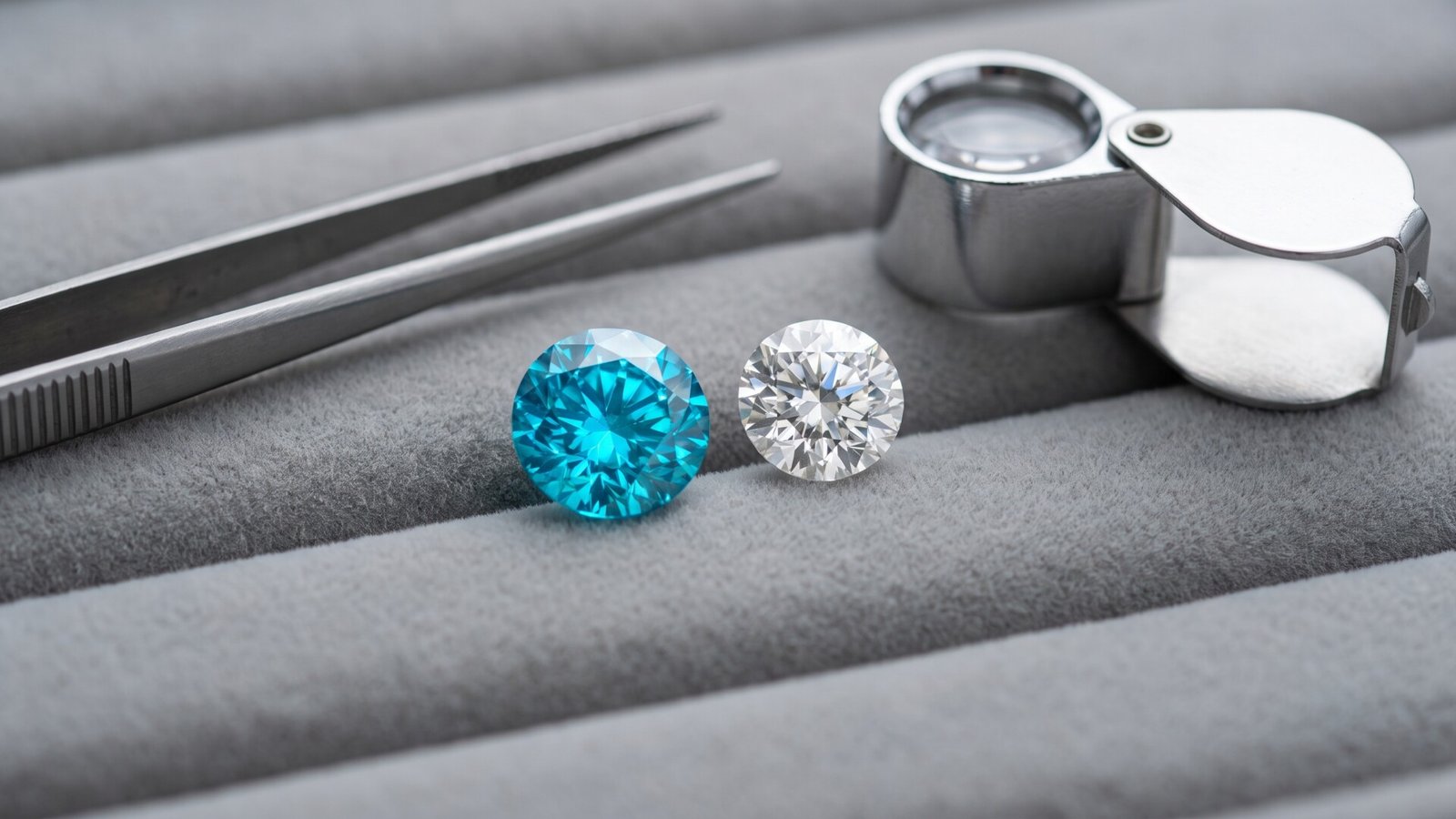
Blue zircon and diamond often get compared for one simple reason: sparkle. Both have exceptional brilliance, and in online photos a well-cut blue zircon can look almost “too sparkly,” which makes people wonder how close it comes to diamond.
The short answer: blue zircon is a bright, colorful gem with real fire, but diamond is far harder, more durable and more stable. This guide breaks down sparkle, hardness, optical performance, durability, price and real-world wearability so you can decide which suits your jewelry. Blue zircon is also one of the stones associated with December; see our December birthstone guide for context, and our full zircon guide for the gem’s background.
Quick Answer: Blue Zircon vs Diamond
- Sparkle: Diamond has higher brilliance and cleaner, sharper flashes. Blue zircon is bright and colorful but a step behind.
- Hardness: Diamond is 10 on the Mohs scale. Zircon is about 6 to 7.5.
- Daily wear: Diamond is made for it. Blue zircon is better in pendants and earrings, or in protective ring settings for occasional wear.
- Price: Blue zircon costs a small fraction of a comparable diamond.
1. What Exactly Is Blue Zircon? (Not to Be Confused with Cubic Zirconia)
Before comparing, clear up one common mix-up: blue zircon is not “zirconia.”
- Zircon is a natural mineral (zirconium silicate, ZrSiO₄).
- Cubic zirconia (CZ) is a lab-made diamond simulant (zirconium dioxide) that is a different material.
Nearly all blue zircon on the market is heat-treated. Brown zircon, mined in places such as Cambodia, is heated to produce blue or colorless stones. GIA notes that some heat-treated zircon can fade back toward its original brown after prolonged exposure to bright light, so treated color is not always permanent.
Blue zircon is loved for its strong dispersion, very high refractive index, intense brightness and noticeable double refraction under magnification. Zircon crystals are also among the oldest minerals ever dated on Earth, which adds to its appeal for collectors. Its weaknesses are mostly about durability, which we cover below.
2. Diamond: The Benchmark for Hardness and Optics
Diamond is a carbon crystal. It is the hardest natural material at 10 on the Mohs scale, highly resistant to scratching, chemically stable and very bright. Contrary to popular belief, diamond is not the stone with the most fire. Some colored gems such as demantoid garnet have higher dispersion. Diamond’s appeal is the balance of brilliance, fire, scintillation and durability in one gem. Read our diamond guide for the full picture.
3. Sparkle Explained: Brilliance, Fire, and Scintillation
“Sparkle” is an umbrella term. Gemologists split it into three parts:
- Brilliance: the amount of white light returned to your eye, which creates overall brightness.
- Fire: the dispersion of white light into colored flashes.
- Scintillation: the pattern of sparkles when the stone or viewer moves.
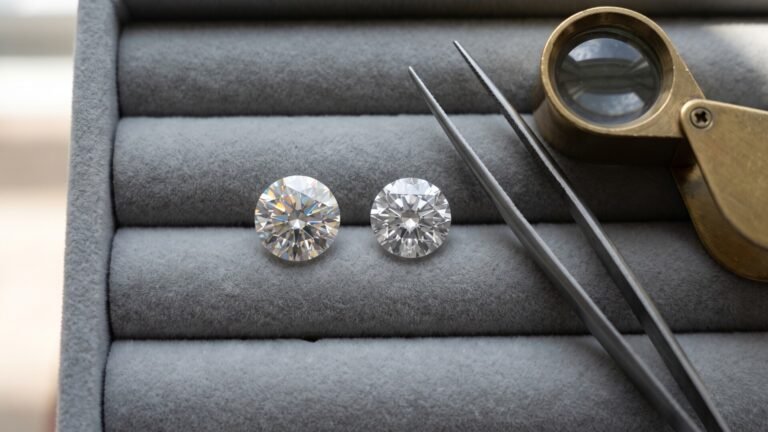
Both stones perform well in all three, but in different ways, and cut quality matters as much as the material. A poorly cut diamond can look duller than a well-cut zircon. See our guide to gemstone shapes and cuts.
4. Refractive Index: Blue Zircon and Diamond Compared
Refractive index (RI) is a major driver of brilliance.
- Blue zircon RI: about 1.92–1.98
- Diamond RI: about 2.42
Diamond’s higher RI gives it stronger brightness, crisper contrast and more intense on-off sparkle. Zircon’s RI is still very high compared with most gems, which is why it looks lively. Zircon also has something diamond lacks: strong double refraction, which gives it a different visual character.
5. Dispersion: How Close Is Blue Zircon to Diamond?
Dispersion (fire) measures how much white light splits into spectral colors.
- Blue zircon dispersion: about 0.039
- Diamond dispersion: about 0.044
The numbers are close, and diamond is slightly higher. The reason blue zircon can still look fiery is its body color: a blue stone can make colored flashes stand out against a vivid background, and doubled facet images under magnification add visual busyness. In plain terms, blue zircon’s fire is real but not stronger than diamond’s.
- Diamond: cleaner, more balanced fire.
- Blue zircon: lively, colorful flashes set against a strong blue body color.
6. Double Refraction: The Wildcard in Zircon
Diamond is singly refractive. Zircon is doubly refractive (birefringent): light entering the stone splits into two rays. Under magnification, the back facet edges appear doubled. To the naked eye, this adds a lively, slightly “busy” look, and cutters often orient zircon so that the doubling is less visible through the table.
The downsides are a fuzzy look in poorly cut stones, and lower sharpness in facet definition. This is one reason experienced buyers look at the cut closely and prefer stones from reputable sellers.
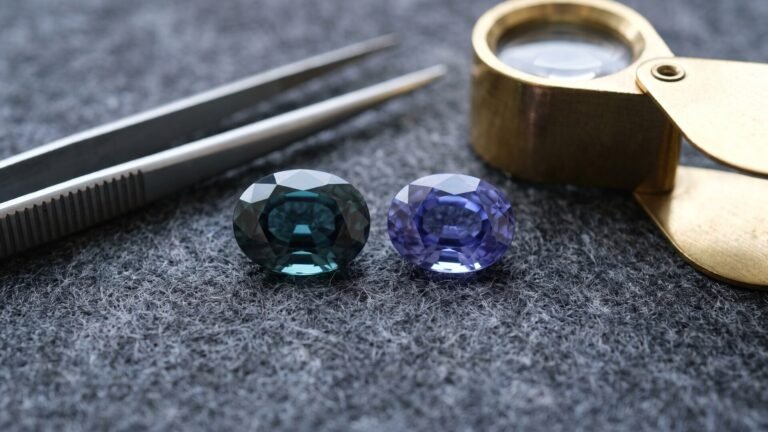
7. Color Influence: Why Blue Zircon Feels “Electric”
Diamond sparkle is neutral because a diamond is essentially colorless. Blue zircon’s body color boosts contrast: a saturated sky-to-electric blue makes light flashes look brighter and more dramatic. This is a perception effect, similar to why a vivid sapphire can look more lively than its optical numbers suggest. For more on color causes, see the science behind gemstone colors.
8. Hardness Comparison: Not in the Same Category
This is the biggest difference and it matters for every buyer. Hardness is scratch resistance. Our guide to the gemstone hardness scale explains why the numbers are not evenly spaced.
Diamond Hardness
- 10 on the Mohs scale
- Extremely scratch-resistant
- Excellent for daily wear, engagement rings and wedding bands
Blue Zircon Hardness
- About 6 to 7.5 on the Mohs scale, depending on the crystal
- Prone to abrasion, so facet edges can soften and look worn
- Can chip if hit
Worn daily, zircon can lose its crisp faceting and look hazy over time, and its sparkle will drop as the facets abrade. GIA says zircon can be worn in all jewelry types but should be protected from hard blows and from rubbing against other materials.
9. Toughness: Resistance to Breaking
Hardness is scratch resistance, while toughness is resistance to breaking or chipping.
- Diamond: good toughness, but it can cleave along certain planes if struck hard. Chips are uncommon in normal jewelry wear.
- Blue zircon: GIA rates its toughness as fair to good, and describes it as somewhat brittle. Pointed corners (pear, marquise, trillion) are the weak spots, so exposed settings are not recommended.
10. Stability: Light, Heat, and Chemicals
- Diamond: extremely stable. It resists most chemicals and does not change color from light. Ultrasonic cleaning is usually safe, except for diamonds with fractures or fillings.
- Blue zircon: stable with chemicals, but some heat-treated stones can fade after long exposure to bright light. Per GIA, ultrasonic and steam cleaners are not recommended. Avoid sudden temperature changes.
This makes blue zircon a higher-maintenance choice than diamond. Clean it with warm soapy water and a soft brush.
11. Real-World Wearability: Daily vs Occasional Jewelry
Diamond
- Suitable for everyday wear, rings and bridal jewelry
- Holds its polish for decades
- Rarely chips in normal wear
Blue Zircon
- Very good in pendants and earrings, where it faces few knocks
- Acceptable in rings only with protective settings (bezel or halo) and mostly occasional wear
- Not ideal for daily-wear rings
- Store it separately so harder stones do not scratch it
For collectors, zircon is a wonderful gem. For daily-wear rings, its limits matter. For more ideas on pairing the right gem to the right piece, see our birthstone jewelry guide.
12. Sparkle: Which One Looks Better?
It depends on what you value.
- Diamond: clean, sharp brilliance, strong white light, balanced fire, crisp facet reflections and very high scintillation.
- Blue zircon: bright flashes, colorful fire, a lively look from double refraction and a strong blue body color that gives it an “electric” appearance.
Diamond is more refined and consistent; zircon is more colorful and dramatic.
13. Price and Value Comparison
Blue zircon is one of the more affordable ways to get a bright, vivid blue stone. Online dealers list smaller blue zircons from about $80 to $200 per carat, while large, high-saturation stones can reach about $1,000 or more per carat. A natural diamond of similar size costs many times more, and prices depend on color, clarity, cut and carat weight. Check current listings before buying, because prices vary by seller and stone.
Diamond
- Well-established grading system (color, clarity, cut, carat)
- Consistent pricing across sellers, but resale value is usually well below retail, as with most jewelry
- Lab-grown diamonds are real diamonds at lower prices; see natural vs lab-grown birthstones
Blue Zircon
- Much lower price per carat
- Less standardized pricing, with value driven by color saturation, cut and size
- Limited resale market, so buy for enjoyment and not as an investment
14. Why People Sometimes Choose Blue Zircon Instead
Even though zircon does not match diamond for durability, it offers things diamond does not: intense blue color, lively brightness, an unusual look and an affordable price. For someone who wants a distinctive, sparkly stone for occasional wear, it can be an excellent choice.
If the goal is a diamond look for a daily ring, blue zircon is not the right substitute. Better alternatives are lab-grown diamond, moissanite or white topaz; our moissanite vs white topaz vs diamond comparison and moissanite vs lab diamond explain the trade-offs. If you want a blue stone with higher durability, consider sapphire (see our sapphire guide and sapphire vs blue topaz) or tanzanite (see tanzanite, which has its own durability caveats).
15. Side-by-Side Summary (Sparkle & Hardness)
| Property | Blue Zircon | Diamond |
|---|---|---|
| Refractive index | About 1.92–1.98 | About 2.42 |
| Dispersion | About 0.039 | About 0.044 |
| Double refraction | Strong | None |
| Brilliance | Very high | Extremely high |
| Fire | Colorful, lively | Balanced and sharp |
| Hardness (Mohs) | 6–7.5 | 10 |
| Toughness | Fair to good, somewhat brittle | Good |
| Light and heat | Some heat-treated stones can fade | Excellent |
| Cleaning | Warm soapy water; no ultrasonic or steam | Ultrasonic usually safe |
| Rings for daily wear | Limited | Ideal |
| Price | From about $80–$200 per carat for small stones | Many times higher |
16. Which Should You Choose?
Choose Blue Zircon If:
- You want dramatic blue color and strong sparkle on a smaller budget
- You prefer a distinctive gem over a classic one
- You are buying a pendant, earrings or an occasional-wear ring
- You enjoy collecting gems with a long geological history
Choose Diamond If:
- You want daily-wear durability
- You need long-term sparkle retention
- You are buying an engagement or anniversary ring
- You want sharp, clean brilliance
Buying Tips for Blue Zircon
- Ask whether the stone is heat-treated (nearly all are) and whether the seller knows about color stability.
- Look for even, saturated blue and a good cut rather than the largest size.
- Choose bezel or halo settings for rings, and avoid sharp corners.
- Make sure the product is zircon and not cubic zirconia or synthetic spinel sold as “blue zircon.”
- Compare sellers and return policies, because stones vary widely in cut and color.
Common Myths About Blue Zircon and Diamond
- “Zircon is a fake diamond.” No. Zircon is a natural gemstone with its own chemistry. It has been used in jewelry for a very long time and is sold as zircon; the confusion comes from its name resembling cubic zirconia.
- “Diamond has the most fire of any gem.” Not quite. Diamond’s fire is strong and well balanced, but some colored gems, such as demantoid garnet, have higher dispersion.
- “Hardness means a stone cannot break.” Hardness measures scratch resistance only. Diamond can still chip along cleavage planes, and zircon’s brittleness is why its pointed corners need protection.
- “Blue zircon is a natural-color blue.” Almost all blue zircon owes its color to heat treatment of brown zircon, which is a standard, accepted practice but should be disclosed.
Choosing a Setting and Jewelry Style for Blue Zircon
Because zircon’s facet edges can abrade, the setting does a lot of the protective work. A bezel setting shields the girdle (the stone’s edge) from knocks, a halo of smaller stones adds a buffer and a low-profile design reduces snagging. Round and oval cuts have no fragile points, while pear, marquise and trillion cuts need V-prongs or bezels to guard their corners. Pendants, drop earrings and brooches are the lowest-risk styles. Cool-toned metals such as white gold, platinum and silver complement the blue, while yellow gold gives a warmer contrast. If you are thinking about gifting the stone for a December birthday, our December birthstone guide lists the other options for the month, and the birthstone jewelry guide helps you match stone to piece.
Frequently Asked Questions About Blue Zircon Vs Diamond
Does blue zircon sparkle as much as diamond?
Blue zircon is very bright and lively, but diamond has a higher refractive index and sharper, crisper sparkle. A well-cut zircon can still look impressive, especially with its blue color.
Is blue zircon the same as cubic zirconia?
No. Zircon is a natural mineral, while cubic zirconia is a lab-made diamond simulant that is a different material.
Is blue zircon hard enough for an engagement ring?
It is rated about 6 to 7.5 on the Mohs scale and can be somewhat brittle, so it is not a first choice for a daily-wear ring. With a protective setting and care, it can work for occasional wear.
Is blue zircon natural or treated?
The stone is natural zircon, but nearly all blue zircon is heat-treated to produce its color. Some treated stones can fade after prolonged exposure to bright light.
How much does blue zircon cost?
Small blue zircons are commonly listed from about $80 to $200 per carat, while larger, highly saturated stones can cost around $1,000 or more per carat.
How do I clean blue zircon?
Use warm soapy water and a soft brush. GIA does not recommend ultrasonic or steam cleaners for zircon.
Final Verdict: Which Sparkles More? Which Lasts Longer?
- Sparkle: Diamond is cleaner and more precise. Blue zircon is colorful and lively.
- Hardness: Diamond wins by a wide margin. Blue zircon is more delicate.
- Daily wear: Diamond is ideal. Blue zircon suits pendants, earrings and occasional rings.
Blue zircon gives you a bright, colorful sparkle at a modest price, while diamond gives you a lifetime of brilliance. Both are beautiful, but they serve different purposes. To keep exploring, visit our gemstones hub, the zircon meaning page and the December birthstone page.