Citrine: Meaning, Properties, Uses & Value
Most of the golden-orange “citrine” sold in jewelry stores is not natural citrine at all. It is amethyst or smoky quartz that has been heated to turn it yellow to orange-brown. That is a stable, widely accepted treatment, and the stone is still real quartz, but it is the single most important thing to understand before buying citrine.
This guide covers what citrine is, how its color forms, natural versus heat-treated stones, what it symbolizes, why it is a November birthstone, how durable it is, how much it costs, how to tell real from fake, and how to care for it. If you want a deeper look at history and spiritual traditions, see our citrine meaning guide.
Quick Facts Box
Gemstone Overview
| Category | Details |
|---|---|
| Mineral: | Quartz (silicon dioxide, SiO₂), yellow to orange-brown variety |
| Color(s): | Pale yellow to golden-orange to brownish-orange |
| Hardness (Mohs): | 7 |
| Toughness / cleavage: | Good toughness for a gem; no cleavage, conchoidal fracture. It can still chip from sharp blows |
| Crystal system: | Hexagonal (trigonal) |
| Transparency: | Transparent to translucent |
| Common treatment: | Heat treatment of amethyst or smoky quartz (stable and permanent) |
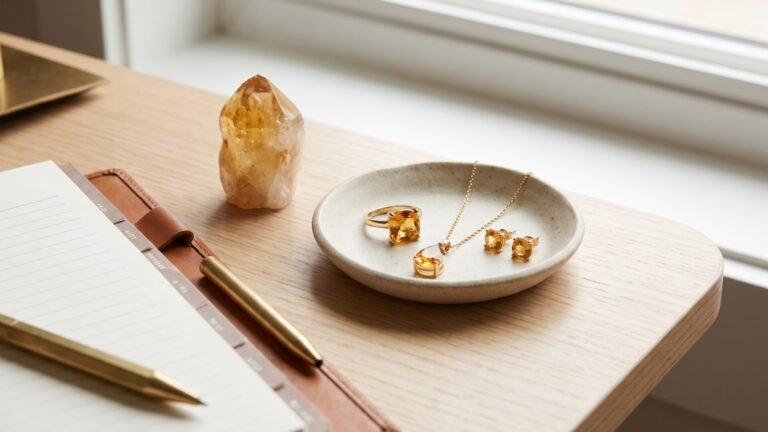
| Common uses: | Rings, necklaces, earrings, bracelets, brooches, large statement pieces |
| Birthstone month(s): | November (modern list, alongside topaz). Often given for the 13th wedding anniversary on modern anniversary lists |
| Zodiac association: | Commonly linked with Scorpio (October 23 – November 21) and Sagittarius (November 22 – December 21); zodiac stone lists vary by source |
What Is Citrine?
Citrine is quartz.
It is the same mineral as amethyst (purple), smoky quartz (brown/gray), rose quartz (pink), and rock crystal (colorless). Its chemical formula is SiO₂, silicon dioxide. The differences between quartz varieties come down to trace elements and natural or artificial irradiation and heat.
The Color Cause
The yellow to orange color of citrine is generally attributed to iron-related color centers in the quartz structure. Amethyst gets its purple color from iron and natural irradiation, and heating changes the way that iron absorbs light, which is why amethyst can turn yellow to orange when heated.
Natural vs. Treated Citrine
Natural citrine is relatively rare. It is typically pale yellow to pale golden, with a subtle, understated color. Natural citrine can form when iron-bearing quartz is exposed to natural heat and radiation in the earth.
Heat-treated citrine is far more common. The great majority of citrine on the market starts as amethyst (or sometimes smoky quartz), often from Brazil. When heated to several hundred degrees Celsius (commonly cited around 400–500°C or 750–930°F), the color changes to yellow, orange or orange-brown.
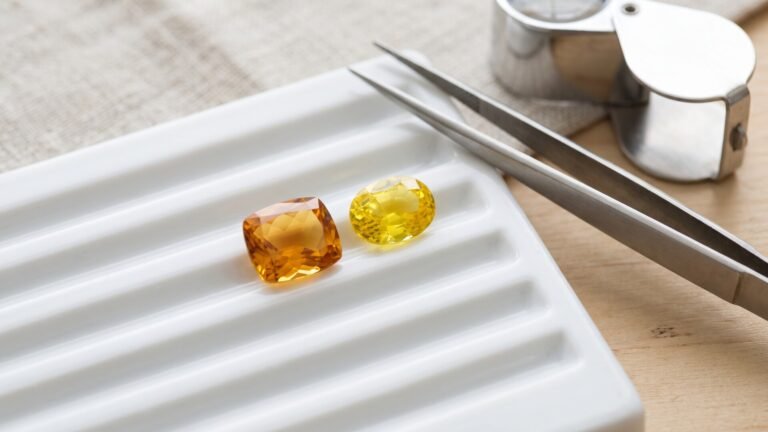
This treatment is considered permanent under normal wear, so heat-treated citrine is a real, stable gem. It is quartz, and it is a legitimate product when sold honestly, but it is priced differently from natural material and should be disclosed. Some dealers label the material “heated amethyst” or simply “citrine,” and in practice the word “citrine” in a jewelry store usually means heat-treated quartz unless the seller says “natural citrine.”
The Name
The name “citrine” comes from the French word “citron,” meaning lemon, reflecting its yellow tones.
Where Citrine Is Found
- Brazil: The world’s leading source of both natural citrine and the amethyst that is heat-treated into citrine. The state of Rio Grande do Sul is particularly important.
- Madagascar: Produces natural citrine, sometimes with a slightly smoky tone.
- Bolivia: The Anahi mine is the best-known source of ametrine, the bicolor amethyst-citrine quartz.
- Other sources: Quartz in yellow shades has been reported from Russia (the Ural Mountains), Spain, Argentina, Namibia, Zambia and the United States, among other places. Origin matters little to the price of most citrine.
The Ametrine Connection
Ametrine is a bicolor quartz that combines purple amethyst and golden citrine in a single crystal. It is thought to form when temperature changes during crystal growth produce different color centers in different zones. The best-known source is the Anahi mine in Bolivia.
Citrine Meaning & Symbolism
Citrine carries warm, positive associations that match its sunny color. The meanings below are cultural traditions and beliefs, not scientific facts. For more, see our dedicated citrine meaning guide.
Ancient Associations
Yellow quartz was used as a decorative gemstone in the ancient Mediterranean world, with gem references dating back to Hellenistic Greece, and later in Roman jewelry. Because of its sun-like color, it has often been linked in later tradition with the sun, warmth and vitality.
The Sun Stone
Citrine is often called a “sun stone” because its color evokes sunlight. In some traditions it is thought to carry the warmth and light of the sun.
Prosperity and Abundance
Citrine is traditionally associated with prosperity and abundance, since its golden color evokes gold and wealth. In crystal traditions it is called the “merchant’s stone” or “success stone,” and some believe it attracts wealth and prosperity. This is a belief, and wearing citrine will not change your finances.
Modern Symbolism
Today, citrine is commonly said to symbolize:
- Abundance and prosperity: Traditionally linked with wealth and success
- Joy and positivity: Its sunny color is associated with optimism
- Creativity: Often seen as a stone of ideas and manifestation in crystal traditions
- Energy and vitality: Linked with the warmth of the sun
- Confidence and self-esteem: Associated with self-expression and personal power
The Thanksgiving Connection
For people born in November, the month of Thanksgiving in the United States, citrine’s golden color suits the autumn theme of harvest and gratitude.
Citrine Healing Properties: Belief and Tradition
Important: This section describes beliefs from crystal-healing traditions only. Gemstones are not medicine, and nothing here is medical advice or a treatment claim. If you are struggling with your health or mood, please speak to a qualified professional. This is consistent with our site disclosure that meanings and properties are based on cultural traditions and beliefs.
Emotional associations
In modern crystal practice, citrine is associated with:
- Uplifting mood: Its sunny look is symbolically linked with brightness and optimism
- Confidence: Seen as a stone of self-esteem and personal power
- Creativity: Used as a symbolic focus for new ideas
- Manifestation: Used as a focus for intentions and goal-setting
The “Success Stone”
Citrine is widely known as the “success stone” or “merchant’s stone” in crystal traditions, where it is symbolically associated with:
- Abundance and prosperity
- Business and career ambitions
- Motivation and goal-setting
Body-area associations in crystal lore
Some crystal-healing writers loosely link citrine with the upper abdomen and the solar plexus. These are symbolic associations used in meditation and energy-work traditions, not claims that citrine affects any organ or condition.
Chakra Associations
Citrine is primarily associated with the solar plexus chakra (Manipura), the energy center at the upper abdomen linked in these traditions with personal power, confidence and will. Some traditions also associate it with the sacral chakra (creativity) and the crown chakra (spiritual connection). Sources do not agree, and these are spiritual beliefs rather than evidence-based claims.
Citrine Colors & Varieties
The Color Spectrum
- Pale lemon yellow: The lightest shade. Often natural, sometimes treated.
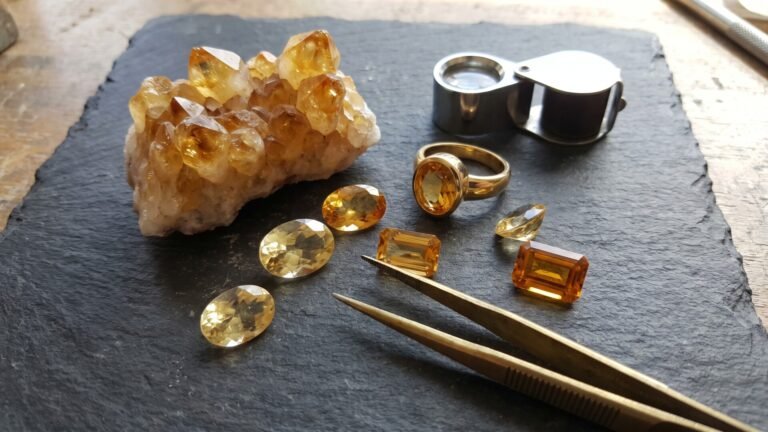
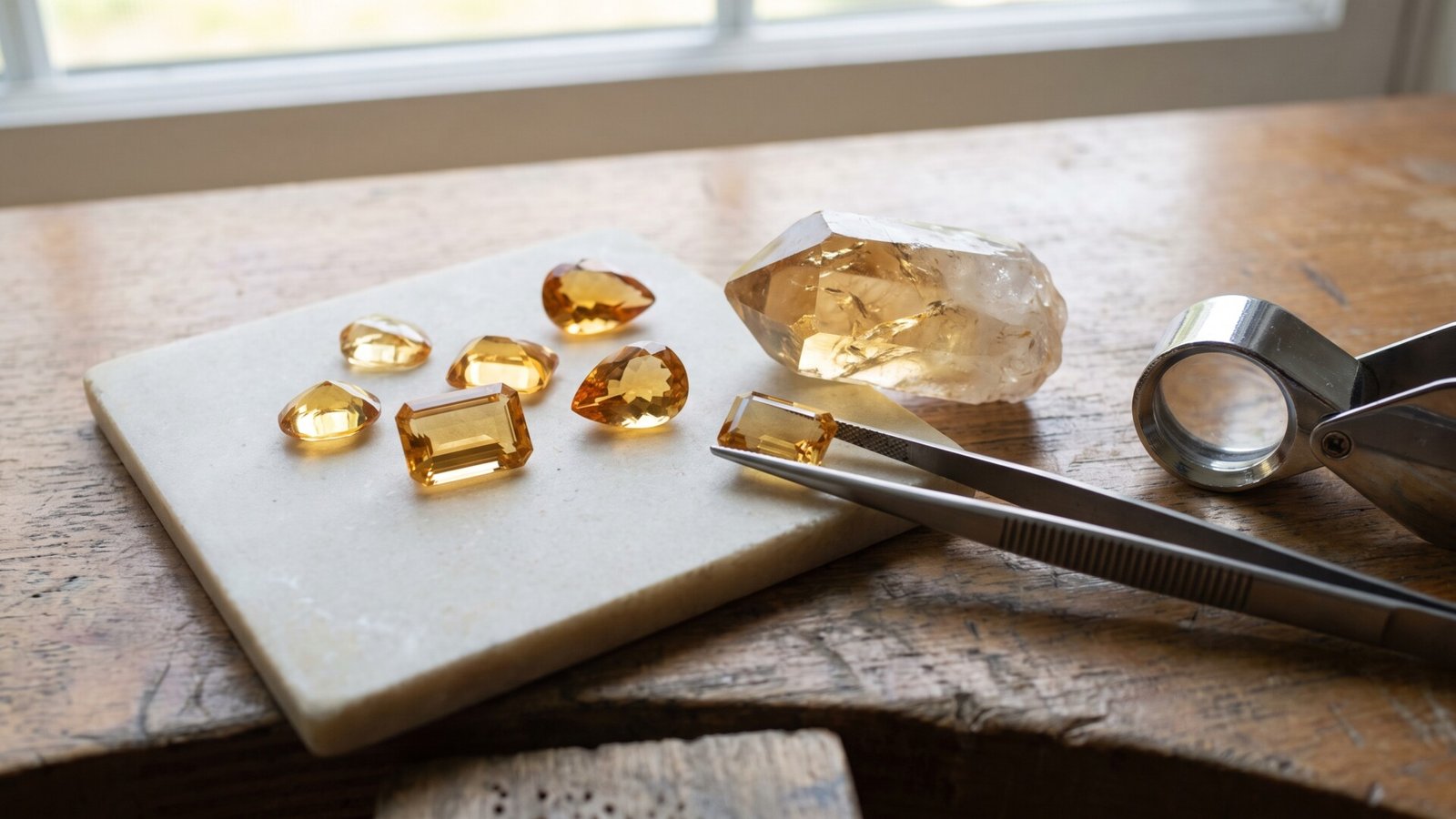
- Golden yellow: The classic citrine color, warm and sunny.
- Honey yellow: Richer, with a slight brownish cast.
- Madeira orange: Deep orange to reddish-orange, named after the fortified wine. It is the most prized color in the trade, and most of it is heat-treated.
- Brownish-orange: Darker, sometimes approaching smoky quartz.
The Madeira Standard
The finest citrine color is often called “Madeira,” after the deep orange-red wine from Portugal’s Madeira islands. True Madeira citrine has a rich, saturated orange with a hint of red. Most Madeira citrine on the market is heat-treated amethyst; natural stones of this color are very uncommon.
Ametrine
Ametrine is a bicolor quartz with zones of purple amethyst and golden citrine in the same crystal. Stones with sharp color boundaries and good saturation are the most prized. You can read more about the purple half of ametrine in our amethyst guide.
Prasiolite (Green Quartz)
Prasiolite, also called green quartz, is sometimes grouped with citrine in the trade. Much of it is amethyst heat-treated to a pale green, although natural prasiolite also exists. It is not citrine but belongs to the same quartz family.
Smoky Quartz and Citrine Look-Alikes
Smoky quartz is brown to gray and can be mistaken for dark citrine. Golden “citrine” is also sometimes sold under misleading names such as “Madeira topaz” or “citrine topaz,” which can be confusing because topaz is a different mineral. Look for plain “citrine” or “quartz” on a label, and ask what the stone really is if the name implies topaz.
The Heat-Treatment Connection
Because most citrine is heat-treated amethyst, the original amethyst and the heating conditions affect the final color. Different amethyst sources and different heating temperatures give a range of results, from pale yellow to deep orange-brown, which is one reason colors in the trade vary so widely.
Is Citrine a Birthstone?
November Birthstone
Yes. Citrine is one of two modern birthstones for November, alongside topaz. Birthstone lists vary by country and organization, so you may see slightly different November stones depending on the source.
Why Two Stones?
The dual November birthstone reflects a long history of confusion. For centuries, many golden-yellow gems were called “topaz” regardless of what they actually were, and yellow quartz was often sold under the name of topaz. Citrine was added alongside topaz on the modern lists in the 20th century, partly because the two stones look similar and citrine is more affordable.
Citrine vs. Topaz at a Glance
| Feature | Citrine | Topaz |
|---|---|---|
| Mineral | Quartz | Topaz (a different mineral) |
| Mohs hardness | 7 | 8 |
| Cleavage | None | Perfect cleavage in one direction |
| Typical price | Usually very affordable | Usually higher for natural golden stones |
| Common treatment | Heat treatment of amethyst | Irradiation and heat (especially for blue topaz); other colors vary |
Wedding Anniversaries
On some modern anniversary lists, citrine is a suggested gem for the 13th wedding anniversary, while the traditional 13th-year gift is often listed as lace. Anniversary lists vary, so check the one your family follows.
Zodiac Associations
Citrine is commonly listed for Scorpio (October 23 – November 21) and Sagittarius (November 22 – December 21), as well as for some other signs, depending on the astrological tradition. These zodiac lists are not standardized and are a matter of belief.
Citrine Uses in Jewelry
Durability Considerations
At 7 on the Mohs scale, citrine is as hard as amethyst and other quartz. Hardness measures scratch resistance, not toughness. Citrine has no cleavage and good toughness for a gem, but sharp knocks can still chip edges and corners. Everyday dust contains tiny quartz particles, so over years it can dull the polish of a ring worn daily, and harder stones such as sapphire, diamond and topaz can scratch it.
Jewelry Recommendations
- Rings: Suitable for regular wear with sensible care. Protective settings (bezel, halo, low profile) are wise, and large exposed stones are best removed for heavy work.
- Earrings: Excellent choice, with minimal wear and tear.
- Pendants and necklaces: Very safe, since they are protected from impact.
- Bracelets: Use some caution, as bracelets knock against surfaces.
- Brooches and pins: Excellent, protected by clothing.
Popular Jewelry Types
- Rings: Solitaires, cocktail rings, three-stone designs, men’s rings
- Earrings: Studs, drops, chandeliers
- Pendants: Single stones in simple settings, often surrounded by diamonds
- Bracelets: Tennis bracelets, bangles with citrine accents
- Brooches: Popular in vintage and Art Nouveau styles
The Size Advantage
Citrine is abundant and available in large sizes, so it suits statement jewelry. Stones of 10 carats and above are widely available, which lets designers create bold pieces at accessible prices.
Metal Choices
- Yellow gold: Traditional choice, enhances citrine’s golden tones
- Rose gold: Romantic complement, especially for orange shades
- White gold and platinum: Modern contrast, often used with pale lemon citrine
- Silver: Affordable option that works with all citrine colors
Citrine Value & Price
Citrine is one of the more affordable gemstones, because heat-treated material is plentiful. Natural, untreated citrine of good color is scarcer and usually costs more.
What Affects Price
Color is the most important factor. Rich, saturated golden to orange stones (Madeira) generally cost the most, and very pale or very brown stones cost less.
Clarity matters. Citrine is often eye-clean, so visible inclusions reduce value.
Cut affects both beauty and price. A well-cut stone shows more brilliance, while a poor cut can look dark or dull.
Size has a moderate effect. Because citrine is abundant in large sizes, price per carat does not climb as steeply as with rarer gems.
Natural vs. treated is another major factor. Untreated natural citrine is rarer and typically priced higher than heat-treated stones, although the difference depends on the seller and the lab documentation.
Approximate Price Ranges (USD)
Note: These are rough retail ranges per carat for loose, well-cut stones and vary by seller, size and quality. We have not verified them against a current market survey, so use them only as a guide.
- Heat-treated citrine, pale to golden, commercial to good quality: roughly $5–$30 per carat
- Heat-treated citrine, fine golden to Madeira orange: roughly $30–$100 per carat
- Natural, untreated citrine: usually priced above heat-treated stones of similar color; ask for a laboratory report to verify
- Ametrine: commercial stones are modestly priced, while fine Bolivian ametrine with sharp color zones costs more
As a rough guide, a 10-carat well-cut golden citrine is often affordable in the hundreds of dollars, which is why citrine is popular for large cocktail rings and pendants. Citrine is bought for its look and meaning, and should not be seen as a financial investment.
Natural vs. Treated Citrine: How to Tell
This is the most common question about citrine, and the honest answer is that it is hard to tell at home.
Why It Matters
Natural citrine is scarcer, while treated citrine is common and affordable. Both are real quartz, but they should be priced and disclosed accordingly.
Clues (Not Proof)
- Color: Very deep orange to reddish-orange stones are usually heat-treated amethyst. Natural citrine is more often pale yellow to pale golden.
- Zoning: Under magnification, color banding or zoning can be seen in both natural and treated stones, and it is not a reliable test on its own.
- Price: Large, vivid orange stones at very low prices are almost certainly heat-treated.
The Best Approach
- Ask the seller: Reputable dealers disclose whether citrine is natural or heat-treated.
- Request documentation: For valuable stones, a gemological laboratory report is the most reliable way to find out, although even labs cannot always be certain.
- Know the price: If it is priced like common citrine, assume it is treated. If it is priced at a premium, ask why.
How to Identify Real vs Fake Citrine
Common Imitations and Look-Alikes
- Glass: Softer, may show bubbles under magnification, and feels warmer to the touch than quartz.
- Synthetic (lab-grown) quartz: Lab-grown citrine exists and has the same chemistry as natural quartz. It is a real quartz but should be sold as lab-grown, not as natural.
- Yellow topaz: Harder (8), with perfect cleavage, and often more expensive.
- Yellow sapphire: Much harder (9) and far more expensive.
- Calcite and other soft yellow stones: Much softer, so they scratch easily.
Visual Clues
- Inclusions: Look for natural quartz features such as tiny crystals, veils or growth tubes. Perfectly clean, bubble-containing stones may be glass.
- Luster: Citrine has a vitreous (glassy) luster typical of quartz.
- Feel: Quartz feels cool to the touch, glass tends to warm up faster.
The Best Approach
Buy from reputable sellers with clear return policies, and use gemological testing for valuable stones. For more on spotting imitations in a related quartz, see our guide on how to spot fake amethyst jewelry.
Care & Cleaning of Citrine
Citrine is relatively easy to care for, but proper handling keeps it looking its best.
The safest method: warm soapy water.
- Use lukewarm water and a few drops of mild dish soap
- Gently clean with a soft cloth or soft brush
- Rinse thoroughly
- Dry with a soft, lint-free cloth
Ultrasonic cleaners are generally considered safe for clean, untreated-looking citrine, but avoid them if the stone has visible fractures or inclusions, or if it is set with other gems that are sensitive. Steam cleaners are generally safe for sturdy settings, but avoid sudden temperature changes. When in doubt, use soapy water.
Storage Tips
- Store citrine separately from harder stones (sapphire, diamond, topaz) that could scratch it
- Individual soft pouches or compartmentalized boxes are ideal
- Avoid jumbling with other jewelry
What to Avoid
- Harsh chemicals: Bleach, ammonia and other strong cleaners can damage settings and the polish
- Extreme heat and sudden temperature changes: These can cause thermal shock, and excess heat may alter color in some quartz
- Prolonged strong sunlight: Amethyst can fade in strong light, and some heated or irradiated quartz may be light-sensitive, so it is sensible not to leave pieces on a sunny windowsill
- Hard knocks: Citrine can chip if struck sharply
Color Stability
Heat-treated citrine is generally considered color-stable under normal wear. Rare cases of fading from prolonged strong light or heat are reported for some quartz, so ask the seller about stability if you plan to wear a piece in sunny conditions.
The Citrine-Heat Connection: Deeper Dive
The History
Naturally yellow quartz has been used in jewelry for a very long time, but large-scale production of heat-treated citrine is tied to the big amethyst and quartz deposits found in Brazil, which supplied the material that now dominates the market.
The Process
Amethyst is heated in a controlled furnace, typically at several hundred degrees Celsius. The heat changes the iron-related color centers that cause the purple color and produces yellow to orange colors. Results depend on the starting material, so heat treaters sort rough carefully.
The Result
Heat-treated stones make up most of the citrine in the market. They are attractive, affordable and considered stable. The important point for buyers is honest disclosure, not whether the stone is better or worse for having been heated.
Citrine Alternatives and Related Gemstones
If you like citrine’s golden color but want a different budget or hardness, consider topaz, the other November birthstone (harder but with cleavage), amethyst, the purple quartz that most citrine starts as, garnet for warm orange tones, yellow sapphire for much greater hardness at a higher price, or peridot for a yellow-green alternative.
For more stones, browse our Gemstones hub, including tanzanite, turquoise, opal, tourmaline, pearl, aquamarine, moonstone, diamond, emerald, zircon, alexandrite and ruby.
Frequently Asked Questions About Citrine
Is citrine expensive?
Generally no. Heat-treated citrine is one of the more affordable gemstones. Natural, untreated citrine is scarcer and usually costs more, but most citrine on the market is quite affordable.
Is citrine suitable for daily wear?
Often yes, with care. Citrine has a Mohs hardness of 7 and no cleavage, but sharp knocks can still chip it, so a protective setting is wise for rings. Earrings and pendants are very safe.
What does citrine symbolize?
Traditionally, citrine symbolizes abundance, prosperity, joy, positivity and creativity. It is called the merchant’s stone or success stone in crystal traditions. These are cultural beliefs, not scientific facts.
Is citrine a birthstone?
Yes. Citrine is one of two modern birthstones for November, alongside topaz. On some modern anniversary lists it is also suggested for the 13th wedding anniversary.
Is all citrine heat-treated?
No, but most of it is. Natural citrine exists but is scarcer. The great majority of citrine sold in jewelry is heat-treated amethyst or smoky quartz.
What is the difference between citrine and topaz?
Citrine is quartz (Mohs hardness 7). Topaz is a different mineral (hardness 8) with perfect cleavage. They were historically confused because both can be golden-yellow.
What is Madeira citrine?
Madeira is the deep orange to reddish-orange color of citrine, named after the fortified wine. It is the most prized citrine color, and most of it is heat-treated.
What is ametrine?
Ametrine is a bicolor quartz with zones of purple amethyst and golden citrine in the same crystal. The best-known source is Bolivia’s Anahi mine.
Can citrine fade in sunlight?
Heat-treated citrine is generally stable under normal wear. Prolonged strong light or heat may affect some quartz, so avoid leaving citrine jewelry in direct sun for long periods.
How can you tell natural citrine from treated citrine?
It is difficult at home. Natural citrine is usually paler and rarer, while deep orange stones are often heat-treated amethyst. A gemological laboratory report is the most reliable way to check.
Is citrine the same as yellow topaz?
No. Citrine is a variety of quartz, and yellow topaz is a different mineral. Names like Madeira topaz or citrine topaz can be misleading, so ask the seller what the stone really is.
Citrine is a warm, affordable and wearable gem, and knowing how it gets its color helps you buy it with confidence. Whether you are choosing a November birthday gift or a statement ring, look for honest labeling of natural versus heat-treated stones, a good cut and a color you love.
Ready to find your own citrine? Browse the options below, organized by color and style.
[Shop Citrine Jewelry]
[Shop Natural Citrine]
[Shop Ametrine]
[Shop November Birthstone Collection]
Explore More Gemstones at Our Gemstones Hub