Moonstone: Meaning, Properties, Uses & Value
Moonstone is known for a soft, floating glow that seems to drift across the stone as it moves. That effect, called adularescence, is why cultures from ancient Rome to India linked the gem with the moon. Moonstone is one of the three modern June birthstones, along with pearl and alexandrite, and it is also traditionally linked with Gemini and Cancer. It is affordable, romantic, and widely available, but it is also a stone with cleavage and moderate hardness, so how you wear it matters.
This guide covers what moonstone is, how its glow works, what it has meant in different traditions, how much it costs, how to tell real moonstone from imitations, and how to care for it. If you are a June baby looking for an alternative birthstone, or a Gemini seeking a zodiac stone, or you simply like the look of captured moonlight, the sections below will help you choose and care for it.
Moonstone Quick Facts
| Category | Details |
|---|---|
| Mineral group: | Feldspar; moonstone is an intergrowth of orthoclase and albite. Rainbow moonstone is a labradorite (plagioclase feldspar) |
| Color(s): | Colorless, white, cream, peach, pink, gray, green, brown, with a blue, white, or multicolor sheen |
| Hardness (Mohs): | 6 to 6.5 |
| Cleavage and toughness: | Two cleavage directions (one perfect, one good); fair toughness, can chip or split on a sharp blow |
| Crystal system: | Monoclinic (orthoclase moonstone) |
| Transparency: | Transparent to translucent |
| Common treatments: | Usually untreated; some stones are coated, dyed, or backed, and glass imitations are common |
| Birthstone: | June (modern list, alongside pearl and alexandrite) |
| Zodiac association: | Gemini and Cancer on many lists; zodiac stone lists vary |
| Daily-wear rating: | Best in pendants and earrings; rings need protective settings |
What Is Moonstone?
The mineral family
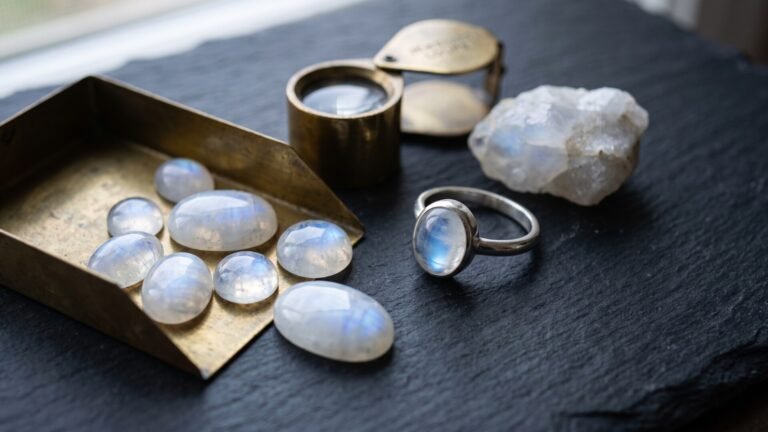
Moonstone belongs to the feldspar group, one of the most abundant mineral groups in the Earth’s crust. Classic moonstone forms when two feldspars, orthoclase and albite, grow together in thin alternating layers as the rock cools. Those microscopic layers are what give the stone its signature look.
Where the glow comes from
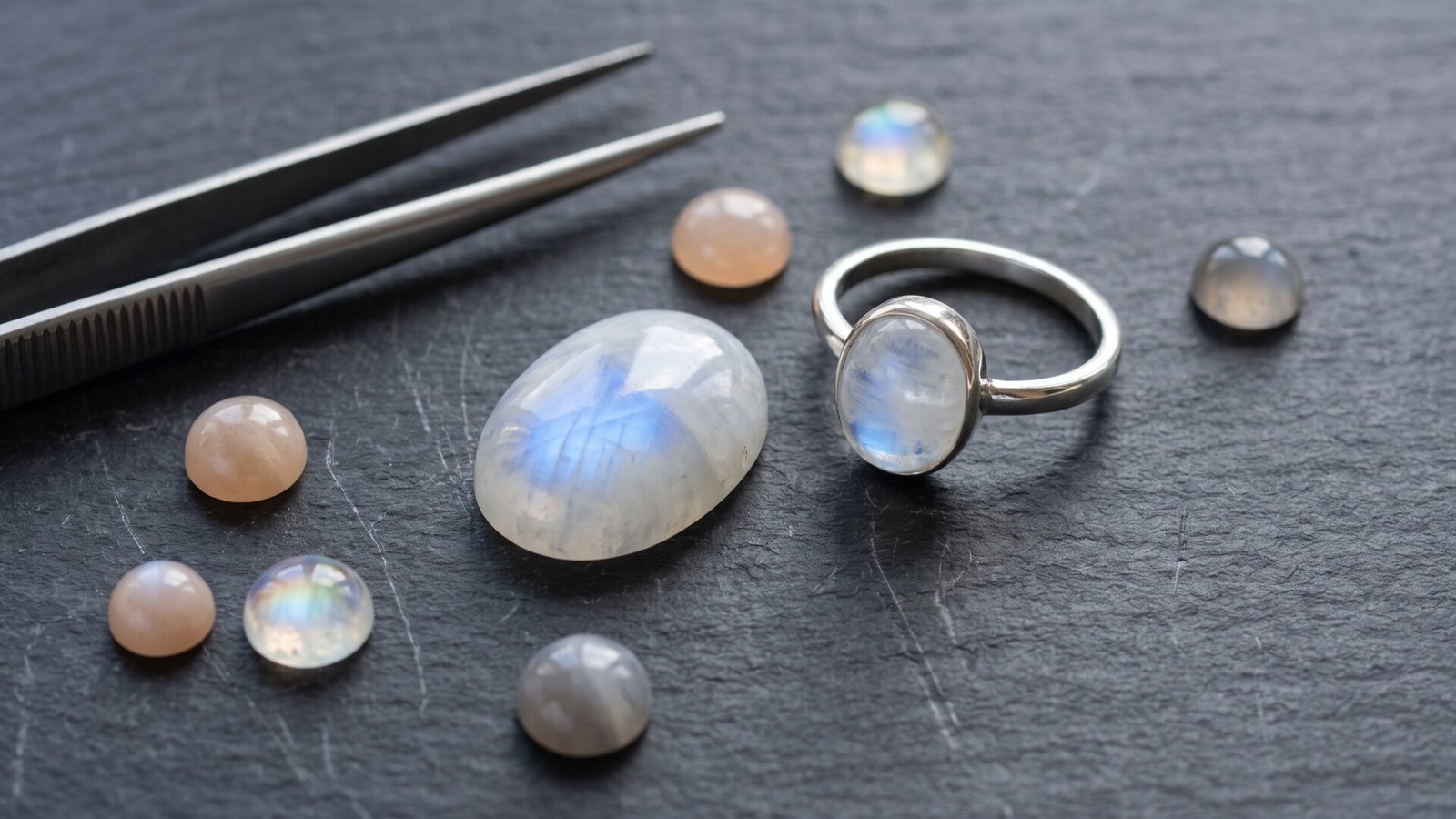
The floating light is called adularescence (sometimes “schiller”), named after the Adula mountains in Switzerland, where early specimens of the related feldspar adularia were found. Light entering the stone scatters between the thin orthoclase and albite layers and emerges as a soft, billowy sheen. When the layers are extremely thin and even, the sheen looks blue, which is the most prized appearance. Thicker or less regular layers give a whiter sheen.
It is why moonstone looks different from faceted gems. It does not flash like a diamond; it drifts, and the effect changes with the angle of the light and the cut. That is why moonstone is usually cut as a smooth, domed cabochon, oriented so the sheen sits in the center.
Other optical effects
Some moonstones show chatoyancy, a cat’s-eye band of light, and a few rare stones show a four-rayed star (asterism). Both are sought by collectors.
Where moonstone is found
Historic fine blue moonstone came from Myanmar (Burma) and Sri Lanka. Today Sri Lanka and India supply much of the world’s moonstone, along with Madagascar, Tanzania, Brazil, Australia, the United States, Armenia, and Norway. Origin should be documented by a seller rather than assumed; a label such as “Burmese” or “Sri Lankan” is not proof on its own.
The Florida connection
Moonstone is the official state gem of Florida, designated in 1970 in connection with the Moon landings, which launched from Kennedy Space Center. The stone does not occur naturally in Florida; it was chosen for its name and its association with the Moon.
Moonstone Meaning & Symbolism
Moonstone’s meanings come from tradition, mythology, and folklore. They are cultural beliefs, not scientific properties. For a deeper look, see Moonstone Meaning: History, Symbolism, Spiritual Properties & Modern Uses.
Ancient Rome and Greece
Roman writers, including Pliny the Elder, described a stone whose glow was said to wax and wane with the Moon, which is often identified with moonstone. Popular accounts add that Romans associated the stone with the lunar goddess and believed it brought love and protection. A frequently repeated tale says the Greeks combined the names of Aphrodite and Selene to create “Aphroselene,” though this naming is better read as popular lore than established history.
India
In India, moonstone is called Chandrakanta, meaning “beloved of the Moon,” and has long been regarded as sacred. Tradition describes it as formed from moonbeams, and some accounts say its glow waxes and wanes with the lunar cycle. In Vedic astrology it is often associated with the Moon. Stories about moonstone and a future-seeing ritual with the stone placed in the mouth under a full moon belong to folklore.
The traveler’s stone and other folklore
Moonstone has been called a “traveler’s stone,” a talisman carried for safe journeys, especially at night. Folk traditions in various places also describe hanging moonstone amulets on trees for good harvests or placing the stone near the bed for restful sleep. These are folk beliefs, not evidence of any effect.
Art Nouveau revival
Moonstone had a notable revival in Art Nouveau jewelry (roughly 1890 to 1910). Designers such as René Lalique and the Tiffany studios favored soft, translucent stones that suited organic, dreamlike designs, and moonstone’s shifting glow fit that style well.
Modern symbolism
- New beginnings and accepting change, linked to the Moon’s phases
- Intuition and emotional awareness, a long-standing lunar association
- Romance, sometimes called the “lover’s stone”
- Travel and protection, from the traveler’s stone tradition
For those born in June, or under Gemini or Cancer, moonstone is often chosen as a symbol of the Moon’s cycles, change, and inner calm. See our jewelry-focused guide, Moonstone Magic: The Best Jewelry for Intuition and New Beginnings.
Moonstone in Crystal Practice: Beliefs, Not Medicine
The following describes beliefs from crystal-healing and spiritual traditions. It is not medical advice. Gemstones do not treat, prevent, or cure any physical or mental health condition, including anxiety, sleep problems, fertility issues, or hormonal changes. Please talk to a qualified health professional about any health concern.
- Emotional balance: In crystal practice, moonstone is often described as a calming, grounding stone that people carry or wear as a reminder to slow down.
- Intuition: It is linked with the third eye chakra and used by some as a focus for meditation or reflection during life transitions.
- Feminine and cyclical themes: Because of its lunar link, some traditions connect moonstone with women’s cycles and life stages. This is symbolic and traditional, not a health claim.
- Love and relationships: The “lover’s stone” tradition treats moonstone as a gift symbolizing devotion.
- Sleep and dreams: A folk belief places moonstone near the bed to encourage restful sleep and vivid dreams. There is no scientific evidence that it affects sleep.
Chakras. Moonstone is most often associated with the sacral chakra (creativity and emotion) and the third eye chakra (intuition), and sometimes the crown chakra.
The left hand / right hand idea
Some crystal practitioners follow a “left receives, right projects” principle: a stone worn on the left hand is said to take in its qualities, while one on the right is said to express them outward. This is a modern spiritual convention, not a rule of jewelry or gemology, and there is no wrong hand. Wear moonstone on whichever hand suits your lifestyle and your ring’s protection needs.
Moonstone Colors & Varieties
“Moonstone” covers a family of feldspar gems with different body colors and types of sheen. Tradition links each to different meanings; those associations below are symbolic.
| Variety | Appearance | Notes |
|---|---|---|
| Blue moonstone | Colorless to translucent body with a blue floating sheen | Most valued; historically from Myanmar and Sri Lanka. Also used loosely as a trade term |
| Rainbow moonstone | White to gray body with multicolored flashes | A labradorite feldspar, not orthoclase; usually affordable |
| White moonstone | White to cream with a white or bluish sheen | The most common type |
| Peach or apricot moonstone | Warm peach to orange body | Less common than white |
| Gray moonstone | Silvery gray body | Popular for modern designs |
| Green moonstone | Pale green body | Less common; the term is sometimes used for other feldspar |
| Black moonstone | Dark gray to black body with a blue or silver flash | Often a labradorite or related feldspar sold under this trade name |
| Cat’s-eye / star moonstone | Shows a band or star of light | Rare and collectible |
Is Moonstone a Birthstone?
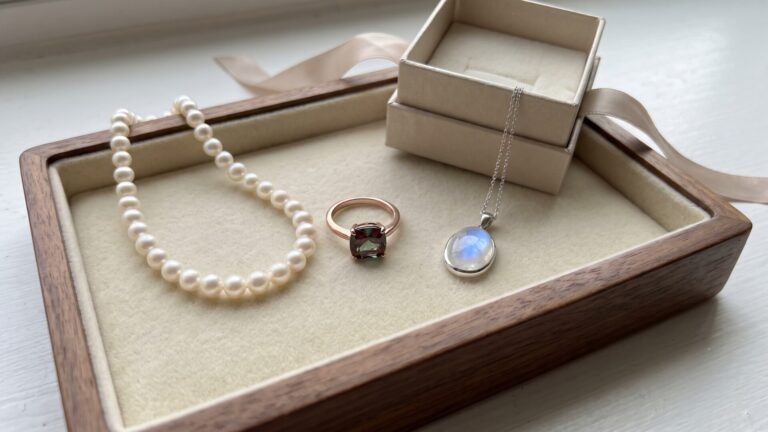
June. The modern U.S. list gives June three birthstones: pearl, alexandrite, and moonstone. Pearl is the classic June stone, moonstone has long been offered as an alternative, and alexandrite was added to the list in 1952. Birthstone lists differ by country and organization, so you may see different June options elsewhere. See our June birthstone guide for the full picture, and our pearl and alexandrite guides for the other two stones.
Zodiac. Many lists give moonstone to Gemini (May 21 to June 20) and to Cancer (June 21 to July 22), the sign ruled by the Moon in astrology. Other signs, including Pisces, Scorpio, and Libra, sometimes appear in modern crystal-practice lists. Zodiac assignments are not standardized and are tradition, not science.
Anniversary. Some gift lists name moonstone for the 13th wedding anniversary. Anniversary lists vary by country and publisher, so check which list you want to follow.
Moonstone Uses in Jewelry
Durability: hardness, cleavage, and toughness
Moonstone has a Mohs hardness of 6 to 6.5. That is softer than quartz (7) and far softer than sapphire (9) or diamond (10), so everyday grit and dust can gradually scratch and dull the surface. Separately from hardness, feldspars have cleavage: orthoclase has one perfect and one good cleavage direction, meaning the stone can split along internal planes if struck sharply. Hardness is scratch resistance; cleavage and toughness describe how a stone handles knocks, and moonstone is only fair on that second measure.
Because of this, gemological sources generally recommend moonstone for pieces that avoid hard daily impact.
| Piece | Suitability | Notes |
|---|---|---|
| Pendants and necklaces | Very good | Low impact risk; a classic showcase for a cabochon |
| Earrings | Very good | Little wear and tear |
| Brooches | Very good | Protected by clothing |
| Bracelets and bead strands | Fair | Can knock on surfaces; beads are less exposed than large cabochons |
| Rings | Fair with care | Best for occasional wear in a bezel or other protective setting |
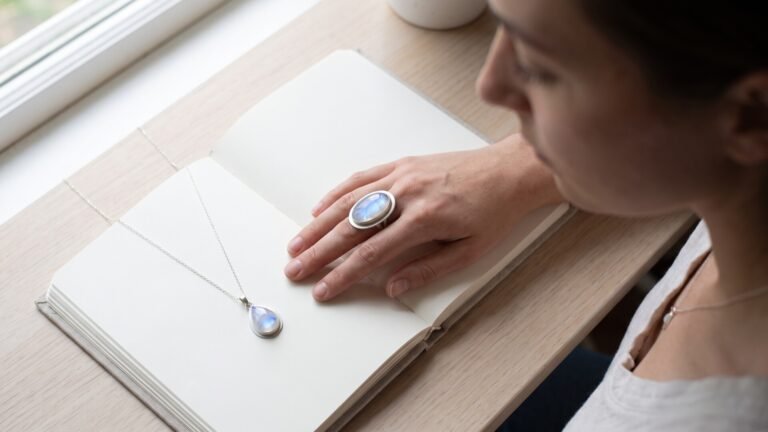
If you choose a moonstone ring, pick a bezel, halo, or recessed setting and remove it for sports, gardening, and cleaning. Moonstone engagement rings exist, but they are a high-maintenance choice that may need re-setting or stone replacement over time.
Metal choices
- Sterling silver: emphasizes the cool, lunar look and keeps prices lower.
- Rose gold: warms peach and white moonstone.
- Yellow gold: traditional and romantic.
- White gold and platinum: a clean, modern frame that lets the sheen stand out.
Moonstone Value & Price
Moonstone is generally affordable, but fine blue-sheen material is priced as a collector’s stone.
What affects price
- Sheen color and strength: a strong blue sheen on a colorless background is the most valuable; white sheen is common.
- Body color and transparency: transparent to semi-transparent stones with a clear body cost more than milky, opaque ones.
- Cut: the sheen should sit in the center of the cabochon and be visible face-up.
- Clarity: eye-visible cracks, cleavage lines, and surface damage lower the price.
- Size: large moonstones are fairly available, so price does not climb as steeply as in rarer gems.
- Origin: historic Burmese and fine Sri Lankan material can carry premiums, when documented.
Indicative price ranges (USD)
Rough, indicative ranges for loose cabochons; actual prices vary by seller and market.
- Commercial white or rainbow moonstone: about $5 to $20 per carat
- Good-quality white or peach: about $20 to $50 per carat
- Fine blue sheen, transparent: about $50 to $300 per carat, higher for exceptional stones
- Cat’s-eye, star, or historic material: collector pricing
Finished jewelry typically ranges from tens of dollars for small silver pieces to several hundred dollars or more for gold settings and larger, finer stones. Moonstone is best bought for enjoyment rather than as an investment.
Natural, Lab-Grown, and Imitation Moonstone
Genuine moonstone is natural feldspar, usually sold untreated. The real concern in the market is imitation, not lab-grown stones. Many items sold as “moonstone,” especially cheap jewelry, are glass or other materials. A lab-grown stone has the same chemistry as its natural counterpart, while a simulant only imitates the look. Sellers should state which one you are buying.
Common look-alikes
- Glass: may show bubbles or swirl marks under magnification and lacks the layered sheen of natural feldspar.
- Opalite (sea opal): manufactured glass with a milky, bluish glow when held against the light. It is not opal and not moonstone.
- Doublets: a slice of moonstone or other material mounted on a backing; look for a flat glue line or abrupt change from the side.
- Plastic: light, soft, and easily scratched.
How to check a stone
Real moonstone’s sheen floats and shifts softly as you turn it; it appears to sit below the surface rather than sit on it as a sharp mirror-like reflection. Under magnification, natural stones may show small inclusions and cleavage lines. Home tests are unreliable, so for a valuable stone ask the seller about treatment and material, check the return policy, and consider a gemological identification.
How to Buy Moonstone
- Choose the piece first: pendants and earrings are the safest picks.
- Look at the stone in different lights and angles; the sheen should be visible face-up.
- Ask whether the material is natural moonstone, and whether it has been dyed, coated, or backed.
- Check for chips, cracks, and surface wear, especially at the edges.
- Confirm the setting protects the stone (bezel or halo for rings).
- Keep the return policy and any documentation.
If you love the soft glow but want something tougher or different, consider opal for play of color (though it is also delicate), pearl for a classic June choice, or sapphire, including pale and white varieties, for much higher durability at a higher price.
Care & Cleaning of Moonstone
Because of its cleavage and moderate hardness, moonstone calls for gentle care.
Safe cleaning
Laboratory guidance such as GIA’s recommends warm soapy water and a soft cloth or soft brush for moonstone, and advises against ultrasonic and steam cleaners, which can stress the stone along its cleavage planes.
- Mix lukewarm water with a few drops of mild dish soap.
- Wipe the stone gently with a soft cloth or use a very soft brush around the setting.
- Rinse with clean lukewarm water and pat dry with a soft, lint-free cloth.
Moonstone is not harmed by ordinary contact with water, but there is no reason to soak it for long, and extended soaking can loosen glue in some settings or affect doublets and treated stones.
What to avoid
- Ultrasonic and steam cleaners: risk of fracture along cleavage planes.
- Harsh chemicals: bleach, acetone, strong acids and household cleaners can damage the surface.
- Hard knocks: remove rings and bracelets during sports, gym work, and chores.
- Sudden temperature changes: can stress a stone with internal fractures.
- Contact with harder stones: diamond, sapphire, and quartz can scratch moonstone.
Storage
Store moonstone in a soft pouch or a lined compartment, separate from harder stones and from jewelry that could scratch it.
“Energetic” cleansing (a spiritual practice)
Many crystal enthusiasts “cleanse” or “recharge” moonstone by placing it in moonlight during the full moon, which is a symbolic practice and is gentle on the stone. Smudging with smoke or resting the stone on a quartz cluster are other common practices. Note that these are belief-based rituals and do not physically clean the stone.
Explore More Moonstone and Gemstone Guides
- Moonstone Meaning: History, Symbolism, Spiritual Properties & Modern Uses
- Moonstone Magic: The Best Jewelry for Intuition and New Beginnings
- June Birthstone: Meaning, Symbolism, and Jewelry Guide
- Related gemstones: Pearl, Alexandrite, Opal, Sapphire, and Tourmaline
Frequently Asked Questions About Moonstone
Is moonstone expensive?
Usually not. Commercial white and rainbow moonstone is affordable, often a few dollars per carat. Fine, transparent blue-sheen stones cost considerably more and are priced as collector material.
Is moonstone suitable for daily wear?
It depends on the piece. Pendants and earrings are well suited to regular wear. Rings are riskier because moonstone has cleavage and a hardness of only 6 to 6.5, so choose a protective setting and remove the ring for sports, chores, and other activities with impact.
What does moonstone symbolize?
Traditionally moonstone is associated with the Moon, intuition, new beginnings, emotional balance, romance, and safe travel. These are cultural and symbolic meanings, not scientific properties.
Is moonstone a birthstone?
Yes. Moonstone is one of the three modern June birthstones, alongside pearl and alexandrite, and is a traditional zodiac stone for Gemini and Cancer on many lists.
Can moonstone get wet?
Ordinary contact with water will not harm genuine moonstone. Still, avoid long soaking, which can loosen glue in some settings, and remove jewelry before swimming or showering to protect the metal, the setting, and the stone from knocks.
What is rainbow moonstone?
Rainbow moonstone is a colorless to white labradorite feldspar that shows multicolor flashes. It is sold under the moonstone name in the trade, though it is a different feldspar from classic orthoclase-albite moonstone.
Can moonstone be used in an engagement ring?
It can, but it is a high-maintenance choice. Use a bezel or other protective setting, wear it with care, and expect it to need more attention than a sapphire or diamond.
How can you tell real moonstone from fake?
Real moonstone shows a soft sheen that appears to float beneath the surface and shifts as you move the stone. Imitations in glass or plastic often have flat, sharp, or uniform effects. Ask the seller about the material, and consider a gemological identification for valuable pieces.
Is opalite the same as moonstone?
No. Opalite, also sold as sea opal, is manufactured glass. It can look milky blue but is not opal or moonstone.
What is the rarest type of moonstone?
The most valuable is transparent, colorless moonstone with a strong, pure blue sheen. Cat’s-eye and star moonstones are also uncommon.
How do I clean moonstone?
Use lukewarm water, mild soap, and a soft cloth, rinse, and pat dry. Avoid ultrasonic and steam cleaners and harsh chemicals.
Final Thoughts on Moonstone
Moonstone is best appreciated as a gentle, glowing stone with a long tradition behind it. Treat it as a piece for pendants, earrings, and occasional rings, ask whether you are buying genuine feldspar, and enjoy the Moon-linked symbolism as part of its cultural story. Browse the retailer options below.
[Shop Moonstone Jewelry]
[Shop June Birthstone Collection]
[Shop Rainbow Moonstone]
[Shop Blue Moonstone]
Explore more gemstones at our Gemstones Hub.