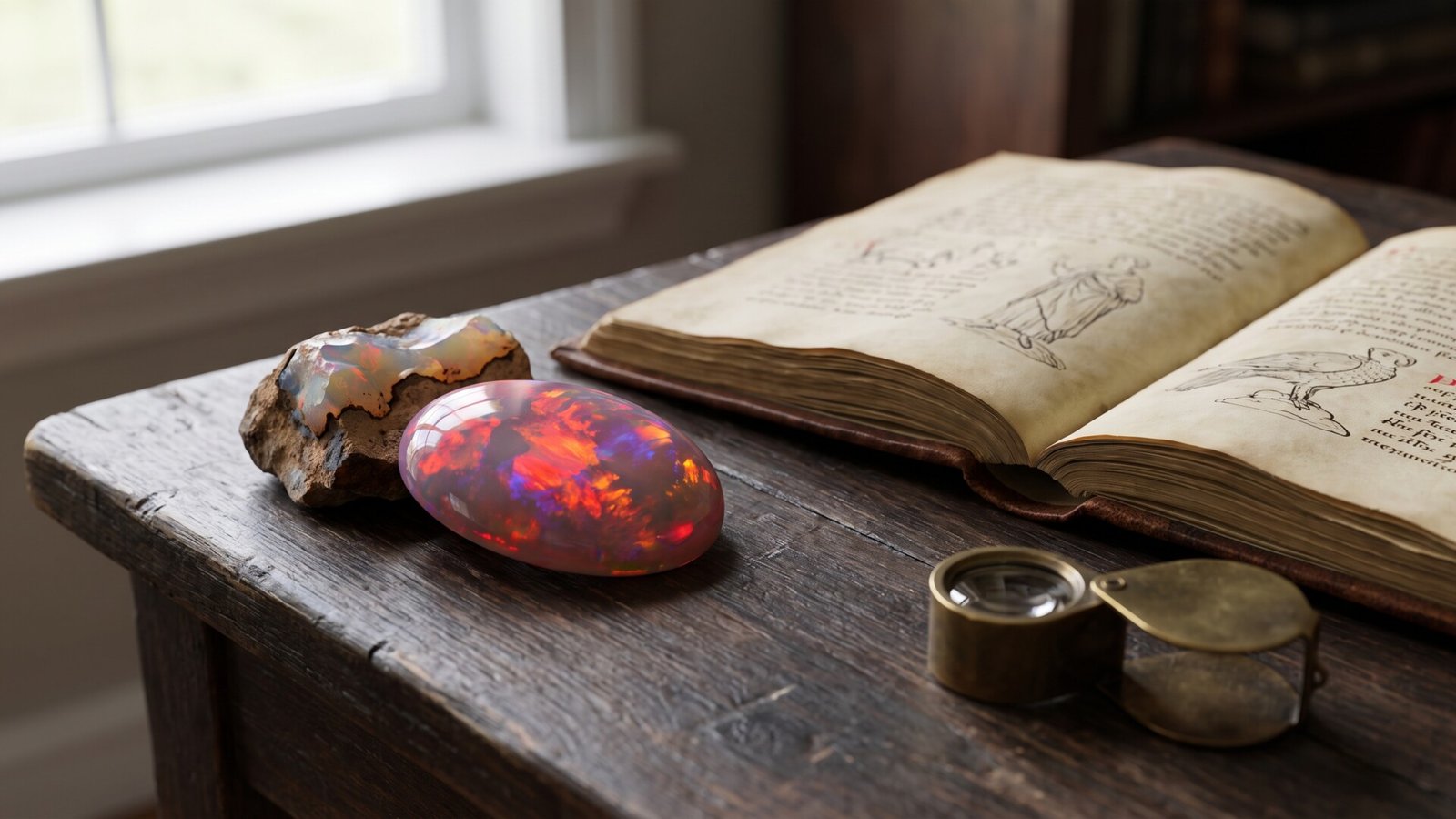
The Fire of Opal: Myths and Legends
Opals look like they hold fire in their core: shimmering, multicolored flashes that shift as the stone moves. People have been telling stories about that effect for a very long time, from Roman scholars and medieval jewelers to Aboriginal Australian storytellers. Some of those stories are documented history, some are folklore, and a few turn out to be 19th-century fiction that stuck.
This guide walks through the best-known opal myths and legends, where each one comes from, how much of it we can actually trace, and what the stone itself is doing to produce the “fire.” If you want the full symbolism and spiritual picture, our opal meaning guide goes deeper, and the main opal guide covers properties, varieties, and value.
Opal Myths and Legends at a Glance
| Legend or belief | Where it comes from | What we can say about it |
|---|---|---|
| Opal holds the power of every colored gem | Ancient Rome (Pliny the Elder) and medieval Europe | Documented in Roman writing; the later “all gems in one” belief is folklore |
| Opal fell from the sky in lightning | Arabic tradition | Folklore, repeated in modern gem-society summaries |
| Opal formed from Zeus’s tears | Greek mythology | Folklore; sources differ on details |
| Opal marks where the Creator’s feet touched the earth | Aboriginal Australian tradition | Stories vary between communities; there is no single “Aboriginal opal myth” |
| Opal makes the wearer invisible | Medieval European lore | Folklore |
| Opal brings bad luck | Popularized after an 1829 novel | Literary and cultural origin, not ancient tradition |
Where the Name “Opal” Comes From
The word reaches English through Latin opalus and Greek opallios, and is generally traced back to the Sanskrit upala, meaning “precious stone.” Some sources link the Greek form to the idea of “seeing a change of color,” which would suit the stone, although etymologists treat that connection with caution. Either way, the name tells you that opal was already being traded and prized as a precious stone long before it had a modern jewelry market.
Ancient Origins and Mystical Reputation
Several ancient and medieval cultures left behind stories about opal. Here is how the main ones are usually told, along with how much weight each deserves.
Rome: the stone that borrowed every color
The best-documented ancient source is the Roman naturalist Pliny the Elder, who wrote that opal combined the fire of the carbuncle (red stones), the purple of amethyst, and the green of emerald in a single stone. That description is the root of a long-lived belief that opal carried the qualities of every colored gem. Pliny also tells the story of the Roman senator Nonius, who is said to have chosen exile rather than give up his opal to Mark Antony. Whether or not every detail is accurate, the story shows how highly Romans valued the stone.
Greece: tears of Zeus and a gift of foresight
One Greek legend, repeated by the American Gem Society, says opals came from the joyful tears Zeus shed after defeating the Titans. Later writers added that opal could give its wearer foresight and protect against illness. Those are traditional beliefs, not medical claims, and they should be read as part of the stone’s folklore rather than as anything opal can actually do.
Arabic tradition: gems from the lightning
An Arabic legend holds that opals fell from the heavens during thunderstorms, carried to earth in bolts of lightning. It is an easy story to understand: a stone that flashes red, green, and blue from within looks as if it has captured a little of the storm.
The Aztecs and fire opal
Mexico is the classic source of fire opal, the transparent orange-to-red variety valued for its body color rather than a rainbow flash. According to the American Gem Society, the Aztecs associated fire opal with the feathered-serpent deity Quetzalcoatl and called it the “Stone of the Bird of Paradise,” linking it to creativity and new beginnings as well as to destruction. We cannot independently verify every detail of that tradition, so treat it as a reported belief.
Aboriginal Australian stories
Australia is where most of the world’s precious opal is mined, and opal appears in Aboriginal Australian oral traditions. A widely shared version says the Creator came down to earth on a rainbow, and the stones glittered with color wherever his feet touched the ground. It is important to be careful here: Aboriginal Australia is made up of many nations with their own languages, laws, and stories, so there is no single opal myth. Versions you will read online are retellings, and the people with the authority to tell these stories are the communities who hold them.
Medieval Europe: luck, eyesight, and invisibility
By the Middle Ages, opal had a reputation as a lucky stone. Folklore said that, because its sheen held the colors of other gems, it carried the virtues of all of them. Other stories credited opal with sharpening eyesight, protecting fair hair from fading, and even making its wearer unseen. People once believed these things; there is no evidence that the stone has any such effect, and none of it should be taken as health advice.
The Fire Within: Opal Symbolism
Opals are often called “fire stones,” and the symbolism attached to them follows the play of color. These are traditional and modern associations, not facts about the stone:
- Creativity and inspiration: the ever-changing colors have long been linked with artists, writers, and imagination.
- Passion and love: warm-colored opal in particular has been associated with romance and emotional intensity.
- Hope: modern birthstone writing often ties opal to hope and optimism, which fits its role as an October stone.
- Luck and protection: in many traditions, opal was worn as a talisman against misfortune.
For a full breakdown of what each variety is said to represent, see Opal Meaning: History, Symbolism, Spiritual Properties & Modern Uses. For a wider look at how stones accumulate meaning, browse our birthstone meanings and symbolism section.
The “Curse of the Opal”: How a Novel Created a Superstition
Not every opal legend is old. The idea that opals bring bad luck is largely a 19th-century development. In Sir Walter Scott’s 1829 novel Anne of Geierstein, a character wears an opal that seems to reflect her moods. After holy water touches it, the stone loses its color and she dies. Scott intended the opal as a plot device, not a warning, but readers took it literally.
Popular accounts, including one from the American Gem Society, say opal sales in Europe fell sharply in the following year. Exactly how large the drop was is hard to confirm, so it is safest to say simply that the novel is widely credited with feeding the superstition. A few other pieces of folklore helped it along:
- The birth-month rule: a common belief held that opal is lucky for people born in October and unlucky for everyone else. It is a folk saying, not a historical rule.
- The Alfonso XII ring: a story says a Spanish king gave his bride an opal ring, and she and several relatives died while wearing it, followed by the king himself. The American Gem Society points out that an outbreak of cholera could explain the deaths, which is a good example of how a coincidence becomes a curse.
The superstition faded as new opal fields opened in Australia from the mid-1800s on, and as jewelers and royal wearers brought the stone back into fashion. Queen Victoria is often credited with helping its reputation recover, although the details of her role are told differently from source to source.
What Is Really Happening Inside the “Fire”
The science is every bit as interesting as the folklore. Opal is hydrated silica (SiO₂·nH₂O), which means it is silica with water locked inside. It is not a crystal: it is amorphous, with no orderly atomic lattice. In precious opal, microscopic silica spheres stack in a regular pattern, and that pattern diffracts light into spectral colors. The size of the spheres affects which colors appear, with smaller spheres tending toward blue and violet and larger spheres toward orange and red, which is why red flashes are the rarest and most prized.
Fire opal is a slightly different case. It is named for its warm body color (yellow, orange, or red) and may show little or no play-of-color at all.
| Property | Opal |
|---|---|
| Composition | Hydrated silicon dioxide, SiO₂·nH₂O |
| Structure | Amorphous (no crystal lattice) |
| Mohs hardness | Roughly 5.5–6.5; some references give a wider range |
| Water content | About 3% to 21% by weight, usually around 6–10% |
| Main sources | Australia (the large majority of precious opal), Ethiopia, Mexico, Brazil, the USA |
| Main risks | Crazing (surface cracking), impact, heat, chemicals |
That water content explains part of opal’s folklore reputation for being delicate: a stone that can craze or crack is easy to blame on bad luck. We cover the practical side in our guide to cleaning an opal ring safely when crazing is a risk.
Healing and Spiritual Beliefs
Modern crystal practice builds on these older stories. In that tradition, opal is described as a stone of emotional balance, intuition, imagination, and personal empowerment, and some people use it in meditation. As the site’s affiliate disclosure also notes, these are cultural and spiritual beliefs, not medical or professional advice. Opal does not treat, prevent, or cure any physical or mental condition, and nothing in this article is a substitute for care from a doctor or therapist.
If you enjoy that side of gemstones, you can read more about the spiritual meaning of opal and treat it for what it is: a way of connecting with a stone through tradition and personal meaning.
Opal as the October Birthstone
Today, opal is one of the two modern birthstones for October, alongside tourmaline, according to the Gemological Institute of America. Birthstone lists differ between countries and organizations, and our October birthstone guide explains how the lists compare. Opal is also traditionally linked to the 14th wedding anniversary, and in astrology writing it is often paired with Libra and Scorpio. You can see how we handle those traditions on our Libra and Scorpio pages, or browse every month on birthstones by month.
If you are choosing an opal as a gift, the folklore can be a nice touch, particularly the part about creativity and hope. Our birthstone jewelry gift ideas by relationship may help you pick a piece that suits the person.
Wearing Opal Today: What to Know Before You Buy
A legend is a good reason to look at an opal, but a few practical points will help you enjoy one for years.
Jewelry suitability
- Pendants, earrings, and brooches: the safest choices, because they take far fewer knocks than rings.
- Rings: best for occasional wear in protective settings such as a bezel or halo. Opal is much softer than sapphire, ruby, or diamond, so it is not an ideal choice for a ring worn every day through heavy use.
- Bracelets: use caution, since they tend to knock against desks and doorframes.
For a closer look at how hardness is measured and why it is not the same as toughness, see our gemstone hardness scale explained.
Solid, doublet, triplet, or lab-grown
Not every opal sold as “opal” is a single natural stone. A solid opal is one piece of natural opal. A doublet is a thin slice of opal glued to a backing, and a triplet adds a clear cap on top. Lab-grown opal has the same basic nature as natural opal but is made in a laboratory, while imitations such as plastic or glass only copy the look. A reputable seller should say clearly which one you are buying, and our guide to natural versus lab-grown birthstones explains the differences.
Rough price ranges
Opal prices vary enormously with body color, brightness, pattern, size, and origin. The ranges below are approximate per-carat figures in US dollars from published retailer and dealer guides and are meant only as a rough orientation, not a quote. We could only cross-check them loosely across sources, so always compare actual listings.
| Type | Approximate range (USD per carat) |
|---|---|
| White (light) opal | About $5–$500 |
| Ethiopian opal | About $5–$300 |
| Boulder opal | About $30–$3,500 |
| Crystal opal | About $30–$3,000+ |
| Black opal | About $500–$50,000+ |
Care in brief
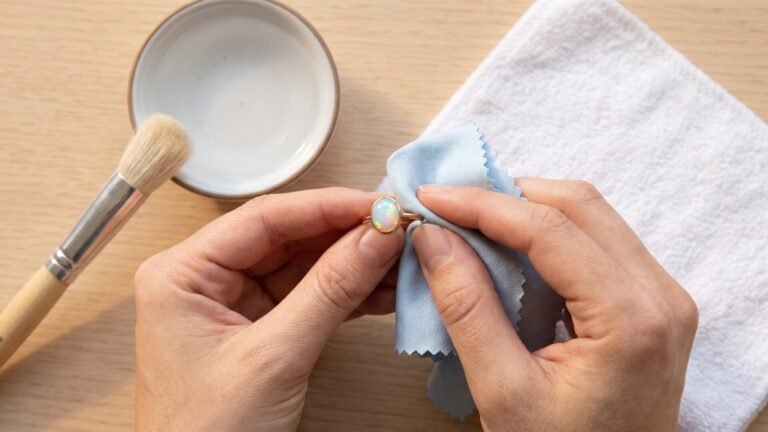
- Clean with lukewarm water, a drop of mild soap, and a soft cloth, then dry it right away.
- Skip ultrasonic and steam cleaners, harsh chemicals, and sudden temperature swings.
- Store opal on its own in a soft pouch so harder stones cannot scratch it.
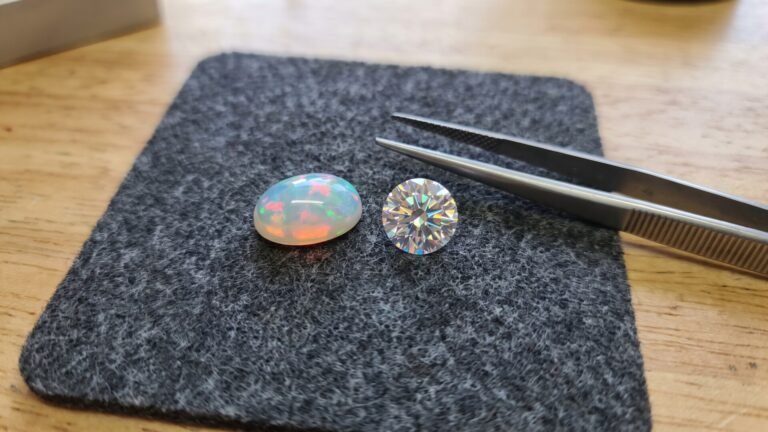
You can compare opal with a more durable look-alike in opal vs moissanite for fire and shine, and browse the rest of our birthstone jewelry guide for settings and styles.
Famous Opals With Stories of Their Own
Some individual stones have picked up legends of their own, mostly about size and luck rather than curses. Two well-documented examples come from Australia:
- Olympic Australis: found in 1956 at the Eight Mile field near Coober Pedy, South Australia, this uncut stone weighs about 17,000 carats (roughly 3.4 kg) and is generally described as the largest and most valuable gem opal ever found.
- Halley’s Comet opal: a black opal nodule of roughly 1,980 carats unearthed at Lightning Ridge on 3 November 1986, the night Halley’s Comet was visible over Australia. It was listed in the Guinness Book of World Records in 1991. Reports about where it is today conflict, so we do not state its current location.
Stories like these show how opal’s reputation moved from “unlucky” to “treasure” once large, undeniably beautiful stones began coming out of Australian fields.
Opal Varieties: Which “Fire” Do the Legends Describe?
Old texts rarely say which kind of opal they mean. Today the main varieties look quite different, so it helps to know what you are looking at.
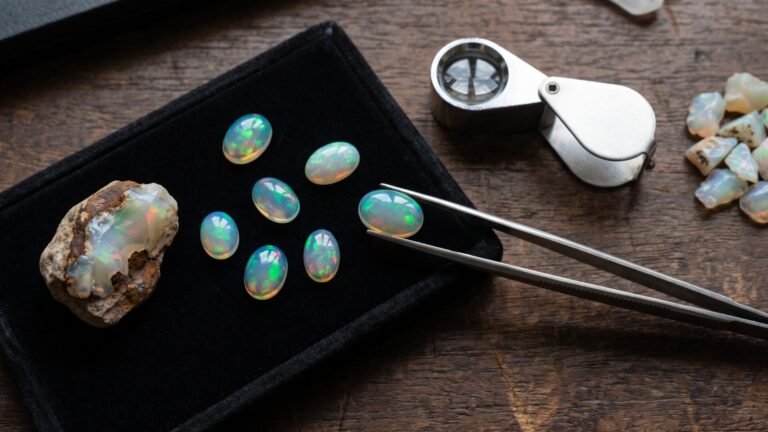
| Variety | What it looks like | Typical source |
|---|---|---|
| Black opal | Dark body tone with vivid play-of-color | Lightning Ridge, Australia |
| White / light opal | Pale body with softer flashes | Coober Pedy and other Australian fields |
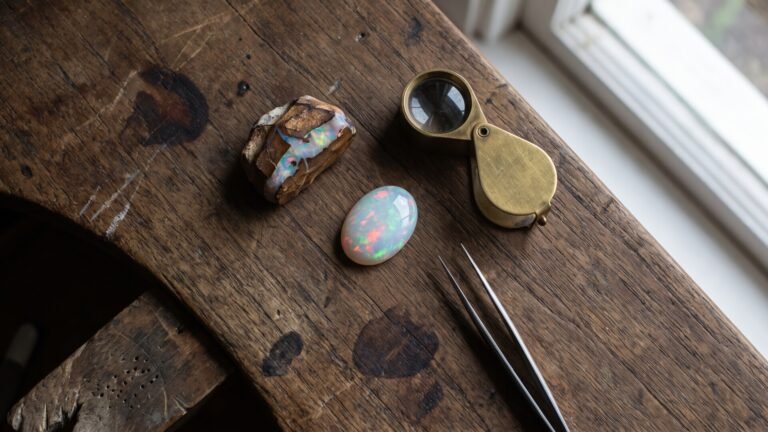
| Boulder opal | Thin opal veins left on ironstone host rock | Queensland, Australia |
| Crystal opal | Transparent to translucent with bright color | Australia, Ethiopia |
| Ethiopian (Welo) opal | Often bright; many stones are hydrophane | Wollo Province, Ethiopia |
| Fire opal | Transparent yellow-orange-red body color; may show no play-of-color | Mexico |
Treatments and Imitations to Know About
Ethiopian Welo opal is hydrophane, meaning it readily absorbs liquids. According to GIA’s opal reading list, treaters have used that property to dye the material in many colors, notably purple, and the same material also responds to smoke treatment, which produces a dark body color. A dark Ethiopian stone sold as “black opal” may therefore be treated. Ask the seller whether the color is natural and whether the piece is a solid stone, doublet, or triplet. Hydrophane opal can also look different when wet, so avoid soaking it.
A Short Buying Checklist for Opal Lovers
- Ask for the type (solid, doublet, triplet, lab-grown, or imitation) in writing.
- View the stone from several angles and in different light; good play-of-color shows across the surface, not from a single spot.
- Check for fine web-like cracks, which can signal crazing.
- Ask about treatment, especially for dark Ethiopian stones, and about the return policy.
- Match the piece to your lifestyle: a pendant or earrings for regular wear, a ring for special occasions.
Why These Legends Last
Opal is one of the few gemstones whose appearance changes with the viewer’s movement, so it invites stories. A Roman scholar saw a stone with every color in it, an Arabic storyteller saw lightning, a Victorian novelist saw a mood ring with a dark side, and a modern buyer sees a gift with personal meaning. Most of these stories are folklore rather than fact, but they are part of why people still care about opal, and knowing where each one came from makes the stone more interesting rather than less.
To keep exploring, visit the gemstones hub or return to the full opal guide.
Frequently Asked Questions About Opal Myths And Legends
Is opal really bad luck?
No. The bad-luck reputation grew mainly after Sir Walter Scott’s 1829 novel Anne of Geierstein and related folklore, not from ancient tradition. Many earlier cultures treated opal as a lucky or precious stone.
Why do people say opal is unlucky unless you were born in October?
It is a folk saying that linked opal to October birthdays as a way to make the stone seem safe for those born that month. There is no historical or scientific basis for it, and opal is now widely worn by anyone.
What did the Romans believe about opal?
The Roman writer Pliny the Elder described opal as combining the colors of other gems, such as the red of a carbuncle, the purple of amethyst, and the green of emerald. This led to the later belief that opal held the virtues of every colored stone.
What is the Aboriginal Australian legend of opal?
One widely repeated version says the Creator came to earth on a rainbow and the stones glittered where his feet touched the ground. Aboriginal Australia includes many nations with their own stories, so there is no single opal myth, and these retellings should be treated with respect.
Why do opals flash different colors?
In precious opal, tiny silica spheres are stacked in a regular pattern that diffracts light into spectral colors. The size of the spheres affects which colors appear, and red is the rarest.
Is opal an October birthstone?
Yes. Opal is one of the two modern October birthstones, along with tourmaline. Birthstone lists vary by country and organization.
Can opal heal or protect me?
Historical and modern crystal traditions attribute healing and protective qualities to opal, but these are cultural beliefs. There is no scientific evidence that opal treats or prevents any condition, and it should never replace medical care.
Is opal fragile?
Opal is softer than many popular gems and contains water, so it can scratch, chip, or craze if mistreated. Pendants and earrings are safer than everyday rings, and a protective setting helps.