Alexandrite: Meaning, Properties, Uses & Value
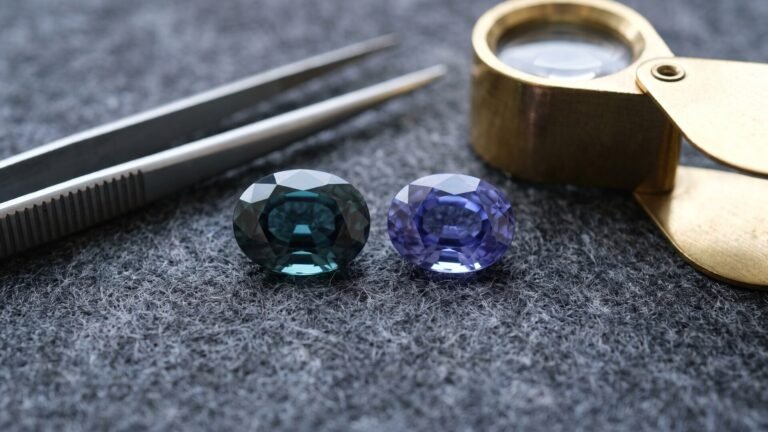
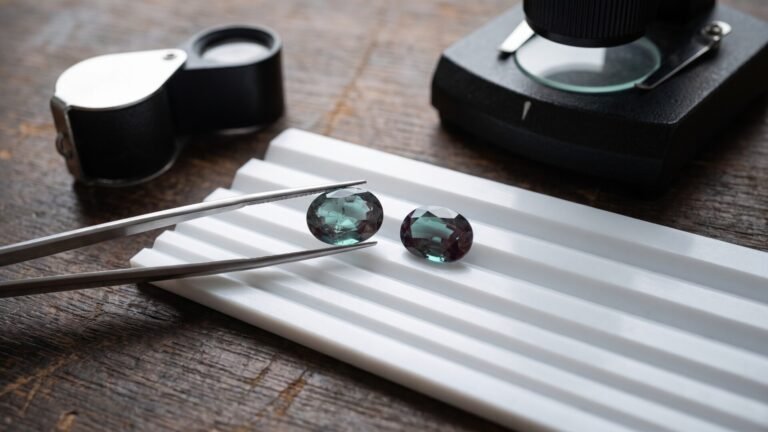
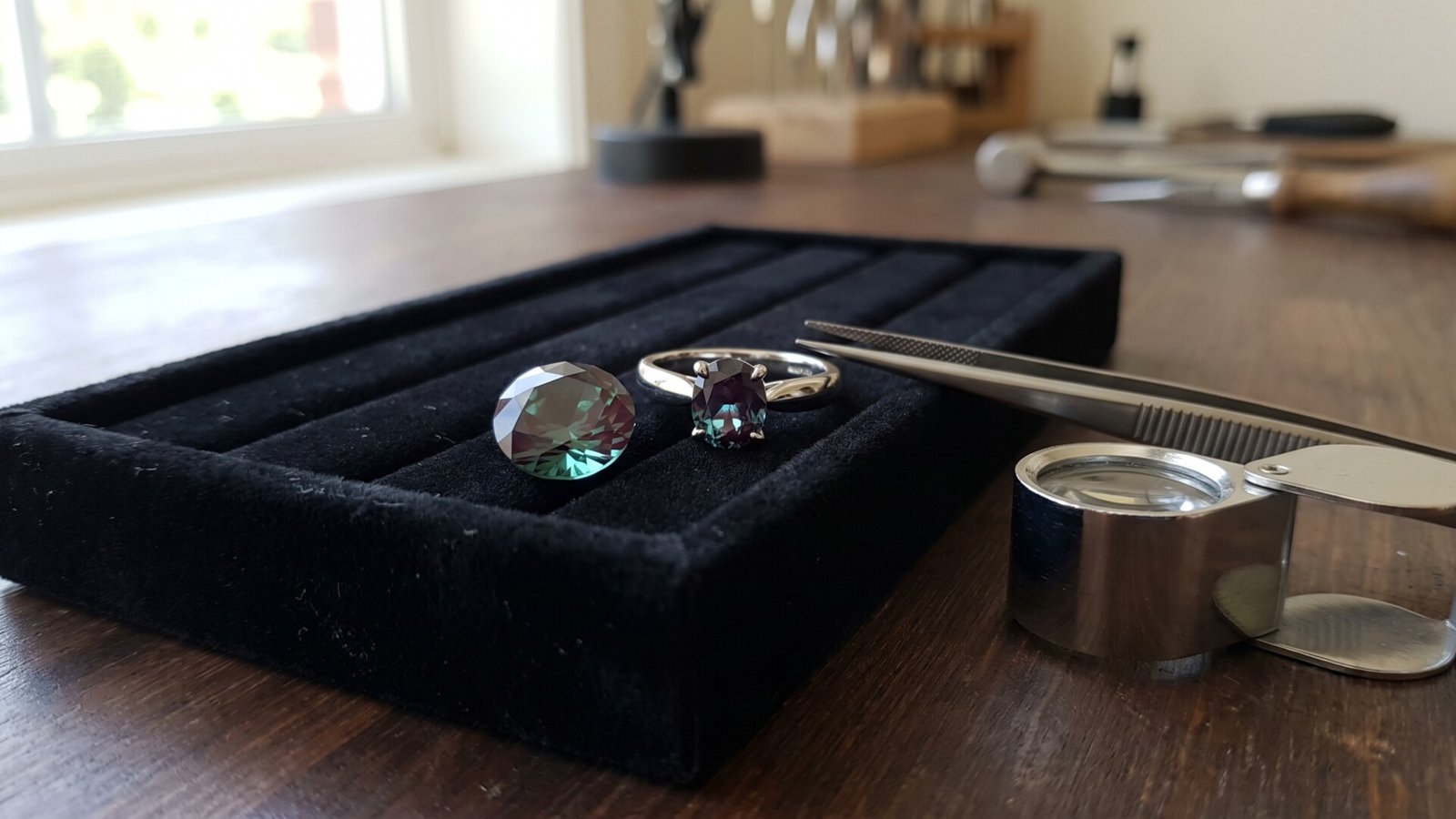
Alexandrite is the gemstone that seems to change its mind. Seen in daylight or under fluorescent light it looks bluish green; under candlelight or an incandescent bulb the same stone turns purplish red. That shift, known as the alexandrite effect, is why this rare variety of chrysoberyl is one of the most talked-about stones for June birthdays, Gemini fans and collectors alike.
This guide covers what alexandrite is, why it changes color, where it comes from, what it costs, how to tell natural from lab-created stones, and how to wear and care for it. Where the article touches on symbolism or crystal-healing ideas, those are traditions and beliefs rather than science, and they are labeled that way.
Quick Facts Box
| Category | Details |
|---|---|
| Mineral / variety: | Chrysoberyl (BeAl₂O₄), color-change variety |
| Cause of color: | Trace chromium; color change from a strong absorption band in the yellow part of the spectrum |
| Color(s): | Bluish or yellowish green in daylight; purplish red to reddish purple in incandescent light |
| Hardness (Mohs): | 8.5 (scratch resistance) |
| Toughness / cleavage: | Good toughness; cleavage is poor to distinct in one direction, so sharp blows can still chip a stone |
| Crystal system: | Orthorhombic |
| Transparency: | Transparent to translucent |
| Common treatments: | Usually untreated; some stones are fracture-filled or oiled, which must be disclosed |
| Birthstone month(s): | June (modern list, with pearl and moonstone); 55th wedding anniversary |
| Zodiac association: | Gemini (May 21 – June 20) in modern lists |
What Is Alexandrite?
Alexandrite is the color-change variety of the mineral chrysoberyl, a beryllium aluminum oxide with the formula BeAl₂O₄. Only chrysoberyl that contains enough chromium to produce a distinct green-to-red change is called alexandrite. Ordinary chrysoberyl is typically yellow to yellowish green, and chrysoberyl with a sharp cat’s-eye streak is called cat’s-eye (cymophane) rather than alexandrite.
The color change comes from how chromium absorbs light. The stone absorbs strongly in the yellow part of the spectrum and transmits both blue-green and red light. Daylight and fluorescent light are rich in blue-green wavelengths, so the stone looks green. Incandescent light and candlelight are rich in red, so the stone looks red. Your eye and brain then sum up what the stone lets through. This is why the same stone can look different at a jeweler’s counter, outdoors, and at home. It also means how color is produced in different gems matters when you compare stones.
The 1830s Discovery in Russia
According to the traditional account, alexandrite was found in the Ural Mountains of Russia around 1830, in emerald mines near the Tokovaya River. Miners reportedly noticed green crystals that looked red by firelight. The stone is said to have been named after the future Czar Alexander II, and the story adds that it turned up around the time of his coming of age at twelve. Whether or not every detail of that legend is exact, the name stuck, and the stone’s green and red were associated with the Russian imperial military colors.
The mineral is usually credited to the Finnish-Swedish mineralogist Nils Gustaf Nordenskiöld, who described it. Alexander II went on to rule from 1855 until his assassination in 1881, and alexandrite became closely tied to imperial Russia in popular memory.
Where Alexandrite Is Found Today
The original Ural deposits are now largely exhausted, and fine Russian stones are very scarce on the market. Current and historical sources include:
- Sri Lanka: A long-running source of alexandrite, typically with a greenish-to-brownish or purplish red change and often larger, paler stones.
- Brazil: The Hematita deposit in Minas Gerais was discovered in the 1980s and produced stones with strong color; Bahia and Espírito Santo also yield alexandrite.
- East Africa: Tanzania, Zimbabwe and Madagascar produce alexandrite of variable quality.
- India and Myanmar: Smaller or sporadic production.
- Russia (Urals): The historic source; old Russian-origin stones are prized by collectors, and origin should be confirmed by a lab report rather than a seller’s claim.
Natural vs Lab-Created Alexandrite
Because fine natural stones are so expensive, lab-created material has been made for decades. It helps to separate three categories:
- Lab-created (synthetic) alexandrite: Grown chrysoberyl with chromium. It has the same chemistry and crystal structure as the natural stone and can show a genuine green-to-red change. Labs identify it by growth patterns and inclusions.
- Simulants: Materials that only imitate the look. The most common is synthetic corundum (sapphire) doped to shift from bluish or grayish to purplish, and synthetic spinel is also used. These are not alexandrite and are typically much cheaper.
- Other natural color-change stones: Some garnets, sapphires, spinels and fluorite change color, but the shift is usually a different pair of hues.
A lab-created alexandrite is not a “fake” if it is sold as what it is; the problem is when a lab-grown or simulant stone is sold as natural. For a deeper walk-through see our guide to natural vs. lab-created alexandrite.
Alexandrite Meaning & Symbolism
The meaning of alexandrite is built on two things: its color change and its imperial Russian story. The ideas below are cultural associations, not facts about the stone.
The Russian Connection
In Russia the stone was linked to the imperial court because its green and red echoed military colors. After Alexander II’s death, a later folk reading associated the green with life and the red with blood. Some stories also describe alexandrite as a stone of omens, bringing good luck to the wise and misfortune to the careless; this is folklore, not documented history.
Modern Symbolism
Today, writers and jewelers commonly describe alexandrite as a symbol of:
- Balance and adaptability: being two things at once and shifting with circumstances.
- Creativity and intuition: a popular association in modern crystal and gift writing.
- Good fortune: a traditional association with rarity and royalty.
- Duality: a natural fit for Gemini, the sign of the twins, in modern zodiac lists.
Zodiac stone lists vary between sources, so treat the Gemini link as one popular tradition rather than a single agreed standard.
Alexandrite Healing Properties (Beliefs, Not Medicine)
Gemstones are not medicine, and nothing here is medical advice. This section describes ideas from crystal-healing practice and folklore, in line with our site disclosure that meanings and properties come from cultural traditions and beliefs.
- Emotional balance: Some people in crystal-healing circles say alexandrite encourages seeing a situation from more than one angle, using the color change as a metaphor.
- Creativity: Crystal practitioners often pair alexandrite with creative work and intuition.
- Chakras: In some systems alexandrite is linked to the heart and crown chakras, with the green side associated with the heart and the red side with grounding.
There is no scientific evidence that wearing alexandrite changes mood, health or luck. If you are dealing with a medical or mental-health concern, please speak with a qualified professional.
Alexandrite Colors & Varieties
Alexandrite’s color is a relationship between the stone and the light, and the quality of the change is the single biggest factor in value.
| Change strength (trade description) | What you see | Market position |
|---|---|---|
| Strong (roughly 80–100%) | Clearly green to clearly red, such as emerald-like by day and ruby-like by night | Rarest and highest price per carat |
| Moderate | Noticeable shift, such as bluish green to purplish red or raspberry | Mid-range; the most common fine-jewelry choice |
| Weak or partial | Slight shift, often brownish or grayish in one light | Lowest prices |
The percentages are trade shorthand, not a standardized lab measurement, so ask a seller to show the stone under both daylight and incandescent light rather than relying on a number.
Pleochroism vs. Color Change
Alexandrite is strongly pleochroic, showing different colors from different crystal directions (commonly green, orange-yellow and purplish red). That is separate from the light-source color change; a cut stone can show both, which is why cutters orient the rough carefully.
Cat’s-Eye Alexandrite
A rare few stones contain fine parallel needles that create a sharp band of light called chatoyancy. When that cat’s-eye effect appears together with a strong color change, the result is a collector’s piece.
Color by Origin
- Russian: Historically described as deep green to vivid red; very scarce today.
- Brazilian: Often vivid with good clarity.
- Sri Lankan: Often lighter, with greenish-to-brownish or purplish red tones.
- East African: Variable, frequently lighter.
Origin affects value but should never be taken on trust; only a gemological laboratory can offer an origin opinion, and even then it is an opinion.
Is Alexandrite a Birthstone?
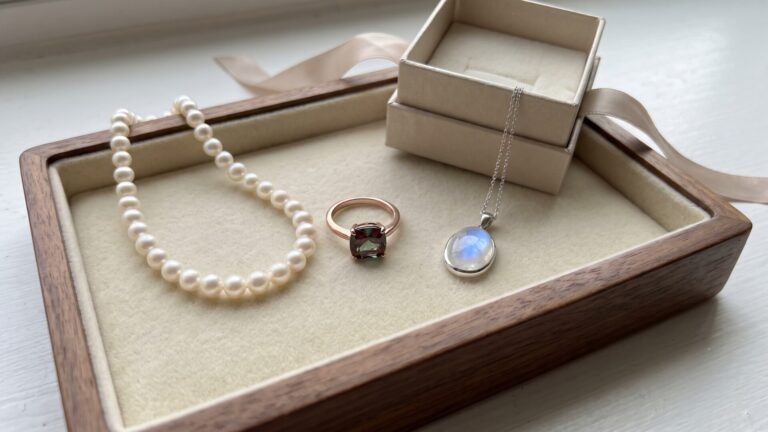
Yes. Alexandrite is a modern June birthstone, alongside pearl and moonstone. The U.S. jewelry industry’s list added alexandrite in 1952; older traditional lists named pearl and moonstone only, and lists differ by country and organization. See what to buy for a June birthday if you are choosing between the three, or read about pearl and moonstone.
Alexandrite is also the traditional gemstone for the 55th wedding anniversary.
Alexandrite Uses in Jewelry
At 8.5 on the Mohs scale, alexandrite resists scratching better than most colored stones and is a good choice for rings, though it is not as hard as sapphire or ruby (9). Chrysoberyl is also tough, but it has a cleavage direction, so a hard knock can still chip it. Choose protective settings for daily-wear rings.
| Piece | Suitability | Notes |
|---|---|---|
| Engagement or everyday ring | Good with care | Bezel, halo or low-profile prong settings protect the girdle |
| Pendant or necklace | Excellent | Low impact risk; color change is easy to show |
| Earrings | Excellent | Good for stones that are small but strongly color-changing |
| Bracelet | Good with care | Contact with surfaces is frequent |
Alexandrite engagement rings have grown in popularity as a distinctive alternative to a diamond. Most fine natural stones in jewelry are under one carat because larger gem-quality crystals are very scarce. If a budget is tight, a lab-created alexandrite offers the real color-change effect at a small fraction of the price, and compares well with a rarer natural stone. For another color-change comparison, see alexandrite vs sapphire color change.
Metal Choices
- Platinum and white gold: A neutral frame that lets the color change lead.
- Rose gold: Emphasizes the warm red side.
- Yellow gold: Adds contrast with the cooler green.
- Mixed metals: Can echo the stone’s two-sided character.
Design Ideas
- Nature motifs: The green-to-red shift suits leaf and seasonal designs.
- Family birthstone rings: Alexandrite alongside other birthstones; see our birthstone pendants for new moms.
- Scatter settings: Several small stones create a field of shifting color.
Alexandrite Value & Price
Fine natural alexandrite is among the costliest colored gemstones. Prices vary enormously with the strength of the color change, size, clarity, origin and whether a lab report is available. The ranges below are approximate retail ranges in USD per carat and should be checked against current listings before you buy.
| Quality tier | Approximate USD per carat | What you get |
|---|---|---|
| Weak or no color change | Under about $2,000 | Often pale or brownish; limited drama |
| Moderate color change | About $2,000 – $15,000 | Noticeable shift, small to medium sizes |
| Strong color change | About $15,000 – $70,000+ | Vivid green to red; rare above one carat |
| Lab-created alexandrite | A small fraction of natural; commonly in the low hundreds to low thousands of dollars per carat | Same chemistry as natural, disclosed as lab-created |
Several factors drive price. Color change quality matters most. Size has an outsized effect because stones over one carat are scarce. Clarity matters, though alexandrite is rarely flawless. Cut controls how well the change shows. Origin can add a premium, but only with documentation. Alexandrite should be bought for enjoyment, not as a guaranteed investment; values can move both ways. For context against other stones, see our ranking of the most expensive birthstones.
How to Identify Real vs. Fake Alexandrite
- Color change: True alexandrite shifts between green/bluish green and red/purplish red. Synthetic corundum simulants typically shift between bluish and purplish tones.
- Pleochroism: Chrysoberyl shows three pleochroic colors; corundum simulants usually look different.
- Inclusions: Natural stones may show fingerprints, needles or growth features; lab-grown stones may show curved growth lines or flux traces.
- Refractive index and spectrum: Only gemological instruments reliably separate natural, lab-created and simulant stones.
The dependable approach is a report from an established laboratory such as GIA, SSEF, Gübelin or AGL, which can identify the species, tell natural from lab-grown, and issue an origin opinion. Always ask whether a stone is natural or lab-created in writing.
Care & Cleaning of Alexandrite
- Everyday cleaning: Warm water, a drop of mild dish soap and a soft brush; rinse and dry with a soft cloth. This is the safest default.
- Ultrasonic and steam: Generally acceptable for clean, untreated alexandrite, but avoid them if the stone has fractures or has been fracture-filled, and ask your jeweler if unsure.
- Storage: Keep it in a separate pouch. Diamond, sapphire and ruby are harder and can scratch it.
- Avoid: Harsh chemicals such as bleach, sharp blows, and sudden temperature shocks. Take rings off for heavy work, gym sessions and gardening.
Because alexandrite’s color depends on the light, show it to others in daylight and under warm light to appreciate it fully.
How to Buy Alexandrite: A Practical Checklist
Because alexandrite is expensive and frequently imitated, a little preparation protects you. Work through this list before you pay:
- Ask what it is, in writing. The invoice should say natural alexandrite, lab-created alexandrite, or color-change sapphire/simulant, whichever applies.
- Request a laboratory report for any natural stone of meaningful value. Reports from GIA, SSEF, Gübelin or AGL identify the species and say whether the stone is natural. Origin is an opinion and costs extra.
- View it in two lights. Check the stone in daylight near a window and under a warm incandescent bulb or phone flashlight. Videos from a seller can be color-corrected, so insist on seeing it yourself or on a return window.
- Check for treatments. Most alexandrite is untreated, but fracture filling or oiling exists. Ask directly and get the answer in writing.
- Look at the cut. A window (see-through center) or an overly dark stone hides the color change. Well-cut stones look lively in both lights.
- Compare return policies. A fair return window of 14 to 30 days lets you test the stone at home.
- Match the setting to your lifestyle. A bezel or halo setting gives extra protection for a ring.
If a price looks too good to be true for a large, vivid natural stone, it very likely is a simulant or a lab-created stone sold without clear labeling. That is the single most common buyer mistake with alexandrite.
Alexandrite vs. Similar Color-Change Stones
| Stone | Typical change | Hardness | Notes |
|---|---|---|---|
| Natural alexandrite | Green/bluish green to red/purplish red | 8.5 | Rare and costly; best with lab report |
| Lab-created alexandrite | Green/bluish green to red/purplish red | 8.5 | Same chemistry as natural; more affordable |
| Color-change sapphire | Blue/violet to purple | 9 | Natural stones exist; many cheap simulants are synthetic corundum |
| Color-change garnet | Green/orange to pink/red | About 7 to 7.5 | Rare color-change variety of garnet |
| Color-change spinel | Blue-gray to purple | 8 | Occurs in some stones; check lab report |
| Color-change fluorite | Bluish to purple | 4 | Soft collector stone, not for rings |
If you want the color-change effect on a lower budget, lab-created alexandrite is usually the closest match to the real thing. If you simply want a green and a red stone in one piece, peridot and garnet in a combined design are easier on the budget, although they will not change color.
Gift Ideas and Occasions
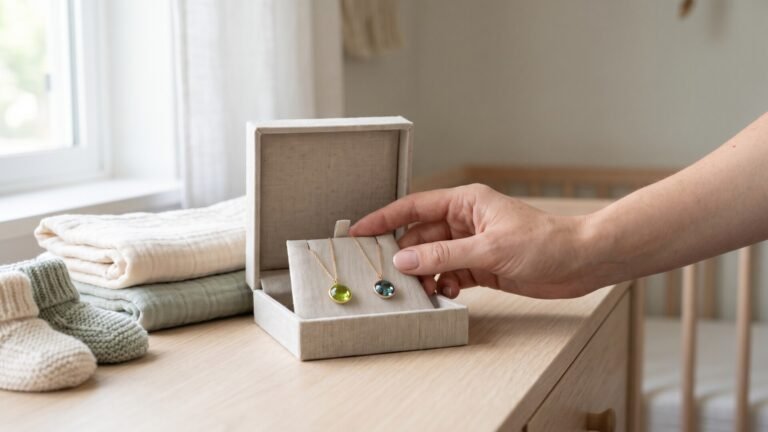
Alexandrite suits more than one kind of gift. For a June birthday, a small pendant or stud earrings in lab-created alexandrite is an accessible choice, while a certified natural stone works well for a milestone birthday or a 55th anniversary. For couples who want a distinctive ring, alexandrite can be a thoughtful alternative to a diamond provided the setting is protective and the stone is documented. Pairing alexandrite with pearl or moonstone in a single piece is a creative way to honor all three June birthstones.
Whichever you choose, include the lab report or purchase documentation with the gift and note the care instructions above so the recipient can enjoy the stone for decades.
Famous Alexandrites
Large and notable alexandrites are held in museum and private collections. The Smithsonian’s National Museum of Natural History is often cited as holding a large faceted alexandrite, and the “Sauer Alexandrite” is a well-known large crystal group found in Bahia, Brazil, in the 1960s. Exact weights and records for these specimens vary by source, so confirm any specific figure with the museum or a reference such as GIA before quoting it. Old Russian stones are scattered through state collections and private hands.
Related Alexandrite Guides
- Natural vs. lab-created alexandrite – clarity and inclusions explained.
- Alexandrite vs sapphire color change – how the two compare.
- Birthstone pendants for new moms – peridot and alexandrite gifts.
- What to buy for a June birthday – pearl, alexandrite or moonstone.
Other gemstone profiles you may like: emerald and ruby (the colors alexandrite is often compared to), sapphire, peridot, garnet, opal, tourmaline, topaz, zircon, pearl and moonstone.
Frequently Asked Questions About Alexandrite
Is alexandrite expensive?
Fine natural alexandrite is among the most expensive colored gemstones, with strong-change stones reaching tens of thousands of dollars per carat. Lab-created alexandrite costs a small fraction of that and shows the same kind of color change.
Is alexandrite suitable for daily wear?
Mostly yes. At hardness 8.5 it resists scratching well, but it has a cleavage direction and can chip from a hard knock, so a protective setting is wise for rings.
What does alexandrite symbolize?
Traditionally, balance, adaptability, creativity and good fortune. These are cultural associations rather than scientific facts.
Is alexandrite a birthstone?
Yes. It is a modern June birthstone alongside pearl and moonstone, and the traditional gem for the 55th wedding anniversary.
Why does alexandrite change color?
Chromium in its crystal structure absorbs yellow light and transmits blue-green and red. Daylight is rich in blue-green so the stone looks green; incandescent light is rich in red so it looks red.
How can you tell natural alexandrite from synthetic?
Only a gemological laboratory can do it reliably, using inclusions, growth patterns and spectroscopy. Ask for a report from a lab such as GIA, SSEF or AGL.
Is lab-created alexandrite real?
Lab-created chrysoberyl alexandrite has the same chemistry as natural stones, so it is a real alexandrite grown in a lab. Simulants such as color-change corundum are not alexandrite at all.
What is the best color change?
The most valued stones shift from a pure green to a pure red or raspberry red, but there is no single standardized grade, so judge the stone in daylight and incandescent light.
What is cat's-eye alexandrite?
A rare alexandrite that shows both a color change and a sharp band of light across the surface caused by fine needle-like inclusions.
Is alexandrite rarer than diamond?
Fine gem-quality alexandrite, especially above one carat, is far scarcer than comparable diamonds, but exact rarity claims vary, so treat them as general statements.
Alexandrite combines real gemological interest with an appealing story. Whether you choose a natural stone with a lab report or a lab-created one at a friendlier price, look at it in more than one light before you buy.
Ready to find your own alexandrite?
[Shop Natural Alexandrite]
[Shop Alexandrite Rings]
[Shop June Birthstone Collection]
Explore More Gemstones at Our Gemstones Hub