The Science Behind Crystal Colors: Understanding Birthstones and Gemstones
Color is the first thing most people notice about a gemstone, and it is usually the biggest factor in its price. But why is a ruby red, an amethyst purple and an aquamarine blue? The answer is a mix of chemistry, crystal structure and the way light behaves inside a stone. This guide explains the main causes of color in crystals and gemstones, then goes month by month through the birthstones, including which colors are natural and which are commonly created by treatment.
It is part of our Education & Buying Guides and focuses on crystals and birthstones by month. For a more general look at gemstone color science, see The Science Behind Gemstone Colors, and for a quick lookup of which color goes with which month, see the Birthstone Color Chart Explained.
Why Crystal Color Matters
Color drives value, appeal and identification:
- A deeply saturated amethyst is generally worth more than a pale one.
- Emerald is valued mainly on the richness and evenness of its green.
- Ruby and sapphire are the same mineral, corundum, so it is color alone that decides which name a stone gets.
Color can also hint at a stone’s chemistry, origin and whether it has been treated, which is why gemologists study it closely.
The Basics: How Light Becomes Color
Light from the sun or a lamp contains all visible wavelengths. When it enters a gemstone:
- Absorption: Some wavelengths are absorbed, and the remaining light that reaches your eye gives the stone its color. A ruby looks red because it absorbs most of the green and blue light and transmits red.
- Transmission: Light passes through transparent stones, so the path length matters. Larger stones usually look more saturated than small ones of the same material.
- Reflection and refraction: How light bounces inside a stone determines sparkle and how color is distributed, which is why the cut matters. See Gemstone Shapes and Cuts Explained.
The Main Causes of Color in Gemstones
Gemologists group the causes of gemstone color into a few categories. Many stones involve more than one.
| Cause | How it works | Birthstone examples |
|---|---|---|
| Essential elements (idiochromatic) | The coloring element is part of the mineral’s basic chemistry, so the mineral is always roughly one color | Peridot (iron), turquoise (copper), almandine garnet (iron) |
| Trace impurities (allochromatic) | Tiny amounts of other elements replace atoms in a colorless host mineral | Ruby (chromium in corundum), emerald (chromium and vanadium in beryl), aquamarine (iron in beryl), tanzanite (vanadium) |
| Charge transfer | Electrons move between neighboring atoms, absorbing light | Blue sapphire (iron and titanium) |
| Color centers (defects) | Structural defects, often created by natural or artificial radiation, absorb light | Amethyst, smoky quartz, irradiated blue topaz |
| Physical optics | Light is diffracted, scattered or interfered with by the stone’s structure | Opal (ordered silica spheres), pearl (nacre layers), moonstone |
Trace Elements: Small Amounts, Big Effects
- Chromium: red in ruby and green in emerald (and in alexandrite’s color change).
- Iron: contributes green in peridot, blue-green in aquamarine, yellow in some sapphires and citrine, and red in almandine garnet.
- Titanium with iron: blue in blue sapphire.
- Manganese: pink in kunzite and rhodochrosite, orange in spessartine garnet.
- Copper: the blue of turquoise.
- Vanadium: the blue-violet of tanzanite and part of the green in some emeralds and tsavorite garnet.
Even a fraction of a percent of one of these elements can be the difference between a colorless and a richly colored stone.
Color Centers and Radiation
- Amethyst: Its purple comes from iron impurities in quartz that have been changed by natural irradiation.
- Smoky quartz: Brown to gray color comes from radiation acting on aluminum impurities in quartz.
- Citrine: Natural citrine is rare. Most citrine on the market is heat-treated amethyst, because heat changes the iron’s behavior and removes the purple.
- Blue topaz: Natural topaz is often colorless. Most blue topaz is irradiated and heated.
Crystal Structure and Optical Effects
- Pleochroism: Some stones show different colors from different directions, such as tanzanite, iolite and alexandrite.
- Dispersion: The splitting of white light into spectral colors, which creates “fire.” It is strong in diamond and zircon, and stronger still in moissanite.
- Color change: Alexandrite shifts from bluish green in daylight to purplish red in incandescent light.
- Play-of-color: Precious opal shows flashes of spectral color as light diffracts through ordered silica spheres.
- Chatoyancy and asterism: Cat’s-eye effects (for example in chrysoberyl) and stars (in some sapphires and rubies) come from tiny aligned inclusions.
Heat, Radiation and Other Treatments
Many gemstones are treated to improve color. Treatment is widely accepted in the trade when it is disclosed, but it affects value and sometimes care:
- Heat treatment: Very common for sapphire and ruby, and also used for tanzanite (which is nearly always heated to bring out its blue-violet), aquamarine (to remove greenish tint) and citrine.
- Irradiation: Used to create or deepen color in topaz, some quartz and some diamonds.
- Diffusion: Introduces coloring elements into the surface of a stone, as in some treated sapphires. It is a significant disclosure item because the color may be shallow.
- Dyeing, stabilizing and oiling: Common for turquoise, opal and emerald.
Ask for treatment details and, for higher-value stones, an independent laboratory report. Our buying guides hub explains how to read these.
Birthstone Colors and Their Causes
Birthstone lists differ by country and organization, and some months have several stones. This is the commonly used modern list, with notes on alternates.
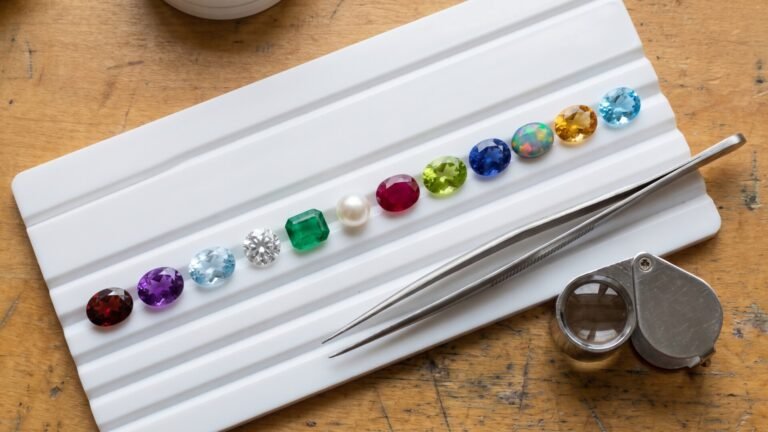
| Month | Birthstone | Typical color | Cause and notes |
|---|---|---|---|
| January | Garnet | Red; also orange, pink, green | Iron in almandine; chromium and vanadium in some varieties; manganese in spessartine. See Garnet Color Types Explained |
| February | Amethyst | Pale lilac to deep violet | Iron impurities altered by natural irradiation |
| March | Aquamarine | Light blue to blue-green | Iron in beryl; often heated to remove green tint |
| April | Diamond | Usually colorless to light yellow or brown | Nitrogen causes yellow; boron causes blue; some pink and brown colors come from structural distortion |
| May | Emerald | Green | Chromium and vanadium in beryl; inclusions are normal; clarity oiling is common |
| June | Pearl, alexandrite, moonstone | White, cream, pink, black; alexandrite changes color | Pearl color comes from nacre and organic pigments; alexandrite from chromium; moonstone sheen from layered structure |
| July | Ruby | Red | Chromium in corundum; heat treatment is common |
| August | Peridot, spinel, sardonyx | Olive to lime green | Iron is a basic component of peridot; its green is intrinsic to the mineral |
| September | Sapphire | Blue (also many other colors) | Iron and titanium; heat treatment is routine |
| October | Opal, tourmaline | Play-of-color; tourmaline in many colors | Opal: diffraction by silica spheres; tourmaline: iron, manganese, copper and other elements |
| November | Topaz, citrine | Yellow, orange, pink, blue | Much blue topaz is irradiated and heated; much citrine is heated amethyst |
| December | Tanzanite, turquoise, zircon, blue topaz | Blue-violet, sky blue to green, blue | Tanzanite: vanadium, usually heated, and pleochroic; turquoise: copper, often stabilized |
For the stones for each month, see Birthstones by Month.
Factors That Change How Color Looks in Jewelry
- Lighting: Daylight, LED and incandescent light can shift a stone’s appearance. Alexandrite is the extreme example, but many stones look different indoors and out.
- Cut: Proportions control how color is spread through the stone and how much sparkle it returns.
- Setting and metal: Yellow and rose gold warm red and orange stones; white metals contrast with blue and purple ones.
- Size: Larger stones show more depth of color; very small stones look paler.
When buying online, ask for video in natural light, and compare it with the seller’s studio photos.
Maintaining Color in Birthstone Jewelry
- Protect from prolonged strong light: Amethyst, kunzite and some other colored stones can fade with extended exposure.
- Avoid heat and harsh chemicals: Heat can alter or damage some treated stones, such as oiled emeralds, and chemicals can damage porous or dyed ones.
- Clean gently: Warm water, mild soap and a soft brush suit most stones. Ultrasonic and steam cleaning are not safe for every gem, so check your stone first.
- Store separately: This prevents scratches that can dull the surface and make color look flatter.
See How to Care for Your Garnet Jewelry for a stone-specific example.
Color Symbolism in Tradition
Beyond the science, many cultures and crystal traditions attach meanings to gemstone colors. These are symbolic and cultural, not scientific, and they vary between traditions:
- Red: commonly linked with energy, courage and passion.
- Green: commonly linked with growth, renewal and prosperity.
- Blue: commonly linked with calm, clarity and communication.
- Purple: commonly linked with intuition and spirituality.
- Yellow and orange: commonly linked with joy and creativity.
These associations are a matter of belief and are not medical or psychological advice. For more, see Birthstone Meanings & Symbolism and How Birthstones Can Boost Your Energy.
Where to See and Buy Colored Birthstone Jewelry
Retailers such as Blue Nile, James Allen, Brilliant Earth, Angara and Etsy sellers list birthstone jewelry in many colors. We list them for orientation only, not as endorsements. Check treatment disclosures, return policies and whether a stone is natural or lab-grown before you buy. For a broader jewelry overview, start at the Birthstone Jewelry Guide.
Frequently Asked Questions About Gemstone And Birthstone Colors
Why are ruby and sapphire the same mineral?
Both are corundum, which is aluminum oxide. Chromium makes it red, which is ruby, while other trace elements such as iron and titanium make blue and other colors, which are called sapphire.
Why does amethyst fade?
Its purple comes from color centers produced by radiation acting on iron impurities. Prolonged strong light or heat can reduce that color, so it is best not to leave amethyst in direct sun.
Is natural citrine rare?
Yes. Most citrine on the market is heat-treated amethyst, and genuine natural citrine is much less common. Ask the seller how the stone was made.
Is blue topaz natural?
Natural topaz is often colorless. The vivid blue topaz sold in jewelry is nearly always created by irradiation and heating.
Why does alexandrite change color?
Chromium in alexandrite absorbs light in a way that makes the stone look bluish green in daylight and purplish red in incandescent light.
Do gemstone colors have healing effects?
No scientific evidence supports healing effects from stone colors. Associations such as calm for blue or courage for red are cultural traditions.
Conclusion
Gemstone color comes from a small set of physical causes: essential elements, trace impurities, charge transfer, color centers and the optics of the stone’s structure. Knowing which applies to your birthstone helps you understand its price, what treatments to ask about, and how to care for it. Take this knowledge into your next purchase with the Education & Buying Guides hub, or browse the Gemstones hub for stone-by-stone profiles.