Tanzanite: Meaning, Properties, Uses & Value
Tanzanite is the newcomer among major gemstones. It was first reported in northern Tanzania in 1967, was named by Tiffany & Co., and is known for a velvety blue-violet color that can resemble fine sapphire. It has no ancient history or centuries of lore, but it has an unusual story of discovery, a single known source and a finite future.
This guide explains what tanzanite is, where it comes from, why nearly all of it is heat treated, what its colors and price depend on, how to handle its cleavage in jewelry, how to spot imitations and how to care for it. If you want the story and symbolism in more depth, see our tanzanite meaning guide, and for a market-focused view, our tanzanite investment guide.
Quick Facts Box
Gemstone Overview
| Category | Details |
|---|---|
| Mineral: | Zoisite (blue-violet variety), Ca₂Al₃(Si₂O₇)(SiO₄)O(OH) |
| Color(s): | Blue, violet, bluish-purple, with possible burgundy flashes |
| Hardness (Mohs): | About 6.5 (often quoted as 6.5–7) |
| Toughness / cleavage: | One direction of perfect cleavage; can split if struck. Treat as fragile for daily rings |
| Crystal system: | Orthorhombic |
| Transparency: | Transparent |
| Common treatment: | Heat treatment (nearly all tanzanite); stable |
| Common uses: | Pendants, earrings, rings (with care), statement and collector pieces |
| Birthstone month(s): | December (modern lists, added in 2002 alongside turquoise and zircon). Suggested for the 24th wedding anniversary on some modern lists |
| Zodiac association: | Often linked with Sagittarius, Scorpio and Pisces; zodiac stone lists vary by source |
A Note on Rarity: Tanzanite is mined in only one known place on Earth, a small area in the Merelani Hills of Tanzania, a few kilometers across. It is often described as far rarer than diamond. That comparison is a trade talking point, not a precise measurement, but the single source is real and is the main reason for the gem’s reputation.
What Is Tanzanite?
Tanzanite is a one-source gem.
Unlike diamonds, which are found on every continent, or sapphires, which come from many countries, tanzanite is mined from a small area near the foot of Mount Kilimanjaro in northern Tanzania. Geologists consider it unlikely that another significant deposit will be found, although this cannot be proven.
The Mineral Family
Tanzanite is the blue-to-violet variety of the mineral zoisite, a calcium aluminum silicate with the formula Ca₂Al₃(Si₂O₇)(SiO₄)O(OH). It belongs to the epidote mineral group.
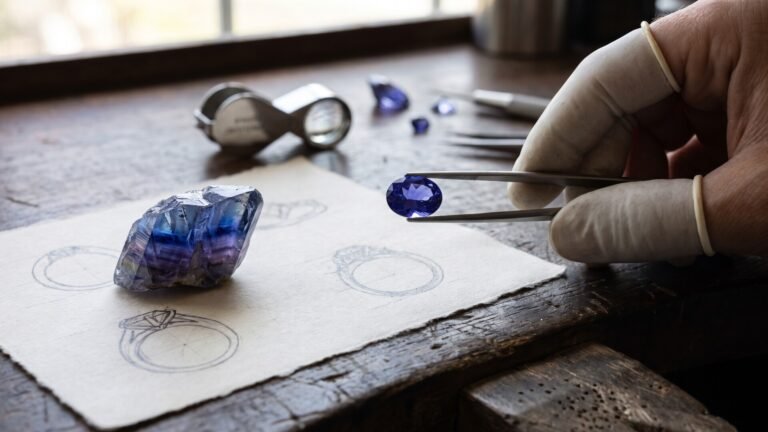
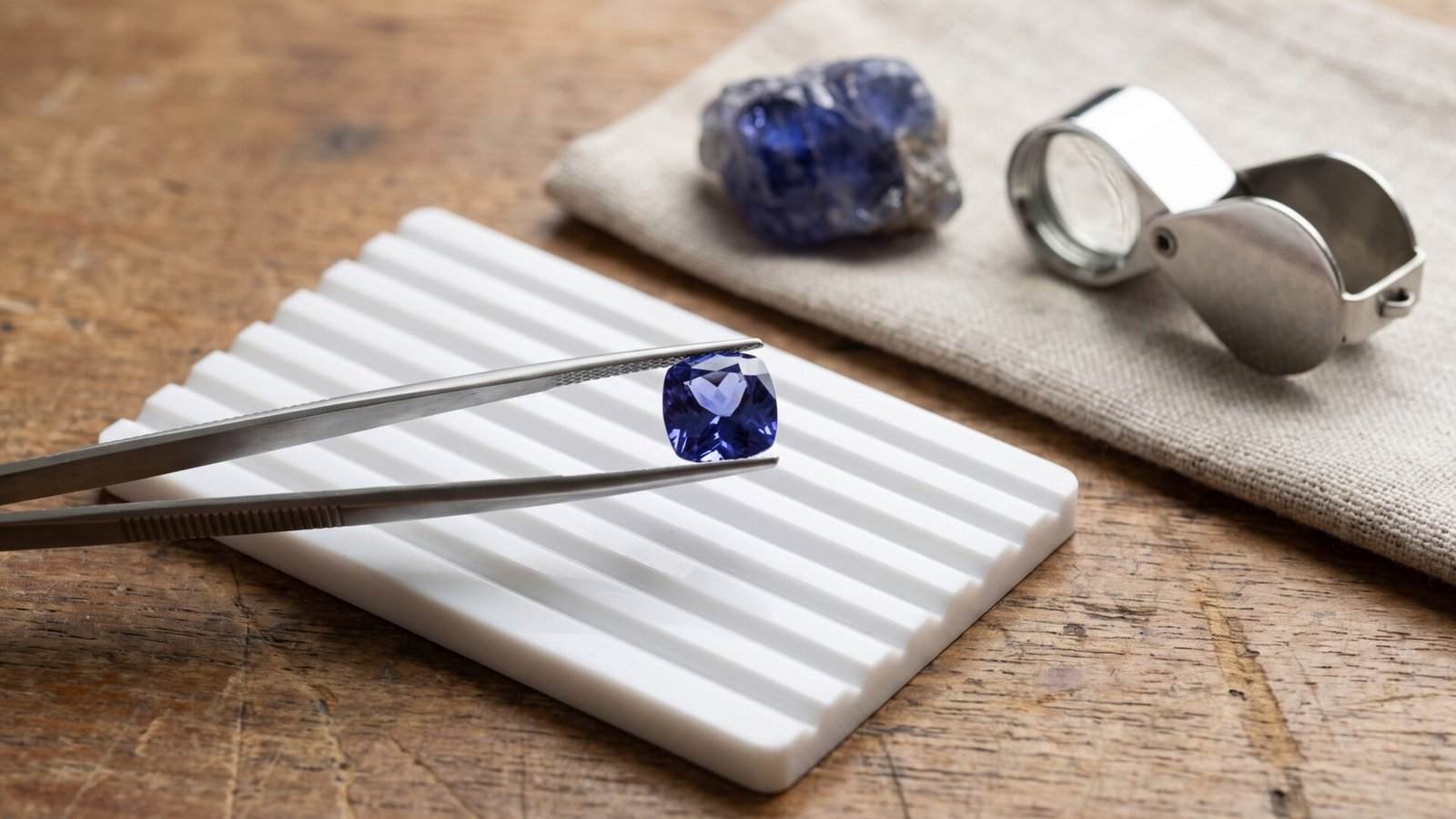
In its natural, untreated state, tanzanite from the mines is typically brownish, grayish or greenish. The blue and violet colors that made it famous are almost always the result of heat treatment.
The Vanadium Connection
The color of tanzanite is caused by trace amounts of vanadium in the crystal structure. Vanadium also colors some other gems, such as certain emeralds and some color-change garnets. Heating changes the vanadium’s oxidation state, which shifts the stone from brown to blue-violet.
The Trichroic Miracle
Tanzanite is strongly trichroic, meaning it shows different colors when viewed from three directions. A rough crystal typically displays:
- Blue from one direction
- Purple from another
- Burgundy or reddish-brown from the third (before heating, and less visible after)
This is both a challenge and an opportunity for cutters, who orient the crystal carefully to emphasize the most desirable colors.
Where Tanzanite Is Found
Tanzanite is mined in the Merelani Hills of the Simanjiro District in Tanzania’s Manyara Region. The mining area is commonly described as divided into four blocks labeled A, B, C and D. Larger mining companies have operated the bigger blocks, while artisanal miners work smaller ones. Ownership and licensing in the area have changed over the years, so check current sources if this matters to your purchase.
The geology is unusual: mountain building, metamorphism and the presence of vanadium combined in a very particular way, which is part of why other deposits are not known.
Tanzanite Meaning & Symbolism
Tanzanite’s symbolism is modern, built mostly in the last fifty-plus years. The associations below are traditions and marketing stories, not scientific facts.
The Discovery Story
According to a popular legend, a Maasai herder came across the first crystals after a bush fire swept through the area near Mount Kilimanjaro, when the heat turned dull brownish stones into glittering blue and violet gems. Some say the Maasai have since regarded these stones as bringing an enriched life to those who possess them. This is folklore, and heat treatment is the reason the story is plausible.
The discovery is commonly credited to Jumanne Mhero Ngoma in 1967, and the Goan tailor and part-time prospector Manuel de Souza played a key role in bringing the gems to attention that year.
Tiffany’s Vision
When samples reached the United States, they were identified as a variety of the mineral zoisite. “Blue zoisite” was not considered a marketable name, since it was said to sound too much like “blue suicide.” Henry B. Platt of Tiffany & Co., a great-grandson of the company’s founder Charles Lewis Tiffany, proposed the name tanzanite, in honor of its country of origin. Tiffany launched a major campaign in 1968 promoting it as a discovery of historic importance, and the gem was soon being marketed with the idea that it could be found in only two places: Tanzania and Tiffany’s.
Modern Symbolism
Today, tanzanite is commonly said to symbolize:
- Transformation and evolution: Its journey from brown rough to blue-violet gem is a natural metaphor for personal growth
- Spiritual awareness: In crystal traditions it is associated with intuition and higher consciousness
- Inner strength: Associated with resilience
- Rarity and exclusivity: A single-source gem
- New beginnings: As the newest major gemstone, it is linked with fresh starts
The December Connection
In 2002, tanzanite was added to the modern American birthstone list as a December stone, alongside turquoise and zircon. Some lists also include blue topaz for December, and lists vary by country and organization. For people born in December, tanzanite is often described as symbolizing transformation and individuality.
Tanzanite Healing Properties: Belief and Tradition
Important: This section describes beliefs from modern crystal-healing practice only. Tanzanite is a relatively new gem and has no ancient healing tradition. Gemstones are not medicine, and nothing here is medical advice or a treatment claim. If you are struggling with stress, anxiety or any health issue, please speak to a qualified professional. This is consistent with our site disclosure that meanings and properties are based on cultural traditions and beliefs.
Associations in crystal practice
Modern crystal practitioners associate tanzanite with:
- Calm and reflection: Used as a focus in meditation, symbolizing letting go of worry
- Spiritual awareness: Used as a meditation stone for intuition and insight
- Creativity: Regarded as a stone of inspiration
Wisdom Connection
Some believe tanzanite can help the wearer reflect on their life’s purpose and let go of limiting beliefs. This is a matter of personal belief.
Chakra Associations
In chakra practice, tanzanite is commonly linked with:
- Throat chakra: Communication and self-expression
- Third eye chakra: Intuition and insight
- Crown chakra: Connection to higher consciousness
Tanzanite Colors & Varieties
Color is the most important value factor in tanzanite, outweighing the other quality factors.
The Color Spectrum
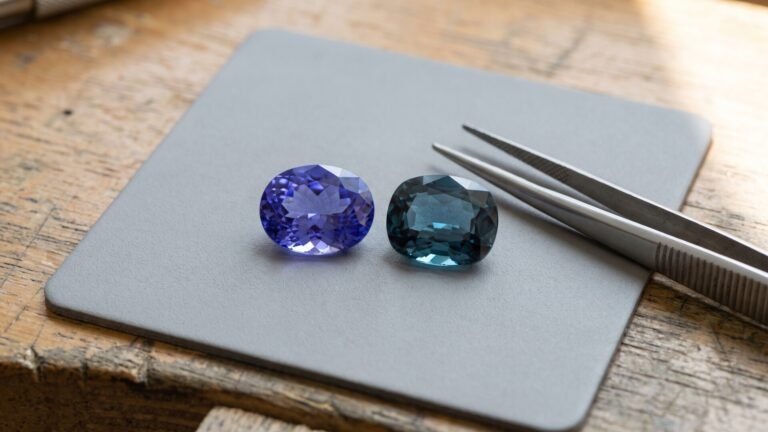
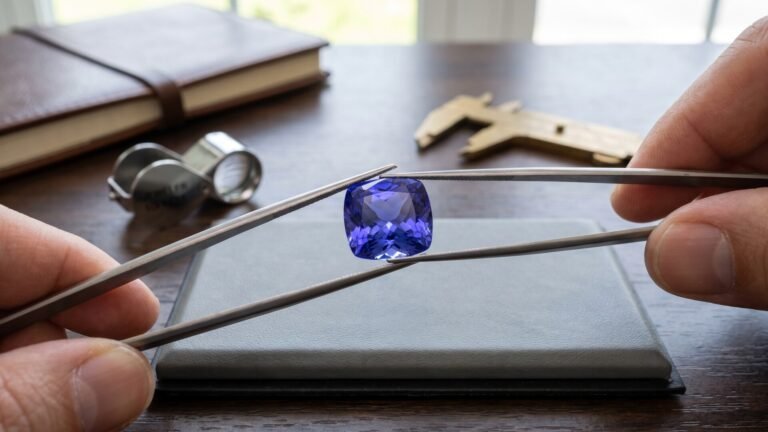
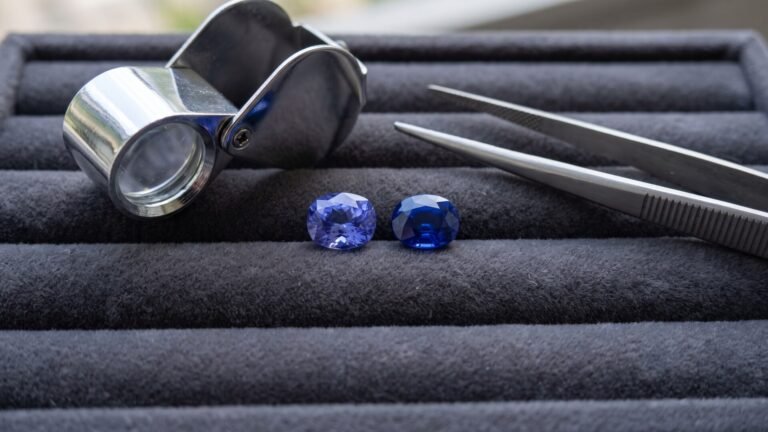
Tanzanite ranges from pale lavender to deep, saturated violet-blue. The most prized color is a rich, velvety blue to violet-blue with strong saturation, sometimes compared to fine sapphire.
The Three Components of Color
- Hue: The balance between blue and violet. Buyers tend to pay more for stones where blue is dominant, complemented by rich violet.
- Tone: Lightness or darkness. Medium-dark is usually ideal, deep enough to show richness without looking inky in low light.
- Saturation: The intensity and purity. Low-saturation stones look grayish or washed out, while high-saturation tanzanite is vivid. This is a major driver of value.
The “Mood Changer”
Because tanzanite is pleochroic, its appearance can shift with lighting. Daylight and fluorescent light tend to emphasize blue, while incandescent light tends to emphasize purple and reddish tones. This is sometimes called the “mood changer” effect.
Color and Size Relationship
- Smaller stones: Tend to be less saturated, showing pastel shades from light blue to lilac
- Larger stones: Can show deeper, more intense color
Intense blue tanzanite in large sizes is uncommon and commands the highest prices, in part because cutting for color can cost yield.
The Four Cs of Tanzanite
Clarity: GIA classifies tanzanite as a Type I gemstone, meaning it is typically eye-clean, so visible inclusions reduce value significantly. This is unlike emerald, where inclusions are expected.
Cut: A precision cut unlocks brilliance and manages pleochroism. The cutter chooses between:
- Cutting to emphasize a bluish-purple color (less waste, larger stone)
- Cutting for a purer blue or violet-blue (more waste, smaller stone)
Poor cutting can create “windows,” lifeless see-through areas, or orient the stone to show brownish tones.
Carat Weight: Price per carat rises with size, especially for stones with very good color. A single 5-carat stone of top quality costs far more than five 1-carat stones of the same grade.
Is Tanzanite a Birthstone?
December Birthstone
Yes. Tanzanite was added to the modern American birthstone list in 2002 as a December stone, making it the newest of the major birthstones. Today December babies have these options on modern US lists:
- Tanzanite: the newcomer, symbolizing transformation
- Turquoise: the ancient stone, associated with protection in many traditions
- Zircon: the colorful gem, available in many colors
Blue topaz also appears on some December lists, so compare sources when choosing. If you are weighing tanzanite against blue sapphire or blue topaz, see our comparison of sapphire vs blue topaz and our guide to blue gemstones and their meanings.
24th Wedding Anniversary
Tanzanite is suggested as the gem for the 24th wedding anniversary on some modern anniversary lists. Anniversary lists vary by country and tradition, so check the one your family follows.
Zodiac Associations
Tanzanite is often associated with Sagittarius (about November 22 to December 21), Scorpio and Pisces, but zodiac stone lists are not standardized and are a matter of belief.
Tanzanite Uses in Jewelry
Durability Considerations
At about 6.5 on the Mohs scale, tanzanite is softer than quartz. More importantly, it has one direction of perfect cleavage, so a sharp blow can split it, and it is sensitive to sudden temperature changes. Hardness measures scratch resistance, while cleavage and toughness describe how a stone survives knocks, and tanzanite is weak on the second.
- Rings: Best for occasional wear, in protective settings (bezel, halo, recessed). Not ideal for an everyday engagement ring. Remove during activities that might cause impact.
- Pendants and necklaces: Very safe, protected from most impact, and ideal for showing off the color
- Earrings: Excellent choice, with minimal wear and tear
- Bracelets: Use caution, as bracelets knock against surfaces
- Brooches and pins: Excellent, protected by clothing
The Single-Source Story
Because tanzanite comes from one known location, it is sometimes marketed as a “generational stone” whose supply could eventually run out. Estimates of mine life vary and should be treated with caution, and scarcity claims in marketing are not a guarantee of future value.
Popular Jewelry Types
Pendants are the safest and most popular choice. A single stone on a delicate chain catches light while staying protected.
Rings need protective settings and thoughtful wear. Tanzanite engagement rings are chosen by those who value individuality over tradition, but they need more care than diamond or sapphire.
Earrings, whether studs, drops or chandeliers, show off tanzanite’s color changes in different lighting.
Metal Choices
- White gold and platinum: Enhance cool blue tones
- Yellow gold: Warm contrast, especially with violet-dominant stones
- Rose gold: Romantic complement that brings out purple and red flashes
Tanzanite is often paired with diamonds. Tiffany & Co., which named the gem and helped introduce it, remains the best-known brand associated with tanzanite, but many independent jewelers and online retailers also sell it.
Tanzanite Value & Price
Tanzanite pricing spans a wide range, from accessible pastels to top-color stones that cost hundreds or thousands of dollars per carat.
What Affects Price
Color matters most. Deep, saturated violet-blue commands the highest prices, while pale or washed-out stones cost much less.
Clarity matters because tanzanite is normally eye-clean, so visible inclusions reduce price.
Cut affects beauty and price. A precision cut maximizes color and brilliance.
Size has a strong effect on price per carat, with notable price jumps at larger weights for stones with excellent color.
Treatment has little effect on price because heat treatment is universal and accepted. Finished tanzanite is assumed to be heated unless the seller states otherwise.
Approximate Price Ranges (USD per carat)
Note: These are rough retail ranges for well-cut stones of a few carats. Tanzanite prices change with supply and demand, and we have not verified these figures against a current market survey, so use them only as a guide and compare several reputable sellers.
| Quality Tier | Color Characteristics | Approximate Price Per Carat (USD) |
|---|---|---|
| Commercial grade | Lighter tones, lower saturation, noticeable gray or brownish modifiers | About $100 – $350 |
| Fine quality | Good saturation, medium tones, pleasing violet-blue | About $400 – $750 |
| Exceptional | Intense, deeply saturated violet-blue, dominant blue hue | About $800 – $1,500 or more |
Tanzanite is best bought because you love it. Prices can fall as well as rise, and no gemstone carries a guaranteed return. If the market side interests you, see our analysis of tanzanite as a collectible.
The “AAAA” Trap
Many sellers use terms like “AAAA” or “AAA” for tanzanite. These are not official, standardized grades but internal marketing labels used by individual sellers. One seller’s “AAAA” might be another’s “AAA.” The most objective assessment comes from a report by a respected gemological laboratory such as GIA.
Heat Treatment: The Standard
Nearly all tanzanite is heat treated.
Mined tanzanite is typically brown, greenish or grayish. The blue and violet colors are produced by heating, commonly cited at several hundred degrees Celsius (roughly 500–600°C, or about 1,000–1,100°F); exact temperatures reported vary between sources.
Heat treatment:
- Removes undesirable yellow and brown tints
- Brings out blue and violet tones
- Is considered permanent and stable under normal wear
The Natural Exception
Some stones from the early days were reported to be naturally blue without laboratory heating, possibly because natural heating occurred underground. Because heat treatment is now standard, “unheated” tanzanite is unusual, and claims of being unheated should be backed by a laboratory report.
The Green Anomaly
Rarely, tanzanite shows a green primary hue after heating. These stones have some collector interest but are seldom sought commercially.
How to Identify Real vs Fake Tanzanite
Tanzanite is less often faked than some gems, but imitations exist. There is no widely sold lab-grown tanzanite, so the main concern is simulants (look-alikes), not lab-grown stones.
Common Imitations and Look-Alikes
- Synthetic forsterite: A well-known simulant that can look very similar
- Blue glass: Softer, may show bubbles, and lacks strong pleochroism
- Synthetic spinel and corundum: Can mimic the color but have different optical properties
- Iolite: Sometimes confused, but with a different color range and properties
- Sapphire: A natural gem, much harder (9), with a different refractive index and usually higher price. See our sapphire guide
Gemological Clues
- Pleochroism: Real tanzanite shows strong color changes when viewed from different angles, though this is a clue and not proof.
- Refractive index: About 1.69–1.70
- Specific gravity: About 3.10–3.38
The Best Approach
Buy from reputable sellers who disclose origin and treatment, and for valuable stones request a report from GIA or another respected gemological laboratory.
Care & Cleaning of Tanzanite
Tanzanite needs more careful handling than harder gemstones because of its moderate hardness and cleavage.
The safest method: warm soapy water and gentle handling.
- Use lukewarm water and a few drops of mild dish soap
- Gently clean with a soft cloth or soft brush
- Rinse thoroughly
- Dry with a soft, lint-free cloth
Avoid:
- Ultrasonic cleaners: Vibrations can cause fracturing along cleavage planes
- Steam cleaners: Thermal shock can crack tanzanite
- Harsh chemicals and strong acids: These can damage the stone and its polish
- Extreme heat and sudden temperature changes: Tanzanite is sensitive to thermal shock
Storage Tips
- Store tanzanite separately from harder stones (sapphire, diamond, topaz)
- Individual soft pouches or compartmentalized boxes are ideal
- Avoid temperature extremes
Wearing Tips
- Apply perfume, lotion and hairspray before putting on tanzanite
- Remove tanzanite rings before washing hands, cleaning, gardening or sports
- Remove tanzanite before swimming or showering
Notable Tanzanite Finds
The 2020 Laizer Discovery
In June 2020, artisanal miner Saniniu Laizer reportedly unearthed two very large rough tanzanite stones in Tanzania. News reports said he sold them to the Tanzanian government for several billion Tanzanian shillings, roughly US $3 million, and the find was widely described as the largest tanzanite ever recorded. Reports differ on the exact weights, so we do not quote them here.
Historic and large cut stones, including a few famous tiaras and collector pieces, exist in private and museum collections, but specific weight and ownership claims vary between sources.
Tanzanite Alternatives and Related Gemstones
If tanzanite’s cleavage or price is a concern, consider a harder or cheaper stone with a similar color. Blue or violet sapphire is far harder but usually costs more, blue topaz is more affordable (though its color is usually produced by irradiation and heat, and it has cleavage too), amethyst offers purple at a low price, and aquamarine gives a lighter blue. Lab-grown sapphire or spinel can imitate the color with more durability, but they are different gems, not tanzanite.
Explore more in our Gemstones hub, including turquoise, zircon, diamond, emerald, ruby, opal, tourmaline, alexandrite, citrine, garnet, peridot, moonstone and pearl.
Frequently Asked Questions About Tanzanite
Is tanzanite expensive?
It depends on quality. Commercial-grade tanzanite is fairly affordable, while stones with deep, saturated color can cost hundreds to over a thousand dollars per carat. See our tanzanite market analysis for more context.
Is tanzanite suitable for daily wear?
With care, in pendants and earrings, yes. Tanzanite has perfect cleavage and is only about 6.5 on the Mohs scale, so rings that receive daily knocks are risky. If you choose a ring, use a protective setting and remove it during activities that might cause impact.
What does tanzanite symbolize?
Tanzanite is commonly associated with transformation, spiritual awareness, inner strength and rarity. These are modern symbolic associations, not scientific facts.
Is tanzanite a birthstone?
Yes. Tanzanite was added as a December birthstone in 2002, joining turquoise and zircon on modern US lists. On some modern anniversary lists it is also suggested for the 24th wedding anniversary.
Is all tanzanite heat treated?
Nearly all. Mined tanzanite is typically brown or grayish, and heat treatment brings out the blue-violet color. The treatment is considered permanent and is widely accepted in the trade.
Where does tanzanite come from?
Only one known source: the Merelani Hills near Mount Kilimanjaro in Tanzania. This single source is the reason tanzanite is described as rarer than diamond, although that comparison is a marketing claim rather than a precise measurement.
What is the best color for tanzanite?
The most prized color is a deeply saturated, velvety blue to violet-blue with medium-dark tone, sometimes compared to fine sapphire.
How can you tell real tanzanite from fake?
Real tanzanite shows strong pleochroism (different colors from different angles), but only gemological testing is conclusive. For valuable stones, request a laboratory report from GIA or another reputable lab.
Can tanzanite be worn as an engagement ring?
It can, but it needs extra care. Tanzanite is softer than sapphire or diamond and has perfect cleavage, so choose a protective setting, remove the ring for rough activities and have it checked regularly.
Is tanzanite a good investment?
No gemstone has a guaranteed return. Tanzanite’s single source supports demand, but prices can change and resale values are often lower than retail prices. Buy a stone because you love it. For market context, read our tanzanite investment guide.
Is tanzanite the same as blue sapphire?
No. Tanzanite is a variety of zoisite with a Mohs hardness of about 6.5, while sapphire is corundum with a hardness of 9. They can look similar in color, but sapphire is much harder and tougher.
Tanzanite is a young gem with a short but memorable history, and its color, rarity and cleavage all shape how it should be bought and worn. Choose a stone for its color, ask for treatment disclosure, and protect it in your jewelry choices.
Ready to find your own tanzanite? Browse the options below, organized by style.
[Shop Tanzanite Jewelry]
[Shop Tanzanite Rings]
[Shop Tanzanite Pendants]
[Shop December Birthstone Collection]
Explore More Gemstones at Our Gemstones Hub