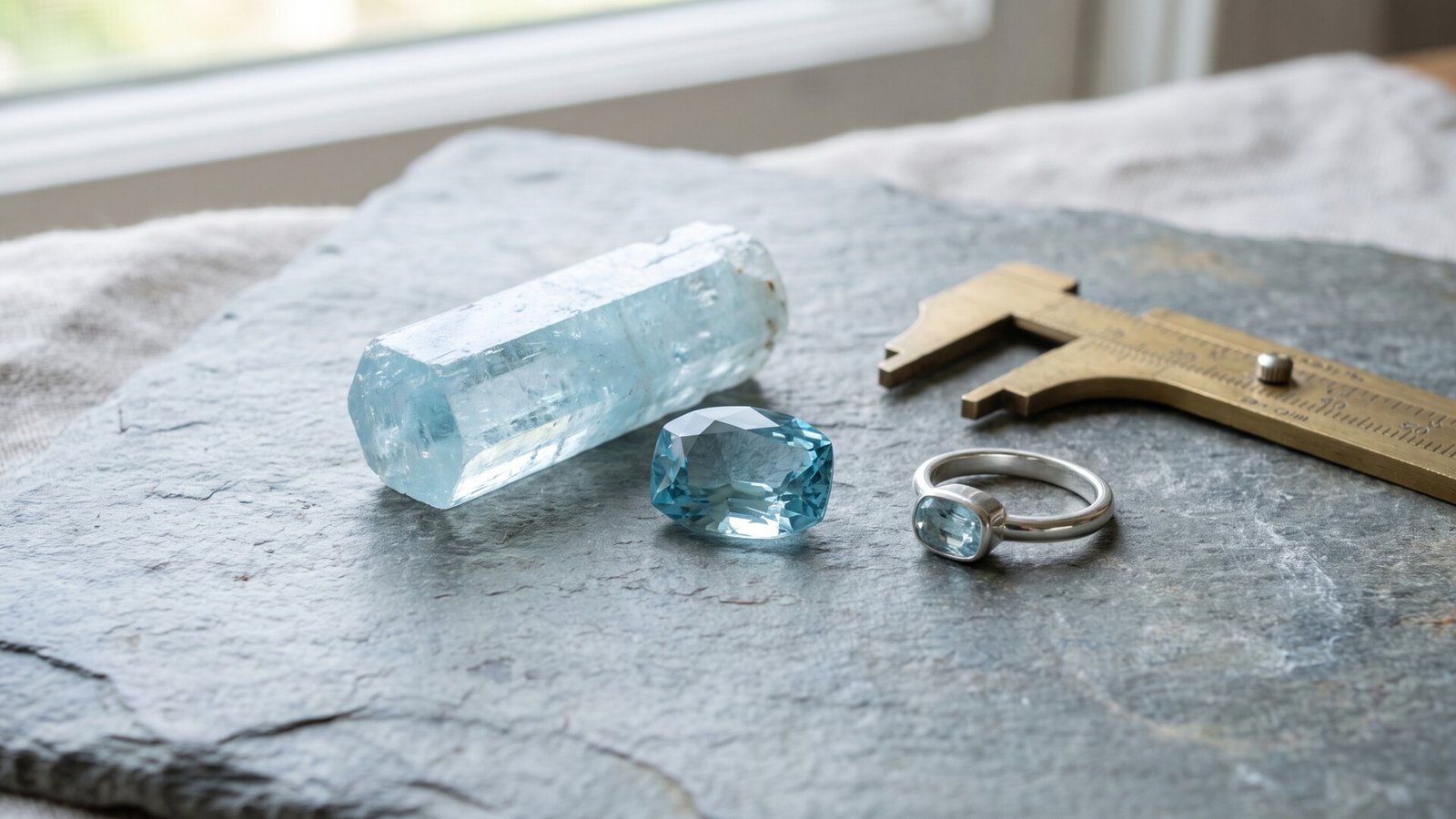
Aquamarine Meaning: History, Symbolism, Spiritual Properties & Modern Uses
Aquamarine is March’s birthstone and carries a long body of sea folklore. The best known legend: Ancient sailors carried it as a talisman against shipwreck, believing it would calm stormy seas. Folklore says Roman healers used it for throat and stomach complaints, and that medieval mystics gazed into aquamarine crystal balls to foretell the future. Today many people wear it as a symbol of courage, clarity, and calm. None of these uses is medically or scientifically supported; they are traditions.
Its legends link it to ancient sailors, Roman writers, medieval seers, and modern crystal enthusiasts. Many of those stories are folklore rather than documented history, so this guide keeps three things apart: gemological facts (what the stone is), traditions (what people have said about it), and modern beliefs (what some wearers hope it offers).
Aquamarine is the blue to blue-green variety of the mineral beryl, the same family that includes emerald, morganite, and heliodor. Its name comes from the Latin aqua marina — “water of the sea” — a fitting name for a gem that captures the tranquil colors of the ocean. But its meaning has grown far beyond that simple definition.
Below you will find its symbolism and history, its spiritual associations, its place in astrology and birthstone lists, and practical advice on durability, treatments, buying, and care. If you want the full stone profile, see our main guide to aquamarine meaning, properties, uses and value, or the March birthstone guide.
Aquamarine at a Glance
Before we dive deep into its meaning, here’s a quick reference guide to aquamarine’s key characteristics.
| Feature | Details |
|---|---|
| Mineral | Beryl (beryllium aluminum silicate) |
| Color | Pale blue to deep blue-green |
| Hardness | 7.5–8 (Mohs scale) |
| Birthstone Month | March |
| Zodiac Associations | Pisces, Aries |
| Anniversary | 19th Wedding Anniversary |
| Symbolism | Traditionally: calm, courage, clarity, protection, communication, hope (beliefs, not science) |
Aquamarine Gemological Facts: Durability, Treatments and Care
Everything in this section is gemology, not folklore. Aquamarine is the blue to greenish-blue variety of beryl, colored mainly by traces of iron. Its hardness measures scratch resistance, but wearability also depends on toughness and cleavage, which is where aquamarine needs a little care.
| Property | Aquamarine |
|---|---|
| Species / variety | Beryl (Be3Al2Si6O18); blue to greenish-blue variety |
| Cause of color | Iron; heating can turn greenish beryl a cleaner blue |
| Mohs hardness | 7.5 to 8 (resists scratching from dust and most everyday materials) |
| Toughness / cleavage | Brittle, with imperfect cleavage in one direction; a hard knock can chip or crack it, especially if it has fractures or long inclusions |
| Clarity | Usually eye-clean; visible inclusions lower value |
| Common treatments | Heat treatment to remove green tones is routine and considered stable; irradiated blue beryl (Maxixe type) can fade and is a different story |
| Lab-grown and simulants | Synthetic aquamarine exists but is uncommon; common look-alikes are blue topaz, synthetic spinel and glass |
| Care | Warm soapy water and a soft brush; avoid ultrasonic cleaners if the stone has fractures or inclusions; avoid knocks and sudden temperature changes |
What Does Aquamarine Symbolize?
Aquamarine’s symbolism is tied to the sea: calm, courage, and protection. Everything in this section is tradition and belief, not science.
Calmness and Serenity
Aquamarine’s tranquil blue color evokes the peace of clear ocean waters. It’s believed to soothe the mind, reduce stress, and promote emotional balance. Its gentle energy makes it a natural choice for those seeking inner peace in a chaotic world.
Courage and Fearlessness
Aquamarine has long been associated with courage. Ancient sailors carried it as a talisman of fearlessness and protection. In crystal healing, it’s thought to quell phobias and irrational fears, giving the wearer the confidence to face challenges.
Emotional Clarity and Communication
Aquamarine is strongly associated with the throat chakra, the energy center connected to communication and self-expression. It’s believed to help the wearer speak their truth clearly and from the heart, making it an excellent stone for public speakers, writers, and anyone who struggles to express themselves.
Protection
Throughout history, aquamarine has been worn as a protective talisman. It was thought to protect sailors from the perils of the sea, to render soldiers invincible in battle, and to guard against enemies and legal adversaries.
Safe Travel
Aquamarine’s most famous association is with safe sea travel. Ancient mariners carried aquamarine to calm waves, protect against shipwreck, and ward off sea sickness.
Hope and Happiness
In modern times, aquamarine is associated with happiness, youthfulness, and hope. Its bright, clear color represents optimism and the promise of better days ahead.
Why Aquamarine Became Known as the “Gem of the Sea”
The name itself tells the story. Aqua marina means “water of the sea.” Ancient legends described aquamarine as the treasure of mermaids, washed ashore from their treasure chests. For centuries, sailors believed the stone came from the depths of the ocean, carrying the protective power of the sea gods.
The Symbolism Behind Its Ocean-Blue Color
Aquamarine’s color ranges from pale, almost transparent blue to deep, saturated “Santa Maria” blue. The lighter shades evoke calm, clear water — peace and serenity. The deeper shades represent courage and strength — the power of the deep ocean. Its color reminds us of the vastness and mystery of the sea.
The History of Aquamarine Meaning
Beryl has been known since antiquity, and writers of the Greek and Roman era described blue-green beryl. Many popular details about aquamarine in ancient Greece and Rome (such as throwing stones to Poseidon) are repeated widely but rest on thin primary sources, so read them as folklore rather than documented history.
Ancient Greece: Sailors’ Protective Stone
The ancient Greeks revered aquamarine as the “sailor’s gem.” They believed it possessed the power to calm waves and protect sailors at sea. Fishermen would wear aquamarine pendants or rings, and in desperate times, they would throw their aquamarines into tumultuous waters as gifts to Poseidon, hoping to calm the storm.
The Greeks also associated aquamarine with mermaids and sirens. They believed the stone could protect sailors from the irresistible charm of these mythical creatures encountered during voyages.
Ancient Rome: Safe Voyages and Good Fortune
The Romans inherited the Greek belief in aquamarine’s protective properties. They considered it the “sailor’s gem”, and later folklore says Roman healers used it for complaints of the throat, stomach, and liver. That is tradition, not medicine. In Roman folklore, wearing aquamarine could even turn enemies into friends.
Medieval Europe: A Stone of Truth and Mysticism
During the Middle Ages, aquamarine was valued by healers and mystics. It became a mystic stone of prophets and seers, who used aquamarine crystal balls to predict the future. It was believed to enhance paranormal abilities and aid in the occurrence of epiphanies.
Renaissance and Royal Collections
In the Renaissance, aquamarine continued to be prized by royalty and the wealthy. Its association with the sea made it a popular choice for maritime-themed jewelry. The gemstone was also believed to bring happiness in marriage.
Modern Symbolism
Today, aquamarine’s meaning encompasses all of these historical associations — and more. It’s the stone of calm, courage, and clear communication. It’s used in meditation, crystal healing, and jewelry. And its beautiful blue color makes it one of the most popular gemstones for spring and summer jewelry.
How the Meaning of Aquamarine Has Changed Over Time
| Time Period | Primary Meaning |
|---|---|
| Ancient Greece | Protection for sailors; calming storms |
| Roman Empire | Safe voyages; healing ailments |
| Middle Ages | Mysticism; prophecy; crystal balls |
| Renaissance onward | Happiness in marriage; maritime-themed jewelry (folklore) |
| Modern Crystal Culture | Emotional healing; communication; calm |
This evolution reflects broader cultural shifts. In ancient times, aquamarine was valued for its physical protective properties. Today, it’s valued for its emotional and spiritual symbolism — a shift from external protection to internal transformation.
Aquamarine in Different Cultures
Aquamarine has been treasured across cultures and continents. Here’s how different traditions have interpreted its meaning.
Greek Traditions
The Greeks called aquamarine the “sailor’s gem” and believed it could calm storms and protect seafarers. They also associated it with mermaids and sirens, believing the stone could protect against their enchanting songs.
Roman Beliefs
The Romans believed aquamarine could heal ailments of the throat, stomach, and liver. They also thought it could turn enemies into friends, making it a stone of diplomacy and reconciliation.
European Maritime Traditions
For centuries, European sailors carried aquamarine as a talisman for safe voyages.
Eastern Symbolism
Some modern crystal sources link aquamarine with the ocean, compassion, and protection in Buddhist and Thai contexts. These are popular associations rather than documented religious doctrine, and we have not verified a primary source.
Modern Western Crystal Practices
Today, aquamarine is widely used in meditation, crystal healing, and mindfulness practices. Its calming energy makes it a popular choice for stress relief and emotional balance. It’s strongly associated with the throat chakra and is used to enhance communication and self-expression.
Common Themes Across Cultures
Despite their differences, most cultures share some common beliefs about aquamarine:
- It offers protection, especially during travel.
- It promotes calm and emotional balance.
- It enhances communication and self-expression.
- Its blue color connects it to water and the sea.
Key Differences
The main difference lies in the specific application:
- Ancient cultures focused on physical protection (storms, shipwreck, illness).
- Medieval practitioners emphasized mysticism and prophecy.
- Modern practitioners emphasize emotional healing and communication.
Spiritual Meaning of Aquamarine
Note: The following information is based on cultural and spiritual beliefs, not established scientific fact. Aquamarine does not treat, prevent, or cure any physical or mental health condition, and these beliefs are not medical advice. If anxiety, grief, or other concerns are affecting you, please speak with a qualified professional.
Aquamarine’s spiritual meaning is deeply connected to calm, courage, and clear communication.
Calm and Serenity
In crystal practice, aquamarine is considered one of the most calming stones. Practitioners say its gentle blue energy encourages inner peace. That is a belief; for many people the pale blue color simply works as a visual cue to slow down and breathe.
Emotional Healing
Aquamarine is believed to help release fear, anxiety, and emotional blockages. Practitioners describe this as emotional release and letting go of old patterns. It is a spiritual idea, not a therapy.
Honest Communication
Aquamarine is traditionally associated with the throat chakra, the energy center linked to speech in Hindu-derived and modern New Age systems. Believers say it supports clear, honest self-expression, and some people wear it as a personal reminder before public speaking or difficult conversations.
Courage
Aquamarine has long been a stone of courage. It helps the wearer face fears, speak their truth, and take bold action. Its energy is gentle but empowering — it doesn’t push, but it supports.
Spiritual Clarity
Aquamarine is believed to clear the mind and enhance spiritual insight. In medieval times, it was used in crystal balls for prophecy and divination. Today, it’s used in meditation to quiet mental chatter and access deeper understanding.
Mindfulness
Aquamarine encourages present-moment awareness. Its calming energy helps the wearer stay grounded in the present, rather than worrying about the past or future.
Letting Go of Fear
Aquamarine is believed to help release irrational fears and phobias. Its soothing energy creates a sense of safety and trust, allowing the wearer to let go of anxiety and embrace courage.
Emotional Meaning of Aquamarine
Beyond its spiritual associations, aquamarine carries emotional meaning for many wearers. These are personal and symbolic associations, not clinical claims, and a stone is not a substitute for professional support.
Managing Stress
Some people keep an aquamarine in a pocket or wear it as a calming reminder during busy or stressful periods. Its value here is symbolic, a cue to pause, rather than a remedy for stress.
Building Emotional Resilience
In crystal practice, aquamarine is a symbol of resilience, often chosen during a hard season. It is not a treatment for grief, heartbreak, or trauma.
Open Communication
Aquamarine supports honest, open communication. It helps the wearer express their feelings clearly and compassionately, making it a valuable stone for relationships and conflict resolution.
Finding Inner Peace
Believers describe aquamarine as a stone for quieting the mind and cultivating calm. It does not reduce anxiety in any clinical sense.
Navigating Life Changes
Aquamarine is a stone of transition. Its calming energy supports the wearer through life changes — career shifts, relationship transitions, and personal growth.
Which Type of Aquamarine Best Matches Your Goals?
Not all aquamarines are the same. Different varieties offer different aesthetics and, for those who believe in crystal energy, different energetic properties.
Pale Blue Aquamarine
Pale blue aquamarine is the lightest shade, often nearly colorless.
- Best for: Everyday jewelry, delicate pieces, and those who prefer subtle colors.
- Symbolism: Gentle calm, clarity, and peace. The pale blue represents the calm shallows of the sea.
Deep Blue Aquamarine (Santa Maria)
Santa Maria aquamarine is the most prized variety, with a deep, saturated blue color. Originally mined in the Santa Maria de Itabira region of Brazil, today the term applies to any aquamarine meeting strict color criteria.
- Best for: Collectors and fine jewelry.
- Symbolism: Courage, depth, and strength. The deep blue represents the power of the open ocean.
Blue-Green Aquamarine
Blue-green aquamarine has a subtle green undertone, reminiscent of tropical waters.
- Best for: Unique personal style, fashion jewelry, and those who prefer warmer tones.
- Symbolism: Balance, harmony, and connection to nature.
Raw Aquamarine Crystals
Raw (unfaceted) aquamarine crystals are popular among collectors and crystal enthusiasts.
- Best for: Collectors, meditation, and crystal grids.
- Symbolism: Natural energy, authenticity, and connection to the earth.
Heat-Treated Aquamarine
Many aquamarines on the market have been heat-treated to enhance their blue color. A yellowish, greenish, or bluish-green beryl can be heat treated to produce a stable blue color.
- Best for: Everyday jewelry, budget-conscious buyers.
- Symbolism: Transformation, enhancement, and accessibility.
| Variety | Appearance | Traditional Symbolism | Best For |
|---|---|---|---|
| Pale Blue | Light blue, subtle | Gentle calm, clarity | Everyday jewelry |
| Santa Maria | Deep, saturated blue | Courage, strength | Collectors, luxury |
| Blue-Green | Blue with green undertone | Balance, harmony | Unique style |
| Raw Crystal | Uncut, natural | Authenticity, natural energy | Collectors, meditation |
| Heat-Treated | Enhanced blue | Transformation, accessibility | Everyday wear |
Aquamarine and Astrology
Zodiac stone lists vary by source and are tradition, not science. Aquamarine is most often linked with Pisces and, in some lists, Aries.
Pisces (February 19 – March 20)
Pisces is a water sign ruled by Neptune and Jupiter. Pisceans are intuitive, compassionate, and deeply emotional. Aquamarine’s calming energy helps Pisces manage emotional overwhelm and stay grounded. Its association with the sea resonates with Pisces’ water sign nature.
Aries (March 20 – April 20)
Aries is a fire sign ruled by Mars. Arians are bold, energetic, and courageous. Aquamarine’s calming energy balances Aries’ intensity, while its courage symbolism supports their natural leadership.
Neptune and Mars Symbolism
Aquamarine’s connection to Neptune (Pisces’ ruling planet) links it to intuition, dreams, and emotional depth. Its connection to Mars (Aries’ traditional ruler) links it to courage, action, and determination.
Why Astrologers Associate Aquamarine With Emotional Balance
Some astrologers suggest aquamarine for Pisces to soothe emotional intensity and for Aries to balance fiery energy. Its calming blue color and association with the throat chakra make it a stone of clear communication and emotional stability.
For more details, explore our Pisces Birthstone Guide, Aries Birthstone Guide, and Zodiac Birthstones Hub.
Aquamarine as a Birthstone
March Birthstone
On the modern list used in the United States, aquamarine is the birthstone for March, while bloodstone is the traditional March stone. Birthstone lists differ by country and organization, and their histories vary by source. The spring-like blue color and associations with hope and youth are part of why aquamarine suits the month.
Anniversary Gemstone
Aquamarine appears on modern anniversary lists as a gemstone for the 19th wedding anniversary (lists vary by source). Its symbolism of calm, courage, and clear communication makes it a thoughtful choice for nearly two decades of partnership.
Gift Symbolism
Giving aquamarine as a gift carries deep meaning. It symbolizes:
- Courage: You believe in the recipient’s strength.
- Calm: You wish them peace and emotional balance.
- Clear communication: You value honest, open dialogue.
- Protection: You want to keep them safe.
- Hope: You wish them happiness and optimism.
Learn more in our March Birthstone Guide and our aquamarine engagement ring ideas.
Aquamarine in Jewelry
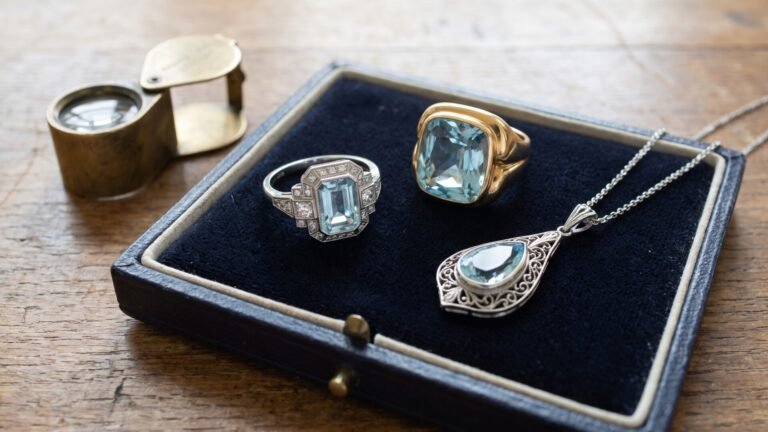
Aquamarine’s hardness (7.5–8 on the Mohs scale), usually excellent clarity, and soft sea-blue color make it a popular jewelry gem, though it is brittle and needs sensible settings (see the facts table above).
Rings
Aquamarine rings are popular for both everyday wear and special occasions. The stone’s blue color pops against white gold, platinum, and yellow gold. Hardness measures scratch resistance, not toughness. Aquamarine is a brittle beryl with imperfect cleavage in one direction, so a hard knock can chip or crack it, especially at corners. It can work in a ring worn regularly if the setting protects it (a bezel, a halo, or prongs that cover the corners of step cuts). If you work with your hands, a pendant or earrings are the safer choice.
Necklaces
Aquamarine pendants are elegant and versatile. A single aquamarine stone on a simple chain can be worn with anything — from casual to formal. When worn close to the heart, aquamarine is believed to promote emotional balance and clear communication.
Earrings
Aquamarine studs are classic and professional. Drop earrings and chandeliers make a statement for special occasions. The cool blue color complements both cool and warm skin tones.
Bracelets
Aquamarine bead bracelets are affordable, stackable, and perfect for everyday wear. Tennis bracelets with aquamarine stones offer a more elegant option.
Men’s Jewelry
Aquamarine is increasingly popular in men’s jewelry — signet rings, cufflinks, and minimalist pendants. Its cool blue color is sophisticated without being flashy.
Everyday Wear
Earrings and pendants are the lowest-risk everyday choices because they rarely take knocks. Bracelets and rings see more impact, so choose protective settings and take rings off for gym work, gardening, and cleaning.
Why Aquamarine Remains a Timeless Jewelry Choice
Aquamarine’s combination of beauty, durability, and affordability makes it a perennial favorite. It’s available in large sizes and is often eye-clean, making it ideal for statement pieces. Its association with the sea and calm makes it a meaningful choice for anyone seeking peace and clarity.
How to Choose an Aquamarine
When selecting an aquamarine, consider these factors.
Color
Color is the most important factor in aquamarine’s value. The most prized color is a slightly greenish blue to moderately strong dark blue. The deeper the blue, the more valuable the stone. “Santa Maria” blue is the most sought-after.
Clarity
Aquamarine is often eye-clean, meaning no visible inclusions to the naked eye. High clarity is one of aquamarine’s selling points. Look for stones with good transparency and minimal inclusions.
Cut
A well-cut aquamarine maximizes brilliance and color. Emerald cuts, oval cuts, and cushion cuts are popular. Poorly cut stones may appear washed out or have dead zones.
Carat Size
Larger aquamarines are available and affordable compared to other gemstones. The price per carat increases with size, but not as dramatically as with rarer stones.
Natural vs Heat-Treated Aquamarine
Many aquamarines on the market have been heat-treated to enhance their blue color. This treatment is permanent and stable. Heat treatment is routine and widely accepted in the trade; ask the seller to disclose it. Untreated stones are not necessarily more valuable, since color and clarity drive price, and treated and untreated stones carry the same traditional symbolism. Be wary of unusually deep blue stones sold cheaply: irradiated blue beryl can fade, and blue topaz, synthetic spinel, and glass are common look-alikes.
Lab-Grown Aquamarine and Simulants
A lab-grown (synthetic) aquamarine has the same chemistry and structure as the natural stone, while a simulant such as glass or synthetic spinel only imitates the look. Synthetic aquamarine is uncommon on the market, so a bargain stone sold as aquamarine is more likely a simulant or a treated stone. Ask for the stone type in writing and, for larger or costlier purchases, an independent gemological laboratory report. We have not verified current price ranges, so compare several reputable sellers and check what each one discloses about treatment.
For more details, explore our aquamarine properties and value guide, the aquamarine color chart, aquamarine vs topaz, and natural vs. lab-grown gemstones.
Caring for Aquamarine Jewelry
Cleaning
Warm, soapy water and a soft cloth are safe for aquamarine (our full guide to caring for aquamarine stones goes deeper). Avoid ultrasonic cleaners if the stone has visible inclusions or fractures. Never use harsh chemicals or abrasive cleaners.
Proper Storage
Store aquamarine separately from harder stones (diamond, sapphire, topaz) to prevent scratching. Use individual soft pouches or compartmentalized boxes.
Protecting Against Scratches
Aquamarine has a hardness of 7.5–8, making it resistant to scratching from everyday wear. However, it can be scratched by harder stones. Store it carefully and avoid wearing it during activities that might cause impact.
Daily Care Tips
Remove aquamarine jewelry before swimming, showering, or applying lotions and perfumes. Wipe with a soft cloth after wearing to remove oils and residues. Avoid abrupt temperature changes, which can fracture the stone.
Common Myths About Aquamarine Meaning
Myth: Aquamarine Guarantees Calmness
Aquamarine is a symbol of calm, not a guarantee. Its power lies in its ability to shift mindset — to encourage peace, clarity, and emotional balance. It can help you feel calmer, but it doesn’t replace healthy coping mechanisms.
Myth: Every Blue Beryl Is Aquamarine
Aquamarine is beryl colored by iron, and the name is a color-based trade term. Heat-treated greenish beryl is still sold as aquamarine if it ends up blue. Blue beryl of the Maxixe type, colored by irradiation, can fade in light and is not the same thing as natural-color aquamarine.
Myth: Ancient Sailors Used Aquamarine Exactly Like Modern Crystal Healing
According to folklore, sailors carried aquamarine for protection against storms and shipwreck. Modern crystal practice emphasizes calm and self-expression instead. The focus has shifted from external protection to personal symbolism.
Myth: Darker Stones Have Greater Symbolic Power
Darker aquamarine is more valuable in jewelry, but its symbolic meaning is the same regardless of depth of color. A pale blue aquamarine carries the same associations of calm, courage, and communication as a deep Santa Maria stone.
Why Aquamarine Became the World’s Most Famous “Ocean Gem”
The sea connection explains much of aquamarine’s lasting appeal.
Ancient Maritime Trade
Aquamarine’s name and symbolism are inseparable from the sea. Legend casts it as a sailor’s talisman for safe travel, though how widely beryl was traded by ancient seafarers is not well documented.
Sailors and Protective Talismans
For centuries, sailors carried aquamarine as a talisman against shipwreck, sea sickness, and the dangers of the open ocean. Legend says it was sometimes thrown overboard as a last resort to calm stormy seas. This is a folk tradition, not a documented practice.
Royal Jewelry Collections
Large, clean aquamarine crystals have made famous showpieces. The Dom Pedro aquamarine, an obelisk carved from a crystal of about 10,363 carats, is the largest cut aquamarine and is held by the Smithsonian’s National Museum of Natural History.
The Influence of Modern Birthstone Traditions
Aquamarine’s designation as the March birthstone cemented its place in modern jewelry. Its calming blue color and association with spring made it a natural choice for the month of renewal and new beginnings.
Why Aquamarine Continues to Symbolize Calm Today
In a fast-paced, stressful world, aquamarine’s association with calm and clarity is more relevant than ever. Its tranquil blue color offers a visual reminder to pause, breathe, and find peace. Whether worn as jewelry or kept as a meditation stone, aquamarine continues to fulfill its ancient promise of protection and peace.
How to Choose the Right Aquamarine Based on Its Meaning
For Peace
Choose a pale blue aquamarine in a simple pendant or bracelet. Its gentle color reflects its calming energy.
For Courage
Choose a deeper blue aquamarine (Santa Maria) in a ring or pendant. The deeper color symbolizes strength and courage.
For Communication
Choose an aquamarine in a necklace or pendant, worn near the throat chakra. Its association with clear communication makes it ideal for public speakers, writers, and teachers.
For Travel
Choose an aquamarine in a bracelet or ring. Its historical association with safe travel makes it a meaningful talisman for journeys.
For Gifts
Choose a classic blue aquamarine in a versatile setting — stud earrings, a solitaire pendant, or a simple bracelet. Its universal meaning makes it a thoughtful gift for any occasion.
Final Thoughts: What Does Aquamarine Really Mean?
Aquamarine’s meaning has evolved over thousands of years — from a protective talisman for ancient sailors to a symbol of calm and courage to a modern emblem people use for reflection and clear communication. But through all these changes, one thing has remained constant: aquamarine represents the tranquility and power of the sea.
Whether you’re drawn to its beautiful blue color, its ancient history, or its modern spiritual associations, aquamarine offers something meaningful. It’s a stone that connects us to the past — to the sailors, mystics, and storytellers who gave it its legends. And it’s a stone that connects us to ourselves — to our own capacity for calm, courage, and clear expression.
The most powerful meaning of aquamarine, however, is personal. It’s the meaning you assign to it. It’s the intention you set when you wear it. It’s the reminder you give yourself to stay calm, speak your truth, and face challenges with courage.
So whether you choose a pale blue aquamarine for everyday wear or a deep Santa Maria stone for a special occasion, choose the aquamarine that resonates with you. Because the stone’s meaning is ultimately what you make of it.
Where Aquamarine Comes From and What Drives Its Value
According to GIA, Brazil is famous for very large aquamarine crystals, while Nigeria, Madagascar, and Mozambique have produced intensely colored stones, often under 5 carats. Origin alone does not guarantee quality, so judge each stone on its own color, clarity, and cut.
Color is the biggest value factor: the most valuable stones are a moderately strong, slightly greenish to pure blue, and most aquamarine on the market is a lighter greenish blue. Most faceted stones are eye-clean, so visible inclusions count against a stone. Because large stones are less in demand except as center stones, per-carat prices tend to fall above about 25 carats. We have not verified current per-carat price ranges, so compare several reputable sellers rather than relying on a single figure. For deeper colour detail see our aquamarine color chart.
Aquamarine Compared With Look-Alike Blue Gems
| Gem | Mineral | Mohs hardness | Key trade-off |
|---|---|---|---|
| Aquamarine | Beryl | 7.5 to 8 | Brittle with imperfect cleavage; usually heat-treated, which is stable |
| Blue topaz | Topaz | 8 | Perfect cleavage; blue is usually from irradiation plus heating; much cheaper |
| Blue spinel | Spinel | 8 | Tough and durable; natural blue spinel is rarer; synthetic spinel is a common simulant |
| Morganite | Beryl | 7.5 to 8 | Same family as aquamarine, but pink to peach |
For a side-by-side look at the closest rival, read aquamarine vs topaz for durability and color. If you enjoy the history of antique pieces, our guide to vintage aquamarine jewelry trends covers how styles changed, and our aquamarine engagement ring ideas help if you are shopping for a proposal.
Related Guides
- March Birthstone Guide
- Pisces Birthstone Guide
- Aries Birthstone Guide
- Aquamarine: Meaning, Properties, Uses & Value
- Natural vs. Lab-Grown Gemstones
- How to Care for Aquamarine Stones
- Aquamarine Color Chart Explained
- Aquamarine in Mythology and History
- Vintage Aquamarine Jewelry Trends
- Aquamarine vs Topaz
- Aquamarine Engagement Rings
- Gemstones Guide our main gemstone hub
Frequently Asked Questions About Aquamarine Meaning
What is the spiritual meaning of aquamarine?
Aquamarine is spiritually associated with calm, courage, clear communication, and emotional healing. It’s believed to soothe the mind, release fear, and support honest self-expression. It’s also associated with the throat chakra, a link believers connect with communication. These are beliefs, not medical advice.
Why is aquamarine associated with the sea?
What does aquamarine symbolize?
Aquamarine symbolizes calm, courage, clarity, protection, safe travel, hope, and happiness. It’s also associated with honest communication and emotional healing.
Which zodiac signs are connected to aquamarine?
Aquamarine is associated with Pisces and Aries. Its calming energy balances Pisces’ emotional depth and Aries’ fiery intensity.
Does aquamarine represent courage?
Yes. Aquamarine has long been a symbol of courage and fearlessness. According to folklore, sailors carried it for protection, and some crystal practitioners associate it with facing fear. This is belief, not a treatment.
What does gifting an aquamarine gemstone symbolize?
Giving aquamarine symbolizes courage, calm, clear communication, protection, and hope. It’s a gesture of trust, support, and belief in the recipient’s strength.
Is there scientific evidence for aquamarine's spiritual properties?
No. Aquamarine’s spiritual and healing properties are matters of cultural tradition and personal experience, not established science. Its meaning comes from thousands of years of human belief, not from measurable physical effects.
Is aquamarine durable enough for everyday jewelry?
Aquamarine rates 7.5 to 8 on the Mohs scale, so it resists scratching well, but it is brittle with imperfect cleavage and can chip or crack from a hard knock. Earrings and pendants suit daily wear; for rings, choose a protective setting such as a bezel or halo.
Is aquamarine usually treated?
Heat treatment to turn greenish beryl blue is routine and considered stable. Ask sellers to disclose it. Blue beryl colored by irradiation (Maxixe type) can fade and is not the same as natural-color aquamarine.
What is the difference between lab-grown aquamarine and a simulant?
Lab-grown aquamarine has the same chemistry and structure as the natural gem. A simulant such as glass, blue topaz, or synthetic spinel only imitates the look. Synthetic aquamarine is uncommon, so ask for the stone type in writing.
Can anyone wear aquamarine?
Yes. Although aquamarine is traditionally linked with March birthdays and, in some lists, Pisces and Aries, anyone can wear it for its beauty and symbolism. Many people simply enjoy its calm, light color.
How is aquamarine different from blue topaz?
Both are pale blue gems, but they are different minerals. Aquamarine is beryl (Mohs 7.5 to 8, imperfect cleavage); blue topaz is topaz (Mohs 8, perfect cleavage) and its blue is usually produced by irradiation and heating. Fine aquamarine generally sells for far more than blue topaz of similar size. See our aquamarine vs topaz comparison.
Where does the best aquamarine come from?
GIA notes that Nigeria, Madagascar, and Mozambique produce intensely colored stones, often under 5 carats, while Brazil is known for very large crystals. Origin alone does not guarantee quality; color, clarity, and cut matter more.
Ready to find your aquamarine? Browse our collections below.
[Shop Aquamarine Jewelry at Blue Nile]
[Shop Aquamarine Rings at James Allen]
[Shop Ethical Aquamarine at Brilliant Earth]