Birthstone Color Chart Explained: Your Complete Guide
Birthstones are not just about personal celebration. They are a blend of color, symbolism and culture. Each month is traditionally associated with one or more gemstones, and each gemstone comes in a range of colors that can change how it looks, what it costs and how it is valued. Understanding the birthstone color chart helps you choose the right ring, pendant or bracelet with confidence.
In this guide we go through every birthstone color month by month, explain what creates the shades, flag which stones are commonly treated, and give practical shopping advice. Birthstone lists differ by country and organization. We follow the list GIA publishes, and where a month has several stones we name them all. For the full picture by month, see our Birthstones by Month hub, and for the wider topic of buying, the Education & Buying Guides for Birthstones hub.
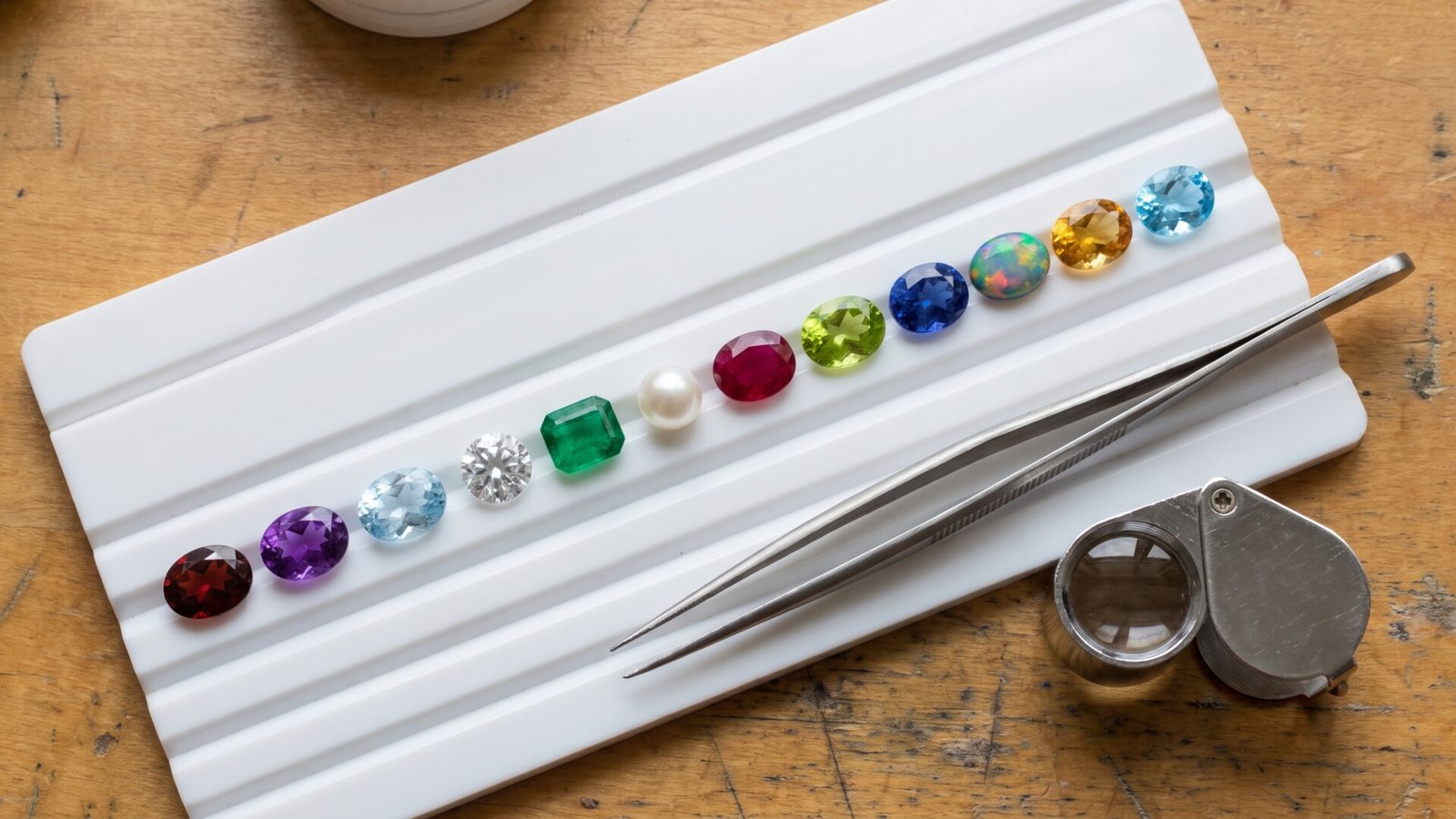
Birthstone Color Chart at a Glance
| Month | Birthstone(s) | Typical colors |
|---|---|---|
| January | Garnet | Deep red (also orange, green, yellow, purple) |
| February | Amethyst | Pale lavender to deep purple |
| March | Aquamarine, bloodstone | Pale blue to blue-green; dark green with red flecks |
| April | Diamond | Colorless to near-colorless (also fancy colors) |
| May | Emerald | Green to bluish green |
| June | Pearl, moonstone, alexandrite | White and cream; blue-white sheen; green to purplish red |
| July | Ruby | Red to purplish red |
| August | Peridot, spinel | Yellow-green to olive; red, pink, blue and more |
| September | Sapphire | Blue (also pink, yellow, green, white) |
| October | Opal, tourmaline | Play-of-color; nearly every color |
| November | Topaz, citrine | Yellow, golden, blue, pink; yellow to orange |
| December | Turquoise, tanzanite, zircon | Sky blue to green-blue; blue-violet; blue, colorless, golden |
Why Color Matters in Birthstones
Color is one of the most important factors in a gemstone’s beauty and, for most colored stones, its value. Here is why it matters:
- Appearance – The right color can complement your skin tone and wardrobe and reflect your personal style.
- Symbolic meaning – Colors carry traditional and emotional associations. Deep blue sapphires are linked with wisdom and loyalty, and red rubies with passion and courage. These are cultural meanings, not scientific facts.
- Quality and value – In most colored gemstones, vivid, even color is a major driver of price, and heavy inclusions or dull color reduce it.
- Personal expression – Some people prefer stones that match their zodiac sign or favorite color rather than their birth month. See zodiac vs monthly birthstones for how to choose.
Birthstone Colors by Month
Below is a month-by-month guide to the birthstones, their colors and what to look for. For the background on how lists were formed, read What Are Birthstones?
January – Garnet
- Color range: Deep red, orange, green, yellow and purple. The classic birthstone color is a rich, dark red.
- Traditional symbolism: Protection, prosperity and friendship.
- Buyer tips: Garnets are generally durable and budget-friendly, which makes them good for rings. Look for even color saturation. Compare shades in garnet color types explained, and see the January birthstone guide and garnet guide.
- Jewelry to consider: Garnet stud earrings, solitaire rings and stacking rings.
February – Amethyst
- Color range: Pale lavender to deep purple, with shades that can lean bluish or reddish.
- Traditional symbolism: Calm, clarity and spiritual growth.
- Buyer tips: Deeper purples, sometimes with flashes of red, are typically more valued. Avoid stones that look cloudy or unevenly colored. Amethyst can fade with prolonged strong sunlight or heat, so store it away from both. See amethyst color variations ranked and the February birthstone guide.
- Jewelry to consider: Pendants, halo rings and raw crystal necklaces.
March – Aquamarine and Bloodstone
- Color range: Aquamarine runs from pale blue to icy blue and sometimes blue-green. Bloodstone is dark green with red flecks.
- Traditional symbolism: Serenity, courage and clarity (aquamarine).
- Buyer tips: A clear, sky-blue color is highly prized, and too much green or brown undertone usually lowers appeal. Aquamarine is often heated to improve its blue, which is routine. See our aquamarine color chart, the March birthstone guide and aquamarine guide.
- Jewelry to consider: Solitaire rings, drop earrings and custom pendants.
April – Diamond
- Color range: Colorless to near-colorless, sometimes with a faint yellow or brown tint. Fancy-color diamonds are graded separately.
- Traditional symbolism: Purity, strength and enduring love.
- Buyer tips: GIA’s color grade runs from D (colorless) downward, and color is one of the 4 Cs of diamonds. Lab-grown diamonds are the same material as natural ones and are sold at lower prices, but they must be labeled as lab-grown. See the April birthstone guide and diamond guide.
- Jewelry to consider: Stud earrings, rings with diamond accents and pendants.
May – Emerald
- Color range: Green to bluish green.
- Traditional symbolism: Rebirth, love and prosperity.
- Buyer tips: Look for vivid, saturated green that is not too dark or too yellowish. Emeralds almost always have inclusions and are commonly treated with oils or resins, so ask about treatment and take care when cleaning. Emerald is hard but can be brittle, as we discuss in is an emerald engagement ring practical? See the May birthstone guide and emerald guide.
- Jewelry to consider: Solitaire rings in protective settings, pendants and necklaces.
June – Pearl, Moonstone and Alexandrite
- Pearl colors: White, cream, black, pink, lavender and more.
- Moonstone colors: Colorless to white or peach with a blue-white sheen called adularescence.
- Alexandrite colors: Green in daylight, purplish red in incandescent light.
- Traditional symbolism: Purity (pearl), intuition (moonstone) and balance or transformation (alexandrite).
- Buyer tips: Pearls should have a smooth surface and good luster. Alexandrite value depends on the strength of its color change, and many alexandrites on the market are lab-created, which should be stated. See the June birthstone guide, pearl, moonstone and alexandrite.
- Jewelry to consider: Freshwater pearl bracelets, pearl drop earrings and alexandrite rings.
July – Ruby
- Color range: Red, from pinkish red to purplish red.
- Traditional symbolism: Passion, courage and protection.
- Buyer tips: A vivid, pure to slightly purplish red is the most prized, and the trade term “pigeon’s blood” describes that top color. Heat treatment is very common, and glass-filled rubies are worth much less. See the July birthstone guide and ruby guide.
- Jewelry to consider: Solitaire rings, stud earrings and pendants.
August – Peridot and Spinel
- Color range: Peridot is yellow-green to olive green. Spinel comes in red, pink, orange, purple and blue.
- Traditional symbolism: Growth and prosperity (peridot).
- Buyer tips: A bright, vivid lime or grass green is ideal for peridot, and olive tones are generally less prized. Peridot is relatively soft for daily rings, so a protective setting helps. See the August birthstone guide and peridot guide.
- Jewelry to consider: Peridot rings, stud earrings and charm bracelets.
September – Sapphire
- Color range: Blue is classic, but sapphire also comes in pink, yellow, green and colorless.
- Traditional symbolism: Wisdom, loyalty and nobility.
- Buyer tips: Deep, uniform blue is the classic. Heat treatment is common, and lab-grown sapphire is real sapphire that should be sold as lab-grown. See sapphire color spectrum explained, the September birthstone guide and sapphire guide.
- Jewelry to consider: Engagement rings, pendants and multi-stone necklaces.
October – Opal and Tourmaline
- Opal colors: Play-of-color flashes over white, black, or other body colors.
- Tourmaline colors: Pink, green, blue and bi-color or multi-color stones.
- Traditional symbolism: Creativity (opal) and emotional balance (tourmaline).
- Buyer tips: Opals are delicate and can crack with heat or dryness, so choose protective settings and avoid knocks. Tourmaline should show even, vibrant color. See the October birthstone guide, opal and tourmaline.
- Jewelry to consider: Opal pendants, tourmaline rings and stacking rings.
November – Topaz and Citrine
- Topaz colors: Yellow, golden, blue, pink and more.
- Citrine colors: Warm yellow to golden orange.
- Traditional symbolism: Joy, success and abundance.
- Buyer tips: Imperial topaz shades are highly prized. Much blue topaz on the market is treated to reach its color, and much citrine is heat-treated amethyst, so ask about treatment. Citrine free of brownish tones looks best. See the November birthstone guide, topaz and citrine.
- Jewelry to consider: Topaz solitaire rings, citrine pendants and stud earrings.
December – Turquoise, Tanzanite and Zircon
- Turquoise colors: Sky blue to green-blue, often with a darker matrix pattern.
- Tanzanite colors: Blue-violet, with strong blue and violet depending on viewing direction.
- Zircon colors: Blue, colorless, golden and other colors. Zircon is a natural gem and is not cubic zirconia.
- Traditional symbolism: Protection (turquoise) and transformation (tanzanite).
- Buyer tips: Turquoise with heavy matrix looks more rustic, while clean sky blue is usually more prized. Treatments such as stabilization are common, so ask. Tanzanite is almost always heat treated and values rise with intense violet-blue saturation. See the December birthstone guide, turquoise, tanzanite and zircon.
- Jewelry to consider: Turquoise bracelets and rings, tanzanite pendants and zircon stud earrings.
Birthstone Colors by Color Family
If you know the color you want but not the month, this table groups the birthstones above by color family. Remember that many stones appear in more than one family.
| Color family | Birthstones | Notes |
|---|---|---|
| Red and pink | Garnet, ruby, spinel, pink tourmaline | Often confused with each other; see the comparison section below |
| Blue | Aquamarine, sapphire, blue topaz, turquoise, tanzanite, zircon | Blue topaz is usually treated; tanzanite is blue-violet |
| Green | Emerald, peridot, bloodstone, green tourmaline, alexandrite (in daylight) | Emerald is commonly oiled or resin filled |
| Purple | Amethyst, tanzanite, alexandrite (in incandescent light) | See our purple gemstones guide |
| Yellow and orange | Citrine, topaz, golden zircon | Much citrine is heat-treated amethyst |
| White and colorless | Diamond, pearl, moonstone, white sapphire | Diamond is graded D to Z for color |
| Multicolor | Opal, tourmaline | Opal shows play-of-color; tourmaline can be bi-color |
Look-Alike Colors: How to Tell Similar Birthstones Apart
Several birthstones share a color family, and sellers, and even experienced shoppers, can mix them up. These distinctions help you ask the right questions:
- Ruby, garnet and red spinel: all can be red, but they are three different minerals with different hardness and price. Compare them in garnet vs ruby and ruby vs garnet vs tourmaline.
- Sapphire and tanzanite: both can look blue-violet, but sapphire is much harder and tougher, while tanzanite has cleavage. See tanzanite vs sapphire.
- Citrine and yellow topaz: both are November stones in yellow to golden shades, but citrine is quartz and topaz is a separate, harder mineral.
- Aquamarine and blue topaz: both are pale to medium blue. Aquamarine is a variety of beryl, and blue topaz on the market is typically treated to reach its color.
- Diamond and its look-alikes: moissanite and white sapphire can resemble diamond, but they are different materials. Lab-grown diamond is real diamond, while moissanite is a simulant of diamond. See our moissanite guide.
Can a Birthstone’s Color Change or Fade?
A few birthstones are sensitive. Amethyst can fade with prolonged strong sunlight or heat, which is also why heating can turn it into citrine. Alexandrite genuinely changes color between daylight and incandescent light, and that is a defining feature rather than a flaw. Opal and pearl can lose their appearance if dried out, cracked or exposed to chemicals, so keep them away from perfume and hairspray. Most other birthstones keep their color for the life of the jewelry when cared for sensibly. Our hardness scale guide and the cleaning guides linked from each month page explain how to look after each stone.
Understanding Hue, Tone and Saturation
A gemstone’s appearance is shaped by three color factors, which gem professionals describe separately:
- Hue – The basic color, such as red, green or blue. Some stones, like alexandrite, show different hues in different light.
- Tone – How light or dark the color is. A very light aquamarine and a deeper blue-green one can look like different stones.
- Saturation – How intense or vivid the color is. Strong, even saturation is usually prized, though stones that are too dark lose brightness.
What creates color in the first place is a separate question. Trace elements, crystal structure and the way a stone absorbs light all play a part. Our guides to the science behind crystal colors and the science behind gemstone colors explain this in more detail.
Color, Treatment and Lab-Grown Stones
Color is also where treatments matter most. Many birthstones are routinely treated to improve or change their color, and a treated stone can look identical to an untreated one at first glance. Common examples include heat treatment of ruby, sapphire, aquamarine and tanzanite, oil or resin filling of emerald, and stabilization of turquoise. Treatments are not a problem when they are disclosed, but they affect value and care. Untreated stones of good color are rarer and usually cost more.
Lab-grown stones have the same chemistry as their natural counterparts and often show very consistent color, while simulants only imitate the look. A seller should tell you which one you are buying. Our guide to natural vs lab-grown birthstones explains how to choose.
Birthstone Color Charts as Visual Tools
Many jewelers and educational sites publish color charts showing the range of colors for each stone, from light to dark and from muted to vivid. Charts help you see what to expect and compare options. Keep in mind that screen and print colors vary, so use a chart as a guide and not as an exact match for a real stone.
Buying Tips for Online Birthstone Jewelry
- Ask about the lab report. For higher-value natural stones, ask for a report from a recognized gemological laboratory such as GIA, and make sure lab-grown stones are labeled clearly.
- Compare colors across stores. The same stone can look different in different photographs, so compare multiple listings and ask for realistic images or video.
- Read the return policy. Make sure you can return or exchange the piece if the color is not what you expected.
- Consider your skin tone and style. Many people find cool-toned stones such as sapphire, amethyst and aquamarine flattering on cool skin tones, and warm-toned stones such as garnet, peridot and citrine on warm ones. This is a common styling suggestion rather than a rule, so trust your own eye.
- Check the lighting. Stones can look different under daylight, incandescent and LED light. Alexandrite and tanzanite are especially sensitive to this.
- Match the stone to how you will wear it. Softer stones such as opal, pearl and turquoise suit pendants and earrings better than daily-wear rings. Our gemstone hardness scale guide explains why.
For help with the shape of the stone as well as the color, see gemstone shapes and cuts explained, and for jewelry ideas, our Birthstone Jewelry Guide.
Some Places You Can Buy Birthstone Jewelry
These retailers are commonly used for birthstone jewelry, and each has a different focus. Always check the current listing for the stone name, treatment, whether the stone is natural or lab-grown, and the return policy:
- Blue Nile – classic designs across many gemstones.
- Brilliant Earth – offers lab-grown and natural gemstones.
- Angara – customizable rings, pendants and stacking sets.
- James Allen – known for high-resolution imagery of its stones.
- Etsy artisan shops – unique handcrafted pieces, where seller quality varies, so read reviews carefully.
For a broader comparison, see our top online stores to buy authentic birthstone jewelry and best online shops for birthstone bracelets.
Birthstone Color Chart FAQs
What color is each month's birthstone?
Garnet is deep red, amethyst purple, aquamarine pale blue, diamond colorless, emerald green, ruby red, peridot yellow-green, sapphire blue, opal play-of-color, topaz and citrine yellow to golden, and turquoise sky blue. Several months have more than one stone, so check the chart above.
Are birthstone colors official?
Birthstone lists are based on tradition and trade conventions, and they differ by country and organization. This guide follows GIA’s list. The colors shown are typical ranges, not strict standards.
Why does the same birthstone look different in different photos?
Lighting, camera settings and screen calibration all change how color appears. Ask for video or natural-light photos and check the return policy.
Which birthstone colors are most valuable?
For most colored stones, vivid, evenly saturated color with good clarity commands the highest prices, for example pure red ruby, vivid green emerald and deep blue sapphire. Treatment and origin also affect value.
Are birthstone colors treated or enhanced?
Often. Heat treatment is common in ruby, sapphire, aquamarine and tanzanite, emerald is commonly oiled or resin filled, and turquoise is often stabilized. Ask the seller to disclose treatments.
Can I wear a different color than my birthstone?
Yes. Many people choose by color preference, zodiac sign or meaning. Birthstones are a tradition, not a rule.
Final Thoughts
The birthstone color chart is a useful starting point, but the best stone is the one whose color you love and whose care and durability suit how you will wear it. Use the ranges above as a guide, ask about treatment and lab-grown status, and compare real photos in different lighting before you buy. For a bigger picture of the year, return to the Birthstones by Month hub or explore the complete guide to your birthstone by month.