Spiritual Meanings of Purple Gemstones: A Complete Guide
Purple gemstones have long been associated with spirituality, transformation and inner vision. From ancient civilizations to modern crystal enthusiasts, these stones are valued for their color and for the meanings people attach to them. In this guide we explore the history, the traditional spiritual meanings and the practical side of the most popular purple gemstones, so you can choose pieces for jewelry, meditation and personal reflection with clear eyes.
Whether you are drawn to amethyst, sugilite, charoite, iolite or tanzanite, it helps to know which statements are gemology and which are belief. The spiritual meanings below come from cultural tradition and crystal-healing practice. They are not scientific claims and not medical advice, and no gemstone has been shown to treat or prevent any condition. If you find a stone meaningful, that is a perfectly good reason to wear it; just keep the facts and the beliefs apart. This matches our affiliate disclosure, which explains how we treat meanings and symbolism.
Purple Gemstones at a Glance
| Stone | What it is | Approx. Mohs hardness | Suits best | Traditional association |
|---|---|---|---|---|
| Amethyst | Purple variety of quartz | 7 | Rings, pendants, earrings, bracelets | Calm, clarity, protection |
| Iolite | Gem variety of the mineral cordierite | 7 to 7.5 (per GIA) | Pendants, earrings; rings with care | Vision, intuition |
| Tanzanite | Blue-violet variety of zoisite | About 6.5 to 7 | Pendants and earrings; protected ring settings | Transformation, insight |
| Sugilite | Purple mineral colored by manganese | About 5.5 to 6.5 | Beads, cabochons, pendants | Love, compassion, protection |
| Charoite | Swirled purple silicate rock-mineral from Siberia | About 5 to 6 | Cabochons, pendants, beads | Transformation, release of fear |
| Fluorite | Calcium fluoride, often purple | 4 | Display pieces, beads, careful wear | Focus, mental clarity |
| Lepidolite | Lithium-bearing mica | About 2.5 to 3 | Display pieces, tumbled stones, beads | Calm, emotional balance |
Hardness figures are approximate and describe scratch resistance only. A stone can be hard and still chip along cleavage planes, which is why we explain the difference in our gemstone hardness scale guide.
The Spiritual Symbolism of Purple
Purple has long been considered a royal and mystical color, often linked to wisdom, intuition and spiritual awakening. Across cultures it stands for nobility, creativity and transformation, which is part of why purple stones have been so highly valued.
In crystal-healing and chakra traditions, purple stones are associated with the crown and third-eye chakras, which practitioners link with spiritual insight, higher awareness and clarity of thought. This is a spiritual framework rather than a scientific one, but it explains why purple stones are so often used in meditation and reflection. If you are new to these ideas, our crystal healing basics for beginners is a gentle starting point, and the science behind crystal colors explains what actually makes a stone purple.
What Makes a Gemstone Purple?
Purple is not one chemistry but several. Amethyst is quartz whose color is generally attributed to trace iron combined with natural radiation. Tanzanite is zoisite, and GIA notes that it shows different colors (including red-violet, deep blue and yellow-green) depending on viewing direction, a property called pleochroism. Iolite is also strongly pleochroic. Sugilite owes its color to manganese, and purple sapphire gets its hue from trace elements in corundum. Because the causes differ, so do durability, treatments and care, which is why the practical sections of this guide treat each stone separately. If you enjoy the science, read the science behind gemstone colors.
Amethyst: The Classic Spiritual Stone
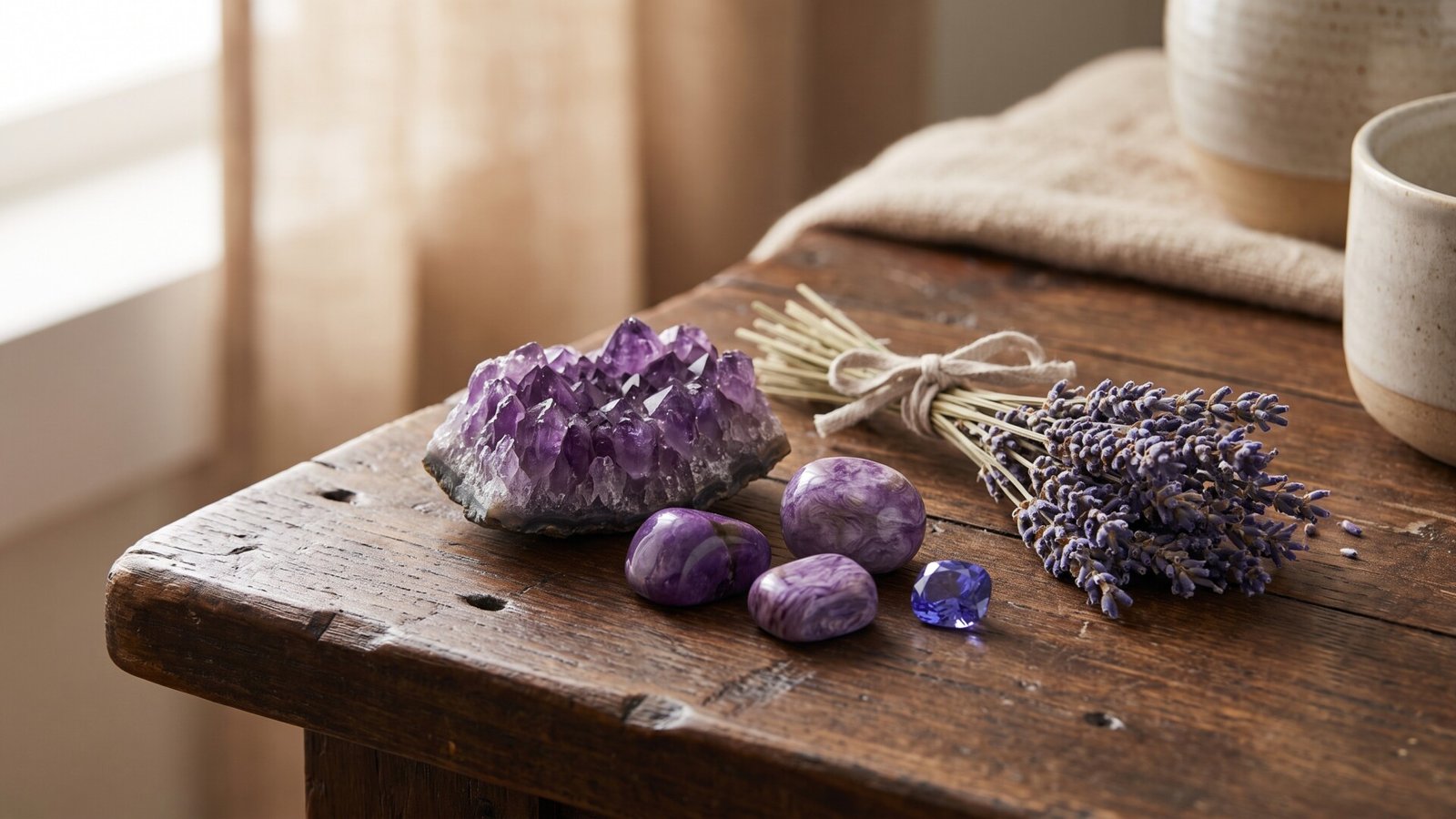
Amethyst is the purple variety of quartz and arguably the best-known purple gemstone. GIA calls it the gem most commonly associated with the color purple, with shades from light lilac to deep royal purple, cool and bluish or reddish. Its name comes from the Greek for “not intoxicated,” and ancient Greeks and Romans associated it with sobriety and a clear mind. Ancient Egyptians carved amethyst into amulets, and in the Middle Ages it became a symbol of spiritual wisdom, often linked with clergy and royalty. It is also the traditional February birthstone.
In spiritual practice, amethyst is traditionally regarded as a stone of clarity, calm and protection. Practitioners say it helps quiet the mind and support intuition, and many people keep an amethyst on a meditation altar, wear it as a pendant or hold a tumbled stone during reflection. These are personal and traditional uses rather than proven effects. Our guides on the role of amethyst in meditation and amethyst crystal beliefs go deeper, and the full amethyst meaning guide covers history and symbolism.
Amethyst Facts Worth Knowing Before You Buy
- Amethyst is quartz, with a hardness of about 7, so it handles everyday wear in rings reasonably well, though it can still scratch and chip.
- Heat can change or fade its color, and some amethyst is heated to produce yellow or orange citrine. Avoid leaving amethyst jewelry in hot cars or in strong direct sunlight for long periods.
- Lab-grown (synthetic) amethyst exists and is chemically the same as natural amethyst, so it should be sold as lab-grown. Dyed or glass imitations also exist; see how to spot fake amethyst jewelry.
- Amethyst is often confused with purple quartz varieties; see amethyst vs purple quartz and what is a chevron amethyst.
For jewelry, faceted amethyst rings, pendants and earrings are popular and affordable. Larger raw clusters are often displayed at home. If you want ideas, see 10 amethyst jewelry pieces for every budget and best amethyst earrings and necklaces.
Iolite: Vision and Intuition
Iolite is the gem name for the mineral cordierite, and its name comes from the Greek ios, meaning violet. It is a violet-blue stone that GIA notes is strongly pleochroic, meaning it shows different colors from different directions: violet-blue in one, pale yellow to colorless in another. That property is why it is sometimes called “water sapphire,” although GIA describes that nickname as incorrect, since iolite is not a sapphire.
Iolite has a hardness of 7 to 7.5 and is typically untreated. In spiritual tradition it is associated with vision, intuition and self-discovery, and some practitioners use it in meditation and dreamwork. Because the color changes with viewing angle, a good cutter orients the stone to show the best violet-blue face-up, so look at it from several angles before buying. Iolite suits pendants and earrings well, and rings with a protective setting.
Tanzanite: The Blue-Violet Gem of Transformation
Tanzanite is the blue-violet variety of the mineral zoisite, and it is the modern December birthstone alongside other stones. GIA lists sapphire and tanzanite alongside amethyst as important purple gems. According to GIA it is mined commercially in only one place, the Merelani Hills of Tanzania, which is where it takes its name, and most tanzanite is heat treated to reduce its yellow-green and brownish tones and emphasize blue and violet. Heat treatment is standard and widely accepted when disclosed. Tanzanite is notably softer and more brittle than sapphire, with cleavage, so it is best in pendants and earrings or in protective ring settings. For a full comparison see tanzanite vs sapphire.
Spiritually, tanzanite is associated with transformation, insight and spiritual awareness. Our tanzanite meaning guide and tanzanite guide cover the stone in depth.
Sugilite: The Stone of Divine Love
Sugilite is a deep purple to violet-pink stone whose color comes from manganese, according to GIA’s research on the material. It was first described in Japan and is now mainly associated with the Wessels mine near Kuruman in South Africa, where it occurs in a large manganese orebody. Because it is relatively soft and usually cut as cabochons or beads, it works best in pendants, bead bracelets and occasional-wear rings.
In crystal-healing tradition, sugilite is associated with love, compassion and spiritual protection, and with the heart and third-eye chakras. Practitioners often describe it as a stone for releasing stress and building emotional resilience. Treat these as traditional beliefs rather than facts about the stone.
Charoite: Transformation and Insight
Charoite is a striking purple stone with swirls of lavender, violet and white. It is found in Siberia, in Russia, and is rarely found elsewhere, which adds to its appeal. Its patterns are best shown in cabochons and polished beads rather than faceted stones.
In spiritual practice, charoite is associated with transformation, insight and releasing fear, and with the crown and third-eye chakras. It is a popular choice during life transitions. Because charoite is softer than quartz, wear it in pendants, bracelets and cabochon rings that are protected from knocks.
Fluorite and Lepidolite: Gentle Stones for Display and Meditation
Two more purple stones are common in crystal collections. Purple fluorite is associated in tradition with focus and mental clarity, and lepidolite, a lithium-bearing mica, with calm and emotional balance. Both are soft, with fluorite around 4 and lepidolite around 2.5 to 3 on the Mohs scale, so they are better as display pieces, tumbled stones and beads than as everyday rings. Lepidolite in particular is delicate, so avoid ultrasonic cleaners, heat and harsh chemicals.
Purple Sapphire: The Hardest Purple Option
If you want a purple stone that can take daily wear in a ring, purple sapphire is worth knowing. It is a variety of corundum, with a hardness of 9, and it comes in shades from pale lilac to deep violet. It costs more than amethyst, and heat treatment is common in sapphire, so ask about treatment. For a wider look at sapphire colors, see our sapphire color spectrum guide and our sapphire guide.
Traditional Associations by Intention
Readers often arrive with an intention in mind rather than a stone. The pairings below reflect common crystal-practice traditions and are offered as a starting point for personal reflection, not as promised outcomes:
| If you are drawn to… | Stones traditionally paired with it | Practical note |
|---|---|---|
| Calm and a quiet mind | Amethyst, lepidolite | Amethyst is sturdy enough for daily wear; lepidolite is a display stone |
| Intuition and vision | Iolite, tanzanite | Check iolite from several angles; protect tanzanite from knocks |
| Compassion and love | Sugilite | Best as beads or pendants |
| Change and new beginnings | Charoite, tanzanite | Charoite is soft; choose cabochons in protected settings |
| Focus and study | Fluorite, amethyst | Fluorite is soft and sensitive to scratches and heat |
| A ring you can wear every day | Purple sapphire, amethyst | Sapphire is hardest; ask about heat treatment |
Common Misconceptions About Purple Gemstones
- “All purple stones are amethyst.” Iolite, tanzanite, sugilite, charoite, fluorite and purple sapphire are different minerals with different durability.
- “Iolite is a kind of sapphire.” It is cordierite, and GIA calls the nickname “water sapphire” incorrect.
- “A hard stone cannot break.” Hardness measures scratch resistance, not toughness; tanzanite has cleavage and can chip.
- “Crystals treat anxiety or illness.” No gemstone has been shown to do so. Many people enjoy stones as a mindful ritual, which is a personal choice and not medical care.
- “A natural color means untreated.” Tanzanite is routinely heat treated, some amethyst is heated, and some purple stones are dyed, so always ask.
Choosing the Right Purple Gemstone
When selecting a purple gemstone, consider:
- Personal meaning – Choose a stone whose traditional symbolism speaks to you, whether calm, intuition or transformation.
- Durability for how you will wear it – Pick harder stones (amethyst, iolite, sapphire) for rings and softer ones (sugilite, charoite, fluorite, lepidolite) for pendants, beads or display.
- Quality and disclosure – Look for even color, minimal distracting inclusions and a cut suited to the stone. Ask whether the stone is natural, lab-grown, treated or dyed, and ask for a lab report on higher-value pieces.
- Form and function – Raw crystals and clusters suit meditation and the home. Faceted or cabochon stones suit jewelry.
- Sourcing claims – Be cautious with phrases like “ethically sourced” unless the seller names a standard or certification. Our ethical gemstone shopping guide explains what to look for.
- Trust your eye – Choosing the stone you are drawn to is a perfectly reasonable personal guide, as long as the practical points above are covered.
Caring for Purple Gemstones
Care depends on the stone, so a single routine does not suit all of them. The cautious default is warm water, a drop of mild soap and a soft brush or cloth.
- Amethyst and iolite: Warm soapy water and a soft brush are generally fine. Avoid prolonged strong sunlight and heat, which can fade amethyst. See how to safely clean amethyst.
- Tanzanite: Has cleavage and can chip. Avoid knocks, sudden temperature changes and ultrasonic or steam cleaning.
- Sugilite, charoite, fluorite and lepidolite: Soft and sensitive. Wipe with a damp cloth, and avoid ultrasonic cleaners, steam and harsh chemicals.
- Storage: Keep softer stones separate from harder gemstones to prevent scratching, using velvet pouches or lined compartments.
Many people also follow traditional cleansing rituals, such as moonlight, sound or smudging. These are personal practices; if you use them, note that long sun exposure can fade some stones such as amethyst, so moonlight or sound are the safer choices for color. Our guide on how to cleanse and charge your birthstones explains the traditions in more detail.
Incorporating Purple Gemstones into Daily Life
- Jewelry – Rings, pendants, bracelets and earrings keep a meaningful stone close. Stacking sets can combine several stones for a personal look, and many people choose pieces for what they symbolize.
- Meditation – Hold a stone or place it nearby as a focus point for quiet reflection.
- Home décor – Clusters, geodes or tumbled stones add color to living spaces and workspaces.
- Work and study – A tumbled stone on your desk can serve as a reminder to pause and refocus. Many people find the ritual helpful, though the stone itself is not proven to improve concentration.
For more ways to connect birthstones with daily routines, see how birthstones can boost your energy, and for the meaning of other colors, our blue gemstones and their meanings article.
Where to Find Purple Gemstone Jewelry
Mainstream stones such as amethyst and sapphire are widely available from large online jewelers and local jewelry stores, including retailers like Blue Nile, Brilliant Earth, Angara and James Allen. Less common stones such as sugilite, charoite and iolite are more often found at specialty gem dealers and independent sellers, including artisan shops on Etsy. Stock changes, so check each listing for the stone name, whether it is natural or lab-grown, any treatment, and the return policy.
Good jewelry ideas to look for include amethyst rings and pendants for versatility, sugilite beaded bracelets for meditation or wear, charoite cabochon pieces as statement jewelry, and iolite earrings or pendants. For more on shopping, see our online stores for authentic birthstone jewelry and our Birthstone Jewelry Guide.
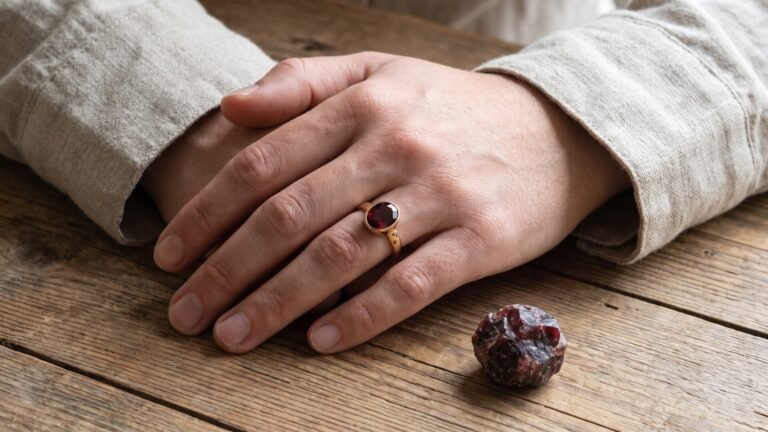
Related reading on the Spirituality theme: the spiritual meaning of wearing garnet on the right hand, and the Birthstone Meanings & Symbolism hub.
Purple Gemstones FAQs
What do purple gemstones symbolize?
In tradition, purple gemstones symbolize wisdom, intuition, spiritual awareness and transformation. These meanings come from cultural history and crystal-healing practice, not scientific evidence.
What is the most popular purple gemstone?
Amethyst, the purple variety of quartz, is the best-known purple gemstone. It is also the traditional February birthstone.
Which purple gemstones are hard enough for everyday rings?
Purple sapphire (about 9 on the Mohs scale), amethyst (about 7) and iolite (7 to 7.5) suit rings best. Tanzanite needs a protective setting, and sugilite, charoite, fluorite and lepidolite are better in pendants, beads or display pieces.
Can amethyst fade in the sun?
Yes. Prolonged strong sunlight or heat can fade or change the color of amethyst. Store it away from direct sun and heat.
Is iolite the same as sapphire?
No. Iolite is the gem variety of cordierite. It is sometimes nicknamed water sapphire, but GIA notes that name is incorrect.
Is tanzanite a purple gemstone?
Tanzanite is a blue-violet variety of the mineral zoisite. It is commonly heat treated to bring out its color and is softer than sapphire, so it needs gentle care.
Can purple gemstones heal or treat illness?
No. There is no scientific evidence that any gemstone treats or prevents illness. Many people value purple stones for personal meaning and ritual, but they are not a substitute for medical care.
How can I tell if an amethyst is real?
Ask the seller whether it is natural, lab-grown or treated, and look for lab documentation on higher-value pieces. Glass and dyed imitations exist, and a jeweler can help confirm the material.
Conclusion
Purple gemstones carry a rich history and meaningful symbolism, which is why they remain popular for meditation, gifts and personal jewelry. Choose amethyst for versatility, iolite for its changing violet-blue, tanzanite for its blue-violet glow, sugilite and charoite for their distinctive character, or purple sapphire when you want a ring that can take daily wear. Match the stone to how you will use it, ask clear questions about treatment and origin, and enjoy the traditions as part of the story rather than as proven effects.