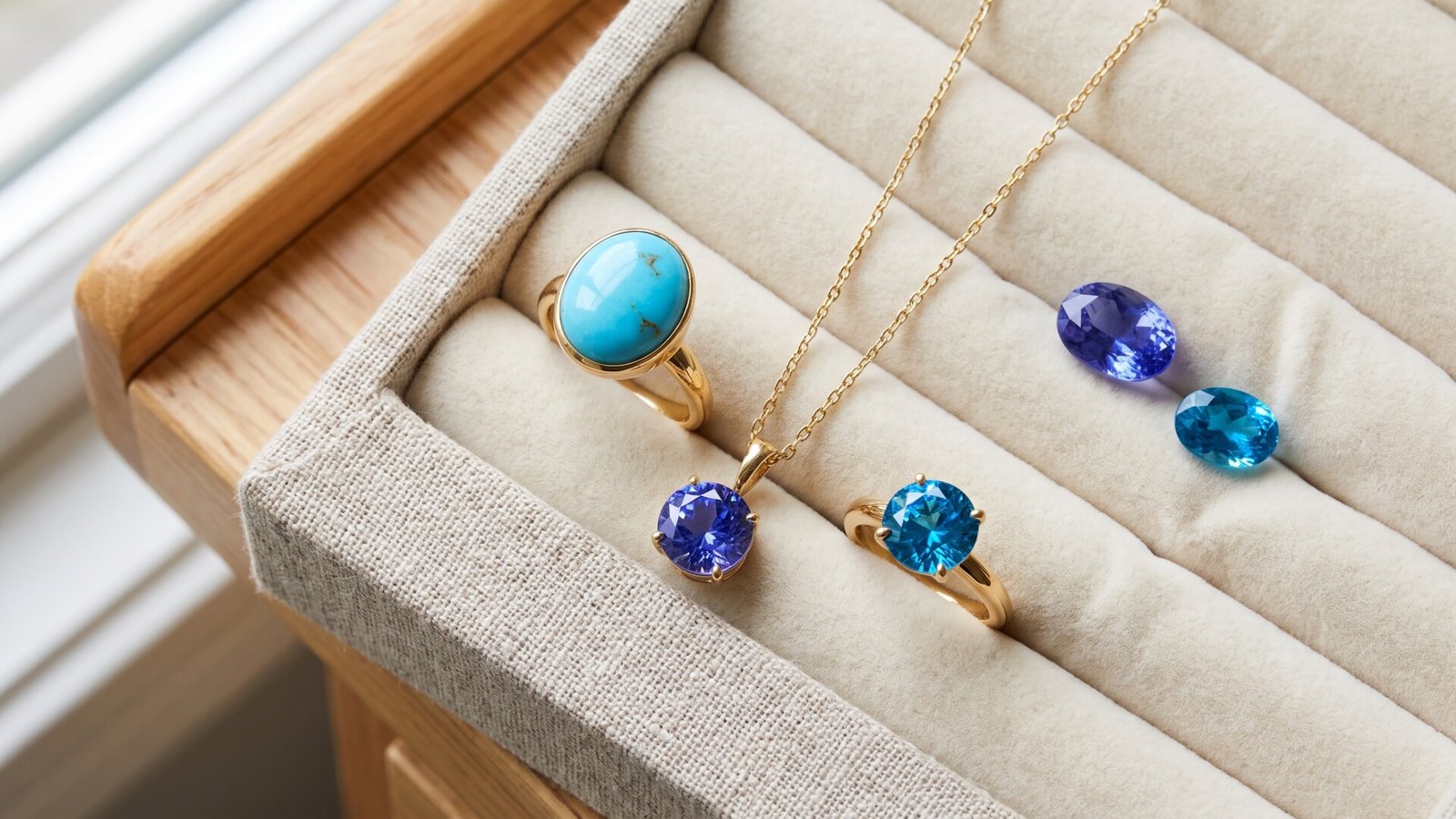
December Birthstone: Meaning, Symbolism, and Jewelry Guide
The December Birthstone at a Glance
December has more birthstones than most months. The three stones named on GIA’s December list are turquoise, tanzanite and zircon, and jewelers also commonly offer blue topaz as a December option. All four are blue, which fits the month’s cool, wintry feel, but they are very different gems when it comes to price, durability and everyday wear.
- Turquoise is the traditional December stone: an opaque blue-to-green gem used in jewelry and carvings for thousands of years.
- Tanzanite is the newest of the group: a blue-to-violet gem first identified in Tanzania in the 1960s and added to modern December lists.
- Zircon comes in blue, golden, red, green and colorless varieties, and is a natural mineral that should not be confused with cubic zirconia.
- Blue topaz is the budget-friendly, bright-blue option that many jewelers sell as a December stone; nearly all of it is treated to get its color.
This guide explains which stone is which, what each is made of, how tough it is, how to wear and clean it, and which one suits a ring, a pendant or a gift. Where we describe meanings and symbolism, those are cultural traditions and beliefs, not scientific or medical claims. You can see every month side by side in our Birthstones by Month guide, or read about the broader meanings and symbolism of birthstones.
What Are the December Birthstones?
Birthstone lists are not universal. Different countries, trade organizations and retailers have updated their lists over time, so “the December birthstone” depends on which list you follow. For December, the commonly cited stones are:
- Turquoise (traditional): a blue to green opaque stone, often with veins of host rock called matrix.
- Tanzanite (modern addition): a transparent blue-to-violet variety of the mineral zoisite.
- Zircon (traditional and modern lists): a brilliant, high-sparkle gem that occurs in many colors; blue is the best-known December choice.
- Blue topaz (widely sold alternative): a clear blue variety of topaz that appears on many jewelers’ lists, including some that are not mirrored by GIA’s three-stone list.
If you are not sure which list to follow, the practical answer is that any of the four is a legitimate way to celebrate a December birthday. For the history behind these differences, see our articles on the history of birthstones and what birthstones are.
December Birthstones Compared at a Glance
The table below puts the key practical facts side by side. Hardness figures are on the Mohs scale and describe scratch resistance only; they say nothing about whether a stone will chip or split. Our guide to the gemstone hardness scale explains the difference.
| Stone | What it is | Mohs hardness | Common treatments | Best suited to |
|---|---|---|---|---|
| Turquoise | Copper aluminum phosphate, opaque, often with matrix | 5 to 6 | Dyeing, resin or epoxy impregnation, stabilization | Pendants, earrings, occasional rings in protective settings |
| Tanzanite | Blue-violet variety of zoisite | 6 to 7 | Heat treatment of brownish rough (considered permanent) | Pendants and earrings; rings only for careful, occasional wear |
| Zircon | Zirconium silicate, many colors | 6 to 7.5 | Heat treatment to produce blue, colorless and other colors | Pendants, earrings, protected rings |
| Blue topaz | Blue variety of topaz | 8 | Irradiation and heat to produce blue | Earrings, pendants, rings with a protective setting |
Hardness, treatments and care points for turquoise, tanzanite and zircon above follow GIA’s December birthstone information. Blue topaz details follow standard gemological references and our own sapphire vs blue topaz comparison.
Why These Stones Represent December
The traditions behind December’s stones are about winter light, protection and endings and beginnings. None of these are proven effects; they are the meanings people have attached to the stones over time.
Turquoise: Protection and Serenity
Turquoise has been valued for millennia. GIA notes that ancient Egyptian rulers wore it and that it was carved in China more than 3,000 years ago. Across many cultures it has been linked in tradition with protection, health and good fortune. Its sky-blue color is an easy match for clear winter skies, which is part of why it became a December favorite. Read more in our full turquoise meaning guide.
Tanzanite: Transformation and Intuition
Tanzanite’s deep blue-violet shifts depending on the light and viewing angle, which is why it is so often tied to ideas of change, intuition and self-discovery in modern jewelry marketing and crystal practice. These are symbolic associations, not facts about the stone. Our tanzanite meaning guide covers them in more detail.
Zircon: Wisdom and Prosperity
In the Middle Ages, GIA notes, zircon was believed to bring sleep and ward off evil, and it is one of the nine gems of the Hindu navaratna tradition. Later it came to stand for wisdom and prosperity. Victorians were especially fond of blue zircon. See our zircon meaning guide for more.
Blue Topaz: Clarity and Calm
Topaz has long been associated in tradition with strength and clarity of mind, and the bright blue of today’s treated stones reads as cheerful and cool. Our topaz meaning guide explains where those associations come from.
History and Cultural Significance
Turquoise
Turquoise is one of the oldest ornamental stones in use. Beyond ancient Egypt and China, it holds a central place in the jewelry traditions of Persia and of Native American peoples in the Southwest United States, where it is worn and exchanged with deep cultural meaning. Prized “robin’s egg” or “Persian blue” shades from the Nishapur district of Iran are especially sought after. For the cultural side of the story, see turquoise healing beliefs and Native American lore.
Tanzanite
Tanzanite is a very recent arrival in gem history. Blue stones from Tanzania were identified as zoisite in 1962, and prospectors found the main deposit in the Merelani Hills in 1967. Tiffany & Co. launched a major promotional campaign in 1968 and gave the stone its trade name. Today, Merelani remains its only significant commercial source, which is why tanzanite is often described as limited in supply. If you want the market side, our tanzanite guide covers properties and value in detail.
Zircon
Zircon is among the oldest minerals found on Earth. As a gem, colorless zircon was once confused with diamond because of its sparkle, and heat-treated blue zircon became a Victorian favorite. Zircon is a natural mineral (zirconium silicate) and is completely different from cubic zirconia, which is a lab-made diamond imitation.
Blue Topaz
Natural blue topaz is rare and usually pale. The vivid Sky, Swiss and London Blue shades sold today are made by irradiating and heating colorless topaz, a widely accepted treatment that is stable under normal wear. This is why blue topaz is inexpensive compared with other blue gems, as explained in our sapphire vs blue topaz comparison.
For wider context, see our Birthstone Meanings & Symbolism hub.
Meaning and Symbolism of the December Birthstones
Taken together, the December stones are traditionally associated with protection, reflection and abundance. These are beliefs and traditions, not measurable effects:
- Turquoise: traditionally linked with serenity, protection and good fortune
- Tanzanite: associated in modern crystal practice with transformation, intuition and personal growth
- Zircon: historically linked with wisdom, prosperity and clarity
- Blue topaz: associated with calm, clarity and strength in traditional lore
Whether you take these meanings literally or simply enjoy them as a story, they can make a December birthstone a thoughtful gift. They are not a substitute for medical or professional advice.
Which December Birthstone Should You Choose?
The best December stone depends on how the jewelry will be worn and what you want it to say.
- For daily wear: choose a piece that protects the stone, such as a pendant or a bezel-set ring. Blue topaz (Mohs 8) has the best scratch resistance of the four, although it has cleavage and can split if struck.
- For a statement piece: tanzanite’s blue-violet depth is more distinctive than almost any other December option. It suits earrings and pendants best.
- For a traditional or heritage gift: turquoise carries the longest history and works especially well in silver and artisan designs.
- For a sparkling alternative: blue zircon has strong brilliance and fire, though it can abrade at facet edges, so it suits pendants and earrings better than a hard-working ring.
- For a tight budget: blue topaz gives a lot of color for the money. Tanzanite is typically the most expensive of the group: one retail price guide quotes roughly $300 to $800 per carat for blue stones, with price depending heavily on size, color saturation and clarity.
Deciding between two stones? Our comparisons can help: tanzanite vs London blue topaz, tanzanite vs sapphire and blue zircon vs diamond. Our guide to blue gemstones compares the wider blue family.
December Birthstone Jewelry Ideas
All four December stones are widely available in jewelry. When you shop, check that the listing states whether the stone is natural, treated or lab-created, and ask whether turquoise has been stabilized or dyed. More ideas are in our Birthstone Jewelry Guide.
Turquoise Jewelry
- Rings: cabochon-cut statement rings suit occasional wear; avoid daily wear if you work with your hands because turquoise is relatively soft and porous.
- Necklaces & pendants: a good way to show off the color with minimal risk of knocks.
- Earrings: studs and drops are low-risk and easy to wear.
- Bracelets: beaded or cuff designs work well, but remove them before washing, cleaning or applying lotions.
Tanzanite Jewelry
- Rings: best for special occasions, ideally in a bezel or halo setting that shields the edges.
- Necklaces & pendants: a safe way to enjoy tanzanite daily.
- Earrings: well suited to evening and formal wear.
- Bracelets: wear with care, as they are more exposed to knocks.
Zircon Jewelry
- Rings: choose protective settings and avoid rough activities.
- Necklaces & pendants: classic or modern settings both work.
- Earrings: bright, sparkly studs and drops.
- Bracelets: occasional wear is best.
Blue Topaz Jewelry
- Rings: popular for cocktail and fashion rings, but cleavage means hard knocks should be avoided.
- Necklaces & pendants: large, affordable stones make a bold statement.
- Earrings: everyday studs are a practical choice.
Shopping for a gift? See our birthstone gift ideas by relationship and, for younger recipients, our birthstone gifts for kids by month. Small gemstone pieces can be a choking hazard for young children, so choose age-appropriate designs.
How to Tell Natural Stones from Imitations
Because December’s stones are popular, imitations are common. A few practical points:
- Turquoise: GIA notes that turquoise is frequently dyed or impregnated with resin, and cavities can be filled with epoxy that imitates the pyrite matrix. Ask whether the stone is natural, stabilized or reconstituted.
- Tanzanite: nearly all tanzanite starts brownish and is heat-treated to blue-violet. This is a standard, permanent treatment and should be disclosed in the listing.
- Zircon: make sure the seller means natural zircon, not cubic zirconia. They are different materials with different properties.
- Blue topaz: expect treatment. If a seller claims untreated natural blue topaz, ask for a lab report.
If you want to understand the difference between natural and lab-created stones in general, read natural vs lab-grown birthstones.
How the December Birthstone List Evolved
The official-looking modern list in the United States dates back to 1912, when the American National Retail Jeweler’s Association (now Jewelers of America) published a standard set of birthstones. According to National Jeweler’s history of the list, zircon was added for December in 1952 and tanzanite followed in 2002. Blue topaz is widely sold as a December stone and appears on many retailer lists, but it is not part of the three-stone GIA list described at the top of this page. That is why you will see different answers from different sources, and why it is reasonable to choose whichever December stone you like best. For the wider story, read the history of birthstones from ancient times to today.
December Birthstone Colors
If you are asking what color the December birthstone is, the short answer is blue: sky blue and blue-green for turquoise, blue-violet for tanzanite, and blue for zircon and blue topaz. Zircon also occurs in golden, red, green and colorless varieties, so a December piece does not have to be blue, although blue is the most popular choice. Compare these tones with the other months in our birthstone color chart, and see how blue stones compare more broadly in blue gemstones and their meanings.
A Quick Buying Checklist for December Stones
- Ask which stone it really is. The listing should say turquoise, tanzanite, zircon or topaz, not just “blue stone,” and should state if it is natural, treated or lab-created.
- Ask about treatment. Turquoise may be stabilized or dyed, tanzanite and zircon are usually heated, and blue topaz is typically irradiated and heated. These are accepted when disclosed.
- Match the piece to the stone. Choose pendants and earrings for softer or cleavage-prone stones and use bezel or halo settings for rings.
- Look at color in several lights. Blue-violet tanzanite and blue zircon can look different under daylight and indoor lighting.
- Get a lab report for expensive stones. For high-value tanzanite or zircon, an independent gemological report helps confirm identity and treatment.
You can compare prices and options in our education and buying guides, or see where tanzanite stands in our ranking of the most expensive birthstones.
Zodiac Connections
December spans two signs: Sagittarius (about November 22 to December 21) and Capricorn (about December 22 to January 19). Exact dates shift slightly from year to year. Zodiac stone lists differ between sources, so the pairings below are one popular tradition, not a fixed rule:
- Sagittarius: turquoise is the stone most often named for Sagittarius in popular lists; in tradition it is linked with protection and travel, and tanzanite with intuition.
- Capricorn: zircon and tanzanite are sometimes linked to Capricorn, with associations of clarity, wisdom and personal growth.
To understand how zodiac and monthly stones fit together, see zodiac birthstones vs monthly birthstones and our complete zodiac birthstones guide.
Caring for December Birthstone Jewelry
Care differs a lot between these stones. When in doubt, use warm water, mild soap and a soft brush, and avoid steam and ultrasonic cleaners unless a jeweler confirms they are safe for your piece.
Turquoise Care
- Clean with warm, soapy water and a soft cloth; GIA advises avoiding steam and ultrasonic cleaners.
- Keep away from acids, household chemicals and heat, which can discolor or damage turquoise.
- Put jewelry on after cosmetics, perfume and lotion, as porous turquoise can absorb oils and products.
- Store separately in a soft pouch to avoid scratches.
Tanzanite Care
- Clean gently with warm, soapy water.
- Avoid ultrasonic and steam cleaners; tanzanite can crack from very high or sudden temperature changes.
- Avoid knocks: tanzanite abrades easily, so a pendant or earrings are safer than an everyday ring.
- Store in a padded box or soft pouch.
Zircon Care
- Clean with a soft brush, mild soap and warm water; avoid ultrasonic and steam cleaners.
- Avoid rough activities such as gardening, sports or dishwashing, because zircon tends to abrade.
- Limit prolonged bright light and heat; some heat-treated stones can fade or change color over time.
- Store separately so the facet edges do not get scratched.
Blue Topaz Care
- Clean with warm, soapy water and a soft brush; avoid ultrasonic cleaners if the stone has any fractures.
- Protect it from hard knocks, since topaz has perfect cleavage.
- Store wrapped or in its own compartment.
For general stone-care basics, browse our Birthstone Education & Buying Guides and the wider Gemstones hub.
Fun Facts About December Birthstones
- Turquoise has been used for thousands of years and is among the oldest ornamental stones.
- Tanzanite was identified as a new gem in the 1960s and has one major commercial source, the Merelani Hills of Tanzania.
- Tanzanite shows different shades of blue and violet when viewed from different angles.
- Colorless zircon was historically mistaken for diamond, yet it is a separate natural mineral.
- Almost all blue topaz is treated, and most tanzanite is heat-treated.
Learn more about how gems get their color in our guide to the science behind gemstone colors.
Frequently Asked Questions About The December Birthstone
What is the December birthstone?
GIA lists three December birthstones: turquoise, tanzanite and zircon. Turquoise is traditional, tanzanite is a more recent addition, and many jewelers also offer blue topaz as a December option.
What is the birthstone for December 21 or 22?
The same December stones apply to every date in the month, including December 20, 21 and 22. If you were born around December 21 or 22 you may be at the Sagittarius-Capricorn boundary, so you can also look at the zodiac stones for both signs.
Which December birthstone is the most durable?
Blue topaz has the highest Mohs hardness (8), but it has cleavage and can split with a hard knock. Zircon (6 to 7.5) and tanzanite (6 to 7) are moderate, and turquoise (5 to 6) is the softest. For daily wear, protective settings matter more than the hardness number alone.
Is tanzanite a real gemstone or is it treated?
Tanzanite is a natural gemstone, the blue-violet variety of zoisite. Most tanzanite is heat-treated to bring out the blue-violet color, and GIA describes that color as permanent. Treatment should be disclosed when you buy.
Is zircon the same as cubic zirconia?
No. Zircon is a natural mineral (zirconium silicate). Cubic zirconia is a lab-made diamond imitation. They have different compositions and properties.
Is turquoise safe to wear every day?
It can be worn often with care, but it is relatively soft and porous. Keep it away from chemicals, heat, cosmetics and perfume, and take it off for rough activities. A pendant or earrings are lower-risk choices than a daily ring.
Which December birthstone is best for a gift?
Choose by wear and budget: turquoise for a traditional or artisan gift, tanzanite for a distinctive special-occasion piece, zircon for sparkle, and blue topaz for good value. Consider whether the recipient will wear it daily or occasionally.
Related Articles and Resources
- Turquoise: Meaning, Properties, Uses & Value
- Tanzanite: Meaning, Properties, Uses & Value
- Zircon: Meaning, Properties, Uses & Value
- Topaz: Meaning, Properties, Uses & Value
- Birthstone Jewelry Guide
- Birthstone Meanings & Symbolism
- Birthstone Jewelry Gift Ideas by Relationship
- November Birthstone
- January Birthstone
Explore More Birthstones
December’s birthstones bring together a long tradition (turquoise), a modern favorite (tanzanite), a sparkling classic (zircon) and an affordable bright blue (topaz). To see the whole calendar, visit our Birthstones by Month hub. Coming from the previous month? Read the November birthstone guide. Looking ahead to a new year? Start with the January birthstone guide.
All twelve months: January, February, March, April, May, June, July, August, September, October, November and December (this page).
Final Thoughts
There is no single right December birthstone, just the right one for the person and the piece of jewelry. Pick turquoise for history, tanzanite for color depth, zircon for sparkle or blue topaz for value, and match the setting to how often the jewelry will be worn. Whatever you choose, ask how the stone was treated and follow the care steps above so it lasts. Return to the Birthstones by Month hub to explore all twelve months.