Moissanite vs Lab Diamond for April birthdays
April is the month of the diamond, and for anyone shopping for an April birthday today, the choice is no longer just “natural diamond or nothing.” Two lab-created options now sit beside the mined stone: lab-grown diamond and moissanite. They are often shown side by side in ads, but they are different materials, and mixing them up is the most common mistake buyers make.
The short version: a lab-grown diamond is a diamond, with the same chemistry and crystal structure as a mined one. Moissanite is silicon carbide, a different mineral that is made in labs and sold as a diamond alternative (a simulant). Both can be beautiful, durable, and mining-free, but they differ in sparkle, price, and what they mean for the person receiving them.
This guide compares the two on science, appearance, price, ethics, symbolism, and care so you can pick the right one for an April birthday. If you want the bigger picture first, start with our April birthstone guide, our diamond guide, or the shorter companion piece Is moissanite a suitable alternative to the April birthstone diamond?
Moissanite vs Lab Diamond at a Glance
| Property | Moissanite (lab-created) | Lab-grown diamond |
|---|---|---|
| What it is | Silicon carbide (SiC), a different mineral that imitates diamond | Carbon; the same material as mined diamond |
| Mohs hardness | About 9.25–9.5 | 10 |
| Refractive index | About 2.65–2.69 | About 2.42 |
| Dispersion (fire) | About 0.104 | About 0.044 |
| Double refraction | Yes (facet edges can look doubled under a loupe) | No |
| Grading | No diamond 4Cs report; brands provide their own specs | GIA, IGI and others issue 4Cs grading reports |
| Typical size labeling | Millimeters or “diamond equivalent weight” | Carats |
| Passes a basic diamond thermal tester? | Often yes (needs a moissanite-aware tester) | Yes |
| Resale value | Low | Low and still falling |
Understanding Moissanite and Lab Diamonds
Overview of Moissanite
Moissanite is named for French chemist Henri Moissan, who found tiny crystals in fragments of a meteorite from Arizona’s Canyon Diablo crater in 1893. He first thought they were diamonds; they were later identified as silicon carbide. Natural moissanite is extremely rare, so the stones sold in jewelry are lab-created, and gem-quality synthetic moissanite has been commercially available since the late 1990s.
What sets moissanite apart:
Brilliance and fire: Moissanite has a higher refractive index (about 2.65–2.69) than diamond (about 2.42) and much higher dispersion, which means more rainbow flashes. Some people love that; others find it more “disco ball” than classic. Our comparison of opal vs moissanite for fire and shine explores the effect in more detail.
Hardness: Moissanite is about 9.25–9.5 on the Mohs scale, harder than every gemstone except diamond. It is a good fit for everyday rings. Hardness is only part of durability, though; setting quality matters as much as the stone.
Color: Early moissanite often showed a faint green or yellow tint. Modern stones are sold in colorless ranges, but quality varies by producer, so look at the stated color grade and ask for photos or video in daylight.
Overview of Lab-Grown Diamonds
Lab-grown diamonds are real diamonds. They have the same chemical composition, crystal structure, and optical and physical properties as mined diamonds. The only difference is origin. In the United States, the Federal Trade Commission’s jewelry guidance treats lab-grown diamonds as diamonds but expects sellers to disclose that they are lab-grown.
There are two main production methods:
High Pressure High Temperature (HPHT): Carbon is subjected to extreme pressure and temperature, which imitates the conditions in the Earth.
Chemical Vapor Deposition (CVD): Carbon-rich gas in a vacuum chamber deposits carbon atoms layer by layer onto a diamond seed.
Both yield real diamonds. Some lab-grown diamonds receive post-growth treatment (for example HPHT processing) to improve color, which a good grading report discloses. Labs can distinguish lab-grown from mined stones with specialist equipment, and most reports include a laser inscription on the girdle.
Lab-grown diamonds are graded on the same 4Cs as mined diamonds: cut, color, clarity, and carat weight. Our guide to the 4 Cs of diamonds applies directly, and reading it before you shop is worth the time.
Moissanite vs Lab Diamond: Key Comparisons
Visual Appearance
| Aspect | Moissanite | Lab Diamond |
|---|---|---|
| Brilliance (white light) | Very high; often described as slightly different in character from diamond | Excellent; identical to mined diamond |
| Fire (rainbow flashes) | Noticeably more fire, especially in direct light | Moderate; classic diamond sparkle |
| Color | Sold in colorless and near-colorless ranges; some stones show a faint tint | Graded on the D–Z diamond scale |
| Clarity | Usually eye-clean; clarity is generally high | Graded from flawless to included, like mined diamonds |
| Cut | Good cuts widely available; quality varies by maker | Cut grade reported on certificates |
| Overall look | Very lively, “rainbow” sparkle | Classic diamond appearance |
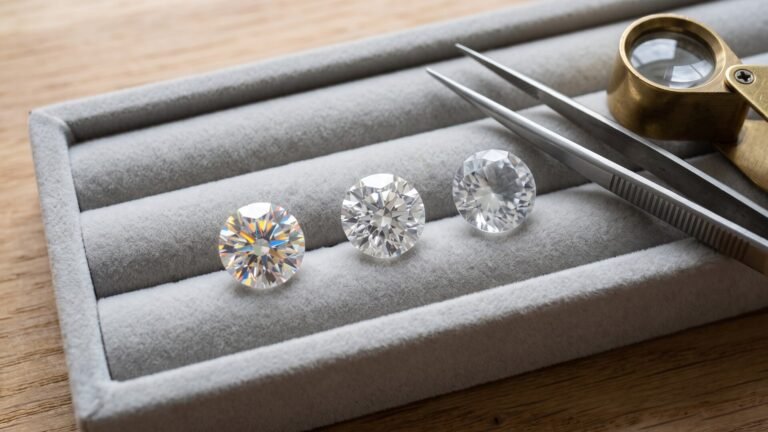
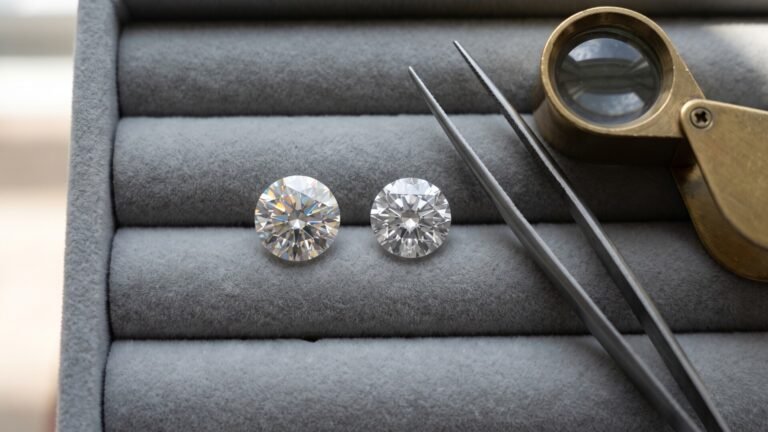
In soft indoor light, many people struggle to tell the two apart. In direct sun or under spotlights, moissanite’s extra fire becomes obvious. Whether that is a plus is personal taste, so if possible, view both in person or request video in more than one lighting condition before buying.
Pricing Comparison
Prices move constantly, especially for lab-grown diamonds, which have fallen sharply as production has scaled. The ranges below are approximate U.S. retail figures for loose, good-quality round stones, based on one 2026 price report for lab and natural diamonds (G color, VS2 clarity, excellent cut) and one moissanite maker’s published guidance. Treat them as a starting point and check current listings.
| Size | Moissanite (approx.) | Lab diamond (approx.) | Natural diamond (approx.) |
|---|---|---|---|
| About 0.5 carat | Varies; typically a fraction of lab-diamond cost | $350 – $550 | $1,300 – $1,700 |
| About 1 carat (6.5 mm for moissanite) | $500 – $1,000 for a branded stone | $900 – $1,500 | $4,000 – $5,500 |
| About 2 carats | Varies by maker | $2,200 – $3,200 | $14,000 – $19,000 |
| About 3 carats | Varies by maker | $4,500 – $6,000 | $37,000 – $48,000 |
Two things stand out. First, the gap between lab-grown and mined diamonds is large and widens with size. Second, the gap between moissanite and lab diamond has narrowed as lab diamond prices fell: at about one carat, moissanite is typically cheaper than a lab diamond, but not 90% cheaper. Moissanite also gives you more visual size for the money, since it is sold by millimeter size rather than certified carat weight.
Durability and Maintenance
Moissanite: At about 9.25–9.5 on Mohs, it resists scratching very well and handles daily wear. Only diamond (and a few man-made abrasives) can scratch it. It is also generally considered tough, though no gemstone is chip-proof.
Lab diamond: At 10 on Mohs, diamond is the hardest known gem material. It is virtually scratch-proof in everyday wear, but, like mined diamond, it has cleavage planes and can chip if struck at the wrong angle, especially at thin girdles and pointed corners.
Care is simple for both: warm water, mild soap, and a soft brush. Moissanite and diamond both tolerate ultrasonic cleaners in most settings, but check the setting and avoid them if a diamond has visible fractures or is fracture-filled. Take rings off before heavy work, keep them away from harsh chemicals that can damage the metal, and have prongs checked yearly. Our gemstones hub links to care guides for other stones if you are buying a set.
Ethical Considerations
It is tempting to call both stones “ethical,” but the honest version has nuance. Neither requires mining, which avoids the environmental disruption and labor issues connected with some mining operations. Neither is automatically free of impact: growing diamonds and moissanite takes substantial energy, and the footprint depends on the power source and the producer. Look for specific, verifiable statements from the seller, such as a named third-party sustainability or carbon audit, rather than general claims.
If your priority is the smallest footprint and lowest cost, moissanite is a strong candidate. If you want a real diamond without mining, a lab-grown diamond is the option. For the full picture, including mined-diamond ethics, see how to buy ethical diamonds.
Symbolism and Meaning for April Birthdays
April’s traditional birthstone is the diamond, long associated with clarity, strength, and enduring love. Those meanings are cultural symbolism rather than scientific properties; our diamond meaning guide covers the history. Birthstone lists also differ by country and organization, so rock crystal (clear quartz) appears as a traditional April alternative in some lists.
Lab diamond: Because it is a diamond, it can carry the full April birthstone tradition. Many buyers also like the story of human ingenuity and creating beauty without mining.
Moissanite: Its origin story, a mineral first found in a meteorite, appeals to buyers who like a cosmic angle. Strictly speaking, though, it is a diamond alternative rather than the April birthstone itself, so it works best when the giver values the look and the story more than a diamond label.
Best Options for April Birthday Gifts
Below are the retailers and jewelry types worth considering for each stone. Check each seller’s current return policy, grading paperwork, and lab-grown or lab-created labeling before you buy.
Top Moissanite Jewelry Recommendations
Rings:
- [Affiliate: Charles & Colvard Moissanite Engagement Rings] – The original moissanite brand, offering warranties and specified cut and color grades.
- [Affiliate: Brilliant Earth Moissanite Rings] – Designer settings with a focus on sustainability messaging.
- [Affiliate: Helzberg Diamonds Moissanite Collection] – In-store try-on options at physical locations.
Earrings:
- [Affiliate: Moissanite Stud Earrings at James Allen] – A practical everyday style; James Allen is known for showing stones in video.
- [Affiliate: Moissanite Hoops at Blue Nile] – Classic designs for gifting.
Necklaces:
- [Affiliate: Moissanite Pendants at Jared] – For layering or wearing alone.
- [Affiliate: Moissanite Solitaire Necklaces at Zales] – A budget-friendly daily-wear option.
Top Lab Diamond Jewelry Recommendations
Rings:
- [Affiliate: Lab Diamond Engagement Rings at Clean Origin] – A lab-grown specialist with published grading reports.
- [Affiliate: Lab Diamond Rings at Vrai] – A lab-grown-focused brand; check its current sustainability disclosures.
- [Affiliate: Lab Diamond Rings at Brilliant Earth] – A wide selection of settings.
Earrings:
- [Affiliate: Lab Diamond Stud Earrings at James Allen] – Certified stones with video previews.
- [Affiliate: Lab Diamond Earrings at Blue Nile] – Check the current return window before buying.
Necklaces:
- [Affiliate: Lab Diamond Necklaces at Grown Brilliance] – Modern designs focused on lab-grown stones.
- [Affiliate: Lab Diamond Pendants at Lightbox] – Confirm current availability and ownership before buying.
Comparison Table of Top Picks
| Product | Type | Typical Price Range (USD) | Key Features | Best For |
|---|---|---|---|---|
| [Affiliate: Charles & Colvard Solitaire Ring] | Moissanite | $500 – $2,000 | Specified color and cut grades | Classic engagement style |
| [Affiliate: Clean Origin Lab Diamond Ring] | Lab Diamond | $1,500 – $5,000 | Certified lab-grown | Real-diamond buyers who want no mining |
| [Affiliate: Moissanite Stud Earrings] | Moissanite | $200 – $800 | High fire, affordable | Everyday wear |
| [Affiliate: Lab Diamond Stud Earrings] | Lab Diamond | $800 – $3,000 | Classic diamond appearance | Traditionalists on a budget |
| [Affiliate: Moissanite Pendant] | Moissanite | $300 – $1,000 | High brilliance | Statement gifts |
| [Affiliate: Lab Diamond Pendant] | Lab Diamond | $1,000 – $4,000 | Certified quality | Milestone gifts |
Price ranges in this table are rough estimates for finished jewelry and vary by metal, setting, and stone size.
Common Buying Considerations
What to Look for When Buying
Cut: For both stones, cut drives brilliance. An excellent cut makes more difference than a small bump in color or clarity.
Color: Diamonds are graded D (colorless) to Z; most buyers choose D–H lab diamonds for a white look. Moissanite makers publish their own color ranges, so compare them to a diamond scale carefully, and check daylight photos, since lower-grade moissanite can show a faint tint.
Clarity: Moissanite is usually eye-clean. For lab diamonds, VS2 or better is generally eye-clean in most shapes, but always check the video.
Size: Moissanite is usually sold by millimeter size. A 6.5 mm round is roughly comparable to a one-carat round diamond in face-up size, though weights differ because the materials have different densities.
Certification: For lab diamonds, insist on an independent report from a lab such as GIA or IGI. For moissanite, ask for the maker’s specification sheet and the retailer’s return policy.
Common Mistakes to Avoid
Mistake 1: Treating moissanite and lab diamonds as the same thing. One is a diamond; the other is a different mineral. Make sure the listing says which you are buying.
Mistake 2: Buying a lab diamond without an independent report. A grading report from a recognized lab is what you are actually paying for.
Mistake 3: Ignoring the setting. A well-made setting protects the stone and secures it for years.
Mistake 4: Not considering the recipient’s taste. Some people love moissanite’s extra fire; others prefer a diamond’s quieter sparkle.
Mistake 5: Falling for unusually low prices. A “lab diamond” priced far below market may be poorly cut, heavily included, or not what it claims to be.
Mistake 6: Assuming a diamond tester settles it. Many standard thermal testers cannot separate moissanite from diamond, and lab diamonds pass them too. Use a moissanite-aware tester or lab report.
Which Should You Choose? A Quick Decision Guide
| If you want… | Choose |
|---|---|
| A real diamond without mining | Lab-grown diamond |
| The most size and sparkle for the money | Moissanite |
| A stone that fits the “diamond is April” tradition exactly | Lab-grown or natural diamond |
| Maximum scratch resistance | Diamond (10), though moissanite is close |
| A certified, graded stone | Lab-grown diamond |
| A lively, rainbow-flash look | Moissanite |
| A heritage stone to hand down | Natural diamond; see natural vs lab-grown below |
If you are also weighing mined diamonds, our guide to natural vs lab-grown diamonds goes deeper on long-term value, and the Herkimer diamond comparison covers a third, naturally occurring “diamond” that is actually quartz.
Long-Term Value and Resale
Neither moissanite nor lab-grown diamonds should be treated as financial investments. Moissanite has little resale market, and lab-grown diamond prices have fallen substantially as production has grown, so resale values are low and unpredictable. Buy these stones for beauty and meaning. Natural diamonds also typically sell for much less than retail when resold, so no diamond purchase should be counted on to hold its price.
Trends to Watch
Lab-grown diamond prices continue to move, so check current listings and expect the price gap to the mined stone to stay wide. Buyers are increasingly asking for verifiable sustainability claims rather than general ones, and custom and bespoke settings remain popular for both stones.
Frequently Asked Questions About Moissanite Vs Lab Diamond
What is the main difference between moissanite and lab diamonds?
Moissanite is silicon carbide, a different mineral made in labs and sold as a diamond alternative. A lab-grown diamond is carbon with the same structure as a mined diamond. Moissanite shows more rainbow fire; a lab diamond looks like a mined diamond.
Is moissanite a real diamond?
No. Moissanite is a separate mineral. It is real moissanite, but it is not a diamond. A lab-grown diamond is a real diamond.
Which is more durable, moissanite or lab diamond?
Both are excellent for daily wear. Diamond is 10 on the Mohs scale; moissanite is about 9.25–9.5. Diamond can chip along cleavage planes if hit at the wrong angle, so setting protection matters for both.
Is moissanite cheaper than a lab diamond?
Usually yes at comparable face-up sizes, though the gap has narrowed as lab diamond prices fell. A branded one-carat-size (6.5 mm) moissanite is often quoted around $500 to $1,000, while a good one-carat lab diamond is often listed in the $900 to $1,500 range.
Are moissanite and lab diamonds ethical?
Neither involves mining, which avoids mining-related harms. Both use energy to produce, so look for verifiable disclosures from the seller rather than general claims.
Do moissanite and lab diamonds hold their value?
Generally no. Both have low resale values, and lab diamond prices have been falling. Buy for beauty and meaning, not as an investment.
Can I tell moissanite from a diamond at home?
Not reliably. Moissanite shows more rainbow fire and can show doubled facet edges under magnification, but a jeweler with a moissanite-aware tester or a lab report is the reliable check.
What should I consider when buying a ring for an April birthday?
Consider the recipient’s taste (classic diamond sparkle or lively fire), your budget, whether a diamond label matters for April tradition, and whether you need an independent grading report.
How do I care for each stone?
Warm water, mild soap, and a soft brush. Avoid harsh chemicals that can damage metal settings, and have prongs checked yearly. Check with a jeweler before using ultrasonic cleaners if a stone has fractures or fillers.