Diamond Alternatives: Moissanite vs White Sapphire
Diamonds Are Forever… But Are They For You?
Diamonds have long been the default in jewelry, from birthstone rings to engagement rings and anniversary gifts. They are also expensive, and some buyers have concerns about mining. If that sounds like you, moissanite and white sapphire are two of the most popular alternatives, and they could not be more different in how they look.
This guide compares the two on brilliance, hardness, color, price, ethics, and everyday wear, so you can decide which one fits your budget and style. We also cover how they compare with white topaz and diamond, and what it means if you are shopping for someone born in April, when the diamond is the traditional birthstone.
Quick Verdict: Moissanite or White Sapphire?
- Choose moissanite if you want maximum sparkle and the hardest, most scratch-resistant option, and you do not mind a lively, rainbow-like flash that looks different from a diamond.
- Choose white sapphire if you prefer a softer, quieter glow that looks closer to a diamond from a distance, and you are happy with a stone that may show wear at the edges over the years.
A Quick Background on Diamonds as Birthstones
Before comparing alternatives, a little context:
- April’s birthstone is the diamond. You can read more on our April birthstone page.
- Diamonds are traditionally associated with strength, purity, and enduring love. Those are symbolic associations, not facts about the stone.
- Mined diamonds come with higher prices and, for some buyers, concerns about environmental and labor practices. Lab-grown diamonds are a separate option: they are real diamonds, not alternatives.
Moissanite and white sapphire are diamond alternatives. They are different materials that look somewhat similar. If you are specifically choosing for an April birthday, read whether moissanite is a suitable alternative to the April birthstone and moissanite vs lab diamond for April birthdays.
Moissanite: The Sparkly Contender
History & Origins
- Moissanite was discovered in 1893 by the French chemist Henri Moissan, who found tiny crystals in rock fragments from a meteorite crater in Arizona. He first thought they were diamonds.
- It is silicon carbide, a mineral species in its own right, and natural moissanite is extremely rare. Essentially all moissanite used in jewelry is grown in a laboratory.
- Since it became available as a gem in the late 1990s, it has gained a large following as an affordable alternative for engagement rings and fine jewelry.
Appearance & Sparkle
- Moissanite has a higher refractive index than diamond (about 2.65–2.69 versus 2.42) and much higher dispersion (the splitting of light into colors), which gives it a very lively, rainbow-colored sparkle.
- Some wearers love that intensity; others find it looks too colorful next to a diamond, so it can be easier to tell apart from the real thing.
- Most modern stones are colorless or near-colorless, though some can show a faint warm or yellowish tint, so check the color grade before buying.
Hardness & Durability
- Mohs hardness is about 9.25 (some sellers quote up to 9.5), compared with 10 for diamond.
- That makes it highly scratch-resistant and suitable for rings and daily wear.
- It is harder than white sapphire, which means it can scratch a sapphire stored next to it.
Ethical & Environmental Considerations
Because moissanite is grown in a lab, it does not involve gem mining. That is the main reason many buyers choose it. “Lab-grown” is not the same as “zero impact,” since growing crystals uses energy, and terms like “eco-friendly” or “conflict-free” are only meaningful when a seller backs them with specifics. If sustainability is important to you, ask the seller how the stones are produced and whether there is a supply-chain policy you can read.
White Sapphire: The Classic Alternative
Origins & Background
- White sapphire is the colorless variety of corundum, the same mineral species as ruby and colored sapphire. Learn more in our sapphire guide.
- It has been used in jewelry for a long time, well before moissanite was available.
- It is available both as a natural stone and as a lab-grown stone. The lab-grown version has the same chemistry as the natural one.
Appearance & Sparkle
- Its refractive index is about 1.77, well below diamond and moissanite, and its dispersion is low, so it gives a soft, subtle glow rather than fiery flashes.
- It is marketed as colorless, but natural stones often carry faint blue, gray, or yellow tints or cloudiness from inclusions. Lab-grown white sapphire tends to be cleaner.
- The quiet look suits traditional, understated jewelry and is often closer to the appearance of a natural diamond from a distance.
Hardness & Durability
- Mohs hardness: 9.
- Tough enough for rings, earrings, and pendants.
- Slightly softer than moissanite, so edges and facets can show small scratches over years of daily wear, and it may need more frequent cleaning to keep its sparkle.
Hardness is only part of durability. Our hardness scale guide explains why scratch resistance and toughness are not the same thing.
Ethical & Environmental Considerations
- A lab-grown white sapphire avoids gem mining, much like moissanite.
- A natural white sapphire is mined, and its ethical profile depends on the source and the seller. If that matters to you, ask for documentation rather than relying on general claims.
Comparing Moissanite vs White Sapphire
Here is a head-to-head view, with diamond included for reference:
| Feature | Moissanite | White Sapphire | Diamond (reference) |
|---|---|---|---|
| Material | Silicon carbide (almost always lab-grown) | Corundum (natural or lab-grown) | Carbon |
| Mohs hardness | ~9.25 (up to 9.5 quoted) | 9 | 10 |
| Refractive index | ~2.65–2.69 | ~1.77 | ~2.42 |
| Fire (dispersion) | Very high (about 0.10) | Low (about 0.02) | About 0.044 |
| Look | Intense sparkle, rainbow flashes | Soft, subtle glow | Balanced brilliance and fire |
| Color | Colorless to near-colorless; some warm tints | Colorless to slightly tinted or hazy (natural) | Graded D–Z |
| Price | About $300–$600 per carat for a 1-carat lab-created stone | Lab-grown: about $50–$150 per carat; natural: about $400–$1,200 per carat | Highest |
| Best for | Maximum sparkle, daily-wear rings | Quiet, classic look; budget-conscious buyers | Traditional choice |
Prices depend heavily on cut, color grade, size, and seller, so treat these as rough orientation in US dollars and compare live listings. Published 2026 retail guides put lab-created moissanite at roughly $300–$600 per carat for a one-carat stone (about $500–$1,000 for two carats). White sapphire splits into two very different markets: lab-grown stones are often around $50–$150 per carat, while natural white sapphire is typically around $400–$1,200 per carat. In other words, a lab-grown white sapphire is usually the cheapest option here, and a natural one can cost more than moissanite. Both cost a small fraction of a comparable diamond.
How to Tell Them Apart From a Diamond
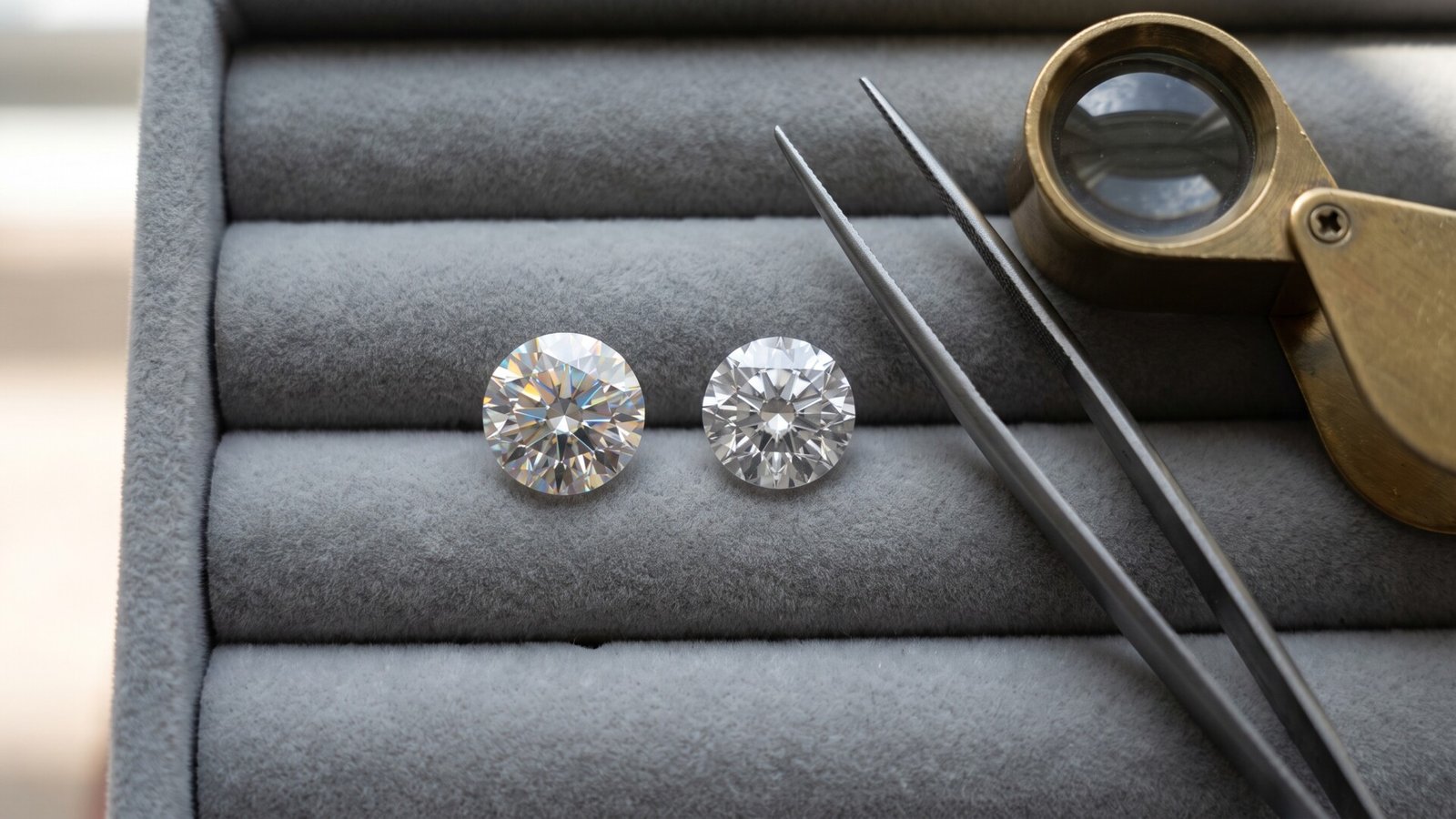
- Fire: moissanite often flashes more colored light than diamond. White sapphire usually looks flatter and less sparkly.
- Double refraction: moissanite splits light in two, which a jeweler can sometimes see as a doubled look of the back facets. Diamond does not do this.
- Testing: a basic heat-based diamond tester can mistake moissanite for diamond. Ask a jeweler about testers that detect moissanite specifically, and ask for a report on any higher-priced stone.
Buying Tips for Both Stones
- Ask whether it is natural or lab-grown. For white sapphire this affects price. For moissanite it is almost always lab-grown. Our guide to natural versus lab-grown birthstones explains the difference between lab-grown and simulant.
- Check the color grade of moissanite. Producers such as Charles & Colvard sell colorless grades under names like Forever One, and lower grades can show a warm tint. Always look at the grade the seller lists.
- Look at the cut. A well-cut stone of either kind shows more life than a poorly cut one, and it matters more than small differences in size.
- Read the return policy. Photos and videos help, but seeing the stone in your own lighting is the best test.
Why Consider Alternatives for Birthstones
- Affordability: both cost far less than a comparable diamond.
- Ethics: lab-grown stones avoid gem mining, which matters to some buyers.
- Style variety: a lower price lets you choose a larger stone or a more elaborate design.
- Durability: both are hard enough for daily wear in rings, bracelets, and necklaces.
If you like the idea of an alternative that is not clear at all, opal is a very different option for fire and color. Our comparison of opal vs moissanite for fire and shine shows how they differ.
Styling Moissanite & White Sapphire
Rings
- Moissanite: works for statement rings, halo settings, or classic solitaires.
- White sapphire: sleek, minimalist solitaires, and a good partner for colored gemstones.
Necklaces & Pendants
- Both work well in pendants, especially when paired with colored gems in a birthstone stack. Our birthstone jewelry guide has more ideas.
Earrings & Bracelets
- Moissanite studs: bold sparkle for any outfit.
- White sapphire hoops or tennis bracelets: subtle elegance for everyday wear.
Caring for Your Moissanite and White Sapphire
- Cleaning: mild soap, warm water, and a soft brush or cloth. Rinse and dry well, because soap film dulls both stones. Avoid harsh chemicals.
- Storage: keep each piece separate. Moissanite is harder than sapphire and can scratch it.
- Maintenance: have a jeweler check the prongs periodically, especially on rings and bracelets.
- Heat: both stones are heat-tolerant, but jewelry repairs involving torches can damage metal settings and any treated stones nearby, so tell a jeweler what you are wearing.
Which One for an Engagement Ring or Everyday Piece?
| If you want… | Lean toward | Why |
|---|---|---|
| A ring worn daily for years | Moissanite | Higher hardness and strong scratch resistance |
| The lowest price | Lab-grown white sapphire | Typically the cheapest of the three kinds |
| A subtle, vintage-style look | White sapphire | Soft glow with little rainbow flash |
| Maximum sparkle in a small stone | Moissanite | High refractive index and dispersion |
| A real diamond at lower cost | Lab-grown diamond | Same material as mined diamond; see our moissanite vs lab diamond article |
Whichever you choose, a protective setting such as a bezel or low-set prongs is sensible for a ring, and a jeweler’s periodic prong check helps prevent lost stones. If the piece is for an April birthday, read our guide on moissanite as an April birthstone alternative first.
Common Myths About Moissanite and White Sapphire
- “Moissanite is a fake diamond.” It is a real gem in its own right, silicon carbide, but it is not diamond.
- “Lab-grown means fake.” Lab-grown means man-made with the same chemistry as the natural stone; a simulant only imitates the look.
- “White sapphire is just a cheap stone.” Natural white sapphire can cost several hundred dollars per carat, and quality varies widely.
- “Either one will last forever unchanged.” Both are durable, but any stone can chip on a hard knock and any setting can wear, so periodic checkups matter.
Fun Facts About Diamond Alternatives
- Moissanite was first found in material from a meteorite crater, which is why it is sometimes described as “out of this world.”
- White sapphire belongs to the same mineral family as ruby and colored sapphire.
- Moissanite’s dispersion (about 0.104) is more than double diamond’s (about 0.044), which is why it can look more colorful in the light.
Rock Your Birthstone Responsibly
April birthstone jewelry does not have to mean a mined diamond. Moissanite gives you maximum sparkle and top scratch resistance, while white sapphire gives you a quiet, classic look at a low price. Which is better depends on how you want your jewelry to look and how you plan to wear it.
To keep exploring, visit the gemstones hub, compare moissanite, white topaz, and diamond, or browse birthstones by month.
Frequently Asked Questions: Moissanite Vs White Sapphire
Which is harder, moissanite or white sapphire?
Moissanite is harder, at about 9.25 on the Mohs scale (some sellers quote up to 9.5), compared with 9 for white sapphire. Both are suitable for everyday wear, but moissanite is more scratch-resistant.
Which sparkles more?
Moissanite. It has a higher refractive index and much higher dispersion than white sapphire, so it throws more brilliance and colored flashes. White sapphire has a softer, more subtle glow.
Is moissanite a real diamond?
No. Moissanite is silicon carbide, a different mineral species, and it is a diamond alternative rather than a diamond. A lab-grown diamond is a real diamond made in a lab.
Is moissanite natural or lab-grown?
Natural moissanite is extremely rare, so almost all moissanite in jewelry is grown in a lab. White sapphire can be either natural or lab-grown.
Which is cheaper, moissanite or white sapphire?
It depends on whether the sapphire is natural or lab-grown. Lab-grown white sapphire is usually the cheapest (roughly $50–$150 per carat), moissanite is typically about $300–$600 per carat for one carat, and natural white sapphire is often about $400–$1,200 per carat. All cost far less than a comparable diamond, and prices vary by size, cut, and seller.
Can moissanite pass a diamond tester?
A basic heat-based tester can read moissanite as diamond. Testers that measure electrical conductivity or are designed to detect moissanite can tell them apart, and a jeweler can use other cues as well.
Is white sapphire good for an engagement ring?
It can be, if you like a subtle look and accept that it may show small scratches over time. Moissanite is generally the more durable choice for a ring worn daily.
Are these good alternatives for the April birthstone?
Many people choose them instead of a mined diamond. The traditional April birthstone is the diamond, so moissanite and white sapphire are personal-choice alternatives rather than official birthstones.