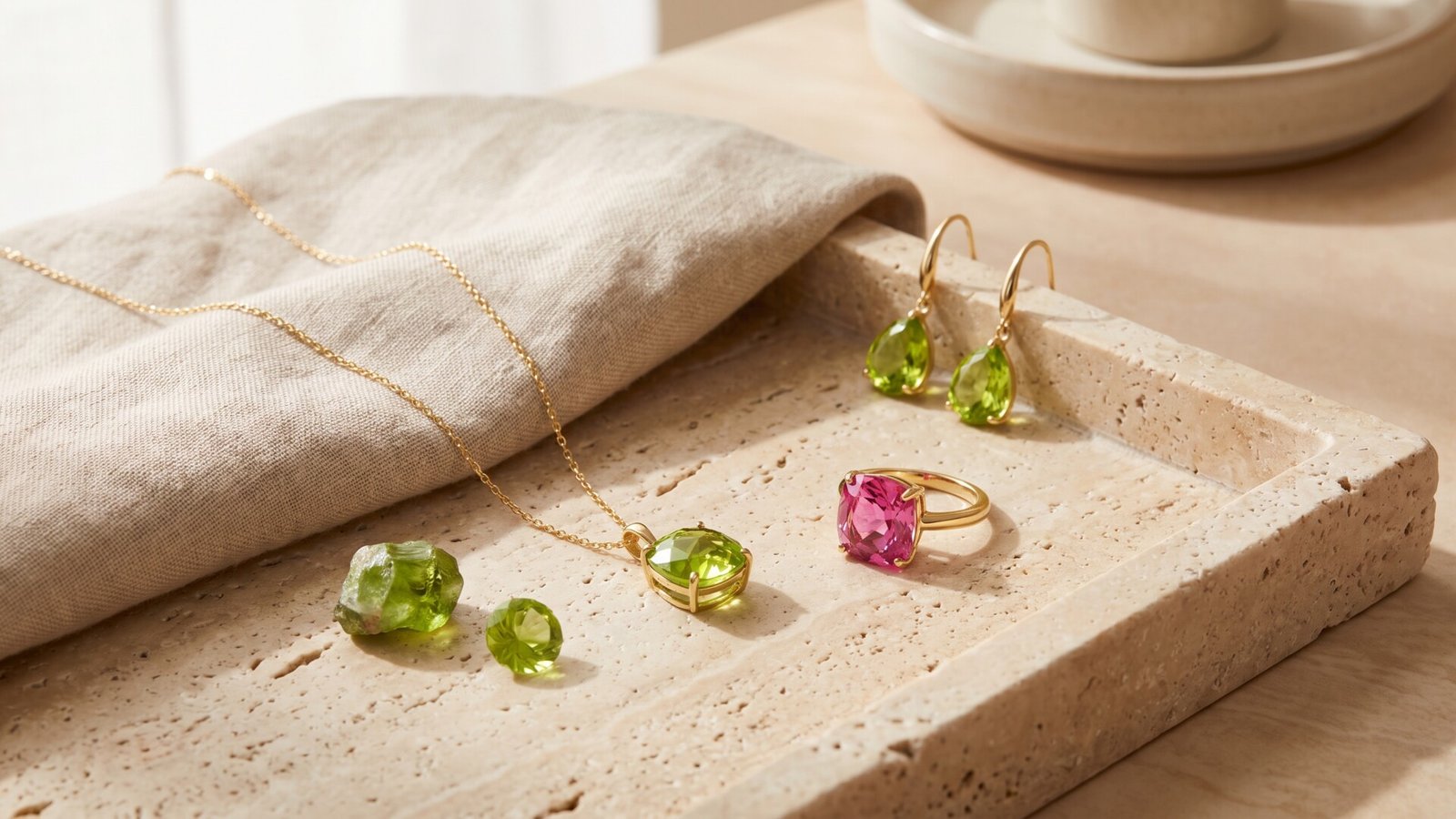
August Birthstone: Meaning, Symbolism, and Jewelry Guide
The August Birthstone at a Glance
August is unusual in having three recognized birthstones: peridot, spinel and sardonyx. Peridot, the glowing yellow-green gem, is the best known and the one most people mean when they say “the August birthstone.” Spinel is a durable, colorful modern addition that was long mistaken for ruby, and sardonyx is a banded stone with the longest history of the three.
This guide covers the meaning and history of each August stone, how they compare in hardness and price, which jewelry suits each, how to clean and store them, and what to ask before you buy. Where we describe meanings and symbolism, those are cultural traditions and beliefs rather than scientific or medical claims. For more on individual stones, see our full peridot guide and peridot meaning guide, the wider Birthstone Meanings & Symbolism hub and our Birthstone Jewelry Guide.
August is one month in our Birthstones by Month guide, which lays out all twelve months, January to December.
What Are the August Birthstones?
Birthstone lists are not universal and have changed over time. GIA recognizes three stones for August:
- Peridot (the best-known August stone): the yellow-green to green-yellow gem variety of the mineral olivine, traditionally associated with renewal, positivity and growth.
- Spinel (the modern addition): available in red, pink, orange, purple, blue and more, traditionally linked with vitality and courage.
- Sardonyx (the oldest August stone): a banded gem made of sard and onyx, two types of chalcedony, traditionally linked with courage and protection.
Because lists vary by country and organization, you may see only one or two of these stones in some places. To see how the lists developed, read our article on the history of birthstones and our beginner’s guide to what birthstones are. In practice, any of the three is a legitimate way to celebrate an August birthday, and many people choose by color, budget and how often they will wear the piece.
August Birthstones Compared at a Glance
The table below puts the practical facts side by side. Mohs hardness measures scratch resistance only and does not say whether a stone will chip or crack. Our guide to the gemstone hardness scale explains the difference.
| Feature | Peridot | Spinel | Sardonyx |
|---|---|---|---|
| What it is | Gem variety of olivine | Magnesium aluminum oxide mineral | Banded chalcedony (a type of quartz) |
| Mohs hardness | 6.5 to 7 | 8 | 6.5 to 7 |
| Typical colors | Yellow-green to olive green | Red, pink, orange, purple, blue, black | Banded red-brown and white or black |
| Common treatments | Usually not treated | Usually not treated | Often dyed |
| Everyday wear | Better in pendants and earrings; rings need care | Suitable for most jewelry, including rings | Suited to cabochons, cameos and signet-style pieces |
| Cleaning | Warm soapy water; avoid steam and ultrasonic | Warm soapy water; ultrasonic often safe unless fractured | Warm soapy water; avoid steam and ultrasonic |
These facts follow GIA’s August birthstone information and standard gemological references. Lab-grown spinel exists, so ask whether a spinel is natural or lab-grown.
Why These Stones Represent August
August sits at the height of summer, so its stones are linked symbolically with sunshine, warmth and abundance. Peridot’s fresh green suggests new growth, spinel’s saturated colors suggest energy, and sardonyx’s earthy bands suggest strength and grounding. These associations come from tradition, not science.
Peridot: Growth and Positivity
Peridot’s radiant green has long been associated with renewal, prosperity and emotional balance. In crystal traditions some people believe it brings positivity; these are beliefs, not medical claims. Learn more in our peridot meaning guide.
Spinel: Vitality and Courage
Spinel is associated in modern jewelry marketing and crystal practice with energy, courage and creativity. Its bright colors suit August’s energetic season and make it a contemporary alternative to peridot.
Sardonyx: Courage and Protection
Sardonyx has been worn for millennia and is traditionally associated with courage, protection and good communication. Its banded structure made it ideal for carved cameos and seals.
Historical and Cultural Significance
Peridot
Peridot has been prized since ancient times. The oldest recorded source is Zabargad, an island in the Red Sea off Egypt, where mining may have begun more than two thousand years ago. Peridot was often confused with emerald and topaz, and gems that were once believed to be emeralds, such as those decorating the Shrine of the Three Holy Kings in Cologne Cathedral, turned out to be peridot, according to GIA. Peridot is also found in pallasite meteorites, and today it is mined in places such as China, Myanmar, Pakistan, Tanzania, Vietnam and Arizona in the United States. In folklore it was believed to protect against evil spirits and bring good fortune; these are traditional beliefs, not facts.
Spinel
Spinel spent centuries disguised as ruby. It was not clearly separated from ruby until the 18th century, which is why many famous “rubies” in royal collections are actually spinels. The best-known example is the Black Prince’s “Ruby,” a roughly 170-carat red spinel given to Edward, Prince of Wales, in 1367 and now set in Britain’s Imperial State Crown. Spinel is valued for hardness, brilliance and vivid color, and it is mined in places such as Tajikistan, Myanmar, Sri Lanka, Vietnam, Tanzania and Pakistan.
Sardonyx
Sardonyx is the oldest of the three August stones. In ancient Rome it was widely used for seals, signet rings, cameos and intaglios, because the banded layers allowed carvers to cut a light figure against a dark background. Sources include India, Brazil, Germany, Madagascar, Uruguay and the United States.
For wider context on how these meanings developed, see our Birthstone Meanings & Symbolism hub.
Meaning and Symbolism of the August Birthstones
Together, the August stones are traditionally associated with late-summer energy. These are cultural beliefs, not measurable effects:
- Peridot: traditionally linked with renewal, positivity, growth and emotional balance
- Spinel: traditionally linked with vitality, courage, creativity and enduring beauty
- Sardonyx: traditionally linked with courage, protection and strength
Whether you take these meanings literally or simply enjoy them as a story, they can make an August birthstone a thoughtful gift. They are not a substitute for medical or professional advice.
Which August Birthstone Should You Choose?
- For the classic August look: peridot. Its yellow-green is distinctive. GIA does not recommend peridot for daily ring wear, so a pendant or earrings are safer, or a protective ring setting for occasional wear.
- For daily wear and rings: spinel. At Mohs 8 it is the hardest and most durable of the three, and it comes in many colors, including ruby-like reds.
- For a traditional or vintage style: sardonyx. It suits cabochons, signet-style rings, cameos and beads.
- For a budget-friendly gift: peridot. As a rough guide from one retail price guide, peridot runs from about $5 to $600 per carat, with good-quality stones commonly in the $50 to $500 range; size, color and origin affect the price. Sardonyx is typically the most affordable.
- For an alternative to ruby or sapphire: spinel. Fine red, pink and blue spinels can be costly, so compare listings and ask whether a stone is natural or lab-grown.
Weighing peridot against another green gem? See our comparisons of peridot vs emerald and peridot vs tsavorite garnet. If you are choosing for everyday wear, read whether peridot is safe to wear while showering or sleeping.
August Birthstone Jewelry Ideas
August gemstones suit a variety of designs. When you shop, check that the listing says whether the stone is natural, treated or lab-created.
Peridot Jewelry
- Rings: bright, uplifting statement pieces. Choose a bezel or halo setting and take the ring off for heavy work.
- Necklaces & pendants: show off the luminous green with little risk of knocks. See our idea for birthstone pendants for new moms.
- Earrings: well suited to casual or formal wear.
Spinel Jewelry
- Rings: colorful options, including ruby-like reds and pinks, that stand up well to wear.
- Necklaces & pendants: add vibrancy to any outfit.
- Earrings: ideal for bold or minimalist designs.
Sardonyx Jewelry
- Rings: classic signet and cabochon styles.
- Cameos & pendants: the banded layers are the traditional medium for carved cameos.
- Beads & bracelets: affordable and easy to wear.
For more ideas, browse our Birthstone Jewelry Guide and our birthstone gift ideas by relationship. For younger recipients, see birthstone gifts for kids by month; small gemstone pieces can be a choking hazard for young children, so choose age-appropriate designs.
Natural, Lab-Grown and Imitation Stones
- Peridot is mostly sold untreated and natural. Be wary of green glass sold as peridot, and check that the listing names the stone.
- Spinel is also generally untreated, but lab-grown spinel exists. A lab-grown stone has the same chemistry as a natural one, while a simulant only imitates the look. Ask for disclosure, and for a laboratory report on expensive stones.
- Sardonyx, like other chalcedony, is commonly dyed to deepen its color. Heat from repair or setting work can affect dyed color, so mention it to your jeweler.
For a broader look at the choice, see our guide to natural vs lab-grown birthstones.
August Birthstones and Wedding Anniversaries
According to GIA, peridot is the traditional gem of the 16th wedding anniversary and spinel the gem of the 22nd. That makes August stones useful gifts for couples as well as for birthdays. If you are choosing for a partner, our birthstone gift ideas by relationship can help narrow the style.
Choosing the Right Setting for Each August Stone
The setting matters almost as much as the stone, because two of the three August gems sit at Mohs 6.5 to 7, where everyday dust and knocks can wear them over time. GIA says peridot is not well suited to daily ring wear and that sardonyx needs similar care in rings.
- Peridot: bezel and halo settings protect the edges of a ring stone, while pendants and earrings give the stone the least exposure. Avoid heat-based repairs without telling your jeweler what the stone is, since peridot is vulnerable to thermal shock.
- Spinel: its Mohs 8 hardness makes prong, bezel and channel settings all reasonable for rings. As with any gem, a fractured stone is more vulnerable, so have settings checked periodically.
- Sardonyx: cabochon and flat-cut stones in low-profile settings suit its banded look. Because it is often dyed, tell your jeweler before any soldering or repair.
Not sure how a stone will hold up to your routine? Our guide to wearing peridot while showering or sleeping and the gemstone shapes and cuts guide are good next reads.
Zodiac Connections
August spans two signs: Leo (about July 23 to August 22) and Virgo (about August 23 to September 22). Exact dates shift slightly from year to year, and zodiac stone lists differ between sources, so the pairings below are one popular tradition rather than a fixed rule.
- Leo: in popular lists, peridot is linked with optimism and vitality, and spinel with courage and energy.
- Virgo: peridot is often linked with balance and clarity, and spinel with resilience.
To see how zodiac and monthly stones fit together, read zodiac birthstones vs monthly birthstones.
Caring for August Birthstone Jewelry
Care differs between these stones. When in doubt, use warm water, mild soap and a soft brush, and avoid steam and ultrasonic cleaners unless you have confirmed they are safe for your piece.
Peridot Care
- Clean with warm water, mild dish soap and a soft brush
- Avoid steam and ultrasonic cleaners, because sudden temperature changes can damage peridot
- Keep it away from acids, harsh chemicals and acidic perspiration, which can etch the surface
- Store separately to prevent scratches from harder stones
Spinel Care
- Clean with warm soapy water; ultrasonic and steam cleaners are generally safe unless the stone has fractures
- Avoid prolonged high heat, which can fade some colors
- Store in a padded jewelry box
Sardonyx Care
- Use warm soapy water and a soft brush
- Avoid steam and ultrasonic cleaners, and keep dyed pieces away from high heat and harsh chemicals
For general stone-care basics, see our Birthstone Education & Buying Guides.
Fun Facts About August Birthstones
- Peridot is the gem variety of olivine, and it has also been found in meteorites called pallasites.
- The Black Prince’s “Ruby” in Britain’s Imperial State Crown is actually a red spinel.
- Spinel’s name is thought to come from the Latin spina, meaning thorn.
- Peridot is always some shade of green, while spinel appears in almost every color.
- Sardonyx was a favorite of Roman carvers for seals and cameos.
Learn more about why gems look the way they do in our guide to the science behind gemstone colors.
Frequently Asked Questions About The August Birthstone
What is the August birthstone?
August has three recognized birthstones: peridot, spinel and sardonyx. Peridot is the best known, spinel is a more recent addition, and sardonyx is the oldest of the three.
What color is peridot?
Peridot is a yellow-green to olive-green gem. It comes in only one color family, and the finest stones are a rich, pure green.
Is peridot durable enough for a ring?
Peridot is 6.5 to 7 on the Mohs scale, and GIA does not recommend it for daily ring wear. Choose a protective setting for occasional wear, or choose a pendant or earrings for regular wear.
Is spinel a real gemstone?
Yes. Spinel is a natural mineral and gemstone, hard (Mohs 8) and available in many colors. It was historically mistaken for ruby. Lab-grown spinel also exists, so ask for disclosure.
What is sardonyx?
Sardonyx is a banded variety of chalcedony made of sard and onyx. It is often dyed, and it has been used for cameos and seals since ancient times.
Can I clean August birthstone jewelry in an ultrasonic cleaner?
Avoid it for peridot and sardonyx. Spinel is generally safe in ultrasonic cleaners unless it has fractures, but warm soapy water and a soft brush is the safest default for all three.
Which August birthstone is the most affordable?
Sardonyx is typically the most affordable, and peridot is also reasonably priced. Spinel ranges widely, and fine natural stones can be expensive.
Which August birthstone is best for Leo or Virgo?
Zodiac stone lists vary by source. Peridot and spinel are commonly mentioned for both signs, but you can choose any August stone you like. Our Leo and Virgo guides cover the traditions in more detail.
Related Articles and Resources
- Peridot: Meaning, Properties, Uses & Value
- Peridot Meaning: History, Symbolism & Modern Uses
- Peridot vs Emerald
- Birthstone Jewelry Guide
- Birthstone Meanings & Symbolism
- Birthstone Jewelry Gift Ideas by Relationship
- July Birthstone
- September Birthstone
Explore More Birthstones
To explore every month and its stones, visit our Birthstones by Month hub. Coming from the previous month? Read the July birthstone guide. Looking ahead? Continue to the September birthstone guide.
Or browse every month: January, February, March, April, May, June, July, October, November and December.
Final Thoughts
There is no single right August birthstone, only the right one for the person and the piece of jewelry. Choose peridot for its fresh green and affordability, spinel for color range and durability, or sardonyx for its long history and classic banding. Whichever you pick, ask how the stone was treated, match the setting to how often it will be worn, and follow the care steps above. Return to the Birthstones by Month hub to explore all twelve months.