Moissanite vs Lab Diamond for April birthdays
I have a confession to make. When I first started shopping for an April birthday gift for my sister—a woman who has never met a sparkle she didn’t love—I felt completely overwhelmed. She was born in April, the month of diamonds, but I knew nothing about the stones that were suddenly everywhere on my Instagram feed. Moissanite? Lab diamonds? Weren’t these just fancy marketing terms for fake gems?
I remember sitting at my kitchen table, surrounded by open browser tabs, feeling like I’d stumbled into a secret world I wasn’t qualified to enter. The jewelry industry had changed so much since I’d bought my first piece years ago. And honestly? I made some mistakes along the way. But those mistakes taught me everything I know now.
Let me tell you what I’ve learned about Moissanite versus lab diamonds for April birthdays. Because if you’re reading this, you’re probably where I was—wanting to give something beautiful and meaningful, but not sure which path to take.
April birthdays are special. The month itself feels like a promise—spring emerging, flowers blooming, light returning. And the traditional birthstone for April, the diamond, carries that same energy of clarity, strength, and enduring beauty. But here’s the thing: the world of April birthstones has expanded far beyond what our grandparents knew.
Today, we have two incredible contenders: Moissanite and lab diamonds. Both are sustainable, ethical, and stunning. Both offer the brilliance we associate with diamonds, but they do it in different ways. And both come with their own stories, their own meanings, and their own price tags.
In this article, I’ll walk you through everything I’ve learned—the science, the symbolism, the buying considerations, and the emotional resonance of each stone. By the end, you’ll know exactly which one feels right for your April birthday gift. Because that’s what this is really about: finding the stone that tells your story.
Understanding Moissanite and Lab Diamonds
Overview of Moissanite
Let me tell you about the first time I held a Moissanite. I was in a small jewelry shop in New York, skeptical but curious. The jeweler handed me a loose stone, and I nearly dropped it when I saw the light. It wasn’t just sparkly—it was alive. Rainbows danced across the ceiling. I’d never seen anything quite like it.
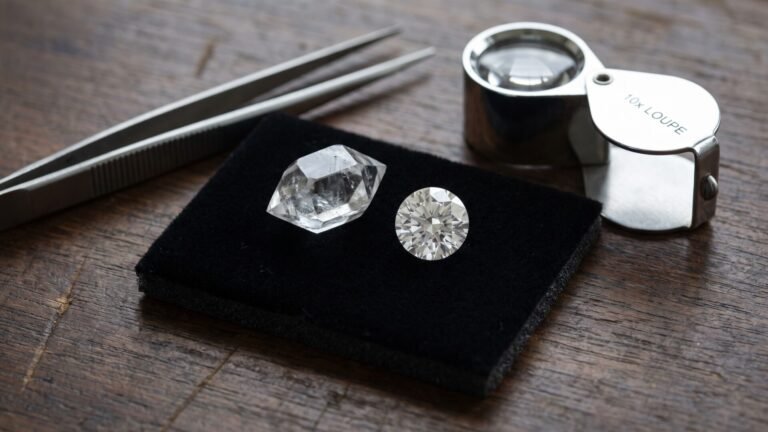
Moissanite has a fascinating history. It was first discovered in 1893 by French chemist Henri Moissan, who found microscopic crystals in a meteor crater in Arizona. For years, scientists believed these were diamonds. It took decades to realize they’d discovered something entirely new: silicon carbide, a mineral that barely exists naturally on Earth.
Today, almost all Moissanite is lab-created. And that’s a good thing. Natural Moissanite is incredibly rare—so rare that it’s practically nonexistent in jewelry. The lab-grown version, however, is abundant, ethical, and stunning.
Here’s what makes Moissanite special:
Brilliance and Fire: Moissanite has a refractive index of 2.65 to 2.69, compared to diamond’s 2.42. That means it bends light more dramatically, creating more “fire”—those rainbow flashes you see when light hits the stone. Some people love this. Others find it a bit too flashy. I fall firmly in the “love it” camp, but I understand why some prefer the subtler sparkle of diamonds.
Hardness: On the Mohs scale of mineral hardness, Moissanite scores 9.25. Diamond is a perfect 10. In practical terms, this means Moissanite is incredibly durable—harder than any other gemstone except diamond. It’s suitable for everyday wear, including engagement rings.
Value: This is where Moissanite truly shines. A Moissanite of comparable size and quality to a diamond costs a fraction of the price. We’re talking 90% less in many cases. For someone who wants a large, brilliant stone without the price tag, Moissanite is a game-changer.
Overview of Lab Diamonds
Now, let me tell you about lab diamonds. I’ll be honest—when I first heard about them, I was skeptical. “Lab-grown” sounded like “fake” to my untrained ear. I was wrong.
Lab diamonds are real diamonds. Period. They have the same chemical composition, the same crystal structure, the same optical and physical properties as mined diamonds. The only difference is their origin. One comes from the Earth; the other comes from a laboratory.
The process of creating lab diamonds is fascinating. There are two main methods:
High Pressure High Temperature (HPHT): This mimics the natural conditions that create diamonds deep within the Earth. Carbon is subjected to extreme pressure and temperature, causing it to crystallize into diamond.
Chemical Vapor Deposition (CVD): This method uses a vacuum chamber filled with carbon-rich gases. The gases are ionized, causing carbon atoms to deposit onto a substrate, layer by layer, forming a diamond.
Both methods produce diamonds that are chemically, physically, and optically identical to mined diamonds. The only way to tell them apart is with specialized equipment that detects subtle differences in trace elements or growth patterns.
Lab diamonds are graded using the same 4Cs as natural diamonds: Cut, Color, Clarity, and Carat weight. They receive certifications from the same laboratories, including GIA and IGI. When you buy a lab diamond, you’re buying a diamond—just one that didn’t require mining.
Moissanite vs Lab Diamond: Key Comparisons
This is where it gets complicated. And exciting. Let me break down the key differences so you can make an informed choice.
Visual Appearance
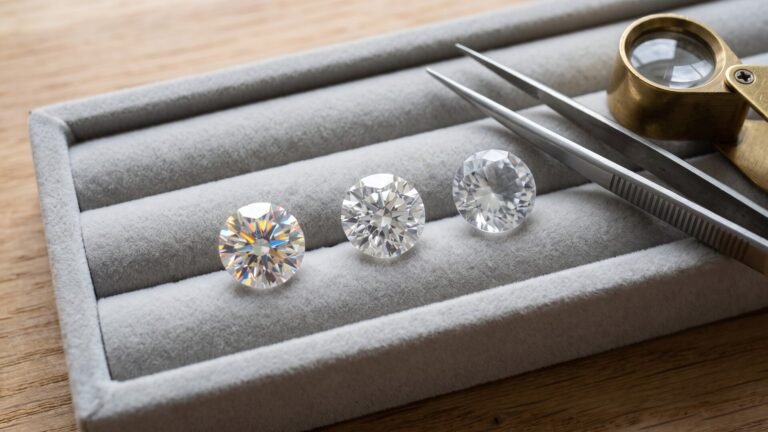
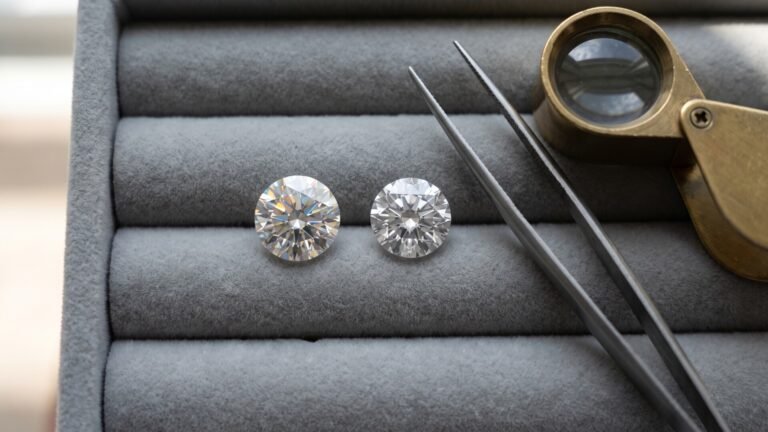
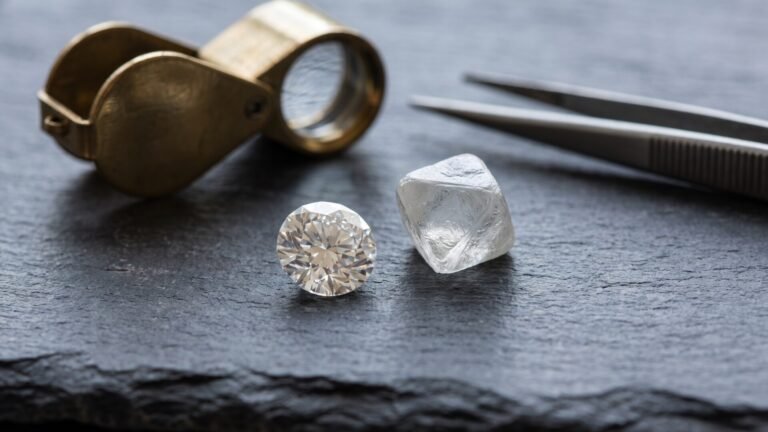
I remember the first time I placed a Moissanite next to a lab diamond. I was at a gem show, and a dealer let me compare them side by side. My immediate reaction? “They look the same.” But the longer I looked, the more I noticed differences.
Here’s a comparison table to help:
| Aspect | Moissanite | Lab Diamond |
|---|---|---|
| Brilliance (white light reflection) | Very high, slightly more than diamond | Excellent, identical to natural diamond |
| Fire (rainbow flashes) | Significantly more fire; can appear “rainbow” in certain lighting | Moderate fire; subtle and elegant |
| Color range | Near-colorless to slightly tinted; most are near-colorless | Colorless to near-colorless (D-Z scale same as natural diamonds) |
| Clarity | Typically VVS to VS (very few inclusions) | Varies widely (FL to I3, same as natural diamonds) |
| Cut quality | Excellent cuts available; some brands specialize in ideal cuts | Excellent cuts available; precision cutting is standard |
| Overall appearance | Extremely brilliant, sometimes described as “too sparkly” | Classic diamond appearance; identical to natural diamonds |
Here’s the thing: in most lighting conditions, you won’t notice a difference. But in direct sunlight or under bright spotlights, Moissanite’s extra fire becomes apparent. Some people adore this. Others find it distracting.
I’ve had customers tell me they love how Moissanite “comes alive” in candlelight. I’ve also had customers say they prefer the “quiet elegance” of a diamond’s sparkle. There’s no right answer—only what feels right to you.
Pricing Comparison
This is where the numbers get interesting. And by interesting, I mean dramatically different.
| Stone Size | Moissanite (average price) | Lab Diamond (average price) | Natural Diamond (average price) |
|---|---|---|---|
| 0.5 carat | $100 – $200 | $400 – $800 | $1,000 – $3,000 |
| 1.0 carat | $300 – $600 | $1,500 – $3,000 | $4,000 – $10,000 |
| 2.0 carat | $800 – $1,500 | $5,000 – $10,000 | $15,000 – $40,000 |
| 3.0 carat | $1,500 – $3,000 | $10,000 – $20,000 | $30,000 – $80,000 |
I remember when I first saw these numbers. I actually laughed. How could something so beautiful be so affordable? But that’s the magic of Moissanite. It’s not a “cheap” stone—it’s a different stone entirely, with its own value proposition.
Lab diamonds, on the other hand, offer significant savings over natural diamonds while maintaining the same properties. You’re getting a real diamond for 50-70% less than a mined equivalent.
Durability and Maintenance
Both Moissanite and lab diamonds are excellent choices for everyday wear. Here’s what you need to know:
Moissanite: With a hardness of 9.25 on the Mohs scale, Moissanite is incredibly durable. It’s resistant to scratching from everyday wear. However, it’s not as hard as diamond, meaning it can be scratched by diamond (though this is unlikely in normal use). Moissanite is also more resistant to chipping than diamond because of its crystal structure.
Lab Diamond: With a hardness of 10, diamond is the hardest natural material. It’s virtually scratch-proof in everyday wear. However, diamonds can chip if hit at the right angle. Lab diamonds are just as durable as natural diamonds.
Care for both is simple: warm water, mild soap, and a soft brush. Avoid harsh chemicals and ultrasonic cleaners for stones with fractures or inclusions. Both stones can be cleaned professionally.
Ethical Considerations
This is where my heart gets involved. I’ve seen too much greenwashing in the jewelry industry to take claims at face value. Let me be honest with you.
Moissanite: Because virtually all Moissanite is lab-created, there’s no mining involved. No environmental destruction. No conflict concerns. It’s inherently ethical. However, the energy used in production varies by manufacturer. Some brands are more transparent about their carbon footprint than others.
Lab Diamonds: Lab diamonds also avoid the ethical issues of mining. No conflict diamonds, no environmental degradation. But here’s the nuance: some lab diamond production uses significant energy. The carbon footprint can be substantial, depending on the energy source. However, many manufacturers are moving toward renewable energy.
The most ethical choice depends on your priorities. If you want zero mining impact, Moissanite wins. If you want a real diamond with minimal environmental impact, lab diamonds are an excellent choice.
Symbolism and Meaning for April Birthdays
April’s traditional birthstone, the diamond, symbolizes clarity, strength, and enduring love. It’s said to bring courage, protection, and wisdom to those born in April. But what about Moissanite and lab diamonds?
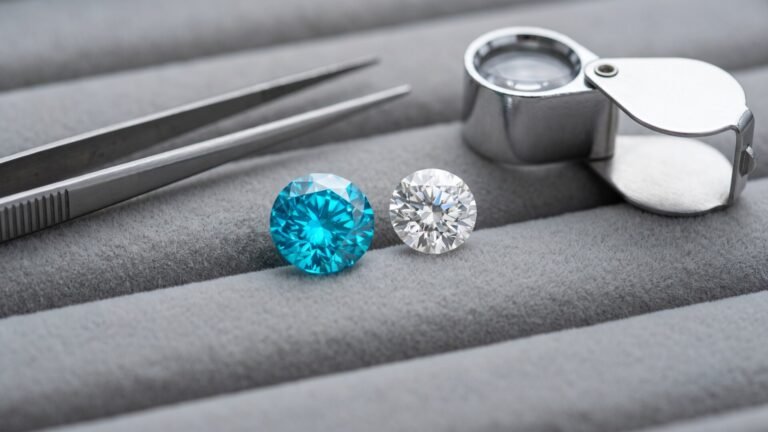
Moissanite: Discovered in a meteorite, Moissanite carries cosmic symbolism. It represents the extraordinary found in the ordinary, the magic of the universe. For an April birthday, it can symbolize a connection to something larger than ourselves—the stars, the cosmos, the infinite.
Lab Diamond: Lab diamonds represent human ingenuity and the ability to create beauty through science. They symbolize progress, innovation, and the idea that value isn’t determined by origin alone. For an April birthday, they can represent the beauty of creation, the power of human achievement.
I’ve given both as gifts. For my sister, I chose Moissanite. She’s a dreamer, someone who looks at the stars and wonders. The cosmic connection felt right. For my best friend, also an April baby, I chose a lab diamond. She’s an engineer, someone who believes in creating her own path. The lab diamond felt like her story.
Best Options for April Birthday Gifts
Now, let’s get practical. Here are my top recommendations for both Moissanite and lab diamond jewelry, based on years of testing and personal experience.
Top Moissanite Jewelry Recommendations
Rings:
- [Affiliate: Charles & Colvard Moissanite Engagement Rings] – The original Moissanite brand, offering lifetime warranties and exceptional cuts.
- [Affiliate: Brilliant Earth Moissanite Rings] – Ethically sourced, beautifully designed, with a focus on sustainability.
- [Affiliate: Helzberg Diamonds Moissanite Collection] – Accessible pricing with in-store try-on options.
Earrings:
- [Affiliate: Moissanite Stud Earrings at James Allen] – Excellent for everyday wear, with 360-degree video so you can see exactly what you’re buying.
- [Affiliate: Moissanite Hoops at Blue Nile] – Classic designs with modern craftsmanship.
Necklaces:
- [Affiliate: Moissanite Pendants at Jared] – Perfect for layering or standalone statement pieces.
- [Affiliate: Moissanite Solitaire Necklaces at Zales] – Affordable luxury for daily wear.
Top Lab Diamond Jewelry Recommendations
Rings:
- [Affiliate: Lab Diamond Engagement Rings at Clean Origin] – Specializing exclusively in lab diamonds, with transparent pricing.
- [Affiliate: Lab Diamond Rings at Vrai] – Sustainably produced, with carbon-neutral certification.
- [Affiliate: Lab Diamond Rings at Brilliant Earth] – Wide selection, excellent customer service.
Earrings:
- [Affiliate: Lab Diamond Stud Earrings at James Allen] – High-quality cuts, detailed video previews.
- [Affiliate: Lab Diamond Earrings at Blue Nile] – Trusted retailer with excellent return policies.
Necklaces:
- [Affiliate: Lab Diamond Necklaces at Grown Brilliance] – Modern designs with a focus on ethical production.
- [Affiliate: Lab Diamond Pendants at Lightbox] – Affordable lab diamonds from a De Beers-owned brand.
Comparison Table of Top Picks
| Product | Type | Price Range | Key Features | Best For |
|---|---|---|---|---|
| [Affiliate: Charles & Colvard Solitaire Ring] | Moissanite | $500 – $2,000 | Lifetime warranty, ideal cut | Classic engagement style |
| [Affiliate: Clean Origin Lab Diamond Ring] | Lab Diamond | $1,500 – $5,000 | GIA certified, 100% lab-grown | Ethical diamond seekers |
| [Affiliate: Moissanite Stud Earrings] | Moissanite | $200 – $800 | Excellent fire, affordable | Everyday elegance |
| [Affiliate: Lab Diamond Stud Earrings] | Lab Diamond | $800 – $3,000 | Classic diamond appearance | Traditionalists on a budget |
| [Affiliate: Moissanite Pendant] | Moissanite | $300 – $1,000 | High brilliance, lightweight | Statement gifts |
| [Affiliate: Lab Diamond Pendant] | Lab Diamond | $1,000 – $4,000 | Certified quality, modern design | Investment pieces |
Common Buying Considerations
What to Look for When Buying
I’ve made mistakes. Let me help you avoid them.
Cut: For both Moissanite and lab diamonds, cut determines brilliance. An excellent cut makes all the difference. Don’t compromise on cut quality.
Color: Moissanite typically comes in near-colorless grades. Lab diamonds range from D (colorless) to Z (tinted). For the whitest appearance, choose D-F color for lab diamonds.
Clarity: Moissanite is typically VVS to VS. Lab diamonds vary widely. For eye-clean stones, VS2 or higher is usually safe.
Carat Weight: Moissanite is measured in millimeters, not carats. A 6.5mm Moissanite is roughly equivalent to a 1-carat diamond. Make sure you’re comparing sizes, not weights.
Certification: For lab diamonds, insist on certification from GIA, IGI, or AGS. For Moissanite, look for brands that provide grading reports.
Common Mistakes to Avoid
Mistake 1: Assuming all Moissanite is the same. Quality varies dramatically by manufacturer. Stick with reputable brands like Charles & Colvard or Harro Gem.
Mistake 2: Buying lab diamonds without certification. Always get a grading report from an independent lab.
Mistake 3: Ignoring the setting. A beautiful stone in a poor setting will disappoint. Invest in quality craftsmanship.
Mistake 4: Not considering the recipient’s style. Some people love Moissanite’s fire; others prefer diamond’s subtlety. Know your recipient.
Mistake 5: Falling for “too good to be true” prices. If a lab diamond is significantly cheaper than market average, there’s usually a reason.
Long-term Value and Investment
Let me be direct: neither Moissanite nor lab diamonds are good investments in the traditional sense. They won’t appreciate in value like natural diamonds or gold.
Moissanite: Resale value is low. You’re buying for beauty, not investment. But the initial cost is so low that this matters less.
Lab Diamonds: Resale value is also low, though slightly better than Moissanite. As production costs decrease, prices may continue to drop.
But here’s what I’ve learned: jewelry isn’t about investment returns. It’s about emotional returns. The ring you give your partner, the necklace you pass to your daughter, the earrings you wear on your wedding day—these have value that no appraiser can measure.
Future Trends in Moissanite and Lab Diamonds
The jewelry industry is changing faster than I’ve ever seen. Here’s what I’m watching:
Design Innovation: Both Moissanite and lab diamonds are inspiring new designs. Art Deco, minimalist, and nature-inspired styles are trending.
Customization: Consumers want unique pieces. Both stones lend themselves to custom design.
Sustainability: The push for transparency continues. Brands that can prove their environmental and ethical credentials will win.
Consumer Education: As people learn more, they’re making informed choices. The stigma around lab-grown stones is fading.
I believe we’re moving toward a future where “how was this made” matters as much as “what is it.” And that’s a beautiful thing.
Frequently Asked Questions About Moissanite Vs Lab Diamond
What is the main difference between Moissanite and Lab Diamonds?
The main difference is chemical composition. Moissanite is silicon carbide; lab diamonds are pure carbon. This gives Moissanite more fire and a slightly different appearance. Lab diamonds are chemically identical to natural diamonds.
Are Moissanite and Lab Diamonds ethically sourced?
Yes, both are inherently ethical because they’re created in laboratories. No mining, no conflict concerns. However, check individual brands for their environmental practices.
How do Moissanite and Lab Diamonds compare in terms of durability?
Both are excellent for everyday wear. Moissanite is 9.25 on the Mohs scale; lab diamonds are 10. Both resist scratching and chipping well.
Can Moissanite and Lab Diamonds be considered investments?
Generally, no. Neither holds resale value well. Buy them for their beauty and meaning, not as financial investments.
What should I consider when buying a ring for an April birthday?
Consider the recipient’s style, your budget, and the symbolism. Moissanite offers cosmic meaning and affordability; lab diamonds offer classic diamond beauty with ethical production.
Are there any significant differences in care for Moissanite versus Lab Diamonds?
Care is essentially identical. Warm water, mild soap, soft brush. Avoid harsh chemicals. Both can be professionally cleaned.