Garnet Jewelry Gift Ideas for January Birthdays: A Love Letter to the Deep Red Stone
I have a confession to make.
For years, I was the world’s worst January birthday gift giver. My best friend—let’s call her Emilia—has a birthday on January 17th. And for a decade, I bought her… nothing. Or rather, I bought her the same thing I bought everyone else: scarves, candles, generic “happy birthday” clutter that could have been for anyone, any month, any occasion.
It wasn’t that I didn’t love her. It was that I didn’t know what to do with January.
December has diamonds and tinsel and obvious, glittery answers. February has hearts and roses and rubies the color of romance. But January? January is the letdown month. The hangover month. The month where everyone is broke from the holidays and cold and just trying to survive until spring.
And then, a few years ago, Emilia opened her birthday gift—a small velvet box—and her face did this thing I’ll never forget. Her eyes got wide. Her mouth opened, then closed, then opened again. She looked at me, then at the box, then back at me.
“Is this… garnet?” she whispered.
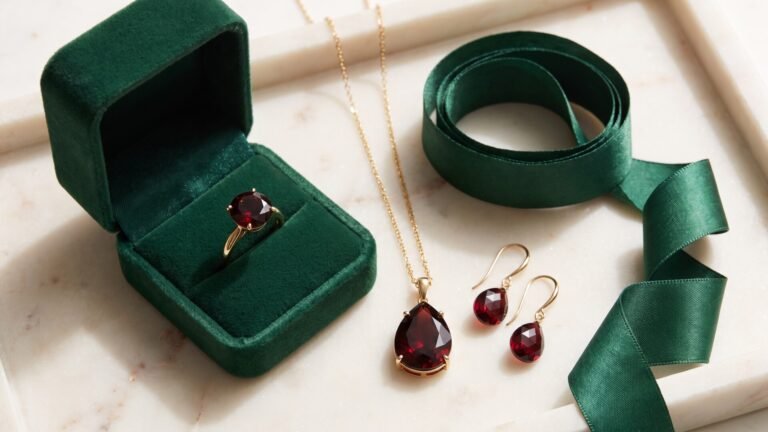
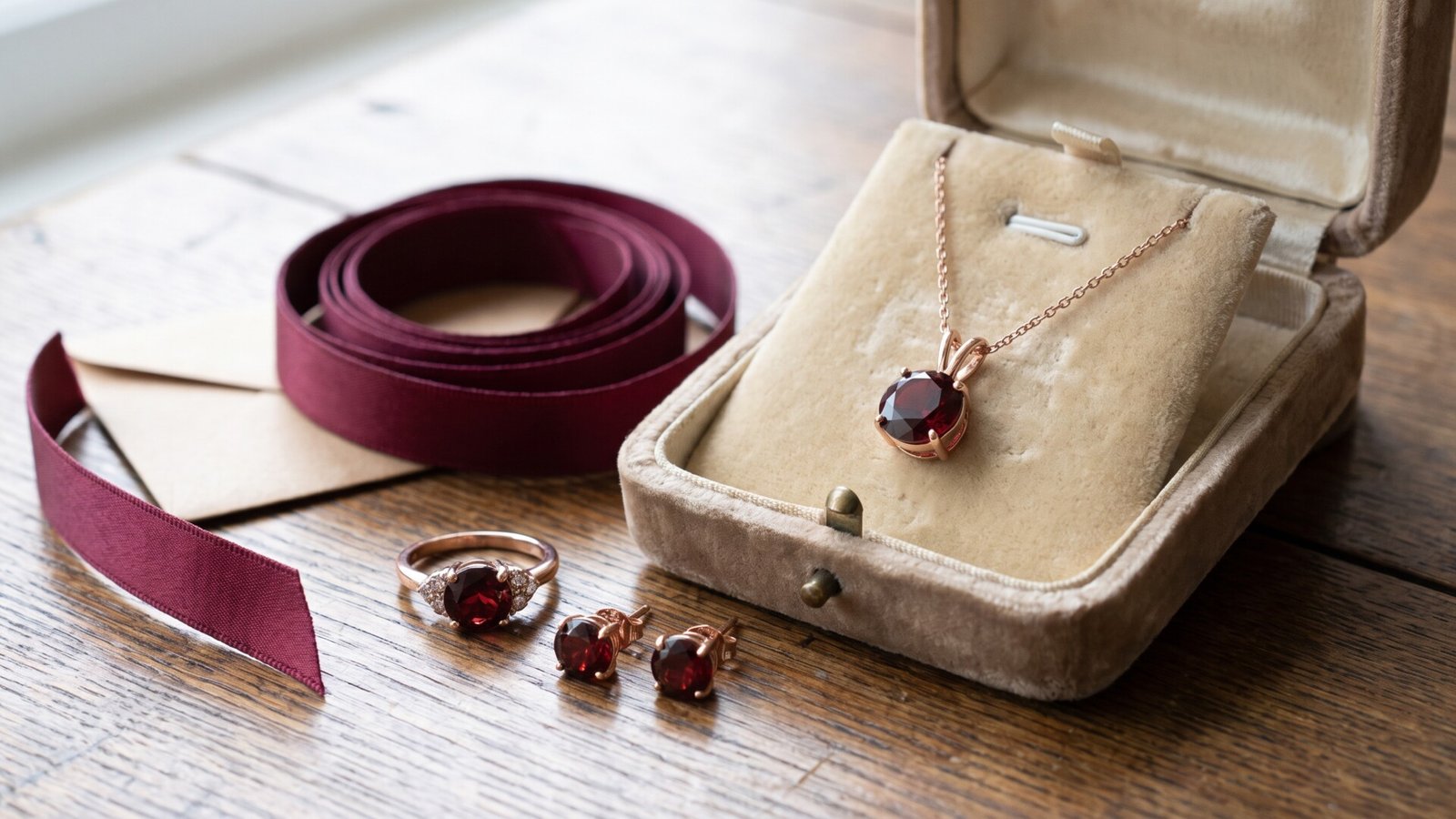
It was. A simple garnet pendant, deep red, set in rose gold, catching the gray January light and turning it into something warm and alive.
“It’s my birthstone,” she said. “You remembered.”
I hadn’t remembered. I had finally learned. And the difference between those two words is the entire reason I’m writing this article.
Why Garnet? Why January? (And Why You Should Care)
Before we dive into the specific gift ideas—organized by recipient and budget—I want you to understand what you’re actually giving when you give garnet. Garnet is the January birthstone on the modern and traditional lists we follow; if you want the full background, start with our January Birthstone guide, our Garnet guide and the Garnet Meaning guide.
Garnet is not a compromise.
I think this is the biggest misconception about January birthstones. People see the price tag—common garnet is eminently affordable compared to ruby or emerald—and they assume it’s the “budget option.” They assume the January baby got shafted in the birthstone lottery.
Nothing could be further from the truth. Garnet has been treasured for thousands of years. Garnet beads have been found in ancient Egyptian burials, Roman signet rings were carved from it, and Victorian jewelry is practically built on garnet—those gorgeous clusters of tiny red stones set in silver and gold.
The name itself comes from the Latin granatus, meaning “seed-like,” because garnets look like the seeds of a pomegranate. And in the myth of Persephone, pomegranate seeds were the food of the underworld—but also symbols of return, of spring, of life persisting through the darkest months.
Do you see why this is a lovely stone for January?
January is the dark month. The cold month. The month when it feels like winter will never end. Garnet is a tiny, wearable symbol that the seeds are still there, waiting under the frozen ground. It doesn’t scream; it glows. It doesn’t demand attention; it rewards those who look closely. (Garnet is also the traditional stone associated with Capricorn, and Aquarius is the other zodiac sign whose season starts in January.)
That’s the January baby I know. Quiet, maybe. Deep, definitely. Worth the wait, absolutely.
So let’s find the perfect garnet for yours.
Garnet at a Glance: Facts Every Gift Giver Should Know
| Fact | What to know |
|---|---|
| What it is | A group of related silicate minerals (pyrope, almandine, spessartine, grossular, andradite and others), not a single mineral |
| Mohs hardness | About 6.5–7.5 depending on the type |
| Cleavage | None, which helps toughness, though hard knocks can still chip a stone |
| Treatments | Garnets are rarely treated, but ask the seller to confirm |
| Imitations | Glass and lab-made look-alikes exist. Lab-made materials such as YAG have a garnet-type crystal structure but are not natural garnet |
| Daily wear | Excellent for earrings and pendants, good for rings with a protective setting |
Before You Buy: Four Things Every Garnet Gifter Should Know
These are worth a quick read before you shop.
1. Garnet Is Actually Many Different Stones
Here’s something that surprises many gift givers: “Garnet” isn’t one gemstone. It’s a family of several related minerals, all with slightly different chemical compositions and colors.
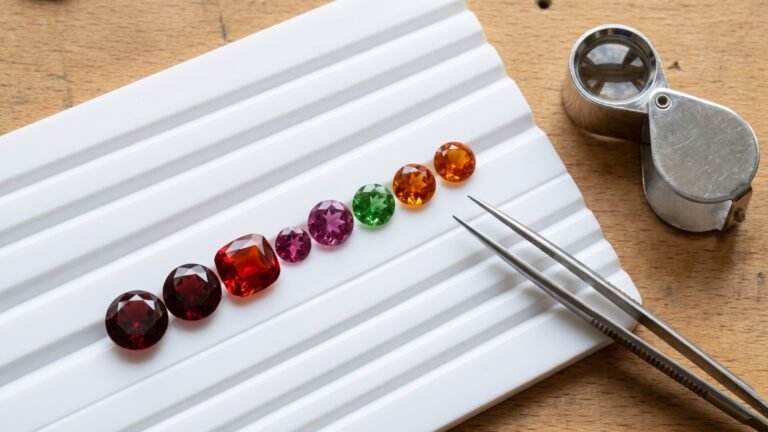
You probably think of garnet as red. And yes, the most common garnets—the ones you’ll see in most jewelry stores—are almandine and pyrope, in deep burgundy to wine red. But garnet also comes in:
- Rhodolite: A stunning raspberry-pink to purplish-red blend of pyrope and almandine. Lighter and brighter than traditional garnet. My personal favorite.
- Spessartine: Orange to orange-red. Sometimes called “mandarin garnet” when it’s that vibrant, juicy orange.
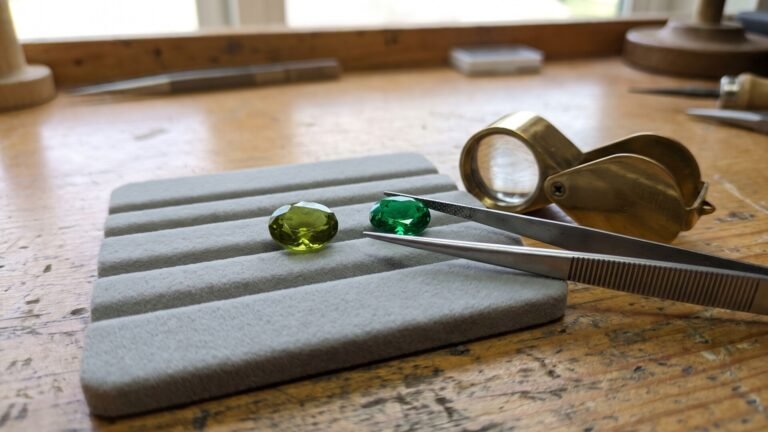
- Grossular: Includes the rare and sought-after tsavorite garnet (vivid green) and hessonite garnet (honey-colored).
- Andradite: Includes demantoid garnet, a brilliant green variety that is rare and highly prized in fine sizes.
Why this matters for gift giving: If your January baby doesn’t love traditional red, you have options. A pink rhodolite garnet or a green tsavorite garnet is still a garnet. You’re not cheating. You’re customizing.
Approximate price per carat (USD, 2026 published ranges):
| Garnet type | Typical price per carat |
|---|---|
| Almandine (top color) | $1 – $40 |
| Pyrope (fine color) | $15 – $25 |
| Rhodolite (faceted) | $15 – $180 |
| Hessonite (fine color) | $15 – $200 |
| Mandarin garnet (fine color) | $150 – $1,500 |
| Tsavorite (fine color) | $400 – $4,200 |
| Demantoid | $200 – $18,000 |
These are rough per-carat ranges for loose stones from one published 2026 guide; finished jewelry costs more once metal, labor and retail margin are added, and prices vary by seller.
2. Size Doesn’t Tell You Everything
With diamonds, bigger is generally more expensive. With garnet, the relationship between size and price is… weirder.
Common garnets are abundant, which means you can get a surprisingly large stone without spending a fortune. A 2-carat red garnet is a modest purchase. A 2-carat fine ruby costs thousands of dollars.
But here’s the catch: garnet is dense. Carat weight measures weight, not size, so a 1-carat garnet can look a little smaller than a 1-carat diamond (especially almandine, which is the densest). The carat weight is the same, but the physical dimensions differ.
What this means for you: Don’t fixate on carat weight. Look at the actual millimeter measurements of the stone, or better yet, look at photos of the jewelry on a model. A 1.5-carat garnet might look exactly the size you want, even if the number seems “small.”
3. Color Is Everything
In garnet, color is the single biggest factor in both beauty and price.
- Deep, vivid red with minimal brown or orange tones: excellent
- Bright raspberry pink (rhodolite): excellent to exceptional
- Brownish-red or dull burgundy: lower quality, less desirable
- Inclusions: Garnet is generally a clean stone, but some inclusions are normal. You’re looking for an eye-clean stone—one where you can’t see inclusions without magnification.
Pro tip: Ask for photos in natural light. Store lighting is designed to make everything look good. Natural light tells the truth. Dark garnets can also look almost black indoors, so look for a stone that still shows red in daylight. Red garnet is sometimes confused with ruby—see Garnet vs Ruby: How to Tell the Difference.
4. Settings Matter More Than You Think
Garnet is durable enough for daily wear (about 6.5–7.5 on the Mohs scale), but it’s not indestructible. It can scratch, chip, or abrade if treated roughly.
What this means for gift giving: Consider how the recipient lives their life.
- Does she work with her hands? Maybe a garnet pendant or earrings instead of a ring.
- Does he lose things? Maybe a sturdy bezel setting instead of delicate prongs.
- Is she gentle with her jewelry? The world is her oyster. Go wild.
The Gift Ideas: Organized by Who You’re Buying For
I’ve organized this section by recipient type rather than price, because that’s how we actually shop. You’re not thinking “I want to spend $200.” You’re thinking “I need something perfect for my wife who already has everything.” The price ranges below are rough planning guides in USD, not quotes. For even more ideas, see 10 Gorgeous Garnet Jewelry Gift Ideas and January Birthstone Gifts for Him and Her.
Let’s fix that.
For the Partner Who Already Has a Jewelry Box
The Challenge: She has pearls. She has diamonds. She has a watch that cost more than your first car. What do you get the woman who buys her own jewelry?
The Solution: Vintage or vintage-inspired garnet.
There’s something about garnet that feels inherently Victorian. Maybe it’s the deep, moody color. Maybe it’s the way it catches light like gaslight through a window. Whatever the reason, garnet and antique settings are soulmates.
Look for:
- Garnet cluster rings: Multiple small garnets arranged in a flower or geometric pattern. These were enormously popular in the 19th century, and modern versions capture that romantic, heirloom feel.
- Eastern European-inspired garnet jewelry: Garnet jewelry from Bohemia, Russia and neighboring regions is known for dense clusters, warm gold and intricate detailing. Look for pieces that reference that aesthetic—stones that seem to glow from within.
- Mixed metal settings: Rose gold and garnet is a match made in heaven. The pinkish tones of rose gold harmonize with garnet’s red in a way that yellow gold sometimes doesn’t quite achieve. Two-tone settings (rose gold + silver or white gold) feel contemporary but timeless.
My favorite pick: A rhodolite garnet pendant in a Victorian-inspired rose gold bezel setting. It’s not trying to be modern. It’s not trying to be trendy. It’s simply beautiful, and that’s exactly what she deserves.
Price range: $300–$1,200
For the Minimalist Who Owns Three Things Total
The Challenge: She has a uniform. Her jewelry is part of that uniform. She doesn’t want something that screams; she wants something that whispers.
The Solution: Solitaire studs or a simple bezel pendant.
Look for:
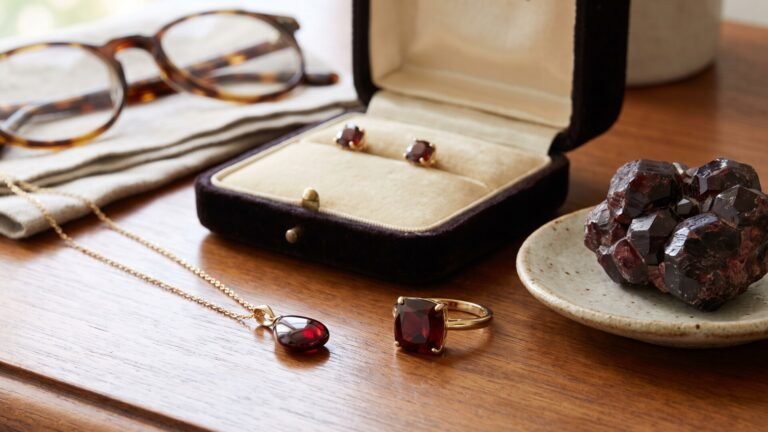
- Garnet stud earrings: 4-5mm each, set in simple 14k gold or platinum. Nothing dangling, nothing ornate. Just two perfect red dots that catch the light when she turns her head.
- Bezel-set garnet pendant: A single round or oval garnet, flush-set into a thin gold rim, hanging from a delicate chain. It should look like a drop of wine suspended in mid-air.
- Garnet and diamond line bracelet: Tiny alternating garnets and diamonds on a fine chain. The garnets provide color; the diamonds provide sparkle. The overall effect is subtle enough for daily wear but special enough for evenings.
Pro tip: For minimalists, metal color matters enormously. Pay attention to what they already wear. If all her jewelry is white gold or platinum, don’t suddenly introduce yellow gold. You’ll disrupt the system.
Price range: $200–$800
For the January Baby Turning 21 (or 30, or 40…)
The Challenge: Milestone birthdays demand milestone gifts. This isn’t just any birthday; it’s the birthday.
The Solution: Demantoid or Tsavorite Garnet.
Remember how I said garnet comes in green? This is where that becomes relevant. For a side-by-side with another green gem, see Peridot vs Tsavorite Garnet.
Demantoid garnet is one of the rarest and most valuable garnet varieties. Discovered in Russia’s Ural Mountains in the 19th century, it was used by Carl Fabergé and Art Nouveau jewelers. Its dispersion—the ability to split light into spectral colors—is actually higher than diamond’s. It’s sometimes called the “Uralian emerald,” and it’s spectacular. It is also softer than other garnets (around 6.5–7), so a protective setting is wise.
Tsavorite garnet is demantoid’s younger, African cousin. It was first found in Tanzania in the 1960s and later in Kenya, and was named after Kenya’s Tsavo region. It’s a vivid, intense green that rivals fine emerald—and it is tougher than emerald, though prices for fine stones can still be significant.
Why this works for a milestone birthday: It honors their January birthstone while acknowledging that they’re not the same person they were at 20 (or 30, or 40). They’ve grown. They’ve changed. They’ve revealed new facets of themselves. A green garnet says, “I see all of you, not just the obvious parts.”
Price range: $500–$2,500+ (demantoid is significantly more expensive than tsavorite at larger sizes)
For the Friend Who’s Never Owned Real Jewelry
The Challenge: She’s always worn fashion jewelry. She’s never owned a “real” gemstone. You want to introduce her to fine jewelry without intimidating her—or breaking her heart if she loses it.
The Solution: Sterling silver garnet jewelry.
I know, I know. Fine jewelry people (myself included) sometimes turn up our noses at sterling. But here’s the truth: sterling silver is beautiful, durable, and affordable. It’s the perfect entry point for someone who’s never owned a proper birthstone piece. (Sterling can tarnish, so polish it occasionally with a soft cloth.)
Look for:
- Sterling silver garnet rings: Look for oxidized or blackened silver settings—the dark metal makes garnet’s red pop like crazy.
- Stackable garnet bands: Thin sterling bands set with small garnets. She can wear one alone or stack several together. They’re approachable, versatile, and forgiving.
- Garnet and pearl combinations: Sterling silver, garnet, and freshwater pearl is a stunning trio. The white of the pearl, the red of the garnet, the cool gleam of the silver—it’s winter in jewelry form. Keep the pearls away from perfume and acids.
Pro tip: If you’re worried about her losing or damaging it, buy from a retailer with a solid return/repair policy. The goal is to make her feel cared for, not anxious.
Price range: $50–$200
For the January Dad Who Doesn’t Wear Jewelry
The Challenge: He doesn’t do rings. He doesn’t do necklaces. His watch is a $40 Casio and he’s had it since 1998. You want to honor his January birthday without giving him something that will live in a drawer forever.
The Solution: Cufflinks, tie clips, or—hear me out—a pocket knife with garnet accents.
Look for:
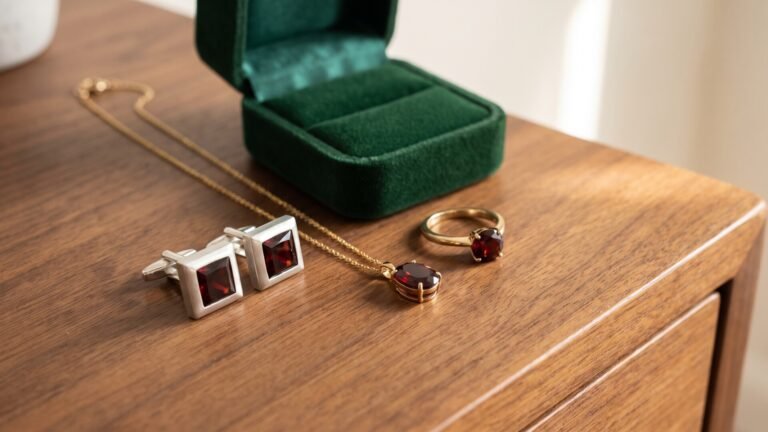
- Garnet cufflinks: Simple, masculine, understated. Round or square garnets in sterling silver or yellow gold. He’ll wear them to weddings and job interviews and think of you every time.
- Garnet tie clip: A small garnet set into the end of a classic tie bar. Just a wink of color against his work shirts.
- Luxury grooming tools: High-end razor handles, watch fobs, or even fountain pens sometimes feature small gemstone accents. If he’s a traditionalist, a vintage-style straight razor with a garnet in the handle might be the most unexpected and beloved gift of his life.
Pro tip: Men’s garnet jewelry should be substantial. Don’t give him something dainty. He’ll feel like he’s going to break it. For more, see custom birthstone rings for men.
Price range: $75–$400
For the January Baby Born in the Wrong Century
The Challenge: She’s a vintage soul. She wears estate jewelry like it’s her birthright. She wants something that looks like it came from her grandmother—or her grandmother’s grandmother.
The Solution: Authentic Victorian or Edwardian garnet jewelry.
Look for:
- Bohemian garnet jewelry: The Bohemian region (now part of the Czech Republic) was a major center of garnet jewelry in the 19th century. Bohemian garnet jewelry is characterized by dense clusters of small, intensely red pyrope stones, often set in silver-gilt or low-carat gold. It’s distinctive, historical, and utterly romantic.
- Georgian-era garnet: If you can find it—and if your budget allows—Georgian garnet jewelry (1714–1837) is the holy grail. Look for “rose cut” or cabochon garnets, often set in closed-back settings that enhance depth of color.
- Victorian sentimental pieces: Garnet also appears in Victorian sentimental and keepsake jewelry, where the deep red was linked with enduring love and loyalty.
Important note: Authentic antique jewelry requires extra care. The settings may be fragile. The stones may have wear. Make sure she understands how to care for it—and consider insuring it. Buy from a seller who can describe the age, materials and any repairs in writing.
Price range: $400–$2,000+
For the January Teenager
The Challenge: She’s 14. She’s 17. She’s just starting to develop her own style. You want something she’ll love now, not something she’ll appreciate when she’s 40.
The Solution: Contemporary, trend-aware garnet jewelry. More ideas in our children’s birthstone gifts and birthday ideas.
Look for:
- Garnet initial necklace: A small garnet set into a gold initial pendant. Personal, modern, and utterly Instagrammable. See custom birthstone initial charms.
- Raw or rough garnet: Uncut, unpolished garnet crystals set into simple metal settings. The “raw crystal” trend shows no signs of slowing down, and garnet’s natural crystalline structure is genuinely beautiful.
- Garnet birthstone stacking rings: Thin, stackable rings in mixed metals, each with a tiny garnet. She can wear one or pile them on. They’re affordable, adaptable, and perfect for a teenager who’s still figuring out her style.
Pro tip: Ask her about her jewelry preferences. I know, shocking advice. But teenagers have opinions, and those opinions change rapidly. A quick, casual conversation will prevent you from buying her a dainty rose gold ring when she’s currently obsessed with chunky silver.
Price range: $50–$300
Garnet Gifts by Budget at a Glance
| Budget (USD) | Good fits |
|---|---|
| $50–$200 | Sterling silver garnet rings, stackable bands, small pendants, stud earrings, teen initial necklaces |
| $200–$800 | 14k gold bezel pendants, garnet and diamond line bracelets, men’s cufflinks and tie clips, rhodolite pieces |
| $800–$2,500+ | Larger rhodolite or mandarin garnet, tsavorite or demantoid pieces, authentic antique garnet jewelry |
Garnet makes a lovely accent stone beside diamonds too. If you are shopping for a proposal, read Garnet Engagement Rings: Symbolism and Style. If the recipient is drawn to crystal traditions, see Healing and Metaphysical Properties of Garnet (beliefs and traditions, not medical advice).
The Garnet Care Card: Print This Out
Here’s something I like to include with every garnet gift: a little care card. It takes two minutes to make and it signals, “This is a real gemstone, and I want it to last.”
Feel free to copy this:
HOW TO LOVE YOUR GARNET
Your garnet is durable, but it’s not indestructible. Treat it like you’d treat anything precious.
DO:
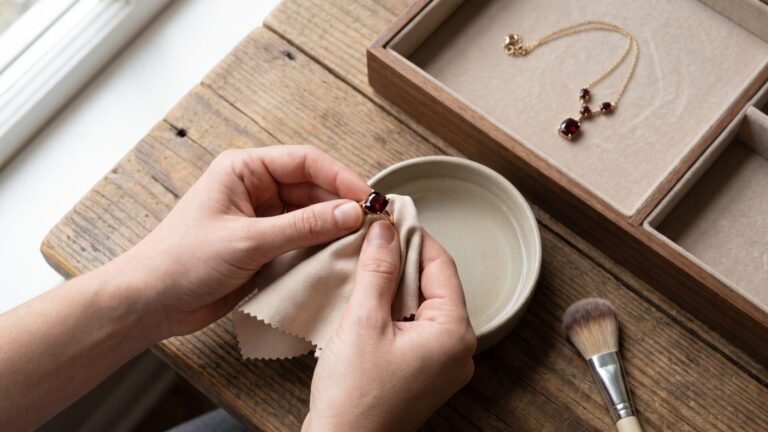
- Clean with warm soapy water and a soft toothbrush
- Store separately from harder gems (diamonds, sapphires, rubies) to prevent scratching
- Remove before heavy exercise or manual labor
- Insure it if it’s valuable enough to miss
DON’T:
- Use ultrasonic or steam cleaners on included, fractured or antique pieces, or on pieces with delicate stones next to the garnet
- Expose to sudden temperature changes
- Soak in harsh chemicals (bleach, acetone, etc.)
- Wear while swimming in chlorinated pools, which can damage the metal and settings
Garnet is the stone of January, but it’s also the stone of constancy. It’s been treasured for thousands of years. With a little care, yours should last for generations.
The Gift of Being Seen
I think about Emilia sometimes—my friend with the January 17th birthday, the one I failed for so many years.
She wore that garnet pendant through hard seasons and happy ones. It’s not her fanciest piece of jewelry; she’s since acquired much more expensive things from much more significant people in her life.
But it’s still the one she reaches for when she needs to feel grounded. It’s still the one she touches, unconsciously, when she’s thinking hard or telling a difficult story.
“It’s not just that it’s pretty,” she told me once. “It’s that you finally saw me. You looked past the generic birthday cards and the last-minute gift certificates and you actually thought about who I am.”
I didn’t tell her that I’d almost messed it up again—that I’d almost bought a ruby, or an amethyst, or any of the other red-adjacent stones I confused with garnet in those days.
Instead, I just said, “You’re welcome.”
And I meant: Thank you for teaching me that the right gift isn’t about the price tag. It’s not about the carat weight or the clarity grade or the provenance of the stone.
It’s about paying attention.
So here’s my challenge to you, whether you’re shopping for a January birthday or any birthday at all: Pay attention.
Notice what they already wear. Notice what they reach for. Notice the colors they’re drawn to, the metals they prefer, the way they move through the world.
Then choose the garnet—or the ruby, or the emerald, or the simple strand of pearls—that reflects that person back to themselves.
That’s not shopping. That’s love.
And that’s a gift they’ll wear forever.
Frequently Asked Questions About Garnet Jewelry Gifts For January Birthdays
Is garnet the birthstone for January?
Yes. Garnet is the January birthstone on both the traditional and modern lists we follow. Birthstone lists vary slightly by country and organization, so it is always worth checking which list the recipient follows.
Is garnet durable enough for an everyday ring?
Garnet is roughly 6.5-7.5 on the Mohs scale and has no cleavage, so it works for daily wear with sensible care. A bezel or low-profile setting protects the stone, and pendants and earrings are the lowest-risk choices for very active wearers.
Do all garnets look red?
No. Garnet comes in red, raspberry pink (rhodolite), orange (spessartine or mandarin garnet), honey (hessonite), and green (tsavorite and demantoid). All of them are garnets.
How much should I spend on a garnet gift?
Common red garnet is very affordable, while rare green and orange varieties cost much more per carat. Sterling silver pieces often start around $50, and gold pieces with quality stones commonly run into the hundreds of dollars. See the budget table above for a rough guide.
Is garnet treated?
Garnet is rarely treated, but you should always ask the seller to confirm, because glass imitations and lab-made look-alikes exist.
How do I clean garnet jewelry?
Use warm soapy water and a soft brush, rinse and dry. Avoid harsh chemicals and sudden temperature changes, and be careful with ultrasonic or steam cleaners on included, fractured or antique stones.
What is the difference between garnet and ruby?
They are different minerals. Ruby is a form of corundum with a hardness of 9, while garnet is about 6.5-7.5 and far more affordable. See our guide to telling garnet and ruby apart.
Ready to find the perfect garnet for your January birthday? Browse the collection below. Always confirm the stone type, any treatments, and the return policy on the seller’s page.
[Shop Garnet Jewelry for January Birthdays]
Explore more: January Birthstone guide · Birthstones by Month · Birthstone Jewelry Guide