Emerald vs Jade: What’s the Difference?
Two Green Gems, Two Very Different Stones
Green stones are timeless, but when it comes to emerald vs jade, even seasoned jewelry lovers can get confused. Both are rich in history and symbolism, yet they differ in mineral type, transparency, durability, price and style. In short: emerald is a transparent, sparkling gem and the traditional May birthstone, while jade is a dense, usually opaque to translucent stone prized for carving, bangles and cultural meaning.
Whether you are choosing a May birthstone ring, a statement bangle or simply a green piece for everyday wear, this guide covers the real differences. For deeper background, see our full emerald guide and our wider Gemstones hub.
Emerald vs Jade at a Glance
| Feature | Emerald | Jade (jadeite / nephrite) |
|---|---|---|
| What it is | Green variety of the mineral beryl | Two different materials: jadeite (a pyroxene) and nephrite (an amphibole) |
| Mohs hardness | 7.5 to 8 | Nephrite about 6 to 6.5; jadeite about 6.5 to 7 |
| Toughness | Brittle because of internal fractures and inclusions | Very tough; nephrite is the tougher of the two |
| Transparency | Transparent to translucent | Translucent to opaque |
| Color | Bright to deep green | Green in many shades; also white, lavender, yellow, orange and more |
| Common treatments | Oiling or resin filling to hide fissures | Jadeite may be bleached and polymer-impregnated (“B jade”) or dyed (“C jade”) |
| Typical jewelry | Rings, pendants, earrings | Bangles, carved pendants, beads, cabochon rings |
| Price level | Moderate to very high, depending on color and clarity | Wide range; fine jadeite is costly, nephrite is generally more affordable |
Takeaway: Emerald is the sparkler: transparent and vivid, but more delicate than its hardness suggests. Jade is the tactile one: smooth, dense and tough, and best known as cabochons, beads and carvings.
Mohs figures describe scratch resistance only. They do not say how a stone reacts to a knock, which is why emerald (harder) is the one that chips more easily. Our gemstone hardness scale guide explains the difference between hardness and toughness.
A Quick History of Emerald
- Ancient roots: Emeralds have been treasured for thousands of years. Historians point to mines in Egypt near the Red Sea as among the earliest known sources, although the exact dating is debated. Cleopatra is famously associated with emeralds in popular history.
- Sources today: Colombia, Zambia and Brazil are leading producers. Colombian stones are especially associated with a rich, saturated green.
- Symbolism: In tradition, emerald stands for growth, rebirth, prosperity and love, and has long been linked with wisdom and foresight. These are cultural associations, not proven properties.
- May birthstone: Emerald is the modern birthstone for May, which makes it a classic choice for birthday gifts and personalized jewelry.
Emeralds are prized for vivid green color and for their natural inclusions, which gemologists call the jardin (French for garden). Read more in the history of emerald in royal jewelry and our emerald meaning guide.
A Quick History of Jade
- Ancient origins: Jade has been worked for thousands of years, notably in China, Mesoamerica and New Zealand, where it served as both ornament and tool material because of its toughness.
- Two materials, one name: The word “jade” covers jadeite and nephrite. Jadeite is rarer and produces the most valuable stones, including intense “imperial” green. Nephrite is more common and was the jade of much of ancient China and of Maori culture.
- Symbolism: In Chinese culture jade is associated with virtue, protection, harmony and longevity. In tradition it is described as a stone of good luck and harmony; those meanings are cultural, not scientific.
- Uses: Beyond jewelry, jade has been carved into ritual objects, sculpture and amulets.
Unlike emerald, jade is usually translucent to opaque with a soft, waxy-to-glassy luster and a smooth, polished feel that suits cabochons, beads, carvings and bangles.
Composition and Durability
Emerald is beryl colored green mainly by chromium (and sometimes vanadium). Almost every natural emerald has fractures and inclusions, so it is more brittle than its 7.5 to 8 hardness suggests. A sharp knock to an emerald ring can chip the stone.
Jade is made of tightly interlocking microscopic crystals, which is why it resists breaking so well. Jadeite sits around 6.5 to 7 on the Mohs scale and nephrite around 6 to 6.5, so both can scratch more easily than emerald, but they are far less likely to chip or shatter. Jade can, however, be scratched by dust and by harder stones, so avoid storing it loose with other jewelry.
Appearance and How to Tell Them Apart
- Emeralds:
- Transparent to translucent with a glassy shine
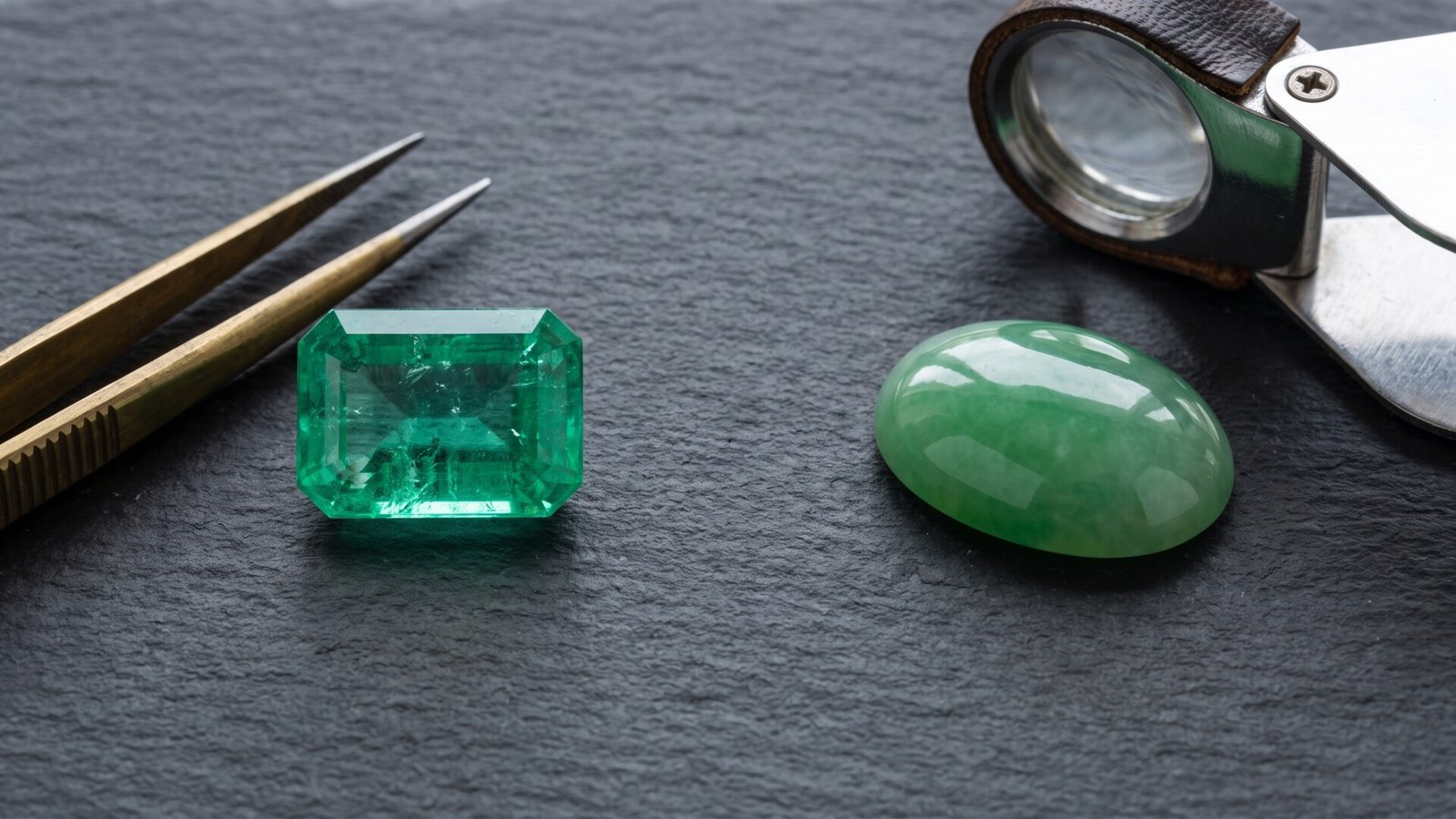
- Typically faceted (often in the rectangular “emerald cut”) to show brilliance
- Visible inclusions (jardin) are normal and are treated as part of the stone’s character
- Jade:
- Smooth surface with a waxy to glassy luster, from opaque to semi-translucent
- Usually cut as cabochons, beads, carvings and bangles instead of faceted gems
- Color is often more even, though banding and mottling are common
Practical tip: If a green stone is faceted and sparkles, it is far more likely to be emerald, peridot, tourmaline or glass than jade. If it is a smooth carved piece or bangle, it is more likely to be jade or a jade look-alike. Green stones are widely imitated, so rely on a laboratory report for anything valuable instead of home tests, and avoid scratching a stone to test it.
Other green stones are often confused with emerald too. Compare them in our guides to peridot vs emerald and emerald vs green tourmaline.
Treatments to Know About
Treatments are common with both stones, and they affect price and care, so ask about them before you buy.
- Emerald oiling: Colorless oils are traditionally used to fill surface-reaching fissures and improve clarity. It is widely accepted but should be disclosed, and the oil can be lost over time.
- Emerald resin filling: Polymers or epoxy resins are also used. They can degrade over the long term and are usually valued lower than lightly oiled stones. Ask for a lab report that states the level of enhancement.
- Jadeite types A, B and C: Type A is natural, untreated jadeite (it may have a light wax finish). Type B is bleached and impregnated with polymer, which can weaken the stone over time. Type C is dyed, and some jade is both. Type A is the most valuable.
- Lab-grown emerald: Lab-grown emeralds have the same chemistry as natural ones and are different from simulants such as green glass. They can be a practical way to get a clean, vivid green at a lower price. See our guide to natural vs lab-grown birthstones.
Symbolism and Spiritual Meaning
Both stones carry deep symbolism, but in different ways. These are traditions and beliefs, not scientific claims, and they are not a substitute for medical advice.
- Emerald: traditionally linked with growth, love, balance, prosperity and intuition
- Jade: traditionally linked with harmony, protection, luck and longevity; in crystal-healing circles some people also associate it with emotional balance
In modern jewelry you will see emeralds in rings, necklaces and earrings, often in birthstone-focused pieces. Jade appears in bracelets, bangles, carvings and statement pendants that blend fashion with tradition.
Uses in Jewelry and Fashion
Emerald
- Rings: Solitaire or halo settings highlight transparency. Because emerald can chip, choose a bezel or protective setting for daily wear. Our guide to whether an emerald engagement ring is practical goes into detail.
- Necklaces & pendants: A lower-risk way to wear emerald daily, and a popular birthstone gift.
- Earrings: Studs and drops show off the color with little exposure to knocks.
Jade
- Bracelets & bangles: Iconic in East Asian jewelry traditions. Jade’s toughness suits these pieces, but a hard knock on a hard surface can still crack a bangle.
- Pendants & necklaces: Often carved into symbolic shapes such as leaves, coins or discs.
- Beads & cabochon rings: Smooth, domed settings suit jade’s look and protect it well.
- Sculptures & home decor: Beyond jewelry, jade is a long-standing decorative art material.
Caring for Emerald and Jade
Both stones need gentle care, but the risks differ.
- Emerald:
- Clean by hand with lukewarm water, mild soap and a soft brush, then pat dry
- Avoid ultrasonic and steam cleaners, which can strip or damage the oil or resin in the fissures
- Keep away from extreme heat and sudden temperature changes, and take rings off for heavy work
- Store separately so harder stones such as diamonds cannot scratch it
- Jade:
- Wipe with a soft damp cloth; mild soap and water is fine for untreated jade
- Avoid acids, bleach, harsh cleaners and ultrasonic cleaning, which can damage treated (B or C) jade or its wax finish
- Keep it away from prolonged strong heat, and store it padded, apart from harder gems
- Dyed jade can fade with long sun exposure, so keep treated pieces out of direct sunlight
Pricing and Accessibility
Both stones span a very wide price range, and quality matters more than the name. These figures come from published retail price guides and change often, so treat them as rough indications and compare current listings.
| Quality level | Natural emerald (1 carat, approx.) | Jade (per carat, approx.) |
|---|---|---|
| Entry / commercial | $500 to $1,200 (pale or yellowish green, heavy inclusions) | Roughly $1 to $15 for dark, brown, grey or red material |
| Mid-grade | $1,200 to $3,500 (medium green, visible inclusions) | Roughly $10 to $300 for many colors; white often $100 to $300 |
| Fine quality | $3,500 to $7,000 (rich, vivid green) | Fine “imperial” green jadeite is the top tier and is usually priced per piece, not by a simple per-carat range; we could not verify a reliable figure, so ask for a lab report and compare actual listings |
| Top gem quality | $7,000 to $10,000 and above | The very best pieces can cost far more than these guide figures |
For context, GIA notes that emerald value can range from a few dollars to tens or even hundreds of thousands of dollars per carat depending on quality. It lists color as the most important price factor (a bluish green to pure green that is vivid, not too dark and evenly distributed), followed by clarity (eye-clean stones are especially rare and valuable), cut, carat weight, origin for exceptional gems, and treatment: untreated stones command more value. GIA also says a laboratory report can confirm whether an emerald has been treated and quantify how much filling material it contains.
Takeaway: Emerald is usually the better value if you want a transparent, sparkling gem and accept some treatment. Jade offers more variety for the money and is easier to find as bangles and carvings, but fine untreated jadeite is a specialist purchase, so insist on a lab report that states whether it is Type A.
Which One Should You Choose?
- For a May birthday gift: emerald is the birthstone, so choose a pendant or earrings for easy everyday wear, or a bezel-set ring for special occasions.
- For everyday durability: jade (especially nephrite) is tougher, so a jade bangle or bead bracelet can be a robust choice, while an emerald ring needs more care.
- For sparkle: choose emerald. Jade is meant to be admired for color, texture and carving, not brilliance.
- For cultural or heritage meaning: jade carries especially deep significance in East Asian traditions.
- For a lower budget: consider lab-grown emerald, or untreated nephrite and good-quality Type A jade in subtler colors.
A Buying Checklist for Emerald and Jade
Because both stones are commonly treated and widely imitated, a few questions will protect you whichever you choose:
- What exactly is it? The listing should say emerald, jadeite or nephrite, and say whether it is natural, lab-grown or a simulant. “Jade” alone does not tell you which material you are getting.
- Is it treated, and how much? For emerald, ask about oil or resin and the level of enhancement. For jadeite, ask whether it is Type A, B or C.
- Is there an independent lab report? For anything of real value, a report from a recognized gem laboratory is worth requesting. Color and treatment are what you are paying for.
- Does the setting suit how you live? A protective bezel or halo matters most for emerald rings. Bangles and beads suit jade, but remove them for heavy work.
- What is the return policy? Reputable sellers let you return a piece that is not as described.
If you are weighing where to shop, our list of online stores for authentic birthstone jewelry is a good starting point, and our Education & Buying Guides cover treatments, certificates and care in more depth.
Other Green Stones Worth Knowing
If neither emerald nor jade feels quite right, several other green gems are worth a look. Peridot offers a lighter, yellow-green color at a lower price (see peridot vs emerald), and green tourmaline is often tougher for rings (see emerald vs green tourmaline). Lab-grown emerald gives you the emerald look and chemistry for less. For the wider picture, browse the Gemstones hub and the Birthstones by Month guide. Our emerald meaning and emerald royal history articles go deeper on tradition, and the emerald engagement ring guide covers ring durability.
Ethical Considerations
- Emeralds: Mining can be labor-intensive and conditions vary. Look for sellers that document sourcing, or consider lab-grown emeralds. See our guides to ethically sourced emeralds and ethical emerald brands.
- Jade: Jade mining, especially in some regions, has been linked to environmental damage and labor concerns. Ask for documentation of origin and treat any “ethical” claim as something the seller should be able to explain.
- Vintage, antique and pre-owned pieces add no new mining. Our ethical gemstones guide explains how to evaluate claims.
Modern Trends
- Mixing stones: Pairing jade and emerald in statement jewelry is a popular look.
- Minimalist pieces: Simple emerald rings and pendants for May birthdays.
- Cultural nods: Jade bracelets and pendants as fashion-meets-tradition accessories.
Fun Facts
- Emerald inclusions are called jardin because they can look like tiny gardens.
- Jade’s toughness made it a material for tools and weapons, not just ornaments, in ancient times.
- “Jade” is a trade name covering two different minerals, jadeite and nephrite.
- Emerald remains the modern May birthstone, often given for birthdays and anniversaries.
Frequently Asked Questions About Emerald Vs Jade
What is the main difference between emerald and jade?
Emerald is a transparent green variety of beryl, usually faceted for sparkle. Jade is a name for two tough, dense materials, jadeite and nephrite, that are usually translucent to opaque and cut as cabochons, beads, bangles or carvings.
Which is harder, emerald or jade?
Emerald is harder on the Mohs scale (7.5 to 8 versus about 6 to 7 for jade), but jade is much tougher. Emerald’s internal fractures make it more likely to chip, while jade resists breaking.
Is jade a birthstone?
Emerald is the modern May birthstone. Jade is not on the main modern lists, although it is valued in many cultures and sometimes appears in regional or alternative lists.
Is emerald more expensive than jade?
It depends on quality. Many emeralds cost from a few hundred to several thousand dollars per carat, while jade ranges from very inexpensive to extremely costly for top-quality untreated jadeite. Compare lab reports, not names.
What are Type A, B and C jade?
Type A is natural, untreated jadeite. Type B has been bleached and impregnated with polymer, and Type C has been dyed. Type A is the most valuable, and treated jade should be disclosed and priced lower.
Are emeralds treated?
Most are. Colorless oils or resins are commonly used to fill fissures and improve clarity. Ask for a lab report that states the level of enhancement, and avoid ultrasonic or steam cleaners.
Can I wear an emerald ring every day?
Many people do, but it needs protection. Choose a bezel or protective setting, remove the ring for heavy work, and have the setting checked regularly. A pendant or earrings are lower risk.
Are lab-grown emeralds real?
Yes, in the sense that they have the same chemistry and crystal structure as natural emeralds. They should be sold as lab-grown, and they usually cost less than comparable natural stones.
Know Your Green
- Emerald: transparent, sparkling, the May birthstone, harder but more brittle, traditionally linked with growth and love
- Jade: translucent to opaque, smooth and tough, culturally rich, traditionally linked with luck and harmony
Whether you want a sparkling birthstone ring or a smooth, symbolic bracelet, knowing the difference helps you choose with confidence. To keep exploring, visit our emerald guide, the Gemstones hub and our Birthstone Jewelry Guide.