June Birthstone: Meaning, Symbolism, and Jewelry Guide
The June Birthstone at a Glance
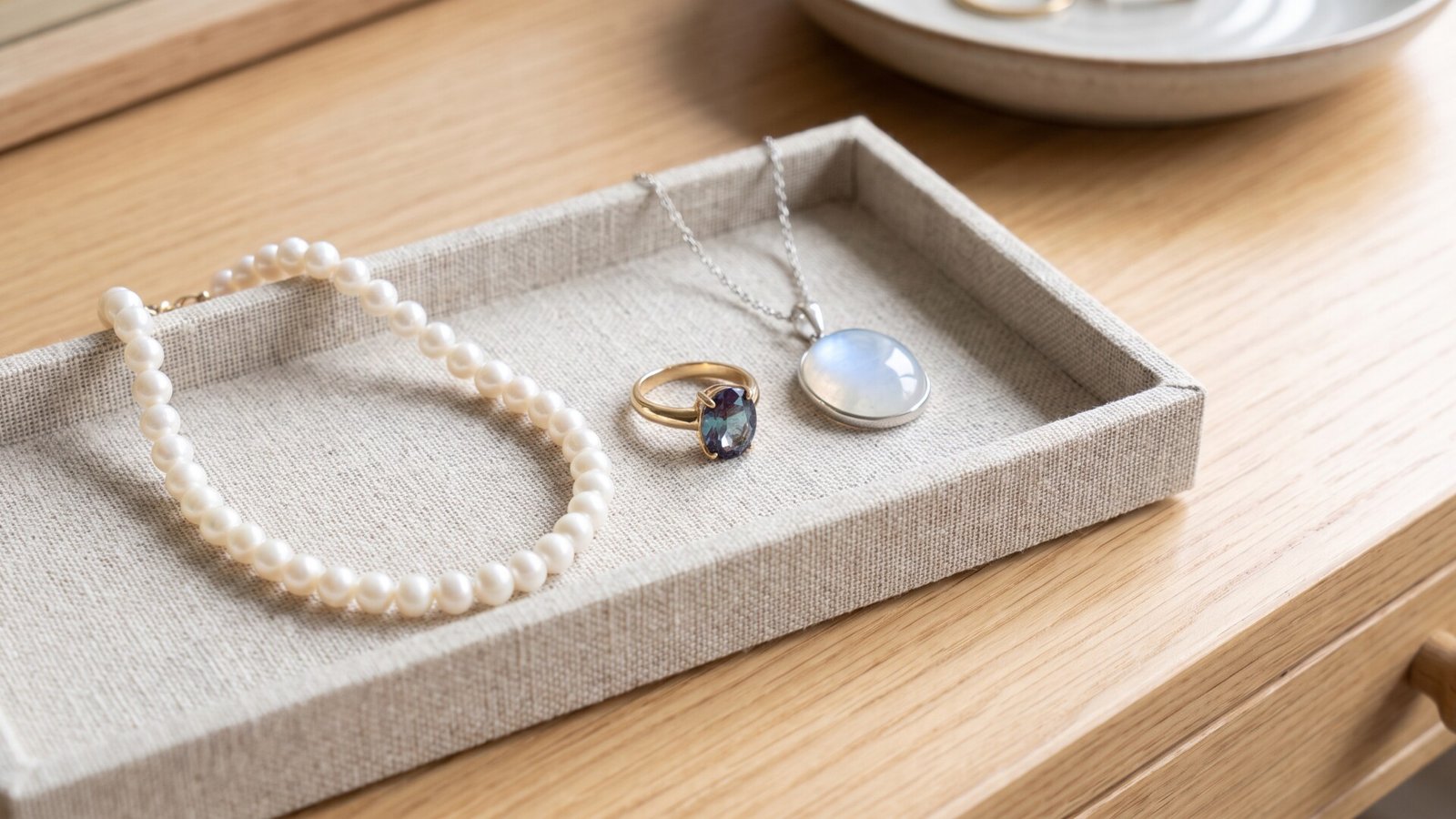
June is the beginning of summer, and it is unusual among the months because it has three recognized birthstones: pearl, alexandrite and moonstone. The Gemological Institute of America (GIA) lists all three as June birthstones. Each has its own look, history and meaning, so June-born people can choose by style, budget or symbolism.
Pearls, with their soft glow, are traditionally associated with purity and calm. Alexandrite, a rare color-changing gem, is associated with transformation and balance. Moonstone, with its drifting shimmer, is linked in folklore with intuition and new beginnings. Those meanings come from tradition and folklore rather than science, and they are a big part of why people choose these stones.
This guide covers the June birthstones, their history, a quick facts comparison, jewelry ideas, how durable each stone is, and care tips. For individual deep dives, see our Pearl guide, Alexandrite guide and Moonstone guide. If you are shopping, our comparison What to Buy for a June Birthday: Pearl vs. Alexandrite vs. Moonstone helps you choose, and the Birthstone Jewelry Guide has ideas by jewelry type.
From pearls to alexandrite, explore all the birthstones in our Birthstones by Month hub.
What Are the June Birthstones?
June is special because it has multiple birthstones. Birthstone lists differ by country and organization, so you may see them presented in different orders:
- Pearl: the classic June birthstone, traditionally associated with purity, harmony and emotional balance.
- Alexandrite: a rare color-changing gem, symbolizing transformation and adaptability.
- Moonstone: celebrated for its soft glow and its folklore of intuition and new beginnings.
Each stone offers a different way to celebrate a June birthday, so you can choose by personal symbolism, aesthetics or budget.
June Birthstones at a Glance: Quick Facts
| Feature | Pearl | Alexandrite | Moonstone |
|---|---|---|---|
| What it is | Organic gem formed inside a mollusk (natural or cultured) | Rare variety of the mineral chrysoberyl | Feldspar-group mineral (orthoclase and albite layers) |
| Signature look | Soft luster; white, cream, black, silver and other colors | Appears green in daylight and purplish red under incandescent light | Billowing blue-white glow called adularescence |
| Approx. Mohs hardness | 2.5–4.5 | 8.5 | About 6–6.5 |
| Durability notes | Soft; sensitive to acids, perfume and abrasion | Hard and tough; good for rings | Cleaves easily and can chip; best in protected settings |
| Best jewelry | Necklaces and earrings; rings with care | Rings, pendants, earrings | Pendants, earrings, bracelets |
| Cost outlook | Wide range; freshwater pearls are budget-friendly | Natural stones are very expensive; lab-created are far cheaper | Generally affordable; check for glass imitations |
| Typical symbolism | Purity, calm | Transformation, balance | Intuition, new beginnings |
Hardness figures are approximate. For more on how to read these numbers, see our explainer on the Mohs hardness scale.
Why These Stones Represent June
Traditionally, each of the three stones is linked to an idea that fits the start of summer: clarity, change and intuition.
Pearl: Purity and Harmony
Pearls have been cherished for thousands of years for their soft, luminous appearance. Traditionally they symbolize purity, emotional balance and calm, echoing the serenity of early summer. For more, read our pearl meaning guide.
Alexandrite: Transformation and Balance
Alexandrite changes color depending on the light, often described as “emerald by day, ruby by night.” Because of that change it has become a symbol of adaptability and personal growth, which suits June’s transitional feel.
Moonstone: Intuition and Renewal
Moonstone has long been associated in folklore with the moon, intuition and new beginnings. Its soft glow reflects the mystical feel of June evenings.
Historical and Cultural Significance
Pearls
Pearls were revered in ancient civilizations from Egypt to Rome as symbols of wealth, purity and status, and they were worn by royalty and used in ceremonial jewelry. Until cultured pearls were developed, natural pearls were extremely rare and costly. Today most pearls on the market are cultured, which means a person implants a bead or tissue and the mollusk builds the pearl around it.
Alexandrite
Alexandrite was discovered in Russia’s Ural region in the 19th century and became popular for its striking color change. Historically it was regarded as a stone of luck, change and good fortune. Its rarity means that many alexandrites on the market today are lab-created, which is fine as long as they are sold as such.
Moonstone
Moonstone has been prized in many cultures, from India to Rome, and is linked in legend with lunar energy, guidance and protection. Gemologically, its glow comes from light scattering between thin alternating feldspar layers.
For a deeper dive into June’s cultural legacy, visit our Birthstone Meanings & Symbolism hub.
Meaning and Symbolism of the June Birthstones
Each June stone carries its own traditional meanings:
- Pearl: Purity, harmony, balance, emotional calm
- Alexandrite: Transformation, adaptability, personal growth, luck
- Moonstone: Intuition, new beginnings, reflection, spiritual guidance
These meanings come from cultural tradition and folklore, not scientific evidence, and they should not be taken as health or medical claims. Together they reflect June’s themes of light, potential and early summer growth.
June Birthstone Jewelry Ideas
The variety of June stones makes jewelry choices flexible and meaningful. Browse our Birthstone Jewelry Guide for more by jewelry type.
Pearl Jewelry
- Necklaces: Classic strands, chokers or single-pearl pendants
- Earrings: Studs, drops or clusters
- Bracelets: Elegant, timeless strands
Pearls suit formal or sentimental pieces. Because they are soft, necklaces and earrings are safer choices than daily-wear rings.
Alexandrite Jewelry
- Rings: Show off the color change, and alexandrite is hard enough for daily wear
- Necklaces: Pendants that catch changing light
- Earrings: Good for highlighting color variations
Natural alexandrite is rare and expensive, especially in larger sizes, while lab-created alexandrite offers a similar color change at a much lower price. Ask the seller to state clearly whether the stone is natural or lab-created.
Moonstone Jewelry
- Pendants and necklaces: The soft glow looks best in simple settings
- Rings and earrings: Work well in bohemian or nature-inspired designs; protect ring stones with a bezel
- Bracelets: Layered or stacked for everyday wear, with care
Moonstone is affordable and widely available. Be aware that some “moonstone” sold online is glass or other imitation, so buy from sellers who describe the material clearly.
How to Choose Between Pearl, Alexandrite and Moonstone
- For a classic, elegant gift: Choose pearl earrings or a pendant.
- For a bold, milestone gift: Consider alexandrite, ideally lab-created if the budget is limited.
- For a dreamy, everyday look: Choose moonstone, and keep it in a protective setting.
- For daily-wear rings: Alexandrite is the most durable of the three. Pearl and moonstone are better in pendants and earrings.
- On a budget: Freshwater pearls and moonstone are usually the most affordable.
Still undecided? Our comparison, what to buy for a June birthday, walks through the trade-offs in more detail.
How to Care for June Birthstone Jewelry
The three June stones are all sensitive in different ways, so a single cleaning routine does not suit them all. When in doubt, a soft cloth, lukewarm water and a drop of mild soap is the cautious default.
- Pearl: Organic and easily damaged by acids, perfume, hairspray and sweat. Put pearls on last and wipe them with a soft damp cloth afterwards. Avoid ultrasonic and steam cleaners, and store them separately so harder stones do not scratch the surface.
- Alexandrite: Clean with warm soapy water and a soft brush. Natural stones can contain fractures, so check with a jeweler before using an ultrasonic cleaner, and avoid steam.
- Moonstone: Moonstone has cleavage, which means a hard knock can cause it to split or chip. Avoid knocks, steam, ultrasonic cleaners and sudden temperature changes, and take rings off for heavy work.
Our guide to the gemstone hardness scale explains why hardness alone does not tell you how well a stone survives daily wear.
Why June Has Three Birthstones
Pearl was the original June stone in older birthstone traditions. Alexandrite and moonstone were added to modern lists later, giving June-born people more choice. Because lists are maintained by different organizations and differ between countries, you may see slightly different line-ups. In this guide we follow the three-stone list that GIA publishes for June; check the list that applies where you live if you need an “official” answer for a gift or a ring engraving.
Pearl Types and What to Look For
Pearl is the most varied of the three stones, and the type you choose affects both price and appearance. Most pearls sold today are cultured, meaning a person starts the process and the mollusk builds the pearl.
- Freshwater pearls: Grown in mussels in lakes and rivers, available in many shapes and colors and typically the most budget-friendly.
- Akoya pearls: Saltwater cultured pearls known for their round shape and bright luster, associated with classic white strands.
- Tahitian pearls: Saltwater pearls with naturally dark colors, from gray to near-black, often with green or purple overtones.
- South Sea pearls: Larger saltwater pearls in white and golden tones, generally at the higher end of pearl pricing.
When comparing strands or studs, look at luster (a bright, mirror-like surface is better than a chalky one), surface quality, shape, size and color. Pearls can be dyed or bleached, so ask the seller to disclose treatments. For a fuller profile, see our Pearl guide.
Alexandrite: Natural, Lab-Created and Look-Alikes
Alexandrite is the June stone most often misunderstood by shoppers. Real alexandrite is a variety of chrysoberyl, and the best natural stones show a clear shift between greenish and reddish-purple tones. Because natural gem-quality stones are scarce, most affordable alexandrite is lab-created. Two points are worth knowing:
- Lab-created alexandrite can have the same chemistry as the natural gem (chrysoberyl), but it should be sold as lab-created.
- Color-change simulants such as synthetic corundum or other manufactured materials are sometimes sold under the “alexandrite” name. These are different materials that imitate the effect. A seller who cannot say what the material is should be treated with caution.
For a stone of any real value, ask for a report from an independent gemological laboratory. More background is in our Alexandrite guide.
Moonstone Varieties and Imitations
The classic moonstone has a milky body with a blue-white shimmer that moves as the stone is turned. You may also see “rainbow moonstone,” which is usually a different feldspar (labradorite-type material) with a white body and multicolored flashes. It is attractive and often sold as moonstone in the trade, but the terms are used loosely, so ask the seller what the stone is if it matters to you. Glass and other imitations are also sold, often with an unusually perfect glow. See the Moonstone guide for tips on what to check.
June Birthday Gift Ideas by Recipient
- For a first birthstone piece: Freshwater pearl studs or a small moonstone pendant are easy to wear and gentle on the budget.
- For a milestone birthday: A lab-created alexandrite pendant or ring, or a strand of cultured pearls, marks the occasion.
- For someone who prefers minimal jewelry: A single pearl on a fine chain or a small cabochon moonstone in sterling silver.
- For a child or teen: Choose secure settings and avoid small loose stones for very young children. Pearl and moonstone are better kept for special occasions than for rough play.
If you are comparing options, the article What to Buy for a June Birthday covers the trade-offs, and the Birthstone Jewelry Guide has ideas by jewelry type.
June Zodiac Signs and Their Stones
June straddles two zodiac signs: Gemini (roughly May 21 to June 20) and Cancer (roughly June 21 to July 22). Zodiac stone lists vary between sources and are a matter of tradition rather than science, so treat them as a fun guide and not a rule. You can read more in our Gemini birthstone and Cancer birthstone guides.
Because Cancer dates run into early July, some readers also like to look at the July birthstone.
Fun Facts About June Birthstones
- Pearl is one of the few gems made by a living creature. It is organic, which is why it is so soft and sensitive compared with minerals.
- Alexandrite shows a color change, typically greenish in daylight and reddish under incandescent light, because of how it absorbs light.
- Moonstone shows adularescence, a soft, floating glow that appears to move as the stone is turned. It comes from thin alternating layers inside the feldspar crystal.
- Alexandrite was named after a Russian ruler and was first associated with the Ural Mountains, though most of today’s alexandrite on the market is lab-created.
Meanings attached to these stones, such as calm, transformation or intuition, come from folklore and cultural tradition. They are not medical advice, and none of these stones is proven to affect health or wellbeing. For more on this, see our birthstone meanings and symbolism guide and our pearl meaning article.
Explore All the Birthstones by Month
Browse every month in our Birthstones by Month hub, or jump straight to a month: January, February, March, April, May, July, August, September, October, November, December.
June Birthstone FAQs
What is the June birthstone?
June has three recognized birthstones: pearl, alexandrite and moonstone. Pearl is the traditional choice, while alexandrite and moonstone are widely listed alternatives.
Which June birthstone is the most durable?
Alexandrite is the hardest and most durable of the three, at about 8.5 on the Mohs scale. Pearl and moonstone are softer and more easily damaged, so they suit pendants and earrings better than everyday rings.
Is alexandrite very expensive?
Fine natural alexandrite is rare and can be very costly. Lab-created alexandrite shows a similar color change at a much lower price, but it should be sold as lab-created.
Are pearls safe to wear every day?
Pearls can be worn often if you care for them well. Put them on after perfume and hairspray, wipe them after wear and store them away from harder jewelry.
What zodiac signs fall in June?
Gemini (to about June 20) and Cancer (from about June 21). Zodiac stone lists vary by source and are based on tradition.
Can I buy a June birthstone as a gift on a budget?
Yes. Freshwater pearls, moonstone and lab-created alexandrite are usually the most affordable ways to give a June birthstone.
Final Thoughts
June gives you three distinct stones: a soft, classic pearl, a rare color-changing alexandrite and a gentle, glowing moonstone. Choose by the style you love, how often the piece will be worn and the care you are happy to give it. Whichever you pick, buy from a seller who states clearly whether the stone is natural, cultured or lab-created, and treat the meanings as part of the story rather than as proven effects.