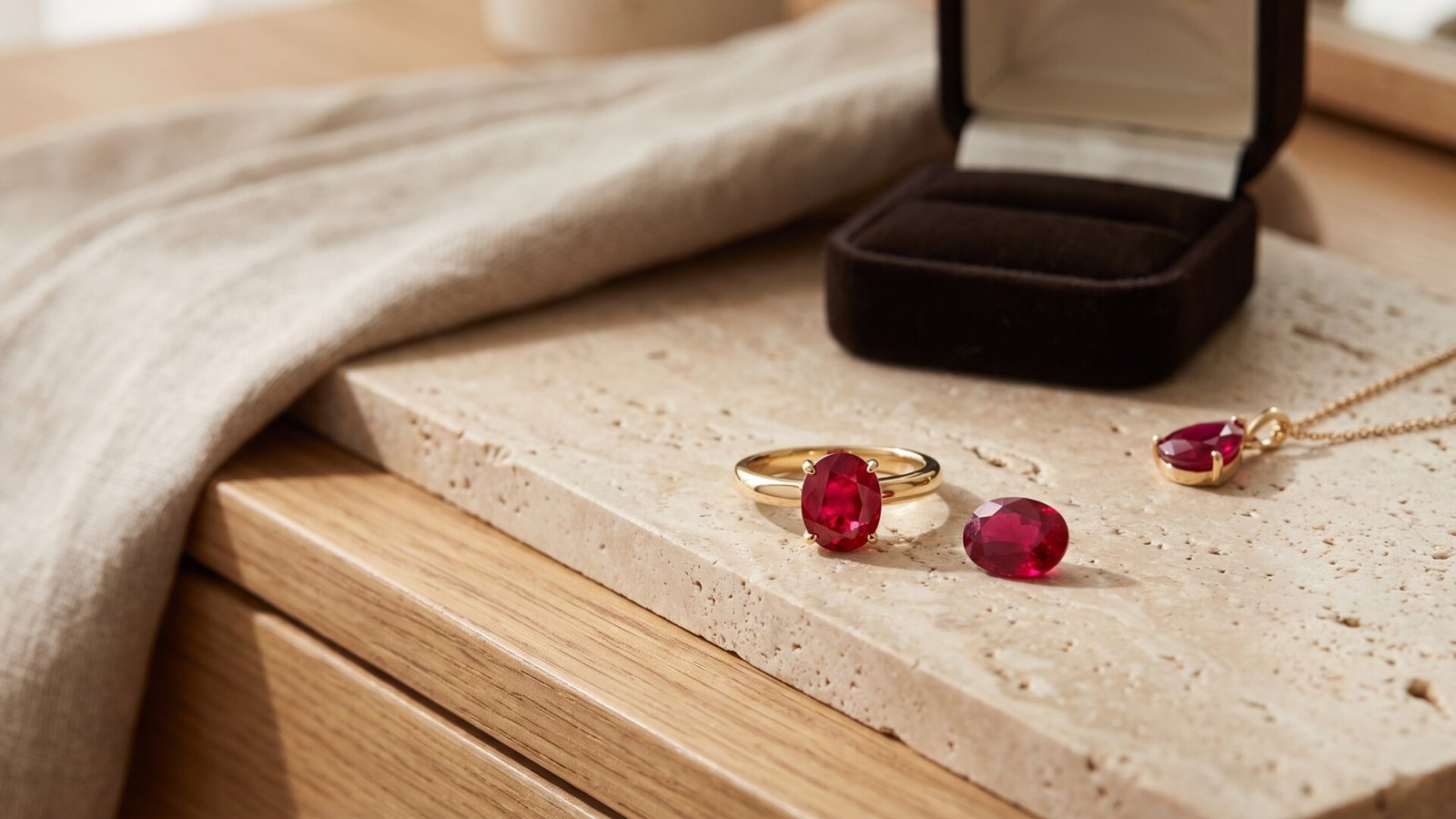
July Birthstone: Meaning, Symbolism, and Jewelry Guide
The July Birthstone at a Glance
July is the heart of summer, and its birthstone is ruby, the red variety of the mineral corundum. Ruby is the one July birthstone you will see on virtually every modern list, and it has been associated with passion, courage and protection in many cultures for centuries.
This guide covers what makes ruby the July stone, the history behind it, a quick facts table, how to buy and care for ruby jewelry, honest alternatives, and the traditions and beliefs attached to the stone. Where something is gemology, history or folklore, we say which, so you can enjoy the stories without mistaking them for science. For a deeper dive into the stone itself, read our ruby gemstone guide and ruby meaning guide.
July sits inside our Birthstones by Month hub, where you can compare every month side by side. If you are new to the idea, What Are Birthstones? explains where the tradition comes from, and our Birthstone Meanings & Symbolism hub collects the symbolism of every stone.
July Birthstone Quick Facts
| Feature | Ruby (July birthstone) |
|---|---|
| What it is | The red variety of the mineral corundum; the other gem variety of corundum is sapphire |
| Color and cause | Red, from trace amounts of chromium; more chromium generally means stronger red |
| Mohs hardness | 9, second only to diamond in GIA’s description |
| Toughness | Good, but stones with fractures or filled cavities are more fragile than clean ones |
| Common treatments | Heat treatment is very common; some stones are fracture-filled with lead glass or have color diffused into the surface |
| Main sources | Myanmar (Mogok), Mozambique, Vietnam and several other countries |
| Lab-created? | Yes. Lab-created ruby is chemically the same as natural ruby and should be sold as lab-created |
| Best jewelry | Rings, pendants, earrings and bracelets; among the more durable colored stones for daily wear |
| Anniversary | Traditionally given for the 15th and 40th wedding anniversaries |
| Traditional meaning | Passion, courage, protection and devotion (tradition and folklore, not science) |
Hardness figures are approximate and measure scratch resistance only. To see why that is not the same as toughness, read our gemstone hardness scale explainer.
What Is the July Birthstone?
The primary birthstone for July is ruby. Birthstone lists differ by country and organization, but ruby is the stone that appears on the standard modern lists, and GIA lists it as the July birthstone.
Other red gemstones are sometimes suggested as stand-ins when a ruby is out of budget, notably red spinel and red garnet. These are different minerals with their own properties, not alternative names for ruby. We compare them honestly later in this guide, and you can see the differences side by side in our garnet vs ruby comparison.
Ruby is valued for three things in tradition:
- Passion and vitality, linked to its blood-red color and the heat of summer
- Courage and strength, a theme in many historical accounts of the stone
- Love and devotion, which is why ruby is a popular romantic and anniversary gift
Why Ruby Is the Birthstone for July
The link between ruby and July is a matter of tradition, not a scientific rule. Early birthstone lists drew on older associations between gems, months and zodiac signs, and ruby’s fiery color made it a natural match for the hottest month of the year in the northern hemisphere. For the full story of how the modern lists came about, see our guide to the history of birthstones.
Symbol of Passion and Vitality
Ruby’s vivid red color mirrors July’s warmth and intensity. Across cultures it has been associated with life force and energy, which is a cultural idea rather than a measurable effect, but one that explains why people still choose it for milestone birthdays.
Strength and Courage
Ancient and medieval accounts describe ruby as a stone of protection and bravery. Some traditions held that it could shield its wearer from danger. These are historical beliefs, and today the courage theme is best read as symbolism.
Love and Commitment
Ruby is widely treated as a stone of devotion. It has a long record in romantic jewelry and is the traditional gem for the 15th and 40th wedding anniversaries. Our guides to the ruby anniversary year and the 40th anniversary ruby cover those gifts in detail.
Historical and Cultural Significance
Ruby has been treasured for a very long time, and several traditions are well documented:
- In ancient India, ruby was called the “king of precious stones” and was associated with power, protection and good fortune. Read more in The Symbolism of Ruby in Ancient India.
- In medieval Europe, ruby was linked with health, wealth and royal status, according to GIA’s summary of the stone’s history.
- In Southeast Asia, especially Myanmar (Burma), ruby has long been a prized gem, and the Mogok region is among the most famous ruby sources.
One gemological footnote adds to the history: some large red stones in historic crown jewelry, once called rubies, were later identified as red spinel. Before modern gem testing, the two were easily confused, which is one reason spinel has its own following today.
Where July’s Ruby Comes From
According to GIA, the Mogok area of Myanmar has produced fine rubies for more than five centuries. Vietnam (including the Luc Yen and Quy Chau regions) became a major source in the late twentieth century, and Mozambique’s Montepuez mines are an important newer source. Rubies also come from Thailand, Cambodia, Afghanistan, Tajikistan, Pakistan, Sri Lanka, Kenya, Tanzania and Madagascar. Because fine rubies now come from so many places, a stone’s origin should always be documented by a lab report rather than assumed from the seller’s description.
A Record-Setting Example: The Sunrise Ruby
To see how far ruby prices can climb, consider the Sunrise Ruby, a 25.59-carat Burmese “pigeon’s blood” ruby set by Cartier between two diamonds. It sold at Sotheby’s in Geneva in May 2015 for roughly $30 million, a record for any ruby at auction at the time. Stones like this are museum-level rarities and say nothing about what a birthstone ring costs, but they show why color, size and documented origin matter so much.
Ruby vs. Sapphire: Same Mineral, Different Names
Ruby and sapphire are both corundum, so they share the same hardness and similar durability. The difference is color: red corundum is ruby, and corundum in every other color, including blue, pink, yellow and green, is sapphire. The line between a pink sapphire and a ruby is a matter of judgment at the trade level, which is why some borderline stones are labeled differently by different labs. If you love ruby’s durability but want a different color, the September birthstone guide covers blue sapphire, and our ruby vs sapphire comparison shows the two side by side.
Meaning and Symbolism of the July Birthstone
The meanings below come from cultural tradition and folklore. They are not scientific facts and not medical advice, and no gemstone has been shown to treat or prevent any condition.
Passion and Energy
Ruby is traditionally described as the “fire” gem, a symbol of confidence, courage and determination.
Love and Loyalty
In jewelry traditions, ruby stands for enduring love, devotion and emotional depth. That makes it a meaningful gift for birthdays, anniversaries and romantic milestones.
Protection and Vitality
Traditionally, ruby was thought to protect its wearer and to carry vitality. Today many people simply enjoy wearing it as a personal talisman, with the understanding that this is belief, not science.
Explore more of these traditions in our Birthstone Meanings & Symbolism hub and the birthstone personality traits by month article.
Ruby Quality: What Affects Value
Ruby is graded and priced on a handful of factors. According to GIA, color matters most: the finest rubies are a strong, pure red to slightly purplish red, neither too dark nor too light. The trade term “pigeon’s blood” refers to the most prized red, and it is a color description, not a guarantee of origin or quality.
- Color: saturation and the exact shade of red are the biggest drivers of price.
- Clarity: some inclusions are normal in ruby. Visible inclusions that reduce brightness or transparency lower value.
- Cut: ruby crystals are often flat, so cutters balance color and weight retention, and well-cut stones can look better than their weight suggests.
- Carat weight: fine rubies over one carat are rare, and price per carat rises steeply with size.
- Treatment: untreated stones with a lab report command the highest prices. Heated stones are the market norm. Glass-filled or diffused stones are worth much less.
- Origin: Burmese rubies with independent lab documentation of origin can command a premium, but origin does not by itself guarantee quality, and fine rubies now come from several countries.
For a closer look at how color is judged, see our pigeon blood rubies vs royal blue sapphires comparison, and for treatment detection basics read how to tell if a ruby is heat treated or natural.
How Much Does a Ruby Cost?
Ruby prices vary enormously, so a range is more honest than a single figure. One specialist dealer’s education guide gives indicative natural ruby prices of roughly $500–$5,000 per carat for stones of 0.5–1 carat, $2,000–$10,000 or more per carat for 1–2 carat stones, and higher again above two carats, with untreated, high-quality stones at the top. Treated and included stones sit well below those ranges. Treat these as ballparks, since actual prices depend on color, clarity, treatment, origin and the seller.
Finished jewelry is priced differently from loose stones, because the metal, setting and brand all matter. For a wider look at where ruby sits among other gems, see our ranking of the most expensive birthstones by price per carat and the high-end ruby jewelry guide.
Natural, Lab-Created and Treated Ruby
These three terms are often confused, so it helps to keep them apart:
- Natural ruby formed in the earth. Most natural rubies on the market have been heated, and GIA advises assuming yours is unless a lab report says otherwise.
- Lab-created ruby is real ruby in chemical and structural terms, simply grown in a laboratory. It is not a fake, but it should always be sold as lab-created, and it is usually far less expensive than a comparable natural stone.
- Simulants such as red glass or red spinel sold as “ruby” only imitate the look. A seller who calls a simulant “ruby” is misdescribing it.
Our guide to natural vs lab-grown birthstones goes through the trade-offs, and ethical gemstones covers sourcing questions. Be cautious with claims like “conflict-free” or “ethically sourced” unless the seller names a specific standard or certification.
July Birthstone Jewelry Ideas
Ruby’s durability makes it one of the most versatile birthstones for jewelry. You can browse more by piece in our Birthstone Jewelry Guide.
Rings
Ruby rings are popular for birthdays, anniversaries and engagements. At 9 on the Mohs scale, ruby resists scratching well, and it is one of the better colored stones for everyday rings. Still, a stone with fractures or glass filling needs more care than a clean one, so ask whether the ruby is treated. A bezel or halo setting adds protection from knocks.
Necklaces and Pendants
A ruby pendant is a low-risk way to wear the stone daily, since it is less exposed to impact than a ring. It pairs well with yellow gold, white gold or platinum.
Earrings
Ruby studs and drops show off the color without much exposure to wear. They are a good choice for a first ruby piece or for a gift when you do not know the recipient’s ring size.
Bracelets
Ruby bracelets are often combined with diamonds or other stones. Because bracelets take frequent knocks, look for protective settings and avoid fragile stringing or open prongs on everyday pieces.
For gift ideas by relationship, see our birthstone jewelry gift ideas by relationship, and for children, our children’s birthstone gifts and best birthstone gifts for kids by month. Small jewelry can be a choking hazard for young children, so choose age-appropriate designs.
How to Buy Ruby Jewelry With Confidence
Ruby is a stone where the details on the label matter as much as the look. Before you buy, work through this checklist:
- Ask what the stone is. The listing should say natural ruby, lab-created ruby, or name the actual material if it is a different gem.
- Ask about treatment. In the United States, the FTC expects disclosure of treatments that affect a gem’s value. Heated is normal and acceptable when disclosed. Glass-filled, fracture-filled or diffused stones should be priced and described accordingly.
- Ask for a lab report on higher-value stones. A report from a recognized gemological laboratory can document identity, treatment and, on request, origin. Do not assume origin such as “Burmese” without documentation.
- Judge color in different light. Ruby can look different under daylight, warm indoor light and LED light, so view it in more than one setting if you can.
- Check the setting. Look for secure prongs or a bezel, especially on rings, and ask about the metal.
- Read the return policy. A fair return window lets you confirm the stone matches its description.
If you are shopping for a gift on a budget, a smaller well-colored ruby or a lab-created ruby often looks better in person than a larger, paler or heavily included natural stone at the same price. Our roundup of online stores for authentic birthstone jewelry is a starting point for comparing retailers.
Choosing a Setting and Metal for Ruby
Red pairs well with most metals, and the choice is mostly about style and practicality. Yellow gold gives ruby a warm, classic look, while white gold and platinum make the red stand out more sharply. Rose gold leans romantic and works especially well with deeper, slightly purplish rubies.
- Bezel settings surround the stone with metal and are the most protective choice for everyday rings.
- Halo settings ring the ruby with small diamonds or other stones, adding sparkle and some edge protection.
- Prong settings show more of the stone but leave edges more exposed, so they suit pendants and earrings better than active-hand rings.
- Three-stone and stacked designs let you pair ruby with a partner’s or child’s birthstone; see how to build a family stack ring for ideas.
Whatever the style, have prongs checked by a jeweler once a year for rings you wear daily. A loose prong is a common reason stones are lost.
Alternatives to Ruby: Spinel, Garnet and Others
Not everyone needs, or can afford, a natural ruby. These alternatives are honest options, each with trade-offs:
- Lab-created ruby: the same material as natural ruby at a lower price. Ask for it to be labeled clearly.
- Red spinel: a different mineral that can be a vivid red, and it was historically mistaken for ruby. It is a good stone in its own right, but it should not be sold as ruby.
- Red garnet: widely available and affordable, but softer than ruby. See garnet vs ruby and our garnet guide.
- Pink or red tourmaline: a colorful, affordable option; compare it in pink tourmaline vs ruby and ruby vs garnet vs tourmaline.
Zodiac Connections
July spans two zodiac signs, and zodiac stone lists vary between sources, so treat these as tradition and a fun guide rather than a rule:
- Cancer (about June 21 – July 22): ruby is sometimes linked with loyalty and emotional strength in zodiac lists. See our Cancer birthstone guide.
- Leo (about July 23 – August 22): ruby is often paired with Leo’s associations of confidence and leadership. See our Leo birthstone guide.
If you are unsure whether to follow the monthly or the zodiac stone, read zodiac birthstones vs monthly birthstones or browse the full zodiac birthstones hub.
Caring for July Birthstone Jewelry
Ruby is hard, but hardness is not the same as toughness, and its care depends on whether it has been treated.
Cleaning:
- For untreated or heat-treated ruby, warm water, mild soap and a soft brush are generally safe. GIA notes that ultrasonic and steam cleaners are usually safe for untreated, heat-treated and lattice diffusion-treated rubies, but if the setting has other gems or you are unsure of the treatment, hand cleaning is the cautious default.
- For fracture-filled, glass-filled or dyed ruby, GIA advises wiping with a damp cloth only. Avoid soaking, ultrasonic cleaners, steam and harsh chemicals, because they can damage the filling.
- If you do not know whether your ruby is treated, take the cautious route and ask a jeweler before using any machine cleaner.
Storage and wear:
- Store ruby jewelry separately in a padded box or soft pouch. Ruby can scratch softer stones, and diamond can scratch ruby.
- Remove rings before heavy lifting, gym work or gardening to avoid knocks.
- Put jewelry on after hairspray and perfume.
For more, see our birthstone education and buying guides hub and the tips in how to cleanse and charge your birthstones, which covers traditional cleansing practices alongside practical care.
Fun Facts About the July Birthstone
- The word “ruby” comes from the Latin ruber, meaning red.
- Ruby and sapphire are the same mineral, corundum. Every gem-quality corundum that is not red is called sapphire.
- Ruby’s red comes from trace chromium.
- In ancient India, ruby was called the “king of precious stones.”
- Large red stones in some historic crown jewelry later turned out to be spinel, not ruby.
- Ruby is the traditional stone for both the 15th and 40th wedding anniversaries.
For more on the science and the history, see the science behind gemstone colors and our wider gemstone library.
More Birthstone Months
July sits between June and August in the calendar. Read the neighboring guides: June birthstone and August birthstone. Or jump to any other month: January, February, March, April, May, September, October, November, December.
Return to the full Birthstones by Month hub, or explore the Birthstone Jewelry Guide for pieces by type.
July Birthstone FAQs
What is the July birthstone?
The July birthstone is ruby, the red variety of the mineral corundum. It is the stone listed for July on the standard modern birthstone lists.
What does the July birthstone symbolize?
In tradition, ruby symbolizes passion, courage, protection and devotion. These meanings come from folklore and cultural history, not from science.
Is ruby durable enough for an everyday ring?
Ruby is 9 on the Mohs scale, so it resists scratches well and is a good choice for rings. Stones with fractures or glass filling need more care, so ask about treatment and consider a protective setting.
How much does a ruby cost?
Prices vary widely. As a rough guide, natural rubies of 0.5 to 1 carat are often priced from about $500 to $5,000 per carat, and fine larger stones cost much more. Treated and heavily included stones cost less.
Is lab-created ruby real ruby?
Yes, in chemical and structural terms, lab-created ruby is the same material as natural ruby. It should be sold as lab-created and is usually much cheaper than a comparable natural stone.
Are most rubies treated?
Heat treatment is very common, and GIA advises assuming a ruby is heated unless a lab report says otherwise. Fracture-filled and diffused rubies are worth less, and they need gentler cleaning.
What is a good alternative to ruby?
Lab-created ruby, red spinel, red garnet and tourmaline are common alternatives. Each is a different material with different durability and price, so ask the seller exactly what the stone is.
What zodiac signs fall in July?
Cancer (about June 21 to July 22) and Leo (about July 23 to August 22). Zodiac stone lists vary by source and are based on tradition.
Final Thoughts
Ruby gives July a stone with real substance: hard enough for daily wear, rich in history, and deeply tied to ideas of love and courage. Choose a ruby by its color first, ask whether it is heated, filled or lab-created, and buy from a seller who is clear about all three. Treat the meanings as part of the story rather than as proven effects, and ruby will be a lasting way to celebrate a July birthday.
To keep exploring, read the August birthstone guide or return to the Birthstones by Month hub for the rest of the year.