Custom Birthstone Initial Charms: The 2026 “Everyday Luxe” Trend
Many people own a few beautiful pieces of jewelry that rarely leave the box. Birthstone initial charms are designed for the opposite habit: small, personal pieces meant to be worn daily.
Initial pendants and birthstone charms are popular because they carry two personal details in one small piece: a letter (a name, a child, a partner) and a stone tied to a birth month. Retailers and trend writers often group this style under labels such as “everyday luxe.” That label is marketing language, not a measured statistic, and this guide treats it that way.
The idea behind “everyday luxe” is simple: fine jewelry is something to wear today, not save for someday. Custom birthstone initial charms fit that idea well, as long as you choose the stone and metal with daily wear in mind.
Personalized jewelry (initials, engraving, birthstones, zodiac motifs) has been a steady category for years, and many jewelers expect it to stay popular in 2026. We could not verify a precise growth statistic, so we do not quote one. What retailer catalogs do show is that layering and small, meaningful pendants are everywhere.
This guide covers what the trend means, which birthstones actually hold up in a daily-wear charm, how metals differ (plated, vermeil, sterling, solid gold), how to pick the right combination for yourself or a loved one, and seven popular design styles with notes on where to shop. For the wider picture, see our Birthstone Jewelry Guide.
Because the best jewelry isn’t locked in a box. It’s around your neck.
What Is the “Everyday Luxe” Jewelry Trend?
Let’s start with a definition, because “everyday luxe” has become something of a buzzword.
In jewelry commentary, “everyday luxe” usually points to minimal, delicate designs that can be personalized, layered, and worn daily: engravable pendants, small charms, initials, birthstones, and zodiac motifs. It describes a styling direction, not a regulated category, so quality still depends on the metal, the stone, and the construction.
But what does that actually mean for you?
High-quality jewelry designed for daily wear
Everyday luxe rejects the idea that fine jewelry is only for galas and anniversaries. Instead, it embraces pieces that are:
- Delicate enough to wear with a t‑shirt.
- Durable enough to survive coffee runs and keyboard typing.
- Meaningful enough to feel special every single time you put them on.
Why personalized charms became so popular
Many shoppers want jewelry that carries meaning: a subtle engraving, a symbolic charm, or a birthstone tucked into a design. That personal detail is what turns a simple pendant into something individual, and it is the main reason initial-plus-birthstone designs stay popular.
Social media and celebrity styling have helped popularize charm necklaces and layered chains, which is part of why so many retailers now offer initial and birthstone charms.
Why initial + birthstone combinations work so well
A monogram is beautiful, but it only tells one part of your story. An initial charm tells people who you are (your name or initial). A birthstone points to the month you (or someone you love) were born, and many people also attach traditional meanings to it. Together, they create a layered, deeply personal piece that looks custom without feeling overly flashy.
Why Custom Birthstone Initial Charms Are Trending in 2026
Here are the practical reasons this style keeps showing up in jewelry catalogs and gift guides.
1. The minimalist luxury movement
Many current designs favor understated looks: bezel settings, satin or polished finishes, and small accent diamonds. For many buyers that means choosing fewer, better-made pieces they will wear for years.
Birthstone initial charms suit this approach: small enough to layer and meaningful enough to wear often. They are keepsakes, not financial investments; the resale value of fashion and personalized jewelry is typically well below what you paid.
2. Layered necklace styling
Layering is still a dominant styling approach, with the current emphasis on a few chosen pieces that complement each other rather than a pile of unrelated chains.
A typical layered look might combine a choker with your initial, a mid‑length chain with a birthstone, and a longer chain with a diamond charm. The result is depth, dimension, and a completely unique personal style.
3. The emotional gifting trend
Birthstone jewelry is no longer only for birthdays. Common reasons to buy include anniversaries, children’s birthstones, couples and family pieces (for example a mother’s necklace with one stone per child), graduations, milestones, memorial pieces, new parents, and “just because” gifts.
An initial charm necklace is the perfect “just because” gift — it doesn’t need an occasion to be appreciated.
4. Gender‑neutral appeal
Initial charms and birthstones are worn by people of all genders. For a more masculine or neutral look, choose a heavier chain (2–3 mm), a larger plain initial, and deeper stones such as garnet or sapphire; mixing metals is an easy way to make a piece feel less delicate.
Birthstones by Month: Modern U.S. List and Traditional Meanings
This chart follows the modern U.S. birthstone list as published by Jewelers of America (alexandrite, citrine, tourmaline, tanzanite and spinel were added to older lists over the years). Other countries and organizations publish different lists, and most months also have traditional stones. The meanings below are cultural and traditional associations, not scientific properties and not medical advice. Click a month to read its full guide.
| Month | Birthstone | Traditional meaning | Popular Color |
|---|---|---|---|
| January | Garnet | Protection, strength, loyalty | Deep red |
| February | Amethyst | Calm, clarity, spiritual awareness | Purple |
| March | Aquamarine | Serenity, courage, clear communication | Light blue |
| April | Diamond | Strength, resilience, eternal love | Clear / white |
| May | Emerald | Growth, renewal, success, rebirth | Green |
| June | Pearl / Moonstone / Alexandrite | Intuition, purity, new beginnings | White / iridescent |
| July | Ruby | Passion, vitality, courage, love | Red |
| August | Peridot / Spinel | Happiness, energy, positivity | Lime green |
| September | Sapphire | Loyalty, wisdom, truth, focus | Blue |
| October | Opal / Tourmaline | Creativity, hope, artistic expression | Multi‑color |
| November | Citrine / Topaz | Joy, abundance, prosperity, warmth | Yellow / golden |
| December | Tanzanite / Turquoise / Zircon | Protection, peace, good fortune | Blue‑violet |
Pro tip: Some months offer multiple options. June has pearl, moonstone, or alexandrite. October offers opal or tourmaline. Choose the stone that best reflects your personality, or the personality of the person you’re gifting, and check the durability notes below before you commit.
Which Birthstones Work Best in a Daily-Wear Charm?
Hardness on the Mohs scale measures scratch resistance only. It does not measure toughness, which is resistance to chipping and breaking. Diamond is a 10 on the Mohs scale, yet it has cleavage directions and can chip with a sharp knock. Emerald is 7.5 to 8, yet its internal fractures make it fragile. Pendants and charms generally take less impact than rings, so some softer stones that are poor choices for a daily ring can work in a necklace, provided they sit in a protective setting (a bezel is safer than prongs) and come off for swimming, showering, workouts and sleep.
| Month | Stone(s) | Mohs hardness | Daily-wear charm notes |
|---|---|---|---|
| January | Garnet | 6.5–7.5 | Good choice. No cleavage and usually untreated. |
| February | Amethyst | 7 | Good choice. Prolonged strong sunlight or heat can fade some stones. |
| March | Aquamarine | 7.5–8 | Good choice. Color is often heat-treated; a hard knock can still chip it. |
| April | Diamond | 10 | Very scratch resistant but can chip along cleavage planes. Lab-grown diamond has the same chemistry as natural. |
| May | Emerald | 7.5–8 | Brittle because of natural fractures. Clarity enhancement with oil or resin is routine. Best in pendants with a bezel; no ultrasonic or steam cleaning. |
| June | Pearl, moonstone, alexandrite | Pearl 2.5–4.5; moonstone 6–6.5; alexandrite 8.5 | Pearl is soft and reacts to perfume, sweat and acids. Moonstone has cleavage. Alexandrite is durable, but most affordable alexandrite is lab-created. |
| July | Ruby | 9 | Very durable. Heat treatment is standard; lower-priced rubies may be glass-filled, which needs disclosure and gentler care. |
| August | Peridot, spinel | Peridot 6.5–7; spinel 8 | Peridot is brittle and sensitive to acids, so it suits pendants better than rings. Spinel is a tough, durable alternative. |
| September | Sapphire | 9 | Very durable. Heat treatment is common and generally stable. |
| October | Opal, tourmaline | Opal 5.5–6.5; tourmaline 7–7.5 | Opal contains water and can crack with heat or dryness; check whether it is solid opal or a doublet or triplet. Tourmaline is a good daily choice. |
| November | Topaz, citrine | Topaz 8; citrine 7 | Topaz has perfect cleavage and most blue topaz is irradiated and heated. Much citrine is heat-treated amethyst. |
| December | Tanzanite, turquoise, zircon | Tanzanite 6.5–7; turquoise 5–6; zircon 6.5–7.5 | Tanzanite has cleavage and is heat-treated. Turquoise is porous and often stabilized with resin. Natural zircon is brittle and is not cubic zirconia. |
Easiest stones for everyday charms: garnet, amethyst, aquamarine, sapphire, ruby, tourmaline and spinel. Stones that need more care: emerald, peridot, topaz, tanzanite, zircon, moonstone, opal, pearl and turquoise. Mohs figures are typical ranges; individual stones vary with inclusions and treatment.
Treatments, lab-grown stones and simulants
Common treatments include heat treatment (ruby, sapphire, aquamarine, tanzanite, and amethyst turned into citrine), oil or resin filling (emerald), irradiation plus heat (most blue topaz), stabilization with resin (turquoise) and glass filling (lower-grade ruby). Treatments affect price, durability and cleaning rules, and a seller should disclose them.
A lab-grown (also called lab-created) stone has the same chemistry and crystal structure as its natural counterpart; a lab-grown sapphire is real sapphire. A simulant only imitates the look of another stone: cubic zirconia, glass and “crystal” are common examples, and moissanite is its own mineral (silicon carbide) often used as a diamond simulant. Many affordable birthstone charms use lab-created or simulated stones, which is fine when it is clearly disclosed. In the United States the FTC Jewelry Guides call for lab-grown stones to be identified as such.
A note on meaning: associations such as protection, calm or good fortune come from tradition and folklore. They are beliefs, not gemological properties, and nothing in this guide is medical advice.
How to Choose the Perfect Initial Charm Necklace
Before you browse designs, make a few key decisions. This will save you time and ensure the final piece feels made for you.
Step 1: Choose the initial
- Your own initial — A declaration of self‑love and identity.
- Your child’s initial — A daily reminder of the little person who changed everything.
- Your partner’s initial — Romantic, subtle, and deeply personal.
- Multiple initials — For parents of multiple children, or for couples who want to intertwine their stories.
Step 2: Select the birthstone
- Your own birth month — Celebrate yourself.
- Your child’s birthstone — The most popular choice for mother’s jewelry.
- A symbolic stone — Choose a stone for its meaning, regardless of month.
- The birthstone of a loved one — Carry them with you always.
Step 3: Pick a metal
- Yellow gold — Timeless, classic, warm. Complements citrine, garnet, and ruby.
- White gold — Sleek, modern, cool. Makes aquamarine and sapphire pop.
- Rose gold — Feminine, romantic, trendy. Pairs beautifully with morganite and pink tourmaline.
- Platinum — Premium durability, heirloom quality. Neutral color works with all stones.
Plated, vermeil, filled, sterling and solid gold: what the labels mean
- Solid gold: gold alloyed through the whole piece. 14k is 58.3% gold and 18k is 75%; the rest is other metals such as copper, silver, zinc, nickel or palladium.
- Gold-filled: a layer of karat gold mechanically bonded to a base-metal core. Under U.S. rules the gold layer must be at least 1/20 of the item’s weight, which is much thicker than plating.
- Vermeil: in the U.S., a sterling silver base with a gold layer of at least 10 karat and 2.5 microns thick.
- Gold-plated: a very thin gold layer over base metal or silver. It wears through with friction, sweat and water, and the thickness is often not stated.
- Sterling silver: 92.5% silver, usually with copper. It tarnishes but is easy to polish.
- Platinum: usually 95% pure in jewelry, dense and typically nickel-free, at a higher price.
Nickel and sensitive skin: some white gold alloys contain nickel, a common cause of contact skin reactions, and “hypoallergenic” is not a regulated promise. If you react to jewelry, look for nickel-free or palladium white gold, platinum, yellow gold, or sterling silver, and ask the seller to confirm the alloy in writing. Talk to a doctor about persistent reactions.
Step 4: Choose your necklace style
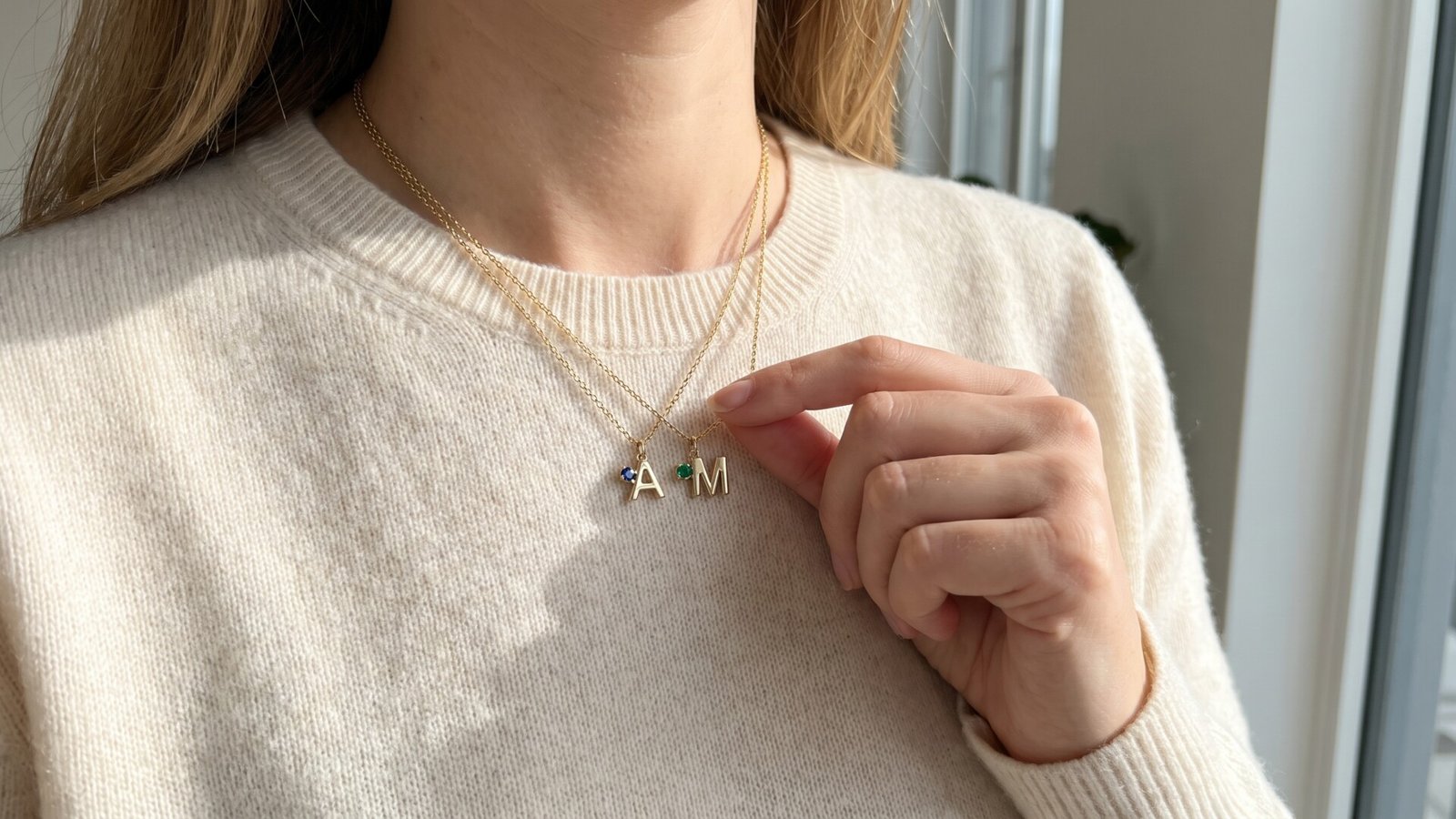
- Minimal solitaire charms — A single small charm with your initial and stone. Best for delicate layering.
- Layered charms — Two or three charms on one chain, or a set of separate chains worn together.
- Diamond accent designs — Adds subtle sparkle and elevates the piece to luxury status.
- Floating birthstone styles — The gemstone appears to float beside or below the initial charm.
Where to Shop for Initial and Birthstone Charms
Rather than one product list, here is how the main types of sellers differ. Catalogs and prices change often, so check each retailer’s current listings and read the stone and metal details before you buy. Our guide to online stores for authentic birthstone jewelry compares retailers in more depth.
- Mejuri: a fine-jewelry brand that lists birthstone pieces in gold, including a birthstone sphere pendant at the time of our research.
- James Avery: a charm specialist whose catalog includes birthstone charms, some set with lab-created stones.
- Pandora: best known for charm bracelets and sells letter and birthstone-colored charms. Check each product page to see whether the stone is a genuine gemstone, lab-created or crystal.
- Brilliant Earth: a fine-jewelry retailer known for diamonds and gemstones that publishes its own sourcing and recycled-metal statements. Birthstone pendant availability varies.
- Blue Nile and James Allen: best known for diamonds and engagement jewelry (both are now part of Signet Jewelers). Check their catalogs for pendants and charms.
- Kay and Zales: mall-based jewelers with birthstone and initial pendants at accessible prices.
- Etsy makers: hand-stamped and made-to-order pieces. Read reviews, ask which stone and metal are used, and confirm return rules for engraved items.
About ethical claims: terms such as “ethically sourced” or “conflict-free” only mean something when tied to a named standard, such as the Kimberley Process for rough diamonds (which has known limits) or Responsible Jewellery Council certification. Look for the retailer’s own cited standard rather than the slogan.
7 Birthstone Initial Charm Styles Worth Considering in 2026
These seven style types cover most of what shoppers look for. Each is a design category rather than a specific product, so use the notes under each one as a checklist when you compare current listings.
1. Minimal Initial Disc Necklace
Why people choose it: The initial disc is the ultimate understated luxury piece — a small gold disc (10–12mm) with a single initial stamped or engraved on the front, and a birthstone set flush on the back or beside the letter. It’s thin enough to stack with other necklaces but substantial enough to wear alone.
Best for: Minimalist everyday wear, first‑time personalized jewelry buyers.
What to look for: a disc of about 10–12 mm in 14k gold or sterling silver, with the initial engraved and the stone set flush. Ask whether the stone is natural, lab-created or a simulant, and whether the metal is solid or plated.
Illustrative price range (varies widely by metal, stone and retailer): $250–900
[Available at Blue Nile (custom engraving + stone selection).]
2. Diamond Accent Initial Charm Necklace
Luxury appeal: This design takes the initial charm and elevates it with a small diamond set next to the birthstone or encircling the initial in a micro‑halo. The diamonds add sparkle without overwhelming the delicate aesthetic.
Best for: Premium gifting, milestone birthdays, or when you want a piece that feels truly special.
What to look for: a faceted birthstone with a single small diamond accent in 14k white or yellow gold. Ask for the diamond’s approximate carat weight and whether it is natural or lab-grown.
Illustrative price range (varies widely by metal, stone and retailer): $700–2,500
[Available at James Allen (360° viewing + customization).]
3. Floating Birthstone Initial Necklace
Why people choose it: The floating design — where the birthstone appears to hover just below the initial charm on a thin, almost invisible bar — is a popular modern look. It’s clean, modern, and architectural.
Best for: Younger luxury buyers, fashion‑forward professionals, anyone who loves minimalist design.
What to look for: a faceted birthstone suspended below a polished initial charm. Minimal metal around the stone looks light, but it leaves the stone more exposed, so this style suits tougher stones such as sapphire, garnet or spinel better than emerald or opal.
Illustrative price range (varies widely by metal, stone and retailer): $500–1,800
[Available at Brilliant Earth (ethically sourced stones + recycled gold).]
4. Multi‑Initial Family Necklace
Why moms love it: A single necklace that holds 2–4 small charms, each with a different initial and birthstone. It’s a wearable family tree — perfect for mothers, grandmothers, or anyone with multiple children.
Best for: Mother’s Day gifts, push presents, blended families.
What to look for: a delicate chain with 2–4 charms, each engraved with an initial and set with the matching birthstone, ideally arranged in birth order. Choose an expandable design if you may add charms later, and see our mother’s birthstone necklace guide for more ideas.
Illustrative price range (varies widely by metal, stone and retailer): $800–3,500
[Available at Blue Nile (expandable for future children).]
5. Layered Charm Necklace Set
Why it’s popular: Instead of buying one necklace, you buy two or three chains of different lengths designed to be worn together. One chain might hold an initial charm, another a birthstone, and a third a simple diamond or zodiac symbol.
Best for: Fashion‑forward styling, gift sets, anyone who loves a curated, “expensive” look.
What to look for: two or three chains (for example 16, 18 and 20 inches). Some sets connect the chains at a single clasp, which can reduce tangling; ask before you buy.
Illustrative price range (varies widely by metal, stone and retailer): $900–4,000
[Available at James Allen (mix‑and‑match chain styles + stones).]
6. Zodiac + Initial + Birthstone Necklace
Symbolic styling trend: For the astrology lover, this design combines your zodiac constellation or symbol with your initial and birthstone. It’s the ultimate expression of identity — who you are (initial), when you were born (birthstone), and the stars that guided you (zodiac).
Best for: Gen Z and Millennial buyers, astrology enthusiasts, as a “soulmate” gift.
What to look for: a small zodiac symbol, an engraved initial and a faceted birthstone on one delicate chain. Zodiac associations are astrological tradition, and zodiac stone lists vary by source, so choose the stone you like rather than one “assigned” list.
Illustrative price range (varies widely by metal, stone and retailer): $600–2,200
[Available at Brilliant Earth (customizable with any zodiac sign + birth month).]
7. Heirloom Diamond Birthstone Charm Necklace
Heirloom appeal: This is the anchor piece — a higher‑carat gold chain, a larger initial charm, and a genuine diamond (or several diamonds) accenting the birthstone. It’s designed to be passed down to the next generation.
Best for: Milestone birthdays (30th, 40th, 50th), anniversaries, or when you want a piece intended to be kept and handed down. It is a keepsake, not a financial investment.
What to look for: a solid 14k or 18k gold charm, a faceted birthstone and a small round diamond beside it, on a sturdier chain (about 2–3 mm). Ask for stone and metal details in writing.
Illustrative price range (varies widely by metal, stone and retailer): $1,500–7,500
[Available at Blue Nile (certified stones + premium metals).]
Comparison Table: Best Birthstone Initial Charm Styles
| Style | Best For | Illustrative Price Range (USD) | Aesthetic | Retailer to Check |
|---|---|---|---|---|
| Minimal Disc Necklace | Everyday wear | $250–900 | Minimalist, delicate | Blue Nile |
| Diamond Accent Charm | Luxury styling | $700–2,500 | Elegant, sparkly | James Allen |
| Floating Charm Necklace | Modern fashion | $500–1,800 | Clean, architectural | Brilliant Earth |
| Multi‑Initial Necklace | Moms & families | $800–3,500 | Sentimental, layered | Blue Nile |
| Layered Charm Set | Trendy styling | $900–4,000 | Fashion‑forward | James Allen |
| Zodiac Charm Necklace | Astrology lovers | $600–2,200 | Symbolic, unique | Brilliant Earth |
| Heirloom Diamond Charm | Milestone gifting | $1,500–7,500 | Premium, heirloom | Blue Nile |
Price ranges are rough illustrations of what personalized birthstone pendants can cost across metals and stone types, not quotes from any retailer. Check current prices before buying.
How to Style Initial Charm Necklaces
Everyday casual styling
- Wear a single initial charm with a t‑shirt and jeans for a polished, put‑together look.
- Pair a birthstone initial charm with a simple sweater — the stone adds a subtle pop of color.
Layering tips
- The best stacks use intentional chain lengths: 16‑inch, 18‑inch, and 20‑inch chains worn together.
- Mixing metal colors and textures can add interest; repeat one metal at least twice so the look feels deliberate.
- Start with a choker (shortest chain), add a mid‑length charm, and finish with a longer chain for depth.
Mixing charms
- Mix an initial charm with a zodiac symbol, a birthstone, and a small diamond or locket.
- Limit yourself to 3–5 charms to avoid visual clutter.
Minimal vs. maximal styling
- For a minimalist look, wear one thin chain with a single charm.
- For a curated maximalist look, layer 3–5 chains of varying lengths and textures.
Best Gift Occasions for Birthstone Initial Charms
Mother’s Day: A multi‑initial necklace with each child’s initial and birthstone is a popular, personal gift: one stone per child, or her own birthstone.
Push presents: A floating birthstone initial necklace with the baby’s birthstone is a beautiful way to mark the arrival of a new family member.
Graduation gifts: An initial charm necklace with the graduate’s initial and birthstone is a sophisticated, “adult” gift that will be worn for years.
Birthday jewelry: A hand-stamped initial tag paired with a genuine birthstone (her birth month, a child’s, or a grandchild’s) is a simple, wearable birthday gift.
Bridesmaid gifts: Matching initial and birthstone charms for each bridesmaid create a cohesive, personal, and wearable keepsake.
Friendship jewelry: A set of matching “best friend” initial charms — each with your own initial and birthstone — is a modern take on the classic friendship necklace.
Anniversary gifts: An heirloom diamond birthstone charm with both of your initials is a romantic, lasting symbol of your relationship.
Gifts for children (safety note): small charms, stones and clasps are a choking hazard for babies and young children, and chains can be a strangulation risk. Choose pieces made for the child’s age, avoid loose stones, and do not let infants wear necklaces unsupervised or while sleeping. For babies, a charm for the parent to wear is often the safer choice. See our graduation birthstone jewelry guide and best friend birthstone guide for older recipients.
Common Mistakes to Avoid
Overcrowding necklaces with too many charms
A single chain can handle 3–5 small charms, but anything beyond that looks cluttered. For more than 5 charms, choose a charm bracelet instead of a necklace.
Choosing low‑quality chains
A beautiful pendant on a flimsy chain is a disaster waiting to happen. Look for chains that are at least 1mm thick, with secure lobster or spring‑ring clasps.
Mixing clashing stone colors
A rainbow of birthstones can look chaotic. If you’re wearing multiple stones, choose a color palette — all cool tones (sapphire, aquamarine, amethyst) or all warm tones (garnet, citrine, ruby).
Buying trendy pieces without timeless appeal
A neon leather cord might be fashionable today, but a solid gold charm necklace is built to last. Prioritize classic metals and simple silhouettes.
Ignoring chain length and layering proportions
The best stacks use intentional chain lengths. Aim for a 2‑inch difference between each chain (16, 18, 20 inches). Avoid stacking chains of the same length — they’ll tangle and clump.
Caring for Birthstone Charm Jewelry
Cleaning
- Hard stones (sapphire, ruby, moissanite, diamond): Warm soapy water and a soft brush are the safe default. Ultrasonic cleaners are often fine for untreated or heat-treated stones, but not for fracture-filled or glass-filled ruby, sapphire or diamond, or for stones with cleavage. If unsure, ask your jeweler.
- Softer stones (opal, pearl, moonstone): Damp cloth only. No ultrasonics, no steam, no soaking.
- Treated or cleavage-prone stones (emerald, tanzanite, topaz, peridot, turquoise): Lukewarm water, mild soap and a soft brush only. Skip ultrasonic and steam cleaners, which can loosen fillings or crack stones.
Storage
Store each necklace separately to avoid tangling and scratching. Use original boxes or a compartmentalized jewelry case with soft lining. Avoid hanging multiple necklaces on a single hook — chains can knot and break.
Maintenance
Have clasps and gemstone settings inspected annually by a jeweler, especially for daily‑wear pieces. Soft stones may need professional cleaning — but never ultrasonic or steam.
Extra care for softer stones
Opal (October), pearl (June), and moonstone (June) are more delicate than sapphire or diamond. Choose protective bezel settings instead of prongs, and remove necklaces before swimming, showering, or applying lotions and perfumes.
Frequently Asked Questions About Birthstone Initial Charms
What are birthstone initial charms?
Small pendants that combine an engraved initial (or name) with a birthstone, which may be natural, lab-created or a simulant. They can be worn alone or layered with other charms.
Why are personalized charm necklaces trending in 2026?
Layering, personalization and small meaningful pendants are popular styling directions, and initial pendants let wearers carry a personal detail every day. Here, “trending” reflects retailer and styling commentary, not a measured statistic.
Which metal is best for everyday luxury jewelry?
Solid 14k or 18k gold is a strong everyday choice, but it is not automatically hypoallergenic: some white gold alloys contain nickel. Platinum (typically 95% pure) is dense and usually nickel-free but costs more. Sterling silver (92.5% silver) is affordable but tarnishes. Gold-plated and vermeil pieces can wear through over time.
Can you add more charms later?
Yes — if you choose an expandable design. A charm necklace with removable bails or open links allows you to add new charms for future children, anniversaries, or milestones.
Are layered charm necklaces still in style?
Yes. Layering is still widely used, with the current emphasis on a few well-chosen chains rather than many.
What birthstones are most durable for daily wear?
Sapphire and ruby (Mohs 9), spinel (8), garnet, amethyst, aquamarine and tourmaline are good everyday choices, and moissanite (about 9.25) and diamond (10) are very scratch resistant. Mohs hardness is not toughness: diamond can chip and emerald is brittle. Opal, pearl and moonstone are softer and need protective settings and gentle wear.
What is the best necklace length for layering?
A 16‑inch chain (choker), an 18‑inch chain (mid‑length), and a 20‑inch chain (long) create the most balanced, tangle‑free layered look.
Are birthstone charms safe for babies and young children?
Small charms, stones and clasps are a choking hazard for babies and young children, and chains can be a strangulation risk. Choose age-appropriate jewelry, avoid loose stones, and do not let infants wear necklaces unsupervised or while sleeping.
Is a lab-created birthstone real?
A lab-created (lab-grown) stone has the same chemistry and crystal structure as its natural counterpart, so lab-grown sapphire is real sapphire. A simulant such as cubic zirconia or glass only imitates the look of a gem. Sellers should say which one you are buying.
What is the difference between gold plated, vermeil and solid gold?
Solid gold is gold alloy all the way through. Gold-plated pieces have a very thin gold layer over base metal. In the U.S., vermeil means a gold layer of at least 10 karat and 2.5 microns over sterling silver. Gold-filled pieces have a thicker bonded gold layer of at least 1/20 of the item weight.
Which birthstones should I avoid for a daily-wear charm?
None are off limits in a pendant, but emerald, opal, pearl, moonstone, tanzanite, topaz, peridot and turquoise need protective settings and extra care because of softness, cleavage, porosity or treatments. Remove them before swimming, showering, exercise and sleep.
Do birthstones have healing powers?
No scientific evidence shows that gemstones treat or prevent any condition. Meanings such as protection or calm are traditions and folklore, and jewelry is not a substitute for medical care.
Final Thoughts
A birthstone initial charm is easy to wear and easy to personalize: your own initial, your child’s birthstone, or a stone chosen for its meaning.
“Everyday luxe” comes down to choosing pieces you will actually wear: a stone that suits daily wear, a metal your skin tolerates, and a design you will still like in five years.
Birthstone initial charms combine personalization and sentiment in one small pendant. They are designed to be worn, so durability and care matter as much as design.
Whichever style you choose, compare current catalogs, ask for stone and metal disclosure in writing, and check return rules before buying an engraved piece, since engraved items are often final sale.
Now go wear your story.
Related guides
- Birthstone Jewelry Guide: rings, necklaces, earrings and more.
- Top online stores for authentic birthstone jewelry
- The best friend birthstone guide
- Raw and uncut birthstone cuffs
- Graduation birthstone jewelry
Ready to find your perfect initial charm? Browse our curated collections below.
[Shop Birthstone Initial Charms at Blue Nile][Shop Custom Charm Necklaces at James Allen][Shop Ethical Birthstone Jewelry at Brilliant Earth]
[Explore More 2026 Jewelry Trends]