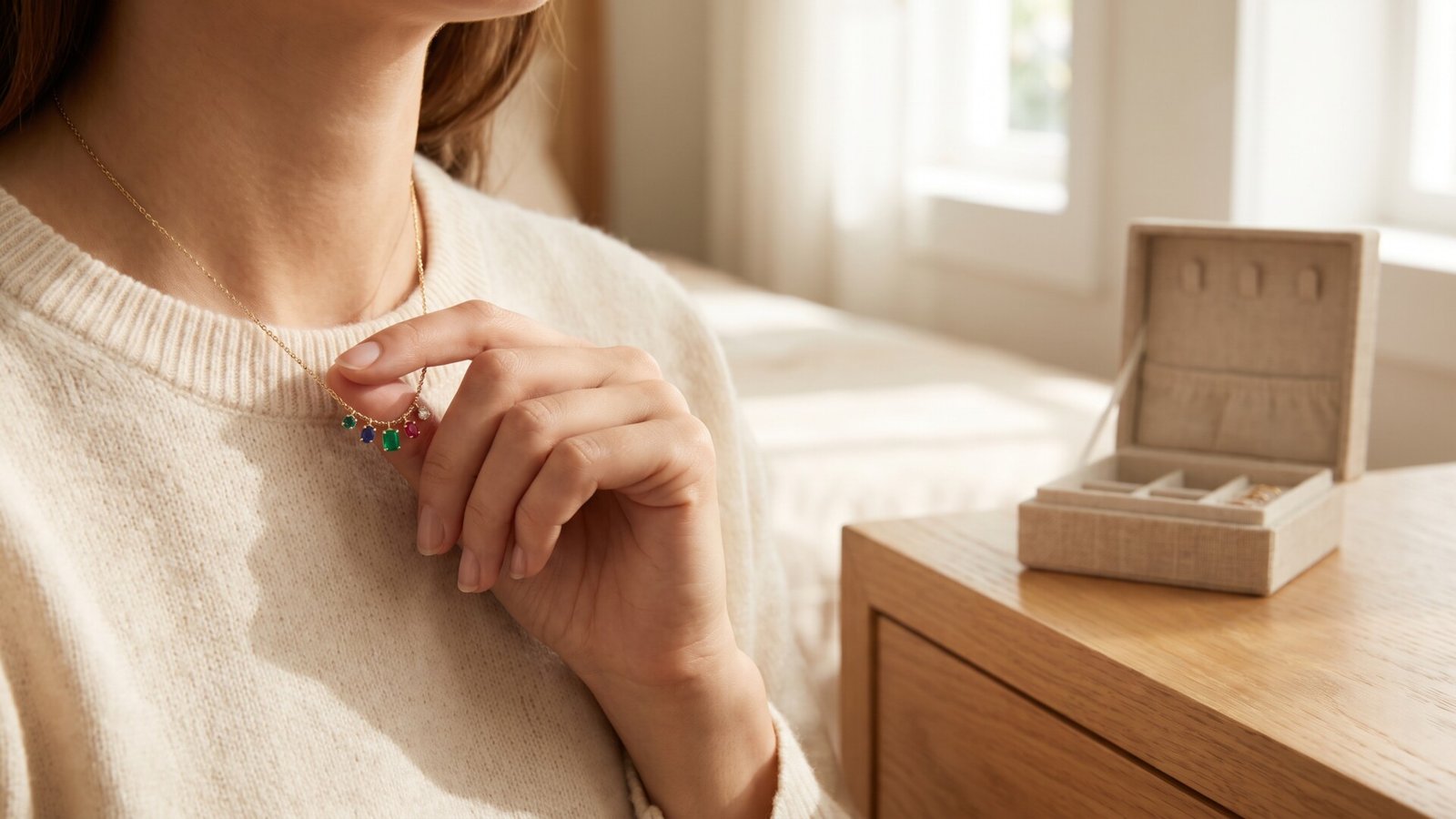
Mother’s Birthstone Necklaces: Top 7 Personalized Designs for 2026
A mother’s birthstone necklace turns a family into a piece of jewelry: one stone for each child, grandchild, or loved one, set on a pendant, bar, or chain she can wear every day. It is a popular gift for Mother’s Day, milestone birthdays, and the arrival of a new baby.
Choosing one takes more than picking a style. You need to know which birthstone list you are using, which stones can handle daily wear, how long the chain should be, and whether the metal suits sensitive skin. This guide covers those decisions first, then seven popular designs.
One safety note up front: if the mother you are shopping for has an infant or toddler, babies grab, pull, and chew on pendants, and a loose stone is a choking risk. See the baby-safety section below before you choose a style.
The American Gem Society’s April 2026 Mother’s Day roundup, built on interviews with jewelers who are also mothers, quoted one jeweler saying clients are “gravitating toward pieces with meaning; birthstones, engravings, or symbolic designs.” Another jeweler in the same piece said the trend is less about personalization and more about a signature look that suits her daily life. That is a useful test for any necklace below: it should be personal and wearable.
The appeal is simple: each stone stands for a specific person, so the necklace feels personal without needing a long inscription.
This guide explains why these necklaces are so popular, how to choose stones and settings that last, and seven popular designs for 2026, from minimalist bars to diamond-accent pieces. If you are comparing multi-stone designs specifically, see our Best Birthstone Necklaces for Moms: Top 7 Multi-Stone Designs; for general sizing and style advice, read How to Choose the Perfect Birthstone Necklace.
Start with the birthstone list and durability table, then pick a style.
Why Mother’s Birthstone Necklaces Are So Popular
The American Gem Society’s Mother’s Day 2026 piece (published April 23, 2026) collected views from jewelers who are also mothers. One said clients are drawn to birthstones, engravings, and symbolic designs, and recommended subtle gemstone accents she can wear every single day. These are individual jewelers’ observations, not a market survey, but they match what most birthstone necklaces are built for.
Emotional meaning. Each stone represents a child, a grandchild, or a loved one. It’s a family portrait you can wear — subtle enough for a work meeting, meaningful enough for a lifetime. Whether you’re representing a single child or building a “family of five” pendant, the idea is the same: one stone per person.
Personalized luxury trend. Customized jewelry feels more thoughtful than generic gifts. When you choose specific stones and engrave specific names, you’re saying, “I know your family. I know your story. I put thought into this.”
Everyday wearability. Unlike a cocktail ring that sits in a drawer, a birthstone necklace is designed for daily use. Today’s designs are lightweight, comfortable, and versatile enough to pair with everything from a white tee to an evening gown. Many pieces are small and light enough to wear all day, though the stone and setting still decide how well a necklace holds up (see the durability table below).
Expandable designs. Many modern necklaces are built to grow with the family. Whether it’s a vertical bar that accommodates new stones, a family circle pendant with space for future grandchildren, or a layered set that can be added to over time, these pieces evolve — just like her family.
For more jewelry types and buying advice, see our Birthstone Jewelry Guide, or open any month in the table below for that stone’s full guide.
Understanding Birthstones for Family Jewelry
Before you design a necklace, you need to know your stones. The table follows the modern U.S. birthstone list maintained by Jewelers of America and the American Gem Trade Association (updated with tanzanite in 2002 and spinel in 2016). Lists differ by country and organization, so a jeweler may offer a slightly different set. The meanings are traditional associations and folklore, not gemological properties. Click a month for its full guide.
| Month | Birthstone | Traditional association | Popular Color |
|---|---|---|---|
| January | Garnet | Protection & strength | Deep red |
| February | Amethyst | Calm & wisdom | Purple |
| March | Aquamarine | Serenity & clarity | Light blue |
| April | Diamond (moissanite is a popular alternative, not a birthstone) | Strength & resilience | Clear / white |
| May | Emerald | Renewal & growth | Green |
| June | Pearl, moonstone, or alexandrite | Intuition & purity | White / iridescent |
| July | Ruby | Passion & love | Red |
| August | Peridot or spinel | Joy & energy | Lime green |
| September | Sapphire | Loyalty & wisdom | Blue |
| October | Opal / Tourmaline | Creativity & hope | Multi-color |
| November | Citrine / Topaz | Joy & abundance | Yellow / golden |
| December | Tanzanite, turquoise, or zircon (blue topaz on some lists) | Peace & protection | Blue |
Pro tip: Where a month has several stones, pick the one that suits the necklace. March also has bloodstone on some lists, and older traditional lists assign different stones to some months. If one stone is too fragile for daily wear (opal, pearl, tanzanite, turquoise), another stone from the same month is a legitimate substitute. Choose the stone that best reflects your mom’s personality.
Birthstone Durability and Care for Necklaces
Mohs hardness measures scratch resistance only. It does not measure toughness (resistance to chipping and breaking), and it ignores cleavage, inclusions, heat sensitivity, and treatments. A pendant usually takes fewer knocks than a ring, which makes it the better home for softer stones, but it still swings, snags, and gets splashed. Use this table alongside the modern list above.
| Stone (month) | Mohs | Weak points | Common treatments | Care |
|---|---|---|---|---|
| Garnet (Jan) | 6.5–7.5 | No cleavage; fairly tough | Usually none | Warm soapy water, soft brush |
| Amethyst (Feb) | 7 | Color can fade with prolonged strong light or heat | Some heated; lab-grown is common | Soapy water; keep out of long sun exposure |
| Aquamarine (Mar) | 7.5–8 | Inclusions can weaken some stones | Heat treatment is common and stable | Soapy water, soft brush |
| Diamond (Apr) | 10 | Cleavage in four directions; a sharp blow can chip it | Laser drilling, fracture filling, HPHT; lab-grown has the same chemistry | Soapy water; avoid ultrasonic if fracture-filled |
| Emerald (May) | 7.5–8 | Usually fractured inside, so brittle in practice | Oil or resin filling is routine | Damp cloth; no ultrasonic, steam, or solvents; bezel setting |
| Pearl (Jun) | 2.5–4.5 | Soft; perfume, sweat, and acids dull the surface | Bleaching and dyeing are common | Wipe after wear; put on last, take off first |
| Alexandrite (Jun) | 8.5 | Tough; natural stones are rare and costly | Lab-created is common in jewelry | Soapy water, soft brush |
| Moonstone (Jun) | 6–6.5 | Two cleavage directions; can chip or crack | Usually none | Damp cloth; protect from knocks |
| Ruby (Jul) | 9 | Tough; filled stones are more fragile | Heat is routine; glass filling in low-end stones | Soapy water; avoid ultrasonic if filled |
| Peridot (Aug) | 6.5–7 | Brittle; sensitive to acids and sudden temperature change | Usually none | Soapy water; no ultrasonic |
| Spinel (Aug) | 8 | Durable | Usually none; lab-created is common | Soapy water, soft brush |
| Sapphire (Sep) | 9 | Tough | Heat is routine; diffusion exists | Soapy water, soft brush |
| Opal (Oct) | 5.5–6.5 | Can crack from dryness, heat, or sudden temperature change | Doublets, triplets, and smoke or sugar treatments exist | Damp cloth only; never soak |
| Tourmaline (Oct) | 7–7.5 | Brittle; can chip | Heat or irradiation for some colors | Soapy water; avoid ultrasonic |
| Citrine (Nov) | 7 | No cleavage | Most commercial citrine is heat-treated amethyst | Soapy water |
| Topaz (Nov/Dec) | 8 | Perfect cleavage in one direction; a knock can split it | Blue topaz is almost always irradiated and heated colorless topaz | Soapy water; avoid knocks and thermal shock |
| Tanzanite (Dec) | 6.5–7 | Cleavage; scratches more easily than sapphire | Heated to bring out blue-violet | Soapy water; no ultrasonic or steam |
| Turquoise (Dec) | 5–6 | Porous; absorbs oils and cosmetics | Stabilizing and dyeing are common | Damp cloth; keep away from lotions |
| Zircon (Dec) | 6.5–7.5 | Brittle; facet edges chip (natural zircon is not cubic zirconia) | Blue zircon is usually heated | Soft brush; avoid knocks |
Sources for treatments and care: GIA’s introduction to gem treatments, tanzanite care guide, topaz care guide, and its explainers on durability beyond the Mohs scale and ultrasonic cleaners. Treated stones are normal and acceptable when disclosed, but they affect price and care, so ask the seller to state treatments in writing.
How to Choose the Perfect Mother’s Birthstone Necklace
Before you browse designs, make a few key decisions. This will save you time and ensure the final piece feels made for her.
Step 1: Decide How Many Stones You Need
- One child → A single birthstone pendant or bar is elegant and understated.
- Multiple children → Stackable designs, vertical bars, or circle pendants work beautifully for 2–5 stones.
- Blended families → Consider a necklace with separate tags for each child or a multi-stone cluster that combines stones from both sides of the family.
- Future expansion → If there may be more children, choose a design that can accommodate additional stones later.
Step 2: Choose a Necklace Style
The style should match her personality and lifestyle.
- Minimalist → Vertical bars, floating stones, single-stone pendants.
- Layered → Multiple charms or tags on one chain.
- Luxury statement → Diamond-accent designs, heirloom clusters.
- Sentimental family pendant → Circles, trees of life, hearts.
Step 3: Pick a Metal
- Yellow gold — Warm, classic, timeless. Complements warm-toned stones like citrine, garnet, and ruby.
- White gold — Modern, versatile, cool. Makes cool-toned stones like aquamarine and sapphire pop.
- Rose gold — Soft, feminine, romantic. Pairs beautifully with pink tones and adds warmth to any combination.
- Platinum — Dense and durable, and usually hypoallergenic when sold as a 90–95% platinum alloy, but it costs considerably more than gold. Neutral color works with all stones.
Step 4: Think About Daily Wear
- Lightweight pendants are more comfortable for all-day wear.
- Adjustable chains (16–20 inches) give her flexibility with different necklines.
- Durable stone settings — bezel settings protect the stone better than prongs for daily wear. Hard, tough stones like sapphire, ruby, and moissanite are the lowest-maintenance choice for an active mom; the durability table above covers every month.
Choosing Stones for the Whole Family
This guide uses the modern U.S. list in the table above. These practical rules help when the family does not fit neatly into twelve months.
- Swap fragile stones for sturdier ones from the same month. For October, tourmaline is more practical than opal; for June, alexandrite is tougher than pearl or moonstone; for December, zircon or blue topaz can stand in for tanzanite or turquoise.
- Twins and same-month siblings. Repeat the stone in different sizes or cuts, or use one stone from the modern list and one from the traditional list.
- Add the mother, partner, and grandchildren deliberately. Decide whether she is included, then order stones by birth date or by age. Leave room, or choose a design with add-on tags, if more are coming.
- Mind the color balance. Garnet, ruby, and sometimes tourmaline are all red or pink, so five similar stones can look like one blob. Alternating cool and warm colors reads better on a small pendant.
- Lab-created is a valid budget option. A lab-grown sapphire, ruby, or spinel has the same chemistry as the natural stone. Only the label should differ, so make sure it is disclosed.
Metal, Skin Sensitivity, Chain Length, and Sizing
Metal and sensitive skin. Nickel is a common cause of contact allergy. Some white gold alloys contain nickel, while others use palladium, so ask for a nickel-free alloy if she reacts to jewelry. Platinum and higher-karat gold (18k is 75% gold, 14k is 58.3%) are generally gentler, though higher karat gold is also softer. Sterling silver is 92.5% silver, usually alloyed with copper, and tarnishes. Gold-plated and vermeil pieces (gold over a base metal or silver) wear through with friction, sweat, and lotion, so they suit occasional wear better than a necklace she never takes off. Gold-filled and solid gold last longer.
Chain length. Lengths vary with neck size and height, so measure a necklace she already wears and likes. As a guide:
| Length | Where it sits | Best for |
|---|---|---|
| 14–16 in | Base of the neck | Small single pendants, layering the top chain |
| 18 in | At or just below the collarbone | The most versatile length for bars and family pendants |
| 20 in | Below the collarbone | Larger pendants, open necklines |
| 22–24 in | Mid-chest | Layered looks and longer drops |
An adjustable chain or a 2-inch extender gives flexibility for different necklines. When layering, space chains about 2 inches apart so pendants do not collide. Use a chain at least 1 mm thick with a lobster or spring-ring clasp; very fine chains are fine for tiny stones but break more easily.
Top 7 Personalized Mother’s Birthstone Necklace Designs
Here are seven popular styles for 2026, chosen for how personal and wearable they are. They are style categories, not endorsements of specific products. Price ranges are rough estimates that vary by metal, stone, and retailer, and we have not verified that every retailer mentioned carries every style, so check current listings. For a sense of real pricing, a gemstone and diamond-accent pendant in 14k gold at Blue Nile was listed around $965 and a ruby halo necklace in 18k white gold around $2,310 when we checked in late 2026.
1. Vertical Bar Birthstone Necklace
About the style: The vertical bar is a minimalist style that is easy to customize. A slim gold or silver bar (typically 1–2 inches long) can hold 1–5 birthstones, each representing a child, arranged in a vertical line. The design is clean, understated, and suitable for everything from jeans to a cocktail dress.
Best for: Minimalist moms who prefer subtle, elegant jewelry. Also great for moms with 2–4 children, as the stones stack beautifully without feeling cluttered.
Why people choose it: It’s modern without being trendy. She’ll wear it daily and layer it with other necklaces.
Material & personalization: Each bar can be engraved with names or initials, and birthstones are set flush or in small bezels.
Price range: $300–$1,500
Metal options: Yellow gold, white gold, rose gold, sterling silver
[For similar vertical designs, explore customizable birthstone necklaces at Blue Nile.]
2. Family Circle Birthstone Necklace
About the style: Circles symbolize eternity, wholeness, and unbroken family bonds. A circular pendant with birthstones set around the circumference (or at the bottom of the circle) creates a visual “family loop” — every child, every grandchild, held in an endless embrace.
Best for: Larger families (3–6 children), sentimental moms who love symbolic jewelry, or as a push present for a new mother.
Why people choose it: Many people read the circle as a symbol of continuity and family bonds. Some designs pair a small engraved circle tag for each person with a tiny colored stone, a good option when you want names and birthstones together.
Material & personalization: Each tag or stone placement can be engraved with names, dates, or initials.
Price range: $400–$2,000
Metal options: Yellow gold, white gold, rose gold, sterling silver
[Shop circle family pendants at Brilliant Earth.]
3. Heart Birthstone Necklace
About the style: The heart is the universal symbol of love — and nothing says “mother” quite like it. In 2026, heart necklaces have evolved from simple silhouettes to multi‑heart designs, engraved name pendants, and diamond-accented cluster hearts. A “triple heart necklace” can represent mom and two children, or three siblings — each heart with its own birthstone.
Best for: Mother’s Day gifts, push presents, and younger moms who love romantic, classic jewelry. Also perfect for grandmothers who want to represent multiple grandchildren on one heart-shaped pendant.
Why people choose it: It’s feminine, emotional, and unapologetically sentimental. When she touches the heart, she thinks of the hearts she raised.
Material & personalization: Hearts can be engraved with names on the front or back; stones are set into the center of each heart or along the edge.
Price range: $300–$1,800
Metal options: Yellow gold, white gold, rose gold, rose gold plating, sterling silver
[See heart-inspired designs at James Allen.]
4. Floating Birthstone Necklace
About the style: A floating necklace appears to suspend its gemstones in mid-air — no visible bezel, no bulky setting, just pure stone and chain. It’s the epitome of minimalist luxury in 2026. The stones are usually set on delicate prongs or in micro-bezels that almost disappear, making the gems themselves the entire focus.
Best for: Younger moms, fashion‑forward moms, and anyone who loves clean, modern design. Also ideal for smaller families (1–2 children), as single or double floating stones are most striking.
Why people choose it: It’s barely there — until it catches the light. The floating effect draws attention to the stones themselves, turning each gem into a tiny, magical detail.
Material & personalization: Stones are set in low-profile mounts; some floating necklaces use a small diamond as a spacer between birthstones. Low-profile settings expose more of each stone, so they suit hard, tough stones (sapphire, ruby, spinel, moissanite) best. Some makers offer recycled-gold versions; if that matters to you, ask which standard or documentation supports the claim.
Price range: $500–$2,500
Metal options: White gold, platinum, yellow gold (rare), recycled gold
[Explore floating design options at Brilliant Earth.]
5. Layered Birthstone Necklace
About the style: Why choose one necklace when you can have three? Layered necklaces — two or three chains of different lengths worn together — have been a street‑style staple for years, but 2026 brings them into the birthstone category. A layered set might include a short chain with a birthstone pendant, a medium chain with a name tag, and a longer chain with a diamond accent.
Best for: Fashion‑forward moms, moms with multiple children (each chain can represent a different child), or as a “complete set” gift for milestone birthdays.
Why people choose it: It’s dimensional, versatile, and infinitely customizable. She can wear all three chains together for a statement look, or just one for everyday simplicity.
Material & personalization: Each chain can be customized independently — birthstones on one, engraving on another, a charm on the third.
Price range: $600–$3,000
Metal options: Mixed metals (yellow + white + rose gold) are especially popular for layered looks.
[Build a custom layered set at Blue Nile.]
6. Tree of Life Birthstone Necklace
About the style: The tree of life is one of the most powerful symbols in jewelry — roots representing family history, branches representing growth and future generations, and leaves representing individual family members. Birthstones placed on the branches as “leaves” turn a beautiful symbol into a completely personalized family portrait.
Best for: Spiritual or sentimental moms, grandmothers, and anyone who loves nature-inspired designs.
Why people choose it: It’s layered with meaning. The tree represents her family tree, and each birthstone represents a specific person. Many designs let you engrave names and set several birthstones among the branches.
Material & personalization: The tree can be engraved with family names, and birthstones (up to 5–7) are placed as “fruit” or “leaves” on the branches.
Price range: $300–$1,500
Metal options: Yellow gold, gold plating, sterling silver
[Find tree of life birthstone pendants at James Allen.]
7. Diamond Accent Birthstone Necklace
About the style: For the mom who deserves the very best, nothing beats a diamond-accent birthstone necklace. Small diamonds — either in a halo around each birthstone, as spacers between stones, or scattered along the chain — elevate the piece from everyday jewelry to heirloom status. The diamonds add sparkle while making the birthstones themselves feel even more precious.
Best for: Anniversary or milestone gifts (40th birthday, 20th anniversary), luxury gifting, and moms who already have classic birthstone jewelry and want something elevated.
Why people choose it: It’s the necklace she’ll reach for on special occasions — and then start wearing every day because she can’t bear to take it off.
Material & personalization: Diamonds can be arranged around each stone (“halo”), between stones (“spacer”), or in a pavé setting on the chain. Some designs combine a larger birthstone with several smaller diamonds in a cluster.
Price range: $1,500–$7,500
Metal options: Platinum, white gold, yellow gold
[Shop heirloom-quality diamond-accent designs at Brilliant Earth.]
Best Mother’s Birthstone Necklace Styles
| Style | Best For | Price Range (USD) | Vibe | Retailers to browse |
|---|---|---|---|---|
| Vertical Bar | Minimalist moms, 2–4 kids | $300–$1,500 | Modern, clean | Blue Nile |
| Family Circle | Large families, sentimental | $400–$2,000 | Symbolic, eternal | Brilliant Earth |
| Heart Necklace | Romantic gifting | $300–$1,800 | Feminine, classic | James Allen |
| Floating Necklace | Fashion-forward moms | $500–$2,500 | Ethereal, minimalist | Brilliant Earth |
| Layered Necklace | Trendy, mix‑and‑match | $600–$3,000 | Dimensional | Blue Nile |
| Tree of Life | Spiritual, nature‑loving | $300–$1,500 | Meaningful | James Allen |
| Diamond Accent | Luxury gifting, heirloom | $1,500–$7,500 | Prestigious | Brilliant Earth |
Best Necklace Styles by Mom Personality
The Minimalist Mom
She wears neutral colors, owns three pairs of shoes, and believes less is more. Choose a vertical bar or floating necklace. Thin chain (1–1.5mm), single stone or small bar, white gold or platinum. No diamonds, no engraving — just clean, quiet elegance.
The Luxury Mom
She loves designer labels, appreciates fine craftsmanship, and believes jewelry should be seen. Choose a diamond accent necklace or a family circle in solid gold with high-quality stones. Platinum or yellow gold.
The Romantic Mom
She cries at commercials, keeps every card, and believes in happily ever after. Choose a heart necklace or a tree of life. Rose gold, with names and stones for each child.
The Sentimental Mom
She wants every piece to tell a story. Choose a family circle with stones for every grandchild, or a tree of life with engraved names on the branches.
The Trendy Mom
She follows fashion accounts, loves to layer, and isn’t afraid of color. Choose a layered necklace — mix metals, mix chain lengths, mix stone colors. Yellow gold, white gold, and rose gold all in one stack.
Natural, Lab-Created, and Imitation Birthstones
These terms are often blurred in product listings, and the differences matter for price and care.
- Natural: formed in the earth and cut and polished. May be treated (see the table above).
- Lab-created (lab-grown, synthetic): grown in a laboratory with the same chemistry and crystal structure as the natural stone. A lab-grown sapphire is a real sapphire, usually at a lower price.
- Simulant (imitation): a different material that only looks like the stone, such as cubic zirconia or colored glass. Many low-priced birthstone pendants use simulants, and synthetic spinel or corundum is also widely used to imitate other months’ stones. The listing should say so.
- Moissanite: its own mineral species (silicon carbide). Gem-quality moissanite is almost always lab-created and is used as a diamond alternative; it is not a birthstone itself.
Ethical sourcing and value. Terms like “ethically sourced” or “conflict-free” mean little without a named standard. The Kimberley Process covers rough diamonds only, not colored gemstones, and recycled-gold claims should come with documentation. Ask the retailer which standard or certification applies. Finally, treat a birthstone necklace as a gift, not an investment: small colored stones and accent diamonds typically resell for far less than their retail price.
Wearing a Birthstone Necklace Around Babies and Toddlers
Push presents and new-mom gifts are among the most common reasons to buy these necklaces, so it is worth being careful. Infants grab, pull, and chew on whatever is within reach. A pendant can be yanked, a chain can catch around a small neck or hand, and a stone that works loose from a prong setting is a choking hazard.
- Prefer smooth bezel settings and flat pendants over prongs and dangling charms while the baby is in arms.
- Check stones and clasps regularly, and have a jeweler tighten loose settings immediately.
- Remove the necklace before feeding, bathing, or sleeping with a baby nearby if she is concerned about grabbing.
- Do not give fine jewelry with small stones to a young child to wear or play with; small parts are a choking hazard. A gift for a child needs an age-appropriate design.
Caring for Birthstone Necklaces
Cleaning
- Hard stones (sapphire, ruby, moissanite): Warm soapy water and a soft brush are the safe default. Ultrasonic cleaners are usually fine for untreated or heat-treated stones, but ask your jeweler first, because fracture-filled rubies and sapphires can be damaged.
- Softer stones (opal, pearl, moonstone): Damp cloth only. No ultrasonics, no steam, no soaking.
- Diamond accents: A soft toothbrush can reach behind the stones.
- Emerald, tanzanite, turquoise, and treated stones: Treat them like the softer group. Oil-filled emerald and dyed or stabilized turquoise can be harmed by solvents, ultrasonic cleaners, and steam.
- Gold chains and silver: Rinse off chlorine and salt water; they can damage solder joints and tarnish silver.
Storage
- Store each necklace separately to avoid scratching. Use original boxes or a compartmentalized jewelry case with soft lining.
- Avoid hanging multiple necklaces on a single hook — chains can tangle and break.
Maintenance
- Have prongs and bezels inspected annually by a jeweler, especially for daily‑wear pieces.
- Soft stones (opal, pearl, moonstone) may need professional cleaning but never ultrasonic or steam.
Protect Softer Stones
- Opal (October) and pearl (June) require protective settings and gentle handling. Bezel settings are safer than prongs.
- Remove necklaces before swimming, showering, or applying lotions and perfumes.
Common Mistakes to Avoid
Choosing too many stones for a small pendant
A tiny pendant can’t hold six birthstones without looking cluttered. For larger families, choose a circle pendant or a longer bar that spreads stones out.
Ignoring durability of softer stones
If she wears jewelry daily — through gym sessions, gardening, and chasing toddlers — choose stones that are both hard and tough: sapphire (9), ruby (9), and moissanite (about 9.25) are the easiest. Hardness is not toughness, though: diamond (10) can chip along its cleavage planes, and emerald (7.5–8) is usually fractured and oil-filled. Opal, pearl, and moonstone need gentle handling and a protective setting, and are better suited to occasional wear than to a necklace she never removes.
Buying necklaces that cannot expand later
If there may be more children, avoid a single solid multi‑stone pendant that can’t be modified. Choose a vertical bar, layered set, or circle design with removable/adjustable tags.
Choosing trendy designs without timeless appeal
A neon leather cord might be fashionable today, but a bar necklace in a classic metal will look current for much longer. Prioritize classic metals and silhouettes, even if the stone colors are bold.
Overlooking chain quality
A beautiful pendant on a flimsy chain is a disaster waiting to happen. Look for chains that are at least 1mm thick, with secure clasps (lobster or spring‑ring).
Frequently Asked Questions About Mother’s Birthstone Necklaces
What is the best birthstone necklace for mothers?
The best style depends on her personality. Vertical bar (minimalist), heart (romantic), or diamond accent (luxury) are the most popular. For a family with several children, a family circle or tree of life design keeps all the stones together.
Which necklace style is most timeless?
Simple bars, circles, and hearts in solid gold are classic shapes that rarely look dated. Trend-driven details such as colored cords or oversized charms date faster.
Can you add birthstones later?
Yes — but only if you choose an expandable design. Vertical bars can often accommodate additional stones on an extended bar. Circle pendants with removable tags or open space for future stones are ideal for growing families.
What metal is best for daily wear?
Platinum and 14k or 18k gold are the usual choices for fine jewelry; platinum is dense and wears by displacement rather than losing metal, and 14k gold is harder than 18k. Sterling silver is affordable but may tarnish and is softer. White gold may need rhodium re‑plating every 1–2 years.
Are diamond accent birthstone necklaces worth it?
They can be, if you like the look. Small accent diamonds add sparkle and a more formal feel, but they add cost without being a store of value, so treat the purchase as a gift, not an investment. A simple gold bar with a well-chosen birthstone is just as meaningful.
Which birthstones are most durable?
Sapphire and ruby (9) and moissanite (about 9.25) are both hard and tough, so they are the lowest-maintenance choices. Diamond (10) is the hardest but can chip along cleavage planes, and emerald is often fractured and oil-filled despite a Mohs rating of 7.5–8. Opal, pearl, and moonstone are softer and need protective settings and gentle handling.
What is the best necklace length for moms?
16–18 inches is the most versatile (falls at or just below the collarbone). 20–24 inches works for layering or larger pendants.
Which birthstone list does this guide use?
The modern U.S. list maintained by Jewelers of America and the American Gem Trade Association, which added tanzanite in 2002 and spinel in 2016. Other countries and older traditional lists assign different stones to some months, so check which list a retailer follows.
Are birthstone necklaces safe to wear around a baby?
Use caution. Babies grab, pull, and chew, and a loose stone or a chain can be a choking or entanglement risk. Choose secure bezel settings, check the piece regularly, and remove it if the baby is likely to grab it. Do not give small-stone jewelry to young children.
Is a lab-grown birthstone the same as a fake one?
No. A lab-grown sapphire, ruby, or emerald has the same chemistry and crystal structure as the natural stone. A simulant such as cubic zirconia or glass only imitates the look. Either should be disclosed by the seller.
Which metals are best for sensitive skin?
Platinum and higher-karat gold such as 18k are generally gentler. Some white gold alloys contain nickel, so ask for a nickel-free alloy if she reacts to jewelry, and note that gold plating can wear off over time.
Final Thoughts
A mother’s birthstone necklace works best when the stones are chosen for how she actually lives: hard, tough stones for everyday wear, softer ones in protected settings, a metal that suits her skin, and room to add more names later.
The sentiment is the gift; the details decide whether it lasts. Confirm the stone type, any treatments, the metal, and the return policy before you buy.
Whether you choose a minimalist vertical bar, a romantic heart pendant, or an heirloom diamond‑accent piece, compare current listings from more than one retailer, since styles, customization, and prices change.
Related guides: Best Birthstone Necklaces for Moms: Top 7 Multi-Stone Designs, How to Choose the Perfect Birthstone Necklace, Top 5 Birthstone Necklaces for Valentine’s Day, and the Birthstone Jewelry Guide.
Ready to find the perfect mother’s birthstone necklace? Browse the retailer links below.
[Shop Birthstone Necklaces at Blue Nile]
[Shop Custom Birthstone Designs at James Allen]
[Shop Ethical Birthstone Jewelry at Brilliant Earth]