What’s My Birthstone? A Complete Guide by Month
Birthstones are one of those long-running traditions that sit at the intersection of meaning, beauty, and personal identity. They are simple enough for anyone to enjoy, yet rich enough in symbolism and folklore to stay interesting year after year. Whether you are buying a meaningful gift, trying to understand your own stone, or curious how gems tie into zodiac and spiritual traditions, a birthstone adds a personal touch to jewelry. If you are brand new to the idea, start with our explainer on what birthstones are and where the tradition comes from.
This guide breaks down every month clearly: the modern birthstone, notable alternatives, color expectations, symbolism, durability notes, and buying tips. It is part of our Birthstones by Month hub, where each month also has its own deeper guide. If you want to see how the stones are said to shape personality, our guide to birthstone personality traits for each month is the natural next read.
A quick note on how we write about stones. Details such as hardness, composition, and treatments are gemological facts. Symbolism, folklore, and metaphysical ideas are cultural traditions and beliefs, and we label them that way. Nothing here is medical, financial, or professional advice.
Why Birthstone Lists Differ
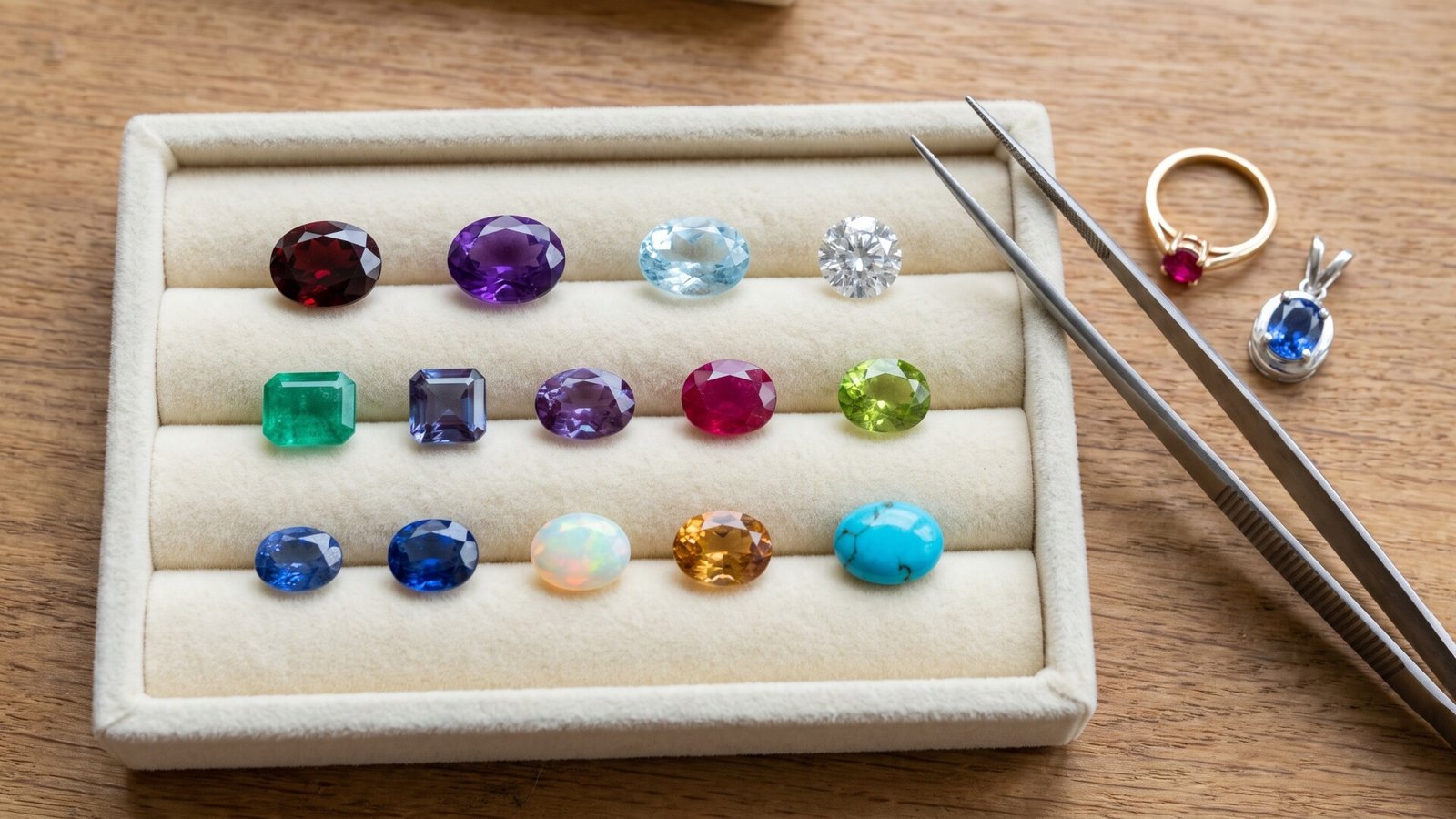
There is no single universal birthstone list. In the United States, the first official list was adopted in August 1912 at a Kansas City meeting of the National Association of Jewelers, now known as Jewelers of America. It has been revised since: alexandrite (June), tourmaline (October), citrine (November), and zircon (December) were added in 1952, tanzanite joined December in 2002, and spinel was added as a second August stone in 2016. Other countries and organizations keep their own versions, which is why you will see stones such as bloodstone, moonstone, or sardonyx listed on one chart and missing from another.
In practice, this means you can treat the modern list as a menu rather than a rulebook. Pick the stone that fits your budget, your lifestyle, and your taste. Many people also wear a traditional stone, or the stone of a partner or child, for sentimental reasons.
Birthstones by Month at a Glance
| Month | Main stone(s) | Other listed stones | Typical Mohs hardness |
|---|---|---|---|
| January | Garnet | — | 6.5–7.5 |
| February | Amethyst | — | 7 |
| March | Aquamarine | Bloodstone | 7.5–8 (aquamarine); about 6.5–7 (bloodstone) |
| April | Diamond | Sapphire on some older traditional lists; rock crystal (clear quartz) on the UK’s 2013 list | 10 |
| May | Emerald | — | 7.5–8 |
| June | Pearl, moonstone, alexandrite | — | About 2.5–4.5 (pearl); 6–6.5 (moonstone); 8.5 (alexandrite) |
| July | Ruby | — | 9 |
| August | Peridot, spinel | Sardonyx | 6.5–7 (peridot); 8 (spinel) |
| September | Sapphire | Lapis lazuli on some lists | 9 |
| October | Opal, tourmaline | — | About 5.5–6.5 (opal); 7–7.5 (tourmaline) |
| November | Topaz, citrine | — | 8 (topaz); 7 (citrine) |
| December | Tanzanite, turquoise, zircon | Blue topaz on some lists | About 6.5 (tanzanite); 5–6 (turquoise); 6.5–7.5 (zircon) |
Remember that Mohs hardness only measures scratch resistance. It says nothing about how easily a stone chips or splits, which is why we cover cleavage and brittleness for the stones where it matters.
January: Garnet
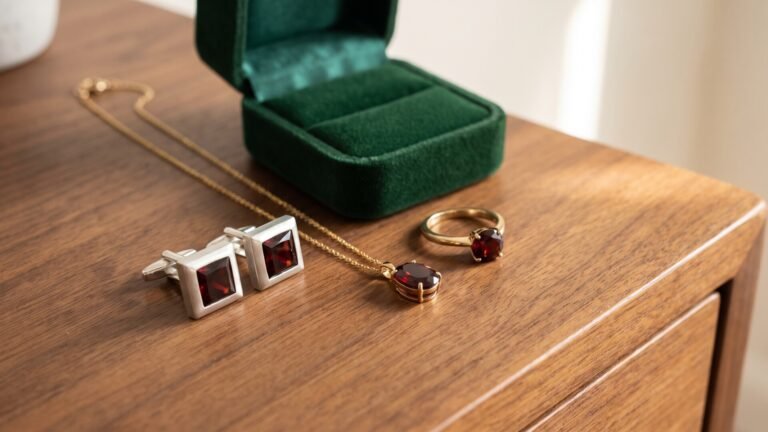
January’s gemstone is Garnet, best known for its deep red tone, though the gem family actually includes greens (tsavorite and demantoid), oranges (spessartite and hessonite), and pinks. Red garnet remains the most iconic and is often used in vintage-style jewelry. Garnet is a group of related minerals rather than a single species, so two garnets can differ noticeably in color and price.
Color & Appearance
You’ll mostly see a warm, earthy, wine-red color. Good-quality garnet has strong saturation and even hue.
Symbolism
Traditionally associated with protection, safety, and strength, especially during travel. These are cultural associations rather than measurable effects; our garnet meaning and history guide traces where they come from.
Durability
With a Mohs hardness of 6.5–7.5 depending on the variety, garnet is relatively durable but can still pick up scratches if worn daily. It is generally not treated, which makes it a good-value stone. Our garnet jewelry care guide covers cleaning.
Buying Tip
Look for clarity; garnets should be eye-clean. Avoid stones that look overly brown. Browse January birthstone gift ideas for him and her if you are shopping for someone else.
Product Examples
• Red Garnet Solitaire Ring — “Merchant Link”
• Vintage-Style Garnet Pendant — “Merchant Link”
February: Amethyst
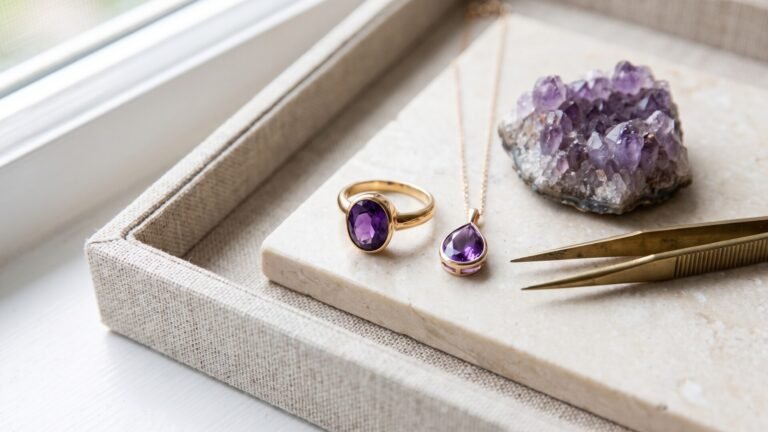
February’s birthstone is Amethyst, a violet quartz that feels calming, versatile, and elegant without being overwhelming. It is one of the most accessible colored gems, which is why it appears in everything from first-jewelry gifts to statement rings.
Color & Appearance
Ranging from soft lavender to deep royal purple. The best stones have even saturation and minimal zoning (visible bands of lighter and darker color).
Symbolism
Traditionally linked to clarity, sobriety, and emotional grounding. The name comes from a Greek word often interpreted as “not intoxicated,” which is why amethyst became tied to sobriety in folklore. Read more in February birthstone meaning: the tranquility of amethyst.
Durability
At Mohs 7, amethyst works well for most jewelry but can still scratch if worn next to harder stones. Prolonged strong sunlight or heat can fade the color of some stones, so store amethyst jewelry away from sunny windowsills.
Buying Tip
If the stone flashes gray or has washed-out sections, it’s lower grade. Even color matters more than deep color. Because purple glass and dyed stones exist, read our guide on how to spot fake amethyst jewelry before buying from an unfamiliar seller.
Product Examples
• Amethyst Cushion-Cut Pendant — “Merchant Link”
• Simple Amethyst Bracelet — “Merchant Link”
March: Aquamarine & Bloodstone
March has two stones: the modern favorite Aquamarine, and the traditional alternative Bloodstone.
Aquamarine
Aquamarine is the blue-to-blue-green variety of beryl, the same mineral family as emerald. It is known for clarity and a soft, cool color. Many aquamarines are gently heat-treated to remove a greenish tint, which is a widely accepted practice.
Symbolism: Traditionally associated with calm, communication, and emotional flow.
Durability: Mohs 7.5–8 — wear-friendly and fairly tough, although long stones can still chip at the edges.
Buying tip: Eye-clean clarity is standard, so avoid stones with obvious inclusions.
Bloodstone
Bloodstone (also called heliotrope) is a dark green variety of chalcedony, which is microcrystalline quartz, with red spots of iron oxide. It is opaque and sometimes sold as a form of jasper. If you are trying to tell it apart from similar-looking green stones, see our bloodstone vs green jasper identification guide.
Symbolism: Traditionally associated with courage, vitality, and grounding.
Durability: Roughly Mohs 6.5–7 and relatively tough because of its microcrystalline structure; ideal for pendants, beads, and signet-style pieces.
Product Examples
• Aquamarine Pendant Necklace — “Merchant Link”
• Bloodstone Tumbled Stone Bracelet — “Merchant Link”
April: Diamond
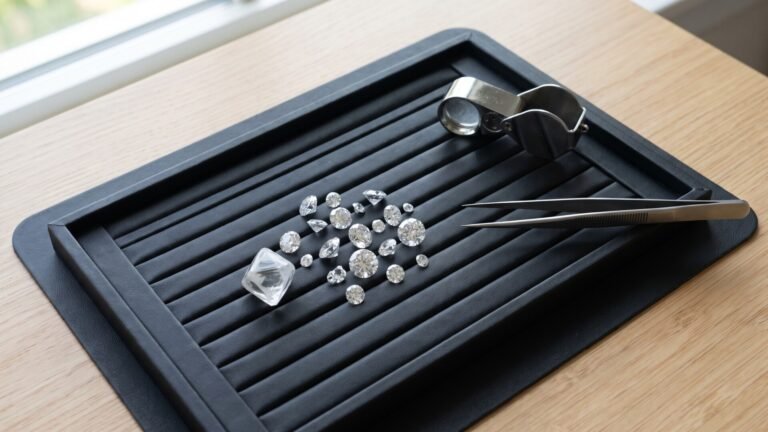
April’s birthstone is the most famous of all — Diamond. Its brilliance and fire set it apart, and its symbolism has long been tied to commitment and endurance. Older traditional lists sometimes pair it with sapphire, and the UK’s 2013 list adds rock crystal. Clear stones such as white sapphire, white topaz, and moissanite are popular stand-ins but are not official April birthstones.
Color & Appearance
Clear, white diamonds are traditional, but black, salt-and-pepper, and champagne diamonds have become widely used in modern designs.
Symbolism
Strength, purity, and clarity of purpose are the traditional associations.
Durability
Mohs 10 — the hardest known natural material, and excellent for everyday wear. Hardness is not the same as toughness, though: diamond has cleavage planes and a hard knock at the right angle can chip it, so protective settings still make sense for rings.
Buying Tip
Focus on cut quality. A well-cut diamond outshines a larger poorly cut one. Lab-grown diamonds have the same chemistry and structure as mined diamonds, and should be sold as lab-grown. Moissanite is a different mineral that imitates diamond; see whether moissanite is a suitable alternative to the April birthstone. For a quirky look-alike, our Herkimer diamond comparison explains why those are actually quartz.
Product Examples
• Classic Diamond Stud Earrings — “Merchant Link”
• Minimalist Diamond Pendant — “Merchant Link”
May: Emerald
May’s birthstone, Emerald, is bold, lush, and instantly recognizable. It’s part of the beryl family but behaves very differently from aquamarine, because emeralds are almost always full of tiny fractures.
Color & Appearance
Ranging from strong green to slightly blue-green. Some inclusions (called “jardin,” French for garden) are normal and expected.
Symbolism
Growth, love, renewal, and creativity are the traditional associations.
Durability
Emerald rates Mohs 7.5–8, but it is brittle because of those inclusions, and most emeralds are treated with oils or resins to improve apparent clarity. Avoid ultrasonic and steam cleaners and harsh chemicals. We look at whether it works for a ring in Is an emerald engagement ring practical?
Buying Tip
Accept inclusions, but avoid surface-reaching cracks that weaken the stone. Ask the seller whether the emerald is treated and how, since the degree of filling affects both value and long-term care.
Product Examples
• Emerald Oval Ring (Gold Setting) — “Merchant Link”
• Natural Emerald Necklace — “Merchant Link”
June: Pearl, Alexandrite & Moonstone
June is one of the rare months with three modern stones, giving you very different looks and price points.
Pearl
Classic, soft luster, and organic: pearls form inside living mollusks. Most pearls on the market are cultured, meaning people started the process but the pearl is still real nacre.
Symbolism: Traditionally wisdom, purity, and intuition.
Durability: Soft (roughly Mohs 2.5–4.5). Put pearls on last and take them off first: keep them away from water, perfume, hairspray, and heat.
Alexandrite
The chameleon gemstone, shifting from greenish in daylight to reddish under incandescent light. Natural alexandrite is a rare variety of chrysoberyl and very expensive in good quality. Most affordable “alexandrite” jewelry is lab-created, and some inexpensive pieces use synthetic color-change corundum, which looks similar but is a different material. Ask for a clear description of what you are buying.
Symbolism: Traditionally balance, luck, and adaptability. Our alexandrite guide goes deeper.
Durability: Mohs 8.5 — great for rings, but pricey when natural.
Moonstone
A feldspar with a milky, floating shimmer called adularescence, and a calming aesthetic. See our moonstone guide for more.
Symbolism: Traditionally emotion, femininity, and reflection.
Durability: Mohs 6–6.5 with cleavage, so it is best in earrings or pendants, or in a protective setting if worn as a ring.
Product Examples
• Cultured Pearl Strand — “Merchant Link”
• Lab-Created Alexandrite Ring — “Merchant Link”
• Rainbow Moonstone Pendant — “Merchant Link”
July: Ruby
Ruby is July’s birthstone and is red corundum, the same mineral as sapphire. The top-quality shade, often described in the trade as “pigeon’s blood,” is a vivid, warm red with a touch of blue.
Color & Appearance
Bright, vivid red with strong saturation. Pinker or purplish-red corundum is usually sold as pink sapphire instead.
Symbolism
Passion, vitality, and motivation are the traditional associations.
Durability
Mohs 9 — excellent for engagement rings and long-term wear. Heat treatment is very common and generally accepted, but fracture-filled rubies (filled with glass) are more fragile and should be disclosed by the seller.
Buying Tip
Check for overly dark stones; a ruby shouldn’t look brown or black under low light. If a very large ruby has a surprisingly low price, ask whether it is treated, lab-created, or actually red spinel.
Product Examples
• Ruby Eternity Band — “Merchant Link”
• Minimalist Ruby Pendant — “Merchant Link”
August: Peridot, Spinel & Sardonyx
August has two modern stones backed by a strong following, Peridot and Spinel, plus the traditional Sardonyx.
Peridot
Known for its bright, yellow-green to olive-green tone. It is the gem variety of the mineral olivine.
Symbolism: Traditionally protection, prosperity, and warmth.
Durability: Mohs 6.5–7 — softer than it looks; avoid ultrasonic cleaning and acids. Peridot suits earrings and pendants better than hard-worn rings.
Spinel
Spinel was officially added to the August list in 2016. For centuries it was mistaken for ruby; the famous “Black Prince’s Ruby” in the British Imperial State Crown is in fact a red spinel. Comes in vibrant red, pink, blue, and violet.
Symbolism: Traditionally rejuvenation, clarity, and energy.
Durability: Mohs 8 — durable, usually untreated, and often more affordable than a comparable ruby or sapphire. A strong ruby alternative if you love red but want a lower price.
Sardonyx
Sardonyx is a banded chalcedony with reddish-brown and white layers. It is often carved into cameos and intaglios and is a good fit for signet-style jewelry. Hardness is about Mohs 6.5–7.
Product Examples
• Peridot Solitaire Necklace — “Merchant Link”
• Blue Spinel Stackable Ring — “Merchant Link”
September: Sapphire
While sapphire can appear in many colors, September is traditionally associated with blue sapphire. Sapphire is corundum of any color except red, which is ruby.
Color & Appearance
Royal blue is the classic choice, but teal, cornflower, and midnight blue are also popular. Our sapphire color spectrum guide explains the full range, and blue gemstones and their meanings compares sapphire with its blue neighbors.
Symbolism
Wisdom, loyalty, and truth are the traditional associations.
Durability
Mohs 9 — outstanding durability. Heat treatment is routine, and lab-grown sapphire is widely sold, so ask what you are getting. See how to spot real vs synthetic sapphire.
Buying Tip
Clarity matters, but expect small inclusions. Even color distribution is more important than total perfection. Not sure if you want sapphire or something cheaper? Compare it in sapphire vs blue topaz.
Product Examples
• Deep Blue Sapphire Pendant — “Merchant Link”
• Sapphire & Diamond Halo Ring — “Merchant Link”
October: Opal & Tourmaline
October offers two strong options: Opal for play-of-color and Tourmaline for color variety.
Opal
Flashes of red, green, and blue create a unique pattern in every stone. Opal is hydrated silica, so it contains water, which is why it is sensitive to dryness and sudden temperature change. Some opals, notably many from Ethiopia, can absorb water.
Symbolism: Traditionally creativity, expression, and emotion.
Durability: Roughly Mohs 5.5–6.5 and prone to crazing or cracking; keep away from heat and dryness, avoid ultrasonic cleaners, and prefer earrings and pendants to everyday rings.
Tourmaline
Pink, green, and multicolor watermelon are especially popular. See our tourmaline guide for the color varieties.
Symbolism: In crystal traditions, tourmaline is associated with inspiration and energy; claims that it heals physical ailments are beliefs, not established fact.
Durability: Mohs 7–7.5 — stable for everyday jewelry, though it can have inclusions that make it fragile in some colors.
Product Examples
• Ethiopian Opal Pendant — “Merchant Link”
• Pink Tourmaline Ring — “Merchant Link”
November: Citrine & Topaz
November’s stones sit beautifully in the warm color palette: Citrine and Topaz (usually sold as golden or yellow topaz).
Citrine
A bright, sunny quartz often used in casual or boho jewelry. Natural citrine is relatively uncommon and tends to be pale; most citrine on the market is heat-treated amethyst, which is a normal and accepted practice but worth knowing.
Symbolism: Traditionally positivity and abundance; modern crystal practice adds ideas such as manifestation.
Durability: Mohs 7.
Topaz
Richer golden tones with a slightly more luxurious feel. Natural topaz comes in many colors, including colorless, and many are enhanced, so ask about treatment.
Symbolism: Traditionally focus, intention, and clarity.
Durability: Mohs 8, but with perfect cleavage, meaning a sharp knock can split it. Fine for most rings with a protective setting, and excellent in pendants and earrings.
Product Examples
• Citrine Pendant Necklace — “Merchant Link”
• Golden Topaz Oval Ring — “Merchant Link”
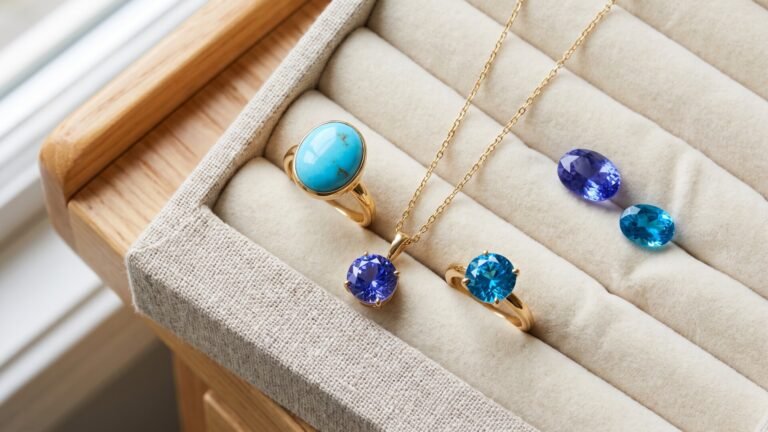
December: Tanzanite, Turquoise, Zircon & Blue Topaz
December is known for its cool-toned blue gemstones, and it has the longest list of any month: tanzanite, turquoise, and zircon, with blue topaz widely sold as a December stone as well.
Tanzanite
A violet-blue gem found commercially only in Tanzania. It was added to the December list in 2002. Most tanzanite is heat-treated to bring out its blue-violet color. If you are curious about its market, see why tanzanite is called underrated, and treat any investment claim with caution.
Symbolism: Traditionally transformation and intuition.
Durability: Mohs 6–7 with perfect cleavage — handle carefully; best in pendants, earrings, or protective ring settings.
Blue Topaz
Bright, clear, and widely available. Nearly all blue topaz is made by treating colorless topaz with irradiation and heat; the deeper “London blue” shade is the same kind of treated stone.
Symbolism: Traditionally calmness and communication.
Durability: Mohs 8 with cleavage — good for everyday wear with a protective setting.
Turquoise
Matte sky-blue to blue-green with natural veining. Much turquoise is stabilized with resin or dyed, so ask for disclosure. See our turquoise guide for how to recognize quality.
Symbolism: Traditionally protection and grounding.
Durability: Mohs 5–6 and porous — avoid chemicals, cosmetics, and soaking.
Zircon
Natural zircon is a brilliant, naturally occurring gemstone and is not the same as cubic zirconia, which is a lab-made diamond simulant. Blue zircon is typically heat-treated. It is fairly hard (about Mohs 6.5–7.5) but can be brittle and prone to chipping at the edges.
Product Examples
• Tanzanite Cushion Pendant — “Merchant Link”
• London Blue Topaz Ring — “Merchant Link”
• Natural Turquoise Bracelet — “Merchant Link”
Choosing the Right Birthstone: A Quick Guide
1. If durability matters most
Go with sapphire, ruby, spinel, diamond, or alexandrite for daily-wear rings. Topaz is hard but can split if knocked, so give it a protective setting.
2. If symbolism is your priority
Pearl for wisdom, garnet for protection, amethyst for calm, citrine for positivity — all traditional associations. For more, see our guides on birthstone personality traits and how people cleanse and charge their birthstones.
3. For budget-friendly gifts
Amethyst, citrine, garnet, moonstone, and blue topaz offer great value without sacrificing beauty. Our birthstone jewelry guide shows which pieces suit each stone.
4. For unique or rare gems
Tanzanite, natural alexandrite, high-quality opal, and emerald. See which birthstones are the most expensive for how rarity affects price.
5. For everyday wear
Look for stones with a Mohs hardness of at least 7.5–8 and no strong cleavage, and match the piece to the stone: rings take the most abuse, while pendants and earrings are gentler on softer gems.
Find a Birthstone by Color
If you know the color you want more than the month, this quick finder points you to the stones that fit. Colors vary within each gem family, so treat it as a starting point.
| Color | Birthstones that come in it |
|---|---|
| Red | Garnet (January), ruby (July), spinel (August) |
| Pink | Tourmaline (October), spinel (August), pink sapphire (September), pearl (June) |
| Purple and violet | Amethyst (February), tanzanite (December), alexandrite in some lights (June) |
| Blue | Aquamarine (March), sapphire (September), blue topaz, tanzanite, zircon, turquoise (December) |
| Green | Emerald (May), peridot (August), bloodstone (March), tourmaline (October), garnet varieties (January) |
| Yellow and orange | Citrine and topaz (November), spessartite garnet (January) |
| Clear and white | Diamond (April), pearl and moonstone (June), opal (October) |
Can You Wear a Different Month’s Stone?
Yes. Nothing about birthstone jewelry is a rule. Some people wear the stone of a parent, partner, or child; others choose a zodiac stone or simply the color they like. If you are weighing monthly stones against astrological ones, our guide on zodiac birthstones vs monthly birthstones lays out the differences, and the zodiac pages, such as Aries and Taurus, show how the two systems overlap. For a family piece, a mother’s ring or a bracelet with a stone for each child is a common choice, and it is easier to keep durable if you pair softer stones with protective settings. Zodiac lists are astrological traditions, not science, and they differ from one source to the next.
Birthstone Gift Tips by Budget and Recipient
When you are buying for someone else, the most useful questions are how the piece will be worn and how much care the stone needs. For a child or teen, choose a hard, low-maintenance stone or a simple design with a secure setting, and remember that small stones and loose beads can be a choking hazard for young children. For an anniversary or milestone, a durable stone such as sapphire, ruby, spinel, or diamond holds up to daily wear. For a first piece of birthstone jewelry, a pendant or stud earring is a low-risk place to start, since neither takes the knocks a ring does. Whatever you choose, ask the seller in writing whether the stone is natural, lab-grown, treated, or a simulant, and keep the paperwork. Our birthstone jewelry guide and education and buying guides cover the next steps.
Which Birthstone Jewelry Suits Daily Wear?
| Wear level | Best stones | Notes |
|---|---|---|
| Everyday rings | Sapphire, ruby, diamond, spinel, alexandrite | Hard and generally tough |
| Rings with care | Aquamarine, garnet, amethyst, citrine, tourmaline, topaz, zircon, emerald | Choose a bezel or halo setting; emerald and topaz need extra caution |
| Pendants and earrings | Pearl, opal, moonstone, peridot, tanzanite, turquoise | Soft, brittle, or sensitive stones are safer away from the knocks hands take |
Natural, Lab-Grown, Treated and Simulant: What the Words Mean
Four terms come up constantly when shopping. A natural stone formed in the earth. A treated natural stone has been enhanced, for example by heating, oiling, or dyeing. A lab-grown (synthetic) stone has the same chemistry and structure as its natural counterpart, just made by people. A simulant only imitates the look of another stone, like cubic zirconia or moissanite standing in for diamond. Lab-grown is not “fake,” but it should always be labeled, and it is usually priced well below a natural equivalent. Ask any seller to state clearly which category a stone belongs to, and for any treatments.
Caring for Birthstone Jewelry
Warm water, a drop of mild dish soap, and a soft brush are the safest default for most stones. Skip ultrasonic and steam cleaners for emerald, opal, pearl, turquoise, tanzanite, peridot, and any fracture-filled stone. Store pieces separately so harder stones do not scratch softer ones, and put jewelry on after makeup and perfume.
Meaning Is Personal
Many readers choose a stone for its symbolism. That is a lovely reason, as long as it is understood as tradition and personal meaning. Gemstones are not a substitute for medical care, and we do not suggest any stone treats or prevents a health condition. For deeper buying advice, visit our education and buying guides, or return to the Birthstones by Month hub to pick your month.
Frequently Asked Questions About Your Birthstone
How do I find out what my birthstone is?
Look up your birth month in the table above. Several months have more than one stone, so you can choose whichever fits your style and budget.
Why does my month have more than one birthstone?
Birthstone lists have been revised over time. The first official US list dates to 1912, and stones such as alexandrite, tourmaline, citrine, zircon, tanzanite, and spinel were added later. Other countries and organizations keep different lists.
Which birthstones are best for everyday rings?
Sapphire, ruby, diamond, spinel, and alexandrite are the hardest and most suitable. Softer stones such as pearl, opal, and turquoise are better in earrings or pendants.
Are lab-grown birthstones real?
A lab-grown stone has the same chemical composition and crystal structure as its natural counterpart, so it is a real gem made by people. It should be labeled as lab-grown, and it is different from a simulant, which only imitates another stone.
Is citrine natural?
Some citrine is natural, but most is heat-treated amethyst. This is a common, accepted practice, and a good seller will tell you.
Do birthstones have healing powers?
Healing and energy claims are cultural and spiritual beliefs, not proven effects. Birthstones are best enjoyed for their beauty and personal meaning, not as medical treatment.
Can I wear a birthstone from a different month?
Yes. Birthstones are a tradition, not a rule. Many people wear the stone of a family member, a zodiac stone, or simply a favorite color.
What is the difference between a traditional and a modern birthstone?
Traditional lists come from older customs, while the modern U.S. list dates to 1912 and has been updated since. Some months, such as June, August, October, November, and December, now have several modern stones.