Is Opal or Pink Tourmaline Better for an October Birthday?
Pink tourmaline is the better October birthstone for a ring that will be worn hard, and opal is the better one for almost everything else. That is the whole tradeoff in a single line, and it is the opposite of what most buyers assume. Opal is the traditional October stone, the one with the shifting spectral flash that makes people stop mid-conversation, and it is also the more fragile of the two by a wide margin. Pink tourmaline is a modern alternative, sold as October birthstone jewelry alongside opal, and it holds a steady pink that does not change with the light. Both are legitimate choices. Which one you should buy depends on whether the piece is meant for occasional beauty or for daily wear, and on who will be wearing it in forty years.
What Makes Opal and Pink Tourmaline October Birthstones?
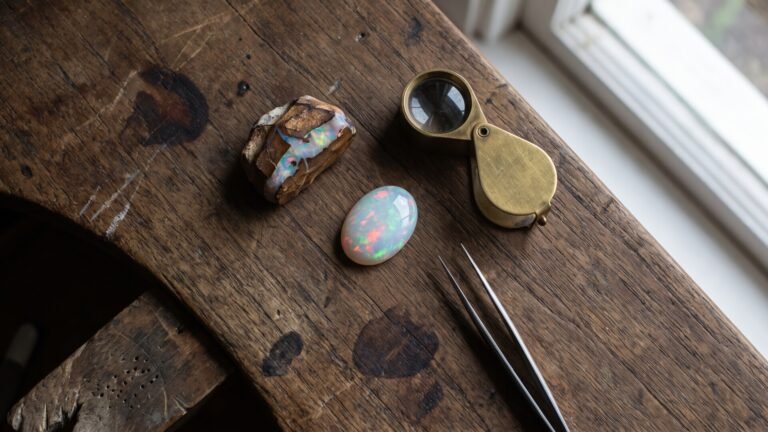
Opal has the older claim on October. It sits in the traditional birthstone lists, and its defining feature is play-of-color, the optical effect in which flashes of different colors appear and shift as the stone moves. That effect comes from microscopic silica spheres inside the stone diffracting light, and no two opals arrange those spheres the same way. A single opal can show green, blue, orange, and red in different patches, and the pattern changes as you tilt it.
Pink tourmaline arrived later. It is a modern alternative October birthstone, widely sold and widely recognized, but it is not a variety of opal and it is not treated identically by every birthstone list. Some lists name opal and tourmaline together for October, some name only opal, and some retailers use the phrase "October birthstone jewelry" for any pink stone they happen to have in stock. That last habit is worth watching.
A seller may label a pink sapphire, a pink topaz, or a piece of pink glass as October birthstone jewelry. Some of those are legitimate alternatives and some are marketing. Before you buy, confirm the actual gemstone species in writing. The word "pink" is not a gemstone name, and "October birthstone" is not either.
If you want the symbolism and history of both stones in more depth than this comparison allows, the October birthstone guide: meaning and jewelry covers the full picture.
Opal vs Pink Tourmaline at a Glance
Neither stone wins every category. That is the point of putting them side by side.
| Factor | Opal | Pink Tourmaline | Why It Matters |
|---|---|---|---|
| October symbolism | Traditional October birthstone | Modern alternative birthstone | Helps buyers match tradition and personal meaning |
| Appearance | Play-of-color with shifting flashes | Stable pink to vivid magenta color | Determines whether the jewelry looks dramatic or consistent |
| Everyday durability | More vulnerable to scratches, impact, heat, and sudden temperature changes | Generally better suited to regular wear, though still not indestructible | Important for rings and active lifestyles |
| Maintenance | Requires more careful cleaning and storage | Usually simpler care | Affects long-term ownership |
| Price behavior | Wide range based on body color, pattern, play-of-color, and origin | Wide range based on saturation, clarity, size, and origin | Prevents misleading one-price comparisons |
| Best use | Pendants, earrings, occasional rings, sentimental gifts | Daily-wear rings, earrings, pendants, and colorful statement jewelry | Connects gemstone properties to the actual purchase |
The practical verdict is that pink tourmaline has the advantage for frequent wear, while opal has the advantage for traditional October meaning and visual individuality. If you want a piece that gets worn three times a week, that first advantage matters more than the second.
Why Opal Still Wins for Some October Birthday Gifts
I have watched a customer open an opal box and go quiet. Not because it was expensive, but because the stone did something she did not expect. It caught the light from the window and threw a green flash across the counter, then a red one, and she kept turning it. Pink tourmaline does not do that. It is beautiful in a steady, confident way, and it stays that way. Opal performs.
That performance is the reason opal remains the stone people reach for when they want an October gift that feels unmistakably tied to the month. Even stones from the same mine can show different flash patterns, dominant colors, and body tones. Two opals cut from the same rough can look like cousins rather than twins.
The common appearances are worth knowing before you shop:
- White opal has a pale body with play-of-color scattered across it. It is the most familiar and often the most affordable.
- Crystal opal has a transparent or semi-transparent body, which lets the play-of-color sit inside the stone rather than on the surface. It can look almost glassy.
- Black opal has a dark body that makes the flashes look brighter by contrast. It is the most prized and usually the most expensive.
- Ethiopian opal is often vivid and relatively affordable, but it has its own care profile and a reputation for absorbing water and changing appearance.
A bright, multicolored opal is not automatically valuable. Body tone, pattern, brightness, and how much of the stone actually shows play-of-color all matter, and a treated or assembled stone can look spectacular while being worth a fraction of a solid one. The opal guide: meaning, properties, and value explains those quality factors properly, and the history and symbolism of opal covers why the stone has held its grip on October for so long.
The best recipients for opal are people who value unusual color, wear jewelry selectively rather than constantly, appreciate gemstone history, and want a clearly recognizable October birthstone rather than a conventional pink stone.
The opal tradeoff buyers often miss
Visual drama comes with care requirements. Opal is softer than quartz, and it is more vulnerable to impact, heat, and sudden temperature changes than most colored stones. A bright appearance alone does not establish quality either. You have to assess body tone, pattern, brightness, play-of-color coverage, and whether the stone has been treated.
Ethiopian opal in particular may require especially thoughtful buying and care decisions, since it can be more sensitive to water and humidity than Australian material. Australian opal is often chosen by buyers seeking a different durability and origin profile. If you are weighing the two, Ethiopian versus Australian opal breaks down the color and durability differences before you commit.
Why Pink Tourmaline May Be the Better Everyday Choice
Pink tourmaline does not need dramatic lighting to look alive. It holds a saturated pink that stays saturated in a kitchen, in an office, and in a car. That consistency is the whole appeal. A pink tourmaline ring looks like a pink ring from every angle, and it does not ask anything of the wearer.
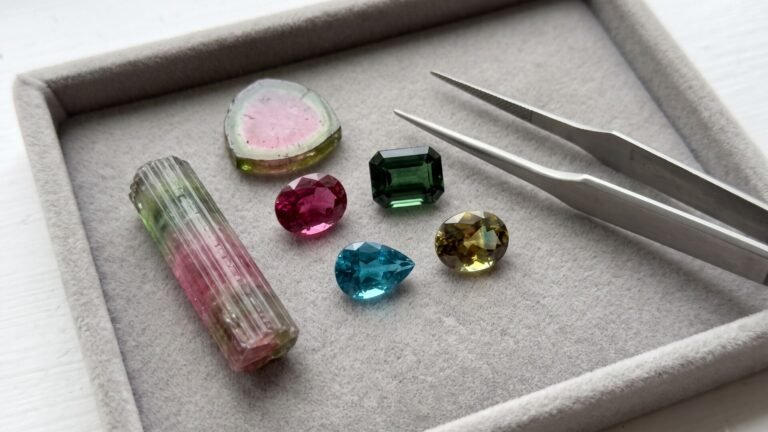
Tourmaline is also pleochroic, meaning it can show different colors or intensities when viewed from different directions. A cutter who reads the rough correctly can orient the stone so the face shows the strongest pink. A cutter who does not can produce a stone that looks washed out from the top and vivid from the side. This is one of the reasons two pink tourmalines of the same weight and price can look nothing alike.
Durability is the practical argument. Pink tourmaline is generally a more forgiving choice for an everyday ring than opal, though the setting, stone exposure, and wearing habits still matter. Tourmaline is not indestructible, and a hard knock on a countertop can still chip it. But it does not carry opal’s sensitivity to heat and sudden temperature change, and it does not need the same level of protective handling.
The best recipients for pink tourmaline are people who want a pink gemstone, wear jewelry often, prefer easier maintenance, or want a contemporary alternative to the most traditional October birthstone. The tourmaline guide: meaning, properties, and value covers how pink fits within the wider tourmaline family, and the symbolism and modern uses of tourmaline explains why the stone has become a favorite for everyday pieces.
The pink tourmaline tradeoff buyers often miss
"Pink tourmaline" covers a broad range, from pale baby pink to strongly saturated pink and deep magenta. The price gap between those colors is real and it is not linear. A vivid pink stone can cost several times what a pale one of the same size costs, and the premium reflects color saturation and size rather than a universally superior stone.
Tourmaline can also show inclusions. Some are attractive, like the fine parallel tubes that create a cat’s-eye effect. Others are fractures that reach the surface or sit close to it, and those are a durability concern, not a beauty mark. A stone with a visible surface-reaching fracture is a stone that may fail.
The most common mistake I see is buying size over color. A well-cut medium-sized pink tourmaline is usually a better purchase than a larger, pale, windowed stone. A window is a transparent area in the middle of the stone that lets you see straight through it, and it makes the color look washed out and the stone look less lively. A smaller stone with strong saturation and a good cut will outperform a bigger one with a window every time.
Which Stone Is Better for Rings, Necklaces, and Earrings?
Durability is not an abstract gemological fact. It becomes real the moment you decide what kind of jewelry you are buying.
Best choice for an October birthstone ring
For a ring intended for frequent wear, especially for someone active or unlikely to remove jewelry for household tasks, pink tourmaline is the recommendation. It handles the ordinary knocks of daily life better, and it does not need to come off every time the wearer washes dishes.
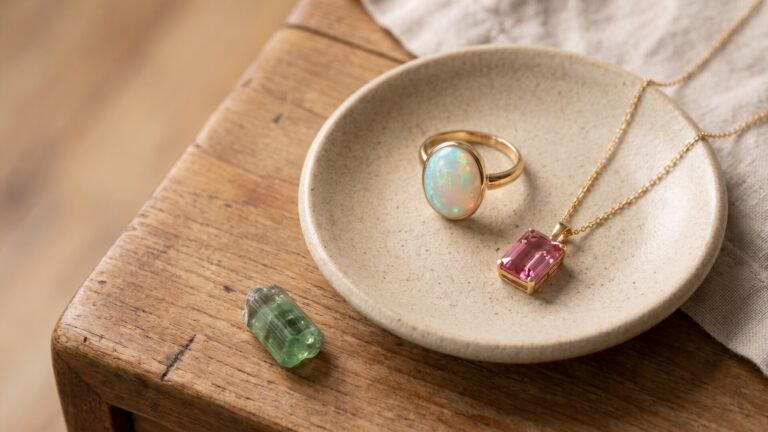
Opal can still work in a ring. It works best when it is protected by a thoughtful setting, worn occasionally, and maintained carefully. A lower-profile setting, a bezel or partial bezel, recessed stone placement, and avoiding exposed corners or thin edges all extend an opal’s life. A high, prong-set opal with an exposed edge is a repair waiting to happen.
Neither stone should be presented as maintenance-free. The setting and the wearer’s habits can matter as much as the gemstone. If you are set on an opal ring, the safest way to clean an opal birthstone ring with crazing risk is worth reading before you buy, because crazing – the network of fine cracks that can develop in some opals – is the failure mode you are trying to avoid.
Best choice for an October birthstone necklace
Opal is an especially strong pendant choice. A necklace typically receives fewer direct impacts than a ring, so the stone’s fragility matters less, and a pendant puts the play-of-color right where people look. A protected opal pendant is one of the few pieces where I would recommend opal without much hesitation.
Pink tourmaline works well for a necklace when the buyer wants a consistent pink accent or a more modern look. It is also the easier piece to wear with everything, since the color does not compete with an outfit the way a flashing opal can.
Pay attention to chain length and pendant security. A heavy pendant on a thin chain is a loss waiting to happen, and a pendant that swings freely will knock against tables and doorframes. Once you have the care and quality criteria settled, [Affiliate: browse opal pendant collections] and [Affiliate: browse pink tourmaline pendant collections] are reasonable places to compare actual pieces.
Best choice for October birthstone earrings
Earrings suit both stones, because they are generally less exposed to knocks than rings. Opal earrings give you luminous, shifting color that catches the light as the wearer turns their head. Pink tourmaline earrings give you coordinated, predictable pink that reads clearly from across a room.
Matching is the issue with both. Opal pairs may have noticeably different play-of-color patterns, and pink tourmaline pairs may vary in saturation and tone. Examine the pair together rather than assuming two stones from the same product listing will look identical. A mismatched pair is not a defect in either stone, but it is something you should see before you buy.
Durability, Treatments, and Care: The Long-Term Ownership Decision
A simple hardness ranking does not tell you how a stone will survive. What matters is scratch resistance, impact risk, heat exposure, sudden temperature changes, setting protection, and how often the piece is worn.
Opal’s care concerns include dehydration and crazing risk in some circumstances. Buyers should follow the seller’s specific care instructions rather than relying on generic jewelry-cleaning advice, because generic advice is written for diamonds and sapphires. The guide to cleaning opal jewelry without causing damage covers the safe method in detail.
Pink tourmaline should still be protected from hard knocks, harsh chemicals, ultrasonic cleaners, and poorly secured settings unless a qualified jeweler confirms the cleaning method is appropriate. Tourmaline is tougher than opal, but it is not a sapphire.
| Ownership concern | Opal | Pink Tourmaline |
|---|---|---|
| Daily ring use | Usually the riskier choice | Generally the more practical choice |
| Heat and temperature changes | Requires particular caution | Still avoid unnecessary heat and thermal shock |
| Cleaning | Gentle cleaning and seller-specific guidance | Gentle cleaning is generally preferred |
| Storage | Separate from harder jewelry and protect from impact | Separate storage helps prevent scratches and abrasion |
| Best heirloom strategy | Use a protected setting and occasional-wear plan | Choose a durable setting and schedule periodic inspections |
Treatment disclosures buyers should require
Sellers should disclose whether an opal has been dyed, impregnated, stabilized, assembled as a doublet or triplet, or otherwise treated. A doublet is an assembled opal made of a thin slice of precious opal glued to a backing; a triplet adds a clear cap on top. Both are assembled constructions rather than solid opal, and both can be legitimate budget choices when they are clearly disclosed. They are not legitimate when they are sold as solid.
Pink tourmaline treatments should be disclosed too, including any clarity enhancement or color-related treatment the seller claims. Ask for written treatment information, an independent laboratory report for high-value stones, and a return policy that lets you inspect the jewelry in person.
Value, Pricing, and What You Actually Get for Your Money
Opal and pink tourmaline cannot be compared by carat price alone, because each has different quality factors.
For opal, the drivers are body color, brightness, play-of-color coverage, pattern, color range, transparency, origin, the thickness of the color bar where relevant, and whether the stone is solid or assembled.
For pink tourmaline, the drivers are hue, tone, saturation, clarity, cut quality, size, origin claims, and whether the color looks lively in normal indoor light rather than only under showroom lighting.
| Budget | Opal jewelry likely to be available | Pink tourmaline jewelry likely to be available | Best buying approach |
|---|---|---|---|
| Under $150 | Small opal accents, assembled opal pieces, or modest earrings and pendants | Small pink tourmaline accents or simple sterling silver jewelry | Prioritize disclosure and a secure setting over size |
| $150-$500 | Better-finished opal pendants, earrings, and entry-level rings | Noticeably stronger color and more substantial pink tourmaline jewelry | Compare cut, saturation, and treatment information |
| $500-$1,500 | More distinctive solid opal jewelry or stronger play-of-color | Larger or more saturated pink tourmaline in better settings | Buy the individual stone quality, not just the gemstone name |
| Above $1,500 | Exceptional opal color, pattern, size, or provenance may command a premium | Fine pink tourmaline with strong saturation, size, clarity, or notable origin may command a premium | Seek independent documentation and a specialist return policy |
Origin is not a substitute for quality. An Australian or Ethiopian opal label, or a Brazilian or other tourmaline origin claim, should be supported when it materially affects the price. Setting quality, metal purity, craftsmanship, and repairability affect the long-term value of the gift as much as the stone does. A beautiful stone in a setting that cannot be repaired is a beautiful stone with a deadline.
What Most Buyers Get Wrong About October Birthstone Jewelry
The most common error is assuming that more colorful means more valuable. Attractive color has to be evaluated alongside brightness, pattern, saturation, cut, durability, and treatment. A large pale pink tourmaline may be less compelling than a smaller, strongly saturated stone, and a multicolored opal may still disappoint if the color is limited to a small area or the stone is poorly protected.
Vague labels are the second trap. "Precious opal," "natural pink tourmaline," "AAA opal," and "healing gemstone" mean nothing unless the seller defines the claim and provides treatment information. "AAA" is not a grading standard. It is a word.
The common buying traps are worth listing plainly:
- Stock images that do not show the actual stone
- Unclear or missing carat weight
- Undisclosed doublets or triplets
- Exaggerated rarity claims
- Certificates that identify a gemstone without independently grading its quality
That last one catches people. A certificate that says "opal" tells you what the stone is. It does not tell you whether it is a good one. Those are different questions, and only a full grading report answers the second.
A practical inspection checklist
- Confirm the gemstone identity, whether the piece contains a natural or laboratory-created material, and whether it is solid or assembled.
- Ask for dimensions, carat weight, treatment disclosure, metal details, and photographs or video of the actual item under neutral lighting.
- Inspect the setting for exposed edges, loose prongs, thin sections, and a design that makes future repair difficult.
- Verify the seller’s return period, resize policy, repair coverage, and whether an independent laboratory report is included or available.
Which Stone Still Makes Sense in Three Years?
Think about where the piece ends up. Occasional opal jewelry tends to remain emotionally distinctive, because its appearance is unusual and it does not get compared to anything else in the drawer. Pink tourmaline tends to receive more wear, because it is easier to integrate into everyday clothing and does not need a special occasion.
The heirloom perspective is worth taking seriously here. A well-protected opal pendant can become a memorable family piece, passed down with the story of the person who wore it. A durable pink tourmaline ring may be easier for a future owner to wear regularly, which is its own kind of inheritance. The question is whether you are leaving behind something to be admired or something to be worn.
Resale reality is less romantic. Neither ordinary opal nor ordinary pink tourmaline should be purchased as a guaranteed investment. Retail markups, fashion preferences, treatment, condition, and documentation all affect resale, and most jewelry sold at retail does not resell at retail. Buy these stones for the person, not the portfolio.
The verdict comes in three parts:
- Choose opal for traditional October symbolism, shifting color, and a recipient who will care for occasional-wear jewelry.
- Choose pink tourmaline for a daily-wear gift, stable pink color, easier maintenance, and a recipient who wants a modern alternative.
- Choose based on jewelry type when the stones are otherwise close: pink tourmaline for an exposed everyday ring; opal for a protected pendant or carefully worn earrings.
Final Recommendations
Opal is the overall winner for the most unmistakably traditional October birthstone gift. It is the stone people picture when they hear the month, and it delivers a visual experience that no other October option matches. Choose it for someone who values individuality, symbolism, and visual surprise more than low-maintenance ownership.
Pink tourmaline is the practical winner for daily wear and for buyers concerned about maintenance. Choose it for someone who wants pink color, regular wear, and a more forgiving gemstone choice. It is also the better answer for an engagement ring or any piece that will not come off.
The buyer rule is simple: select the stone that matches the recipient’s habits, not merely the color that looks best in a product photograph.
Frequently Asked Questions About October Birthstone Jewelry
Is opal or pink tourmaline the traditional October birthstone?
Opal is generally treated as the traditional October birthstone, while pink tourmaline is commonly presented as a modern alternative. Birthstone lists and retailer terminology can vary, so buyers should confirm which gemstone they are actually purchasing.
Is pink tourmaline more durable than opal?
Pink tourmaline is generally the more practical choice for frequent wear, especially in a ring. Opal can be worn successfully in jewelry, but it requires more careful protection from scratches, impact, heat, and sudden temperature changes.
Is opal or pink tourmaline more valuable?
Neither gemstone is automatically more valuable. Opal value depends heavily on brightness, play-of-color, body tone, pattern, transparency, origin, and construction. Pink tourmaline value depends on color saturation, clarity, cut, size, and sometimes origin.
Can I wear an opal engagement ring every day?
An opal engagement ring can be worn daily only with a realistic care plan, a protective setting, and a willingness to remove it during activities that expose it to impact, chemicals, heat, or sudden temperature changes. Pink tourmaline is usually the safer choice for buyers seeking lower-maintenance daily wear.
Does pink tourmaline count as October birthstone jewelry?
Pink tourmaline is widely sold and recognized by many modern birthstone references as an October alternative. Buyers who want the most traditional interpretation of October birthstone jewelry should choose opal; buyers who prefer pink color and practicality may reasonably choose pink tourmaline.
Should I buy a natural opal or an opal doublet?
A natural solid opal is not automatically the best choice for every budget. A clearly disclosed doublet can offer attractive color at a lower price, but the buyer should understand its construction, care requirements, durability, and resale limitations before purchasing.
Do I need a certificate for an opal or pink tourmaline?
A certificate or independent gemological report is especially useful for a high-value stone, a stone sold with an important origin claim, or a purchase involving unusual treatments or an expensive setting. For lower-priced jewelry, detailed written disclosure and a reliable return policy remain essential.
The next question most buyers ask is whether a lab-grown or assembled alternative can give them the same look for less, and the answer for opal is genuinely complicated – a doublet is not a fake, but it is not the same object either. That decision is covered properly in the Ethiopian versus Australian opal comparison, which is the right place to go before you spend real money on a stone you intend to hand down.