Best Personalized Birthstone Bracelets for Graduation Gifts (2026 Guide)
Graduation gifts tend to fall into two camps: things that get used for a season and things that get kept for years. A personalized birthstone bracelet belongs firmly in the second camp. It marks an achievement, quietly carries the graduate’s birth month, and can be worn with a work outfit, a gown, or jeans.
This 2026 guide helps you choose one. It covers what you actually get at each price (the part most gift lists skip), how to pick the stone, metal, style, and size, which stones survive daily wear on a wrist, and what to look for at trusted online jewelers such as Blue Nile, James Allen, and Brilliant Earth. It is part of our Birthstone Jewelry Guide.
Why Birthstone Bracelets Make a Good Graduation Gift
Meaning. A birthstone ties the gift to the graduate’s birth month. In gift terms, it says: this is chosen for you, not off a generic shelf. Many families also read the stones symbolically (garnet for steadiness, sapphire for loyalty, for example). Those are traditions rather than facts about the stone, but they give a card something to say.
Ways to personalize it.
- The graduate’s birthstone alone: simple and individual.
- Family birthstones: parents, siblings, or grandparents represented alongside the graduate.
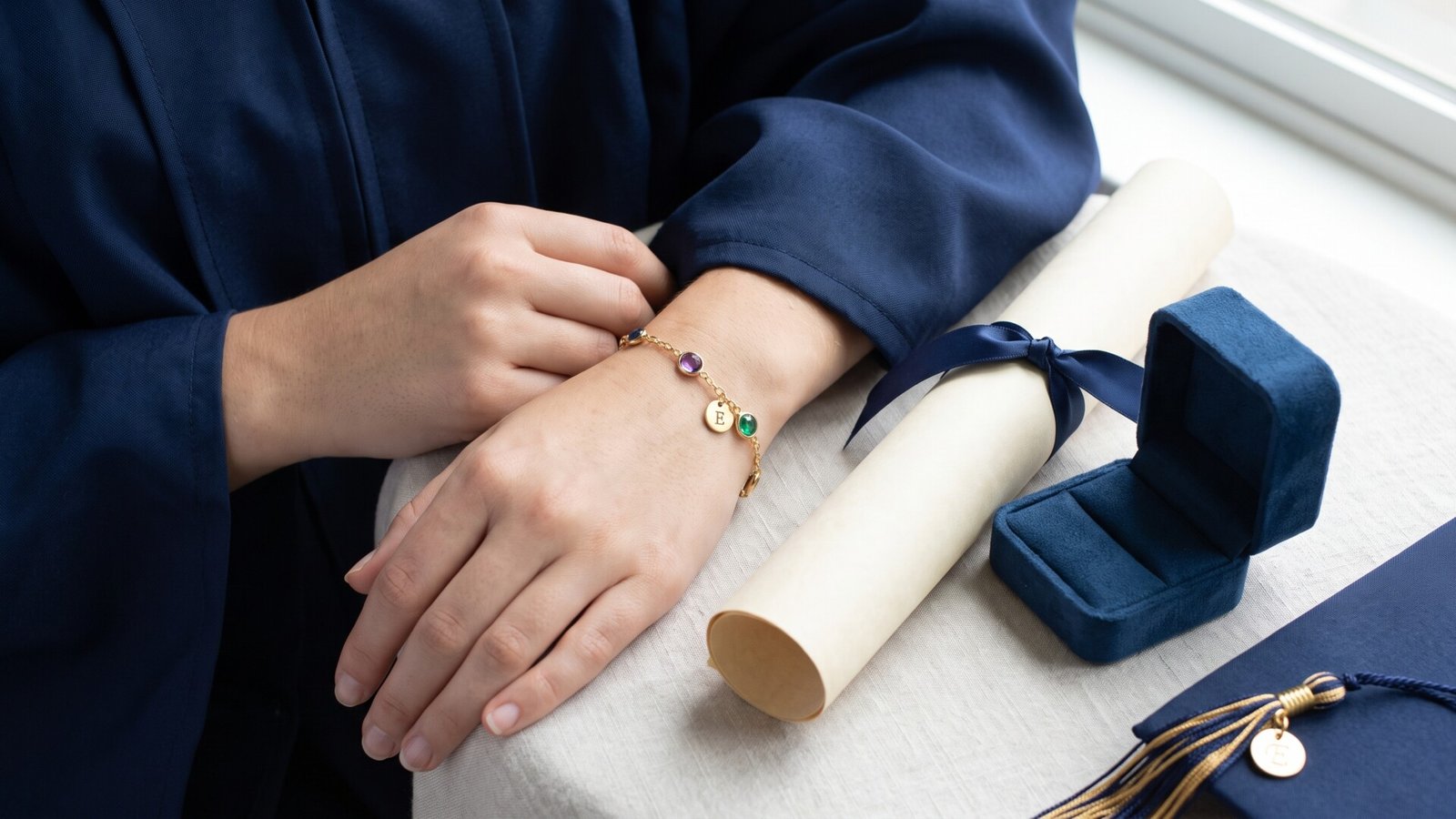
- School-color nods: a deep blue sapphire for a navy-and-gold school, or a garnet for maroon. Subtle, but meaningful.
- Engraving: a name, date, coordinates, or “Class of 2026” on the back of a bar or charm, where the retailer offers it.
Practicality. Bracelets avoid the sizing problem of a ring (although you still need the wrist measurement), they do not dangle like a necklace, and they layer with a watch or other bracelets. A bracelet does face knocks on desks and doors, which matters for stone choice, as we explain below.
Not sure which stone belongs to which month? Our complete guide to birthstones by month lists every option.
What You Actually Get at Each Price
Search for “personalized birthstone bracelet” and you will see prices from about $10 to well over $1,000 for pieces that look similar in photos. The difference is rarely the design. It is what the “birthstone” is made of and how much gold is really in the metal. Two words in the listing tell you most of it.
The stone. In many low-priced bracelets the “birthstone” is colored glass or crystal chosen to match the month’s color. That is a simulant: it imitates the look, not the gem. A lab-grown stone (lab ruby, lab sapphire, lab emerald, lab spinel) has the same chemistry as the natural gem. A natural stone is mined. All three can make a lovely gift, but only the last two are the actual birthstone, and the listing should say which you are buying. If it only says “birthstone” or “crystal” with no gem name, assume a simulant.
The metal. In the US, the FTC’s Jewelry Guides set minimums for the common gold terms, so the label means something:
- Gold-plated or gold-tone: a thin gold or gold-colored layer over a base metal. It can wear through with daily use. PVD coatings over stainless steel are more wear-resistant than ordinary plating but are still a surface layer.
- Gold vermeil: sterling silver coated with at least 10k gold, at least 2.5 microns thick.
- Gold-filled: a gold layer of at least 10k that makes up at least 1/20 of the item’s total metal weight, often stamped “1/20 14K GF”. Much thicker than plating.
- Solid 10k, 14k, or 18k gold: gold alloy all the way through. Nothing to wear off.
| Typical price | Usual metal | Usual stone | Example seen in 2026 | Best for |
|---|---|---|---|---|
| About $10-$60 | Plated brass or PVD-coated steel | Glass or crystal simulant | Mint & Lily Personalized Birthstone Bracelet, $29 (gold-tone PVD over 316L steel, up to six 6mm stones) | Younger graduates, fun keepsakes, layering |
| About $60-$300 | Sterling silver, vermeil, or gold-filled | Simulant, lab-grown, or small natural stones | Engraved bar and charm bracelets from personalization shops | High school and college graduates who will wear it daily |
| About $300-$1,500 | Solid 14k gold | Natural or lab-grown gems, often with diamond accents | James Allen 14k bezel garnet birthstone charm, about $310 (chain sold separately); Blue Nile Emerald and Diamond Graduated Curve Bracelet in 14k white gold, about $1,080 | College, graduate, and professional degrees; heirloom gifts |
| $1,500 and up | 14k or 18k gold, platinum | Matched natural gems or diamonds | Gemstone tennis and line bracelets | Major milestones from close family |
Prices are list prices seen in November 2026 and change often, so treat them as ranges, not quotes. A simple decision rule: if the graduate will wear it every day for years, spend on the metal first (gold-filled, vermeil, or solid gold) and accept a small or lab-grown stone. If it is mainly a keepsake for the day, a plated bracelet with a simulant stone is fine, as long as you know that is what you are buying.
How to Choose the Right Birthstone Bracelet
Step 1: Choose your stone strategy
- One stone: simple, elegant, and easiest on a tight budget.
- Several stones: better for a family gift or for marking milestones (a birthstone plus a stone for the graduation month). More personal, usually pricier.
Step 2: Pick the metal color
- Yellow gold: classic and warm; flatters green, red, and orange stones.
- White gold: modern and cool, and it makes blue and purple stones stand out. It is usually rhodium-plated, so expect occasional re-plating.
- Rose gold: soft and warm, pairing well with pink stones.
- Platinum: dense, durable, and commonly used for heirloom pieces, at a higher price. It is a good option for sensitive skin, as is solid gold.
- Sterling silver: affordable, but softer and prone to tarnish.
Step 3: Get the size right
Bracelet length is not wrist size. Wrap a soft tape measure or a strip of paper just below the wrist bone, snug but not tight, then add an allowance: about 1/4 to 1/2 inch for a snug fit, about 3/4 inch for a comfortable everyday fit, and about 1 inch for a loose, drapey fit. Tennis bracelets are usually sized snug so they do not slide around.
Buying as a surprise? Measure a bracelet the graduate already wears, or choose a design with an adjustable chain or sizing stations. Many fine-jewelry bracelets adjust between 6 and 7 inches, and many personalization shops offer a 1-inch extender, which covers most adult wrists.
Will the Stone Survive Wrist Wear?
A bracelet is hit more often than a pendant, so it deserves tougher stones. Mohs hardness measures scratch resistance, while toughness and cleavage affect how likely a stone is to chip or crack, as we explain in our hardness scale guide.
| Month | Stone | Mohs | Bracelet verdict |
|---|---|---|---|
| January | Garnet | 6.5 to 7.5 | Good |
| February | Amethyst | 7 | Good |
| March | Aquamarine | 7.5 to 8 | Good |
| April | Diamond | 10 | Excellent |
| May | Emerald | 7.5 to 8 | Use with care; brittle, often oil- or resin-filled |
| June | Pearl / moonstone / alexandrite | 2.5 to 4.5 / 6 to 6.5 / 8.5 | Alexandrite very good; pearl and moonstone are delicate |
| July | Ruby | 9 | Excellent |
| August | Peridot / spinel | 6.5 to 7 / 8 | Spinel very good; peridot fair |
| September | Sapphire | 9 | Excellent |
| October | Opal / pink tourmaline | 5.5 to 6.5 / 7 to 7.5 | Tourmaline good; opal delicate |
| November | Topaz / citrine | 8 / 7 | Good; topaz has cleavage and can split if struck |
| December | Turquoise / tanzanite / zircon | 5 to 6 / 6.5 to 7 / 6 to 7.5 | Delicate to fair; tanzanite has cleavage; better for occasional wear |
If the graduate’s stone is soft, you can still choose it: use a bezel setting that shields the edges, pick a charm that sits away from the wrist’s contact points, or select the alternative birthstone for the month. Lab-grown versions of ruby, sapphire, emerald, and spinel have the same chemistry as natural ones at lower prices, provided the seller labels them as lab-grown. A glass simulant, by contrast, is softer than most real birthstones and scratches more easily with daily wear.
Bracelet Styles to Look For and Where to Look
Retailers change their catalogs and prices often, so we describe each style and what to check rather than recommending a single listing. Open each retailer’s current listings, then compare stone type, metal, and return terms.
1. Classic single-birthstone chain bracelet (Blue Nile)
The entry point to personalized birthstone jewelry: a fine chain with one small stone in a bezel or prong setting. It suits a high school graduate or anyone receiving a first piece of fine jewelry. Check the chain length against the graduate’s wrist and whether the clasp has a safety feature.
[Shop Classic Single Birthstone Bracelet at Blue Nile]
2. Birthstone station bracelet (Blue Nile)
Small stones spaced along a chain, with plain links between them. This is the most flexible gift: add the graduate’s stone plus siblings’ or parents’ stones, or one stone per milestone. Stones that sit flat against the wrist are less likely to catch on clothing. Blue Nile’s graduated curve bracelets (sapphire, ruby, or emerald alternating with small diamonds on a 7-inch adjustable 14k chain) are a ready-made version, listed at around $1,000-$1,100 in late 2026. The listing discloses treatments, such as heating for sapphire and oiling or resin for emerald, which is exactly what you want to see.
[Shop Birthstone Station Bracelet at Blue Nile]
3. Diamond and birthstone accent bracelet (James Allen)
A step up from a plain station bracelet, alternating birthstones with small diamonds or surrounding a single stone with a diamond halo. The diamonds add sparkle and make the birthstone feel more formal. James Allen is best known for diamonds, so check what colored-stone and birthstone options are currently listed, and whether diamonds are natural or lab-grown.
[Shop Diamond + Birthstone Bracelet at James Allen]
4. Custom birthstone bar bracelet (Brilliant Earth)
A slim bar holding one to four small birthstones set flush into the metal, popular for a minimalist look. Look for the option to engrave the back with a name, date, or short message, and for adjustable length. Bars layer well with a watch or other bracelets. Brilliant Earth also sells multi-stone bar designs that use lab-grown emeralds, rubies, and sapphires, which is worth knowing if you want real birthstone chemistry at a lower price.
[Shop Custom Birthstone Bar Bracelet at Brilliant Earth]
5. Delicate birthstone charm bracelet (James Allen)
The expandable option: start with one birthstone charm on a thin chain and add more for future milestones. James Allen’s 14k bezel-set birthstone charms are listed at around $300 each, but they are sold without a chain and fit only the brand’s own charm chain, so price the chain in too. Check how charms attach (a jump ring is easy to replace but can open), and choose bezel-set stones for better protection.
[Shop Birthstone Charm Bracelet at James Allen]
6. Infinity birthstone bracelet (Brilliant Earth)
The infinity symbol is a familiar sentiment about endless love and potential, paired here with one or two birthstones. It suits a parent or grandparent giving to a graduate, and a small diamond can be added for extra brightness. The symbol is not subtle, so make sure it matches the graduate’s style.
[Shop Infinity Birthstone Bracelet at Brilliant Earth]
7. Birthstone tennis bracelet (Brilliant Earth)
The premium choice: a continuous line of matched gemstones in platinum or gold, often with a secure double-locking clasp. It suits major milestones. Stone choice matters most here, because a tennis bracelet takes the most knocks of any style. Ask for color-matched stones, confirm treatments, and prefer sapphire, ruby, spinel, or diamond over softer gems.
[Shop Luxury Birthstone Tennis Bracelet at Brilliant Earth]
Quick Comparison of Bracelet Styles
| Style | Retailer example | Personalization | Best for |
|---|---|---|---|
| Single-stone chain | Blue Nile | Low (one stone) | Simple, minimalist gifts |
| Station | Blue Nile | Medium (several stones) | Family or milestone stories |
| Diamond accent | James Allen | Medium | Premium feel, added sparkle |
| Bar | Brilliant Earth | High (stones plus engraving) | Modern, clean look |
| Charm | James Allen | High (expandable) | Long-term, add-on gifts |
| Infinity | Brilliant Earth | Medium | Sentimental gifts |
| Tennis | Brilliant Earth | Low (repeating stones) | Luxury milestones |
Best Styles by Graduate Personality
Minimalist. Wears neutrals and believes less is more. Choose a single-birthstone chain or a bar bracelet without engraving, in white gold or platinum.
Sentimental. Keeps every card and remembers everyone’s birthday. Choose an infinity bracelet, or a charm bracelet with family stones, in rose gold.
Fashion-forward. Follows trends and likes color. Choose a station bracelet with mixed stones, or an engraved bar bracelet in yellow gold.
Luxury-oriented. Appreciates fine craftsmanship. Choose a diamond-accent or tennis bracelet in white gold or platinum.
Prefers a sturdier look. Some graduates, often men, will not wear a fine chain. Look for a chain or cord bracelet with a single flush-set stone, or an engraved ID-style bar with the birthstone set into the plate, in a heavier gauge.
Birthstone Bracelet vs Other Graduation Jewelry
Bracelet vs necklace. Necklaces are lovely but can dangle and catch. A bracelet sits quietly on the wrist and is more subtle for daily wear, including at a job interview.
Bracelet vs ring. Rings need accurate sizing. A bracelet is easier to buy blind, particularly with an adjustable chain. If you are considering rings, see our family stack ring guide.
Bracelet vs earrings. Earrings are personal but less visible and are often removed at night. A well-made bracelet can be worn much of the time, though take it off for showers, swimming, and workouts.
How Much Should You Spend?
There is no fixed rule for graduation gifts. A useful way to decide is to start from your relationship to the graduate and the milestone. Aunts, uncles, godparents, and family friends often choose a thoughtful piece in the first two price tiers above; parents might step up to solid gold for a college graduation; and a professional-degree milestone or an heirloom gift justifies the top tiers. What matters is that the stone and style suit the graduate. A simple bracelet chosen with care means as much as an expensive one chosen carelessly.
Buying Checklist
- Confirm the stone is natural, lab-grown, or a simulant, and that the listing names the gem rather than just saying “birthstone” or “crystal”.
- Check the metal wording: plated, vermeil, gold-filled, or solid karat gold.
- Ask about treatments, especially for emerald, ruby, sapphire, and topaz, where treatments are common.
- Check the wrist size and the bracelet’s adjustability, as described above.
- Read the return and resizing policy, and note that engraved or custom items are often final sale or exchange-only.
- Order early. Personalized pieces often take one to two weeks to make before they ship, and graduation season is busy, so aim for at least three to four weeks before the ceremony.
Care and Durability
Daily wear. Remove the bracelet before swimming, showering, or applying lotions and perfumes. Store it apart from other jewelry to prevent scratching, and check the clasp periodically.
Cleaning. Warm water, mild soap, and a soft cloth or soft brush are the cautious default. Avoid ultrasonic and steam cleaners for opal, pearl, turquoise, emerald, and tanzanite. On plated pieces, skip polishing cloths with abrasives, which remove the gold layer faster.
Metal. Gold and platinum can be polished with a jewelry cloth. White gold may need rhodium re-plating every so often, depending on wear.
Frequently Asked Questions About Birthstone Bracelets For Graduation Gifts
Can you add more stones to a birthstone bracelet later?
It depends on the design. Charm bracelets and some station bracelets can be added to, while tennis and bar bracelets usually cannot. If future additions matter, check before buying whether the retailer sells matching charms and whether its charms fit other chains; some only fit the brand’s own chain.
Should I buy natural or lab-grown stones?
Both are real gemstones with the same chemistry. Lab-grown stones usually cost less for the same look and size, while natural stones carry rarity and tradition. Neither is a simulant. Whichever you choose, the listing should state it clearly, and a reputable seller will also disclose treatments.
What should I engrave on a graduation bracelet?
Keep it short, because bars and charms have little space. Popular choices are the graduate’s initials, “Class of 2026”, the graduation date, the school’s coordinates, or a two- or three-word phrase. Check the character limit before you write the card, and remember engraved pieces are often not returnable.
Is a birthstone bracelet a good graduation gift for a guy?
Yes, if the style fits. Fine chains with a dangling charm suit fewer men; a heavier chain, a cord bracelet with one flush-set stone, or an engraved ID bar with an inset birthstone is usually the safer choice. Darker stones such as sapphire, garnet, or black spinel tend to read as understated.
What if I do not know the graduate's birth month?
Ask a parent or close friend, or skip the birth month and choose a stone with another link: the graduation month’s birthstone, the school colors, or the graduate’s favorite color. A sapphire for a blue-and-gold school or a garnet for maroon still makes the gift personal.
Final Advice
Pick a stone tough enough for the wrist, a metal that will still look right in five years, a style that suits the graduate, and a seller that is clear about stone type, treatment, and returns.
Ready to find the perfect graduation bracelet? Browse the collections below.
[Shop Blue Nile Birthstone Bracelets]
[Shop James Allen Birthstone Bracelets]
[Shop Brilliant Earth Birthstone Bracelets]