How to Spot Fake Amethyst Jewelry
If you want a guarantee, there is no home test. No scratch, no flame, no breath on the stone, no trick you saw in a video. Anyone who tells you otherwise is either repeating something they heard or selling you something.
Here is what you can actually do. You can learn the warning signs well enough to walk away from a bad piece before money changes hands. You can ask questions that separate a straight seller from a slippery one. And for anything expensive, you can pay a professional to tell you the truth.
That is the whole game with spotting fake amethyst jewelry. Not a magic test. A filter, applied in the right order, before the return window closes.
Why Fake Amethyst Jewelry Is Difficult to Identify
The word "fake" covers at least five different things, and they are not equally bad.
There is glass, cut and colored to look like amethyst. There is dyed quartz, real quartz with color introduced along cracks. There is synthetic quartz, grown in a lab. There is another purple stone entirely, sold under an amethyst label. And then there is genuine amethyst sold with lies attached, about its origin, its rarity, or what it is worth.
That last one is the most common, and the hardest to spot, because the stone is real.
Synthetic amethyst is laboratory-grown quartz with essentially the same chemical composition and crystal structure as natural amethyst. It is not glass. It is not a fake in the sense of being a different material. It is quartz that grew in an autoclave instead of in the ground, and it can be beautiful. The problem is price and disclosure, not chemistry.
Mounted jewelry makes all of this harder. A setting hides the girdle, the pavilion, the edges where glass seams show, and the underside where you would look for a shallow, molded stone. You are inspecting maybe a third of the material, through a window the jeweler chose.
So the buyer-protection principle is this: no single test proves authenticity, and no test is worth damaging the piece to run.
What Real Amethyst Should Look Like
Amethyst is the purple variety of quartz, colored by trace iron and, in most material, by natural radiation over long periods. Color runs from pale lilac to a reddish purple to deep violet. The most prized material leans toward a strong reddish purple rather than a flat bluish violet, though that is a preference as much as a rule.
Color, transparency, and internal features
Natural amethyst commonly shows color zoning, uneven bands or patches of color rather than one flat tone through the stone. You will often see this best by looking through the side of the stone against a white background, or by tilting it under a single light source.
Color zoning is a clue, not proof. Very even color can occur in treated or synthetic material, and a clever cutter can orient a zoned rough so the zoning hides under the table facet. Natural-looking zoning can also be imitated.
Inclusions are tiny internal features formed while the crystal grew. Natural amethyst often has them: wisps, feathers, small crystals of other minerals, sometimes a slight haziness. A completely flawless stone should prompt a question, especially if it is large and inexpensive, because flawless natural quartz in large sizes is uncommon and priced accordingly.
But clarity alone settles nothing. Synthetic quartz can be grown very clean, and some natural material is clean too.
And remember that cut, lighting, camera processing, and the color of the metal around the stone all change how saturated amethyst looks. A stone photographed on white under studio light and set in yellow gold will read warmer and deeper than the same stone in your hand on a cloudy day.
What should not be treated as proof
Darker purple does not automatically mean higher quality or natural origin. Some of the deepest, most uniform purple on the market is synthetic or treated.
Bubbles are a warning sign for glass. Their absence proves nothing. Natural amethyst does not typically contain round gas bubbles, but plenty of non-glass imitations do not either.
And a low price is not evidence of fraud. Amethyst is genuinely affordable because deposits are widespread. An ordinary price on an ordinary stone is exactly what you should expect. The problem is never a fair price for a modest stone. It is a high price for a modest stone with a story attached.
Safe Checks You Can Make at Home
Before anything else: do not scratch the stone, do not heat it, do not use chemicals or acetone on it, and do not try to remove it from the setting. Everything below is non-destructive by design.
Inspect the stone under good light
Take the piece to a window in daylight, or under a neutral white lamp. Not warm indoor light, which flatters purple and hides brown tones.
Rotate the piece slowly. Look for color bands, surface wear, internal features, and color that is suspiciously uniform across a large stone.
Then turn it over. Look at the back and the sides, where the setting leaves the stone exposed. This is where you spot bubbles, molded seams, or a stone that is unusually shallow for its width, which suggests a molded glass top rather than a cut gem.
Learn the difference between a surface scratch and an internal inclusion. A scratch catches light on the surface and changes as you tilt. An inclusion sits inside the material and stays put relative to the stone.
Use a loupe carefully
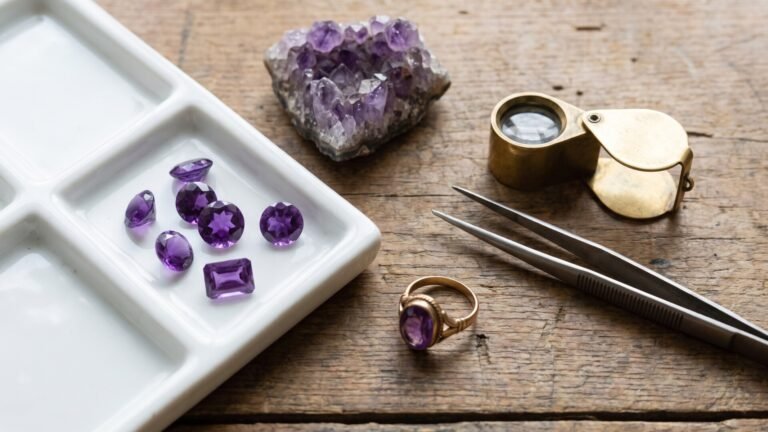
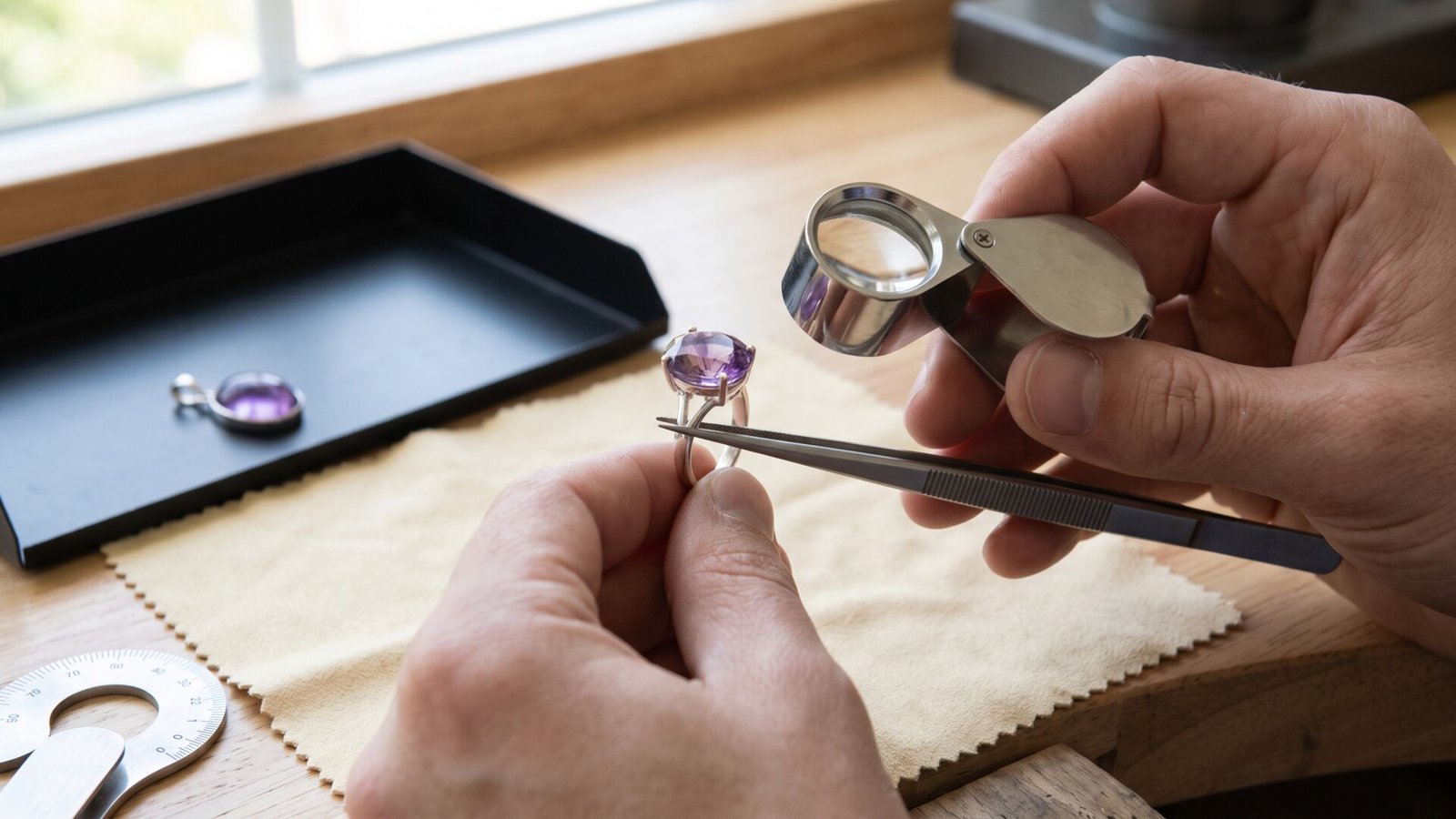
A loupe is a small magnifying lens, usually 10x, that gemologists hold close to the eye. A 10x loupe costs very little and is the single most useful tool a buyer can own. [Affiliate: Check gemstone loupe kits on Amazon]
Under magnification, glass often shows rounded gas bubbles, flow lines from the molding process, or softly rounded facet edges where the mold wore. Those are meaningful clues.
Inclusions under magnification are evidence to investigate, not a verdict. Natural, synthetic, and treated stones can all contain internal features.
One caution: do not confuse facet junctions, internal reflections, or a bit of dust on the surface with inclusions. Half of what alarms new loupe users is the stone doing exactly what a cut stone does.
Assess temperature and weight cautiously
Glass may feel different from quartz in some situations. Hand-temperature tests are unreliable, because the setting, the room temperature, and the size of the stone all affect what your fingers report.
Density and refractive index – the measure of how much a material bends light – are the tests that actually separate quartz from glass in a lab. Both require proper instruments and technique. A kitchen scale and an online comparison chart will not get you there.
These observations can give you reasons to pause. They cannot certify a stone as genuine.
The Tests That Can Damage Jewelry – And Why To Avoid Them
If a jeweler offers to scratch-test your stone, leave.
That is not a conservative position. Scratching a stone or a setting can permanently reduce its value, and the result is easy to misread anyway. Quartz ranks 7 on the Mohs hardness scale, the ten-point scale that ranks minerals by which ones can scratch which. A material harder than quartz scratches it. A material of similar hardness might scratch it or might not, depending on the piece and the pressure. You can damage a genuine amethyst and learn nothing.
Heat, flame, and chemical tests are worse. Acetone, household cleaners, and hot water can damage coatings, dyes, adhesives, and plating even when the stone itself survives. On a dyed quartz, the dye is often in the fractures. Solvent can lift it. On a foil-backed or coated imitation, you may destroy the color entirely.
Freezing, biting, tapping, and the fog test are internet methods with too many uncontrolled variables to mean anything. A stone fogs because it is cold and your breath is warm. That is physics, not gemology.
For a valuable, heirloom, antique, or unusually expensive piece, stop experimenting and get professional testing. It costs less than the mistake.
Real Amethyst, Synthetic Amethyst, Glass, or Dyed Quartz?
| Material | Common clues | Buyer risk | Best way to confirm |
|---|---|---|---|
| Natural amethyst | Possible color zoning, natural inclusions, quartz properties | Overpaying for ordinary material or undisclosed treatment | Independent gemological examination |
| Synthetic amethyst | May appear unusually clean or evenly colored; hard to identify visually | Paying a natural-stone premium | Laboratory testing when origin matters |
| Glass imitation | Bubbles, molded seams, rounded wear, glassy look | Buying an imitation presented as gemstone jewelry | Gemologist or gemological laboratory |
| Dyed quartz or other material | Color concentrated around cracks or drill holes; inconsistent disclosure | Misunderstanding durability and value | Professional identification and treatment assessment |
| Genuine amethyst with treatment | Real quartz, enhanced or heat-altered appearance | Assuming treatment makes it rare or investment-grade | Written treatment disclosure and professional report |
The most important distinction for ordinary jewelry is usually not natural versus fake. It is whether the seller accurately discloses what you are receiving.
Synthetic amethyst may be chemically similar to natural amethyst and still carry very different rarity and resale implications. A genuine stone can still be a poor purchase if its treatment, quality, origin, or pricing is misrepresented. And a glass stone honestly sold as glass fashion jewelry is not a scam at all. It is a glass stone.
What Most Buyers Get Wrong About Amethyst Authenticity
Four beliefs cause most of the bad decisions I have watched.
The first is that a real gemstone must be expensive. Amethyst is generally more accessible than many precious gemstones, so price has to be judged against size, color, clarity, cut, metal, craftsmanship, and seller reputation. A fair price for a modest stone is not a red flag. A high price for a modest stone is.
The second is that vivid purple proves superior quality. Saturated color is attractive, and it is worth paying something for. It does not make a stone rare or investment-worthy. Some of the most saturated amethyst available is synthetic, and much of the rest has been heated to deepen the color.
The third is that "natural" means untreated, exceptionally rare, and valuable. Natural means it grew in the ground. It says nothing about treatment, and amethyst is not a rare mineral. When a treatment claim affects the price, ask for it in writing.
The fourth is that certificates and seller language are interchangeable. They are not. A retailer’s card may simply identify the product and the store. An independent laboratory report is a different document with a different weight. Check who issued it and what it actually verifies. Our [Internal: gemstone certification guide] walks through how to read one properly.
How to Buy Amethyst Jewelry Without Being Misled
Evaluate the seller before the stone
Look for a clear product description, treatment disclosure, metal details, photographs that are not heavily color-corrected, and a return policy you can actually use. A seller who shows the stone on a hand in daylight, alongside the studio shot, is telling you something about how they operate.
Ask direct questions and see how they land:
- Is the stone natural, synthetic, treated, or an imitation?
- Is the color stable, or could it change with wear and light?
- What does any certificate identify, and who issued it?
- Is the report for this exact stone, or a generic one for the type?
Red flags are consistent. Unexplained "investment grade" language. Claims of guaranteed appreciation. Vague origin stories with no documentation. Pressure to buy immediately. Prices justified by supposed rarity rather than observable quality.
Match verification to the purchase price
For inexpensive fashion jewelry, focus on honest labeling, return rights, and whether you like the piece. An expensive laboratory report may cost more than the jewelry and is not worth demanding.
For a substantial purchase, an heirloom, an antique piece, or a large center stone, request an independent gemological report or pay for an examination before the return period expires. Use a laboratory or qualified gemologist with no financial interest in the sale. Organizations such as GIA set the standards that independent labs and treatment-disclosure practices are built on, and that independence is the point. A report does not guarantee value. It tells you what the material is.
Understand what the report should say
A useful report identifies the gemstone, states whether it is natural or laboratory-grown when that determination was made, notes detectable treatments, and lists the limitations of the examination.
It may not establish an exact mine origin or a future resale price unless those services were specifically requested and supported.
And match the document to the object. Check the report number, the photographs, the dimensions, and the stone description against the jewelry in front of you. A beautiful report for a different stone is worth nothing.
Which Amethyst Jewelry Still Makes Sense in Three Years?
Three buyer paths, and all three can be sensible.
Affordable natural amethyst from a transparent retailer. You get real quartz, a fair price for the quality, and a piece that will still be what it was sold as. This is the everyday value path.
Synthetic or imitation material bought knowingly for appearance. If you love the color and you are paying a glass or synthetic price, you have bought fashion jewelry at a fashion jewelry price. That is a clean transaction. It only goes wrong when the buyer pays a natural-stone premium for it.
A higher-value natural piece with independent documentation. This is the path for an heirloom, a significant gift, or anything you intend to hand down. The documentation is what makes the price defensible years later.
Durability matters in all three. Quartz sits at 7 on the Mohs scale, which is reasonable for a ring, earrings, or a pendant. But rings take far more impact and abrasion than earrings and pendants, and a ring worn daily will show wear at the facet edges over years. Protective settings and regular inspection matter more than the stone’s hardness number. Our [Internal: gemstone jewelry care guide] covers what to check and how often.
| Buyer | Best choice | What to insist on |
|---|---|---|
| Everyday value | Disclosed natural amethyst, well-made setting | Treatment disclosure and returns |
| Appearance on a strict budget | Clearly labeled synthetic or glass | Labeling and a price that matches |
| Heirloom purchase | Natural amethyst, documented | Independent report and stable color |
Avoid any piece whose seller refuses to identify the material, leans on urgency, invents rarity, or promises investment returns. That is true regardless of the price.
What Happens to This Piece in Thirty Years
Think about the end of the story, not the beginning.
The glass ring you bought knowingly for $40 will still be a glass ring, and if it was labeled honestly, nobody will feel cheated by it. The synthetic stone sold to you as natural will be a small grievance you carry, or one your daughter carries when she has it appraised. The natural amethyst with a report and a straight description will be exactly what the paperwork says, and it will still be wearable if the setting was good and someone checked the prongs every few years.
That is the real difference between these purchases. Not the color. The paper trail and the honesty behind it.
So the rule is three steps, in order. Inspect without damaging anything, and treat what you see as clues rather than proof. Verify the seller’s claims and the return policy before you pay. And when the price or the emotional weight justifies it, get independent testing from someone with no stake in the sale.
An affordable piece is not automatically suspicious. An expensive piece is not automatically genuine. The only thing that reliably separates them is whether someone put it in writing and stood behind it.
If you are still deciding what to buy, the [Internal: amethyst buying guide] covers quality and pricing in detail, and our [Internal: amethyst birthstone guide] explains where the stone sits in the traditional birthstone systems. Start there before you start shopping.
Frequently Asked Questions About Spotting Fake Amethyst Jewelry
Can you tell if amethyst is real by looking at it?
Visual inspection can reveal warning signs such as bubbles, molded seams, or suspicious color concentration, but it cannot reliably prove natural origin. For a valuable piece, professional testing is the right call.
Is synthetic amethyst fake?
Synthetic amethyst is laboratory-grown quartz rather than natural amethyst. It is not glass, but it should be disclosed, because its rarity, origin, and resale appeal differ from natural material.
Does real amethyst have bubbles?
Natural amethyst may contain inclusions, but obvious rounded gas bubbles are more consistent with glass. Their absence does not prove a stone is natural.
Is dark purple amethyst more valuable?
Not automatically. Color quality matters, but value also depends on saturation, undesirable brown or gray tones, zoning, clarity, cut, size, treatment, and the quality of the setting.
Can a jeweler test amethyst?
A qualified jeweler or gemologist can perform useful identification tests, though certainty depends on the equipment and whether the stone is loose or mounted. For a major purchase, seek an independent laboratory report.
Should amethyst jewelry come with a certificate?
Not for every inexpensive piece. For a costly, unusually large, antique, or investment-oriented purchase, independent documentation helps establish what the stone is and whether treatments were detected.
Can fake amethyst damage your skin?
The gemstone itself is usually not the concern. Irritation is more likely from the metal, plating, adhesives, dyes, or undisclosed materials. If you have sensitivities, verify the metal composition and stop wearing the piece if irritation appears.
Does a loupe prove a stone is natural?
No. A loupe shows you clues. It can reveal bubbles or flow lines that point to glass, and it can show you inclusions worth investigating. It cannot establish natural origin on its own.