Burmese vs Mozambique Rubies: Color, Origin and Value
I had a customer once who spent eleven thousand dollars on a Burmese ruby ring without asking a single question about treatment. She asked about the origin four times. The stone was lead-glass filled. The origin was genuine. Both things were true at once, and only one of them mattered to what she actually owned.
Neither origin automatically produces the better ruby. Exceptional Burmese stones carry the greatest prestige in the trade. Fine Mozambique rubies can deliver vivid, saturated red at a price that leaves room for a better setting, a bigger stone, or a proper laboratory report. The comparison gets difficult because origin, treatment, color language, and laboratory confidence all move the number, and sellers know exactly which lever to pull. Your real decision is simpler than the marketing: pay for recognized provenance and rarity, or secure the strongest visible beauty and documented quality your budget can reach.
The Short Verdict: Which Ruby Is Better for Which Buyer?
Choose a Burmese ruby when historical prestige, collector appeal, and access to the top auction tier matter to you, and when the stone is natural, untreated, vividly red, and backed by a respected laboratory report. Choose a Mozambique ruby when strong red color, larger size, and value relative to the origin premium matter more than the cachet of Myanmar provenance.
A fine Mozambique ruby beats a mediocre Burmese ruby every time. That sentence would have gotten me in trouble behind the counter, and it is the most useful thing in this article. Heavily treated, dark, or lifeless Burmese material carries a famous name and nothing else. Buyers pay for the name and wear the stone.
| Buying priority | Better starting point | Important qualification |
|---|---|---|
| Maximum origin prestige | Burmese ruby | Requires credible origin evidence |
| Best color for the money | Mozambique ruby | Compare treatment and saturation |
| Collector-grade rarity | Burmese ruby | Untreated examples are especially scarce |
| Larger vivid red stone | Mozambique ruby | Size alone does not establish value |
| Lower origin premium | Mozambique ruby | Fine color and transparent disclosure still matter |
| Investment-quality purchase | Either | Quality and documentation matter more than the label |
What Burmese and Mozambique Ruby Actually Mean
"Burmese ruby" means ruby mined in Myanmar, the country the trade called Burma until 1989. The name carries a powerful association with classic saturated red stones, and that association has been building for well over a century. Myanmar’s famous deposits, particularly the Mogok region, produced material that set collector expectations for what fine ruby should look like. Historical supply, scarcity of fine untreated material, and longstanding auction recognition all feed the premium.
Not every ruby from Myanmar is exceptional. Most are not. An origin report identifies geological origin. It does not guarantee color, clarity, treatment status, or value. That distinction is where buyers lose money, and it is worth reading the full picture of ruby properties and value before you shop, because origin is one line on a report and the rest of the page matters more.
Mozambique ruby: the modern supply story
Mozambique became a major source of gem-quality ruby largely through the Montepuez area in the north of the country, with significant production emerging in the late 2000s. Mine location is a geological fact. A commercial brand name attached by a seller is marketing, and the two should not be confused.
Mozambique materially expanded the availability of attractive red rubies, including sizes and qualities that are genuinely difficult to find from older sources. That increased supply can reduce the origin premium for comparable stones. It does not make fine Mozambique rubies common. Top-color, untreated Mozambique material in larger sizes is scarce and priced accordingly.
Why origin reports are not automatic
Origin determination is a laboratory opinion based on gemological evidence, including internal inclusions and trace-element patterns, that indicates where a stone likely formed. It is an opinion, not a certificate of birth. Laboratories can and do state "inconclusive" when the evidence does not support a confident call, and an honest lab will say so rather than guess.
A laboratory origin opinion is not the same thing as a seller’s mining-region claim. For expensive stones, insist on a report from a respected laboratory, with the laboratory named clearly on the document. GIA, SSEF, Gübelin, and AGL are the names that carry weight in this trade. If a seller says "Burmese" and cannot produce one of those reports, you are being asked to pay a premium for a story.
Color: Burmese Red Versus Mozambique Red
Color decides more purchases than origin ever will. A wearer looks at a stone every day and sees red, not a country.
How to compare ruby color properly
Three dimensions do the work. Hue is the basic color impression, such as red with a slight purple or pink influence. Tone is how light or dark the stone is. Saturation is the strength and richness of the color. Strong commercial and collector demand centers on vivid, balanced red, not simply the darkest stone in the tray.
A dark ruby with weak brightness looks dead on the hand. A well-cut, lively stone at a lighter tone can look more valuable and more beautiful than a darker one with heavy extinction, which is the trade term for areas of the stone that go black because light is not returning to the eye. Cut quality drives this, and cut is the factor sellers discount most often because it is hard to put on a price tag.
Typical Burmese color profile
The traditional Burmese appearance is vivid red to slightly purplish red, often with strong fluorescence, the property that makes a stone seem to glow in daylight. That fluorescence can enhance visual life, and collectors have prized it for generations.
"Pigeon blood" is the phrase you will hear. Treat it carefully. It is a commercial and laboratory color description, not a standardized guarantee of quality, and different laboratories and sellers apply it with different strictness. If you want to understand how premium color language works across the trade, the comparison of pigeon blood ruby and royal blue sapphire investment grades is worth your time. But the practical instruction is simpler: discuss the actual face-up appearance, tone, saturation, fluorescence, and treatment. Never accept the phrase alone.
Typical Mozambique color profile
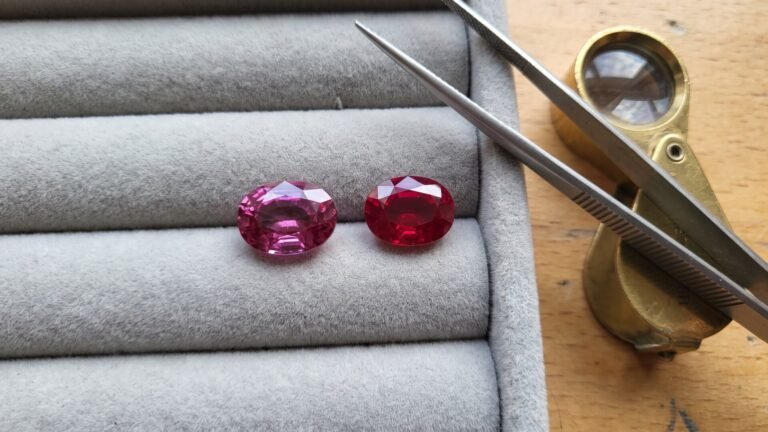
Mozambique rubies produce saturated red, red-pink, purplish red, and darker red appearances depending on the deposit and the individual stone. The best Mozambique material can visually compete with Burmese ruby in a side-by-side comparison. Commercial-quality material may show weaker saturation, darker tone, or more visible inclusions.
Origin cannot substitute for looking at the stone under neutral lighting. Ask for it. A seller who cannot show you a ruby in daylight, away from the warm spotlights that flatter every red stone, is not showing you the ruby you will wear.
| Factor | Burmese ruby | Mozambique ruby | Buyer implication |
|---|---|---|---|
| Common market association | Classic vivid red and strong prestige | Broad range of red qualities and sizes | Inspect the actual stone, not the origin alone |
| Best material | Rare, saturated red with strong life | Fine saturated red can be highly competitive | Exceptional examples from either source are scarce |
| Fluorescence | Often discussed as a positive visual feature | Can also occur, but varies by stone | Fluorescence should support beauty, not replace it |
| Risk of misleading color language | “Pigeon blood” used too loosely | “African pigeon blood” may be marketed aggressively | Require laboratory and visual evidence |
| Value of color | Usually drives the greatest premium | Can offer strong value before origin premium | Color and treatment should lead the comparison |
What Most Buyers Get Wrong About Origin and Value
Here is the quality-over-origin rule: a vivid, transparent, well-cut Mozambique ruby with acceptable treatment is a better purchase than a dull, heavily included, or extensively treated Burmese ruby. Every time. The trade knows this. The marketing does not say it.
Origin premiums cause buyers to overpay for mediocre stones carrying a prestigious label. I have watched a man pay a Burmese premium for a stone so heavily included it looked cloudy in the case, because the report said Myanmar and he had decided that was the point. It was not the point. He bought a country and got a weak ruby.
The opposite mistake is just as expensive. Assuming Mozambique means inexpensive commercial material leads buyers to undervalue fine stones and sellers to exploit the assumption. The finest Mozambique rubies command substantial prices because rarity is determined by quality, size, treatment, and demand, not by a map.
| Situation | More sensible choice |
|---|---|
| You want a meaningful red gemstone for regular jewelry and care about appearance first | Fine Mozambique ruby with transparent treatment disclosure |
| You are building a provenance-focused collection | Well-documented Burmese ruby |
| Your budget only supports a dark or heavily treated Burmese stone | Consider a better-colored Mozambique ruby |
| You want an investment-grade stone | Compare both origins through laboratory reports and specialist valuation |
| You are buying primarily because a seller uses “pigeon blood” | Pause and verify the report, treatment, and actual color |
Treatment, Clarity and Certification: The Value Factors That Matter Most
Treatment disclosure outweighs the origin headline. This is the section that saves you money.
Heat treatment and untreated status
Heat treatment is controlled heating used to improve ruby color and clarity. It is common in the trade, it is centuries old, and it does not automatically make a ruby fraudulent or undesirable. A well-heated stone with beautiful color is a legitimate purchase at a fair price.
The distinctions that matter: heated ruby, unheated ruby, and ruby with indications of lead-glass filling or other clarity enhancement. Unheated status can command a major premium when the stone is attractive and a respected laboratory supports the conclusion. That premium is real and defensible. What is not defensible is a seller calling a stone "natural" to imply unheated when the report says otherwise. If you want to learn the verification process properly, how to tell whether a ruby is heat treated or natural walks through it.
Lead-glass filling and heavily enhanced ruby
Lead-glass-filled ruby should never be priced like fine natural ruby. The treatment can dramatically alter apparent clarity by filling fractures with glass, and it creates real durability, cleaning, repair, and resale problems. A glass-filled stone can look like a clean ruby and behave like a fragile one.
Be wary of vague phrases: "clarity enhanced," "natural-looking," "permanent enhancement." None of these are full treatment statements. Sellers should disclose treatment in writing, and valuable purchases require an independent report before payment is final. If a jeweler offers to scratch-test your stone to prove it, leave. Scratch testing tells you almost nothing useful about ruby and risks damage.
Clarity and inclusions
Ruby almost always contains inclusions, the internal features that form as the crystal grows. Inclusion-free material is unusually rare and priced as such. The question is not whether a stone has inclusions but which ones and where.
Acceptable internal character is one thing. Fractures that reach the surface, cavities, heavily disrupted transparency, and inclusions that weaken durability are another. A modestly included stone with superb color is more desirable than a clean but grayish or lifeless one. That trade-off is the heart of buying ruby well, and most buyers get it backwards because clarity is easier to see than saturation.
Certification checklist
- A report that identifies the material as natural ruby and states detected treatments.
- Origin determination when the Burmese or Mozambique claim materially affects price.
- A clear statement such as "no indications of heating," or another conclusion explained in plain terms.
- The report number matched to the stone, and an independent appraisal for high-value or investment-oriented purchases.
A report is an opinion about the stone. It is not a guarantee of resale value, and no laboratory will promise you one.
Price and Value: How Burmese and Mozambique Rubies Compare
Burmese origin can add a premium when the stone is fine, especially for natural-looking, vivid, untreated material with credible origin documentation. Mozambique rubies often offer better size or color per dollar because the origin premium is lower for comparable commercial qualities.
Treatment, carat weight, color, clarity, cut, fluorescence, report quality, and market timing can each move prices more than origin alone. A two-carat unheated stone with a GIA report is a different financial object from a two-carat heated stone with no report, and the gap between them is larger than the gap between origins at the same quality.
| Ruby profile | Typical market position | Main value driver |
|---|---|---|
| Commercial ruby with visible inclusions or significant treatment | Lower-priced jewelry category | Appearance and treatment disclosure |
| Attractive heated Mozambique ruby | Mid-market fine jewelry | Color, size, cut, and transparency |
| Fine heated Burmese or Mozambique ruby | High-value jewelry | Strong color and comparatively good clarity |
| Fine ruby with no indications of heating | Premium collector category | Natural beauty plus rarity |
| Exceptional Burmese ruby with strong color and documentation | Top collector and auction category | Rarity, provenance, quality, and demand |
Cost-per-beauty framework
Compare the visible face-up color and liveliness you receive for your total budget, not the carat weight on the tag. A smaller, brighter stone is frequently the smarter purchase. A larger dark stone is a stone you will stop wearing.
Prioritize color and treatment disclosure. Then cut and clarity. Then, and only then, pay a premium for origin. Retail prices vary enormously between sellers, and a laboratory report does not guarantee a specific resale price. It guarantees that you know what you bought.
Durability, Jewelry Use and Long-Term Ownership
Ruby is durable enough for many ring, pendant, and earring applications. It sits at 9 on the Mohs hardness scale, second only to diamond among common gemstones. But inclusions, fractures, cavities, and treatment change practical durability, and origin changes none of it.
Judge daily-wear suitability by stone condition, not source. A sound, well-cut ruby from either origin works well in a ring worn every day. A heavily fractured or glass-filled ruby requires much more caution, whatever its report says about where it formed. If you are moving from loose-stone comparison toward a finished piece, what to look for in high-end ruby jewelry covers setting and construction decisions.
Cleaning should follow the report and the seller’s treatment disclosure. Do not assume every treated ruby is safe for steam, ultrasonic cleaning, heat, or repair work. Glass-filled stones in particular can be damaged by jeweler’s torches during a simple resizing, and that repair can turn a filled fracture cloudy.
Here is the hidden cost nobody quotes you. The less expensive stone can become the more expensive ownership choice. A treated ruby that complicates resizing, repair, cleaning, or insurance costs more over twenty years than a slightly pricier sound stone that never causes a problem.
Which Ruby Still Makes Sense in Three Years?
Fine ruby can be a store-of-value purchase, but only at a high quality level: natural material, strong color, credible documentation, and a realistic understanding of liquidity. Below that level, it is jewelry, and jewelry is priced for wearing, not for selling.
Gemstone resale is not automatic. Retail purchase prices include margins that are difficult to recover immediately, and a private seller rarely gets the retail number back. Burmese provenance is the stronger collector signal. Mozambique’s advantage is buying visible quality without paying the same origin premium, which matters if you plan to enjoy the stone rather than flip it.
Auction headlines represent exceptional stones. They are not a guide to what an ordinary retail ruby will return. Do not let a record-setting sale at Sotheby’s convince you that a mid-market stone is an investment.
The heirloom test
Choose the stone with durable beauty, transparent treatment history, a secure setting, and documentation a future owner can understand. That last point is underrated. A documented Mozambique ruby may become a stronger heirloom than an undocumented Burmese stone, because the grandchild who inherits it can verify what they have. A famous name with no paperwork is a rumor by the second generation.
Keep the laboratory report, purchase invoice, treatment disclosure, appraisal, and care instructions together. If you want the historical and symbolic layer that makes a ruby worth handing down in the first place, the history and symbolism of ruby gives you that context.
Buying Recommendations by Budget and Buyer Type
Best choice for a beauty-first buyer
A vivid, well-cut Mozambique ruby with disclosed heat treatment, when budget efficiency matters. Prioritize face-up red color, brightness, and durability over a prestigious but weak origin claim. You will look at this stone far more often than you will explain where it came from.
Best choice for a provenance-focused collector
A Burmese ruby with a respected origin report, clear treatment disclosure, and an attractive color profile. "Burmese" alone is not enough. The stone should justify its premium through rarity and quality, and if it does not, walk.
Best choice for a budget-conscious gift buyer
Compare smaller fine-color rubies from both origins rather than increasing size at the expense of color. A one-carat vivid stone outclasses a two-carat muddy one in every conversation that matters. Avoid lead-glass-filled stones entirely when the purchase is meant to last across generations. If the occasion is a fortieth anniversary, the guide to buying a 40th anniversary ruby maps the gift decision properly.
Best choice for a serious collector
Independent laboratory review before purchase, specialist appraisal, and seller documentation covering treatment, return rights, and insurance value. An exceptional unheated ruby from either origin deserves closer consideration than a merely average stone from a famous source. That is the sentence to carry into the showroom.
| Buyer | Recommended option | Why |
|---|---|---|
| Wants the best appearance per dollar | Fine Mozambique ruby | Often lower origin premium |
| Wants maximum historical prestige | Fine Burmese ruby | Strongest traditional provenance appeal |
| Wants an everyday heirloom | Well-documented ruby from either origin | Condition and treatment determine durability |
| Wants collector rarity | Untreated Burmese ruby, or exceptional untreated Mozambique ruby | Unheated status and quality matter most |
| Wants lower buying risk | Any ruby with an independent report | Documentation limits misleading claims |
Frequently Asked Questions About Burmese Vs Mozambique Rubies
Is Burmese ruby better than Mozambique ruby?
Not automatically. Burmese ruby has greater traditional prestige and can command a larger premium, but a fine Mozambique ruby may have better color, size, or value than a mediocre Burmese stone. Judge the individual stone.
Are Mozambique rubies real rubies?
Yes. Mozambique produces natural corundum with the red color required to be classified as ruby. The important questions are the individual stone’s color, treatment, clarity, and laboratory documentation.
Why are Burmese rubies more expensive?
Fine Burmese rubies benefit from historical demand, recognized provenance, limited availability of exceptional material, and strong collector interest. The premium is justified only when the stone’s quality and origin are both credible.
Can a Mozambique ruby be pigeon blood red?
A Mozambique ruby may show vivid saturated red color, but “pigeon blood” is a commercially sensitive description. Do not accept it without understanding the laboratory terminology, the actual color appearance, and the treatment behind the claim.
Which origin is better for investment?
Neither origin guarantees investment performance. A natural, attractive, well-documented ruby with strong color and limited treatment is more investable than a lower-quality stone chosen only for its origin label.
Are heated Burmese and Mozambique rubies worth buying?
They can be worthwhile when the treatment is fully disclosed, the price reflects it, and the stone remains attractive and durable for its intended use. They should not be priced like comparable unheated rubies.
How can I verify whether a ruby is Burmese or from Mozambique?
Use an independent report from a respected gemological laboratory that offers origin determination. A seller’s description, mine name, or marketing phrase is not equivalent to laboratory evidence.
Does a certificate guarantee my ruby is worth what I paid?
No. A report confirms identity, treatment status, and sometimes origin. It says nothing about retail margin or resale value. Treat it as evidence about the stone, not a price endorsement.
Burmese is the prestige choice when rarity, provenance, and collector appeal justify the premium. Mozambique is often the value choice when you want vivid color and strong size without paying as much for a country name. Compare the stone’s actual color, treatment, clarity, cut, durability, and report before you compare country names, and the decision usually makes itself. The ruby that survives forty years and lands on a grandchild’s hand will be the one with honest paperwork and a body sound enough to take daily wear, not the one whose label impressed the buyer on the day of purchase.