Can You Wear Gemstone Rings While Washing Your Hands?
Most gemstone rings will survive a quick handwash at a public sink. That is the honest answer, and it is also where the trouble starts, because "survived a handwash" and "safe for a lifetime of handwashing" are two different claims, and the jewelry trade has gotten very comfortable blurring them.
Here is what I mean. People come to the counter with a ring they’ve worn through a thousand handwashes, and the stone still looks fine, so they assume the ring is waterproof. No gemstone ring is waterproof. That word belongs to watches. What they have is a ring that hasn’t failed yet. The soap film is dulling the pavé, one prong has been quietly bending for two years, and the next time they knock it against a faucet, the stone is gone down the drain.
So the practical rule is this: if the stone is porous, fracture-filled, heavily treated, soft, or valuable enough that losing it would ruin your week, take it off before you wash your hands. Everything else depends on the stone, the treatment, the setting, and how often the ring actually gets wet.
Can You Wash Your Hands While Wearing a Gemstone Ring?
A single handwash is not the enemy. A hard, untreated stone in a sound setting will tolerate brief contact with ordinary tap water, and if that is the whole question, the answer is yes.
Repeated daily exposure is a different animal. Constant wetting and drying leaves mineral and soap residue behind, and that residue collects in the places you can’t see: under the girdle, between prongs, in the drill hole of a bead-set ring. Over months it dulls the stone and makes the ring harder to clean properly, because now you’re trying to remove old soap with new soap.
Water is rarely what does the damage. Soap is. So is the friction of a ring against a sink basin, and the temperature swing when you go from hot water to cold, and the moment your wet fingers let a slightly-too-large ring slip off the knuckle. Water is the stage; the other things are the actors.
That is why I tell people to think about the setting before the stone. A well-set diamond in a sturdy four-prong mount is one thing. The same diamond in a delicate antique mount with worn prongs is a stone waiting to be lost, and handwashing is exactly when it happens. You can read more about how different stones behave in the complete guide to gemstones if you want the broader context before you decide.
There is also the metal to consider. Wet hands are slippery hands. A ring that fits snugly when dry can rotate or slide when it’s soapy, and that rotation is how stones get knocked against the faucet or the edge of the basin. Rubbing a ring against a hard surface during handwashing is a real impact risk, and impact is what chips stones, not water.
The practical decision rule I give people is short. Durable stone, secure setting, ordinary handwash: leave it on if you want. Antibacterial products, harsh cleaners, hot water, or vigorous scrubbing: take it off. And if you’re not sure which category your ring falls into, take it off. It costs you three seconds.
Quick decision table
| Ring type | Brief handwashing | Daily exposure | Safer habit |
|---|---|---|---|
| Diamond or sapphire in a secure setting | Usually acceptable | Generally manageable with cleaning | Inspect setting and dry thoroughly |
| Ruby, spinel, or durable garnet | Usually acceptable | Usually manageable, depending on treatment | Avoid harsh chemicals and impacts |
| Emerald, opal, pearl, turquoise, or moonstone | Not recommended as a routine habit | Higher risk | Remove before washing |
| Fracture-filled or surface-treated stone | Avoid when possible | Not advisable | Follow the jeweler’s care instructions |
| Loose, cracked, or visibly damaged ring | Avoid | Unsafe | Have it inspected before wearing |
Which Gemstones Are Safest Around Water?
Two words get used interchangeably that shouldn’t be. Hardness is resistance to scratching, measured on the Mohs scale. Toughness is resistance to breaking or chipping. A stone can be hard and still be brittle, which is why hardness alone tells you almost nothing about whether a ring is safe around water, soap, and a bathroom sink.
Diamond sits at the top of the Mohs scale and is about as hard as a gemstone gets. Sapphire and ruby, both corundum, sit just below it. None of them is indestructible. A diamond can chip at a vulnerable point, and a sapphire can crack if it takes a hard enough hit against a countertop. What makes them practical for daily wear is the combination of hardness, reasonable toughness, and the fact that they don’t dissolve, absorb, or react to water and mild soap.
If you want the numbers explained properly, the gemstone hardness scale is worth reading before you buy anything you plan to wear every day.
Rubies, spinel, and many garnets are reasonably durable for ordinary wear, with caveats. Inclusions and existing fractures matter. Heat treatment is common and usually stable, but it isn’t nothing. Setting design matters just as much: a spinel in a bezel is a different proposition from a spinel in a high-profile prong setting that catches on everything.
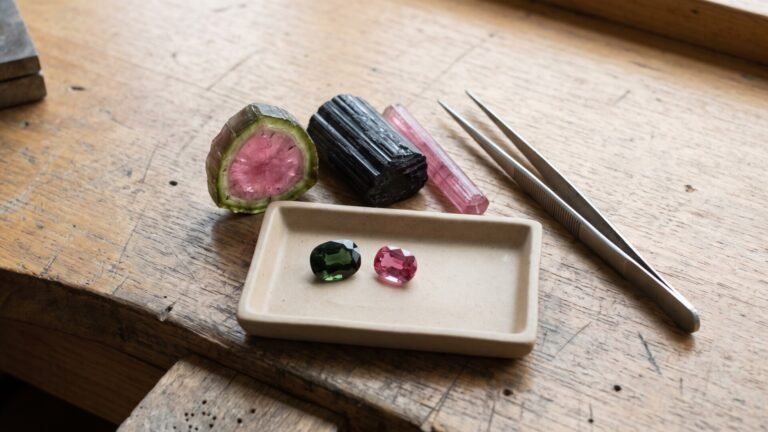
Tourmaline sits in a middle zone. Many tourmalines are fine for ordinary wear, but some are more included or more brittle than others, and a tourmaline ring that gets wet every day needs more attention than a sapphire.
Here is the part most care guides skip: "safe around water" does not mean safe around chlorine, bleach, abrasive cleaners, or prolonged soaking. A swimming pool is not a handwash. A long soak in a cleaning solution is not a rinse. The stone that shrugs off tap water can still be damaged by the chemistry in a bathroom cleaning product, and that is true of stones that are otherwise perfectly durable.
Stone-by-stone guidance
| Gemstone | Handwashing guidance | Main concern |
|---|---|---|
| Diamond | Usually fine for brief washing | Soap film, loose settings, impact |
| Sapphire | Usually fine for brief washing | Treatment, setting wear, residue |
| Ruby | Usually fine if securely set | Fractures, treatment, impact |
| Amethyst | Occasional brief contact is usually manageable | Heat, chemicals, fading concerns, residue |
| Aquamarine | Brief contact is often manageable | Scratching, chips, treatment, impact |
| Emerald | Remove as a routine precaution | Fractures, oil treatment, chemicals |
| Opal | Remove | Porosity, crazing, dehydration and sudden changes |
| Pearl | Remove | Soft nacre, soap, moisture around the drill hole |
| Turquoise | Remove | Porosity, discoloration, chemicals |
| Moonstone | Prefer removal | Cleavage, scratching, impact |
| Tanzanite | Prefer removal | Lower toughness and sensitivity to heat or impact |
| Peridot | Limit routine exposure | Scratching, inclusions, chemicals |
Why Soap, Sanitizer, and Cleaning Products Matter More Than Plain Water
Soap and lotion leave a film. That film is the single most common reason a ring that was brilliant at the counter looks tired six months later. It coats the pavilion of the stone, traps dust and skin cells underneath, and builds up in the tight spaces around prongs and in halo and pavé settings where a cloth can’t reach.
Closed-back settings are the worst offenders. A ring with a solid back behind the stone gives soap and water nowhere to drain, so residue collects and stays. I’ve seen rings come in for cleaning where the underside of the stone was essentially coated in old hand cream.
Then there’s hand sanitizer, which is not the same as soap. Alcohol-based sanitizer may not dissolve a gemstone on contact, but repeated exposure can affect some finishes, coatings, porous materials, adhesives, and the metal components around a stone. It also dries out skin, which changes how a ring fits, and a ring that spins more freely is a ring more likely to catch on something. If you use sanitizer regularly, the safer habit is to remove the ring first and let your hands dry before you put it back on.
Bleach, bathroom cleaner, ammonia, disinfectant sprays, and abrasive hand scrubs are a different category entirely. These are not "rinse it off later" products. Remove the ring before you clean, full stop. A splash of bleach on a porous stone or a treated emerald is not something you fix with a rinse.
One more thing worth saying plainly: "green," "non-toxic," and "gentle" on a label do not make a cleaning product jewelry-safe. Those words describe how the product behaves in a drain, not how it behaves on a treated gemstone. Read the ingredients and follow the jeweler’s care instructions for the specific piece. If you also worry about daily exposure to personal-care products, how perfume, lotion, and hairspray affect gemstones covers that side of the problem.
The Gemstones and Ring Settings You Should Remove First
Some stones are routinely described as "delicate," which is too vague to be useful. Here is what is actually going on with each.
Pearls are soft nacre, layer by layer, and soap and moisture work into the drill hole and around the setting. A pearl ring worn through daily handwashing will dull and yellow faster than one that comes off first. If you own pearls, the pearl guide is a good place to understand what you’re protecting.
Opals are porous and contain water, and they are sensitive to sudden changes in moisture and temperature. Crazing, the network of fine cracks that can develop in an opal, is a real risk, and repeated wetting and drying is exactly the kind of stress that makes it worse. Opal owners should read how to clean an opal ring with crazing risk before they clean anything.
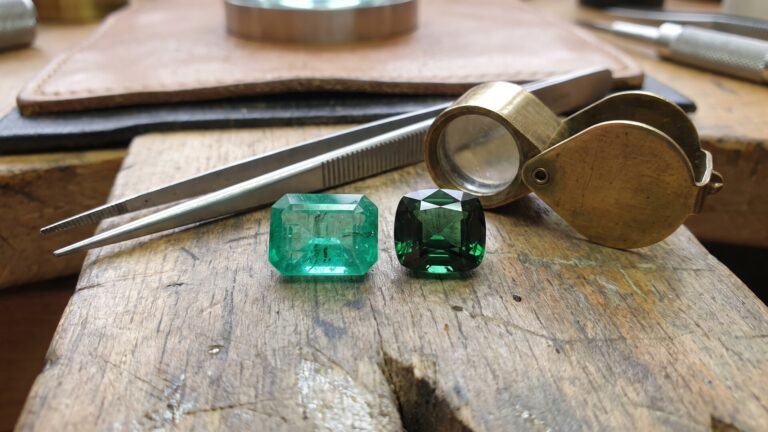
Emeralds deserve their own paragraph. Many emeralds are clarity enhanced with oil or resin, and that treatment is part of what makes the stone look the way it does. Repeated exposure to chemicals, heat, or aggressive cleaning can compromise the treatment or make existing fractures more noticeable. An emerald is not a stone to wear through a bathroom cleaning session, and it is not a stone to leave on at the sink as a habit.
Turquoise is porous and can discolor with exposure to chemicals, oils, and moisture. Moonstone has cleavage, meaning it breaks along flat planes, and it scratches and chips more easily than its appearance suggests. Tanzanite has lower toughness and is sensitive to heat and impact, so a knock against a faucet is a real concern. Peridot scratches and has inclusions that can make it more vulnerable than its Mohs number implies.
The setting can make a durable stone vulnerable. Loose prongs, exposed corners, delicate pavé, thin bands, open-backed settings, and antique mounts with weakened metal all raise the risk regardless of what stone is sitting in them. A diamond is only as safe as the metal holding it.
If you’re a birthstone-ring owner and not sure where your stone falls, which birthstones should never be exposed to water sorts them by risk.
Here is the checklist I give people. Remove the ring immediately if you see a visible crack, a loose stone, a lifted prong, or hear a rattling sound. Remove it after any recent impact, if the treatment is unknown, or if the ring has already caught on clothing. That last one is the earliest warning sign most people ignore.
What Most Buyers Get Wrong About "Water-Safe" Gemstone Jewelry
The first wrong assumption is that hardness equals durability. It doesn’t. A hard stone can chip at a vulnerable facet junction, loosen in a worn setting, or react badly to chemicals and heat. Diamond is the hardest gemstone and still breaks.
The second is that lab-grown and natural versions of the same gemstone need different care. Generally they share the same basic physical properties, because they are the same material. What changes the care requirements is treatment, inclusions, and setting quality, not origin. A lab-grown emerald with the same fractures and the same oil treatment needs the same caution as a natural one.
The third is trusting retailer language. "Waterproof," "everyday safe," and "shower-proof" are marketing phrases, not gemological terms, unless the seller specifies the stone, the treatment, the metal, the setting, and the limits of the claim. If a listing says "waterproof" and nothing else, that listing is telling you nothing.
The fourth is assuming price buys safety. It doesn’t. A valuable emerald or an antique ring may need more conservative care than a modest sapphire ring, because treatment and construction matter more than the number on the tag. Expensive jewelry is not automatically more robust; sometimes it is more fragile precisely because the maker prioritized beauty over toughness.
Before you buy, ask the seller four questions:
- Is the stone treated, and how?
- Is it porous or fracture-filled?
- Can it tolerate routine water and soap?
- How often should the setting be inspected?
If the seller can’t answer those, that is your answer.
How to Wash Your Hands Safely When You Keep the Ring On
Use lukewarm water, mild soap, and gentle pressure. Skip the very hot water, the abrasive scrubbing, and the chemical-heavy products. Hot water and harsh soap are harder on both the stone and the skin under the ring.
Rinse underneath the setting without twisting or pulling the ring. Don’t push soap into delicate pavé or prong areas with a fingernail; you’re more likely to loosen a stone than clean it. Let the water do the work.
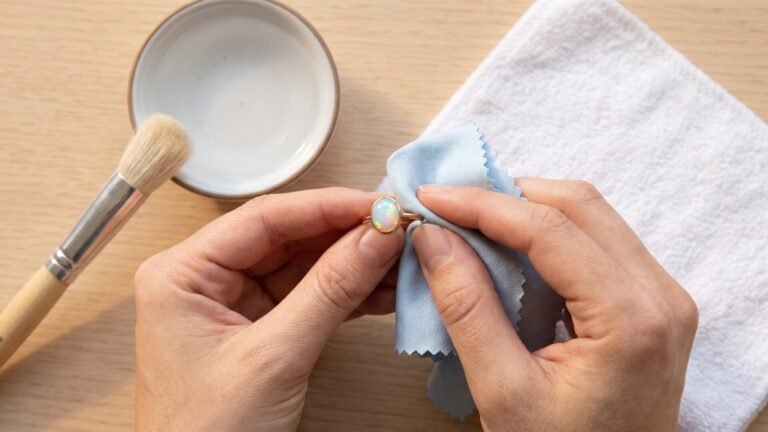
Then dry properly. Rinse thoroughly, blot with a soft lint-free cloth, and let moisture leave the underside of the setting before you apply lotion or sanitizer. A rough towel or a tissue can catch on prongs, so use something smooth. If you want the right tools, a [Affiliate: soft lint-free jewelry cloth] and a [Affiliate: covered ring dish] are worth keeping by the sink.
The sink-loss risk is real and it is the most common way people lose rings. If you’re going to remove the ring, put it in a small lidded dish or a pouch away from the drain, not on the basin edge where one nudge sends it down. A [Affiliate: travel ring pouch] solves this when you’re not at home.
Have rings worn daily inspected professionally on a regular schedule, especially prong-set stones, antique rings, engagement rings, and anything showing visible wear. A jeweler can tighten a prong in minutes; replacing a lost stone is a different conversation.
What not to do
- Do not use bleach, chlorine, abrasive powders, or household disinfectants as a substitute for jewelry cleaning.
- Do not dry a ring with a rough towel or tissue that can catch on prongs.
- Do not reach for an ultrasonic cleaner just because a ring looks dull. Inclusions, treatments, and fragile stones can make ultrasonic cleaning unsafe, and which gemstones are safe for ultrasonic cleaning explains why before you try it.
- Do not force a ring off a swollen finger. Cool the hand, use lubrication if appropriate, and get professional help if it becomes painfully tight.
Which Option Still Makes Sense in Three Years?
Think about the ring three years from now, not the day you buy it. The question isn’t whether it survives this week’s handwashing. It’s whether it’s still sound after a thousand of them.
Best for daily wear and frequent handwashing: diamond, sapphire, or ruby in a secure, inspectable setting. These are the stones that tolerate the habit.
Best for occasional wear: emerald, aquamarine, amethyst, garnet, and tourmaline, when the wearer is willing to remove the ring for cleaning and chemicals.
Best for sentimental or heirloom pieces: conservative wear, planned inspections, and removal before all wet or chemical exposure. An heirloom ring’s job is to outlive you, and that job is easier if you don’t test it.
Best for low-maintenance buyers: a durable stone in a protective setting with a simple band, rather than a porous stone in a delicate halo.
There is a hidden cost to choosing a ring that can’t tolerate your habits. More frequent cleaning. Treatment repairs. Replacing worn prongs. A higher chance of losing the stone entirely. None of that shows up on the price tag, and all of it shows up over the years. If you’re also wondering about longer exposure than a handwash, showering with gemstone jewelry covers the stone-by-stone picture.
The heirloom point is the one I’d underline. A ring that survives its future owners is protected by habits established now, not by a marketing claim about everyday wear. The grandchild who inherits it will never know you took it off before washing your hands. They’ll just have a ring that’s still intact.
So the buying decision resolves cleanly. If you refuse to remove jewelry while washing, choose a well-set diamond, sapphire, or ruby after confirming treatment and setting condition. If you’re set on a pearl, opal, emerald, turquoise, moonstone, or tanzanite ring, removal before washing is the clear recommendation, and the ring should be bought with that habit in mind.
Frequently Asked Questions About Washing Hands With Gemstone Rings
Can you wash your hands with a diamond ring on?
Usually, yes, if the diamond is secure and the ring isn’t exposed to harsh cleaners. Rinse away soap, dry underneath the setting, and have the prongs checked periodically. The diamond will be fine long after the setting needs attention.
Is it better to remove a gemstone ring before washing your hands?
For vulnerable or treated gemstones, yes. Removal matters most for pearls, opals, emeralds, turquoise, moonstone, and tanzanite, and for any ring with a loose stone or weakened setting. For a secure diamond or sapphire, it’s a judgment call.
Can hand sanitizer damage a gemstone ring?
Repeated exposure can leave residue and may be unsuitable for certain stones, treatments, finishes, or jewelry components. Remove vulnerable rings before applying sanitizer and follow the care instructions for the specific piece.
Can water loosen a gemstone?
Water alone doesn’t normally loosen a properly secured stone. Moisture, soap residue, repeated wear, and impact can expose a weak or damaged setting, but a loose prong is a mechanical problem. Water makes it easier to overlook, not something it creates instantly.
Should you remove an emerald ring before washing your hands?
Yes, as a routine precaution. Emeralds are often clarity enhanced and may contain fractures, so soap, chemicals, heat, and repeated exposure are less forgiving than they are for many diamonds or sapphires.
How should you dry a gemstone ring after washing?
Rinse away all soap, blot with a soft lint-free cloth, and dry the underside of the setting. Don’t use heat, abrasive materials, or force around the prongs.
Can you wear an opal or pearl ring while washing your hands?
It’s safer to remove both. Opal and pearl are more vulnerable to moisture, soap, chemicals, scratching, and changes in condition than many transparent hard gemstones.
The bottom line
You don’t need to treat a good gemstone ring like it’s made of sugar. Brief handwashing is generally fine for many secure, durable stones, and a life spent worrying about every splash is not a life spent wearing the ring.
But the priority order matters, and it doesn’t change: identify the stone, check the treatment, assess the setting, avoid chemicals, and dry the ring properly. If you do those five things, you can stop researching and buy with confidence. If you can’t answer them, that’s a sign to slow down, not to spend more.
And if the ring you love is a pearl, an opal, or an emerald, the answer is simpler than you think. Take it off before you wash your hands, put it somewhere safe, and put it back on when your hands are dry. Three seconds, every time, and the ring outlives you.