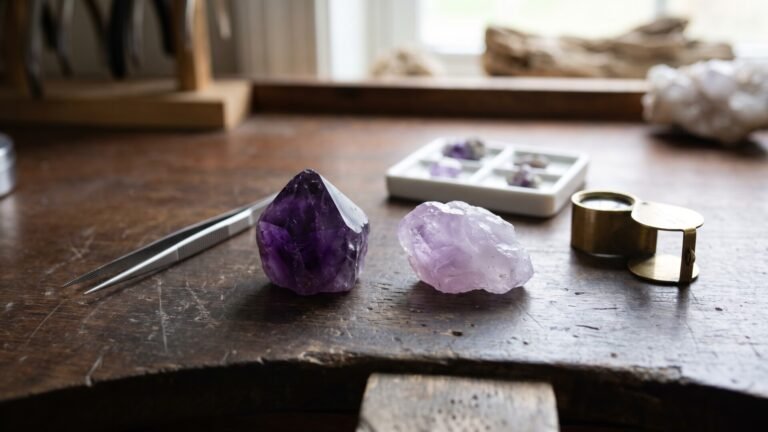
Does Amethyst Fade in Sunlight? How to Protect Its Color
Prolonged or intense sunlight can fade some amethyst, and the damage is usually permanent. That is the short answer, and it is worth having before you read anything else. But the sentence needs a qualifier, because the internet has split into two unhelpful camps: people who treat amethyst as though a minute outdoors will bleach it, and people who leave a $400 ring on a windowsill for three years and wonder why the purple went grey.
The distinction that actually matters is between a stone’s natural color stability and its sensitivity to light. Not every amethyst fades at the same rate. Color origin, treatment history, the intensity of the exposure, and how long it lasts all change the outcome. A brief walk to the car is not the same event as a decade of direct afternoon sun.
The good news is that protecting amethyst takes almost no effort and costs almost nothing. Keep it out of sunny windowsills and away from display lighting that runs all day. That is most of the job.
| Amethyst fact | What it means for color |
|---|---|
| Species: quartz (silicon dioxide) | Same mineral as citrine, rose quartz and rock crystal |
| Color cause: trace iron plus natural irradiation | The purple is a “color center” that strong light or heat can undo |
| Hardness: 7 on the Mohs scale, no cleavage | Resists scratches well; says nothing about light stability |
| Common treatment: heating | Lightens very dark stones or turns them yellow (citrine) |
| Light sensitivity | Some stones fade with prolonged strong light; most are stable in normal wear |
| Safe cleaning | Lukewarm water, mild soap, soft brush; avoid thermal shock |
How Sunlight Can Change Amethyst’s Color
Amethyst is quartz, and according to GIA its purple comes from natural irradiation acting on trace amounts of iron in the crystal. Gemologists call the result a color center: a small defect in the crystal lattice, involving iron in an unusual charge state, that absorbs certain wavelengths of light and produces the purple you see. Ultraviolet and high-intensity visible light can, over time, push that iron back toward a more stable state in some stones. When that happens, the color weakens.
What most people call fading is really a slow, uneven reduction in saturation. It is not a switch flipping. A stone that sits in direct sun for an afternoon looks the same afterward. A stone that sits in the same window for two years may not.
Two things get blamed on each other constantly, and it helps to separate them.
Fading is a change to the stone’s body color. It comes from light exposure (or serious heat), and it does not wash off.
Surface damage is scratches, abrasion, polish loss, or a film of oil and dust. It makes a stone look duller, but the color underneath has not moved. Warm soapy water fixes the film, and a jeweler can re-polish wear; the guide to removing scratches from amethyst jewelry explains what is realistic at home. Nothing fixes true fading at home.
If your amethyst looks tired, clean it before you panic. A dirty stone and a worn polish are a far more common explanation than a genuine color change.
For the broader picture of what amethyst is, where it is mined and what it costs, the main guide on amethyst meaning, properties, and value covers the gemology in more depth.
Why the change is gradual
Color centers do not collapse on contact with light. They degrade as energy accumulates, which is why duration matters more than any single exposure. A ring worn outdoors for an hour a week is a very different case from a specimen on a south-facing sill.
The process is also uneven. Amethyst often shows natural color zoning, so a strongly saturated stone may develop patchy lighter zones before an overall change becomes obvious. A pale stone may simply look washed out, because there was less saturation to lose.
Light, Heat or Dirt? What Actually Changes Amethyst’s Color
Most care advice lumps sunlight and heat together as “things that fade amethyst.” They work very differently, and the difference tells you which everyday situations are worth worrying about.
Heat changes amethyst’s color only at temperatures far beyond anything jewelry meets in daily life. A 2020 study in Scientific Reports found amethyst stays purple below roughly 420°C (790°F), passes through a green stage around 420-440°C, and turns yellow above about 440°C. That is how most citrine on the market is made, and GIA notes that heat-treated color is permanent. Above about 573°C, where quartz changes its crystal structure, the purple cannot be brought back at all.
A hot car or a sunny dashboard stays well under 100°C (212°F). That is not enough to change the color, but it can stress a setting, and a sudden jump from heat to cold water (thermal shock) can crack quartz. The genuinely risky heat source is a jeweler’s torch during resizing or repair, so ask for the stone to be removed or protected before any soldering.
| Exposure | Changes color? | What to do |
|---|---|---|
| Normal outdoor wear | Very unlikely | Wear normally |
| Months or years of direct sun | Can fade some stones | Store in the dark; no sunny displays |
| UV lamps, tanning beds, strong spotlights | Can speed fading | Keep amethyst away |
| Hot car (under 100°C) | No, but stresses settings | Avoid; let it cool before rinsing |
| Jeweler’s torch or kiln (400°C+) | Yes, often permanently | Remove the stone before repairs |
| Dirt, lotion, soap film | No, only looks duller | Clean gently |
The practical rule: worry about cumulative light and about workshop-level heat, not about a warm day. The stone that faded in a sunny window and the stone that went yellow at the repair bench had two different problems.
Which Amethyst Is Most at Risk?
Color stability is not a single property of the species. It varies stone to stone and deposit to deposit, so two amethysts that look identical can behave differently over years. Gem-trade references describe noticeable fading in commercial amethyst as uncommon and slow, while collectors report that material from some deposits is far more sensitive than the Brazilian and Uruguayan stones that dominate the jewelry market.
Natural, treated and lab-grown color
Heat treatment is the most common enhancement. According to GIA, gentle heating can lighten very dark amethyst or remove brownish tints, but it cannot make pale amethyst darker; stronger heating turns it into citrine. Irradiation is how lab-grown (hydrothermal) amethyst gets its purple, and dyeing turns up in low-grade beads and inexpensive jewelry. Lab-grown amethyst is real quartz with the same color mechanism, so it is not inherently more or less light-stable than mined stones; the guide to amethyst vs purple quartz explains how these labels get used in shops.
None of these treatments is automatically a defect. What matters is disclosure. If a seller will not tell you what has been done to a stone, that silence is the information.
You cannot identify treatment by eye. A vivid, uniform purple is not proof of anything, and a modest color is not proof of anything either. For a high-value stone, a gemological report or a jeweler with a gemologist on staff is worth more than any amount of squinting.
Color intensity, clarity, and setting
A pale amethyst can show a visible shift sooner, simply because there is less saturation to work with. A deeply saturated stone may look fine until you notice one zone has gone lighter than the rest.
Settings matter less than people hope. A closed-back setting does not make direct sunlight safe if light still reaches the face of the stone. Protection comes from limiting exposure, not from covering part of the setting.
And a cloudy or included amethyst is not automatically more light-sensitive. Inclusions affect appearance and durability. They do not, by themselves, tell you anything about fading risk.
What Most Owners Get Wrong About Amethyst and Light
There are two opposite errors, and both are common.
The first is that any sunlight ruins amethyst. It does not. Normal outdoor wear, a walk to the office, a few photographs in the garden – these are low-risk events. GIA’s own summary is that the color is stable with normal use, though this is not a gem to wear to the beach every day. Treating the stone as though it were sugar in rain leads people to leave jewelry in drawers and never enjoy it.
The second is that quartz is hard, so it can live on a windowsill forever. Hardness is a measure of resistance to scratching. It says nothing about light stability. Amethyst sits at 7 on the Mohs scale, which is respectable for jewelry and completely irrelevant to whether ultraviolet light will alter its color over years.
The third error is subtler. “Natural” does not mean indestructible, and “treated” does not mean poor quality. Both the origin of the color and its treatment history matter, and neither can be inferred from marketing language.
A note for crystal owners: some crystal-care traditions suggest “charging” stones in sunlight. Whatever you believe about that practice, which our guide to amethyst’s healing properties treats as tradition rather than science, sunlight is the one method that carries a physical risk for amethyst. Many practitioners use moonlight or other methods for this stone instead.
One warning, stated flatly. Do not test your amethyst with a UV lamp, a grow light, a tanning bed, or strong display lighting. A home experiment can permanently alter the color and cannot reliably identify treatment. There is no upside.
How to Protect Amethyst Color in Daily Use
Wear the jewelry. That is the first instruction, and it is the one people skip. Amethyst is a practical stone for regular wear as long as you are not asking it to survive a decade of direct sun.
Remove it before the situations where it will sit in strong light for hours: beach days, long outdoor work, tanning, gardening through an afternoon. Not because a minute will hurt it, but because hours repeated over years is how fading actually happens.
Storage is where most of the protection lives:
- A dark drawer, a closed jewelry box, or an opaque pouch
- Away from windowsills, dashboards, and open shelves in direct sun
- Away from high-intensity lamps and display spotlights that stay on all day
- Separated from harder gems such as sapphire and diamond, which can scratch it
If you are still deciding how much daily wear makes sense for your lifestyle, whether you can wear amethyst every day covers the durability and scratch side of the question, which sunlight protection does not address.
Cleaning Amethyst Without Making the Problem Worse
Routine cleaning is lukewarm water, a drop of mild dish soap, and a soft cloth or very soft brush. Rinse, pat dry, and let it air-dry the rest of the way indoors rather than on a sunny sill. That is the whole method, and our guide to whether amethyst can get wet covers showers, pools and salt water.
Cleaning matters for appearance. It does not reverse fading. Dirt, skin oil, and residue make purple amethyst look duller and greyer than it is, and washing restores that. It cannot restore an altered color center.
Skip bleach, harsh household cleaners, abrasive powders, and steam cleaners, which bring the thermal-shock risk described above. Ultrasonic cleaners are usually fine for untreated, uncracked amethyst but risky for fracture-filled, dyed, heavily included or repaired stones, so ask a jeweler first if you are unsure.
Detailed instructions, including what to do with a fragile setting, live in the guide to safely cleaning amethyst without damaging the polish.
Can Faded Amethyst Be Restored?
Not at home, and rarely in practice.
First, confirm the color actually changed. Photograph the stone under consistent neutral lighting – same window, same time of day, no flash – and compare after cleaning. Lighting changes, metal tarnish, and a dull surface fool people constantly. A stone that looks different in your kitchen may look identical under a jeweler’s lamp.
If it has genuinely faded, household treatments will not fix it. Sunlight, moonlight, oils, dyes, and household chemicals do not restore gemological color, and some of them cause further damage. Anyone promising to “recharge” the purple is selling something that does not exist.
There is one technical exception worth knowing. Because amethyst’s purple is created by radiation in the first place, laboratory gamma irradiation can sometimes rebuild the color center in quartz that was bleached by light or moderate heat; research published in GIA’s Gems & Gemology documented exactly this reversal. It is not a consumer service, the result must be disclosed as a treatment if the stone is sold, and it does not work on stones heated past the point described earlier.
For a valuable or inherited stone, take it to an independent gemologist or a reputable jeweler. Bring old photographs. They can compare the current appearance, inspect the setting, and tell you whether professional testing is worth the fee. In most cases, recutting or replacing the stone is more realistic than restoration. A $60 ring with sentimental weight is a different calculation from a large collector stone.
Buying Amethyst With Color Stability in Mind
You cannot test color stability in a shop, so buy on disclosure and documentation instead. Three questions cover most of it.
- What is the treatment history? Heated, irradiated, dyed, lab-grown, or none. A seller who answers clearly is worth more than one who answers smoothly.
- How will it be stored and worn? A ring worn daily and stored in a drawer is a different purchase from a specimen on a sunny shelf.
- Is the color documented well enough to compare later? Good photographs under consistent lighting, plus any report or appraisal.
Look for a seller who discloses treatments in writing, shows consistent photographs, explains return terms, and avoids absolutes. “Never fades,” “UV-proof” and “permanent purple” are claims no honest gemologist makes without a defined basis. Vague “natural gemstone” language that omits treatment details is the most common dodge in the category.
If the piece is destined for a bright, permanent display, consider whether amethyst is the right stone at all. The parent amethyst guide compares it with purple sapphire and spinel, which are far harder and are not known for light sensitivity, at a much higher price per carat.
Certification is worth the cost for an unusually large, expensive, or antique stone. It is overkill for an inexpensive commercial piece. Independent reports tell you what a stone is; they do not guarantee it will never change color.
If you are comparing shades, start with amethyst color variations and symbolism for the range, then look at amethyst color variations ranked for how the market values them. Color preference and fade resistance are separate questions, and a darker stone is not automatically better or more stable.
Suspicious color claims are worth checking against how to spot fake amethyst and, for finished pieces, how to spot fake amethyst jewelry. Misrepresented material is a bigger risk to your money than fading is.
Which Protection Strategy Fits You?
Different owners need different plans, and the differences are practical rather than expensive.
The daily jewelry wearer should prioritize a secure setting, remove the piece for prolonged direct sun, and store it in darkness. The setting matters as much as the light – a loose stone is lost long before it fades.
The collector or crystal display owner should avoid windowsills entirely and use enclosed, shaded storage. If display matters, rotate pieces so no single specimen takes years of continuous exposure, and keep display spotlights off when nobody is looking.
The owner of an inherited or sentimental stone should photograph it under consistent lighting now and keep any treatment or appraisal information with it. Documentation is the only way to know later whether the color moved.
The budget buyer should spend on sensible storage and honest disclosure rather than a premium for unsupported claims of permanent color. A $12 opaque pouch in a drawer outperforms most of what gets marketed as color protection.
The hidden cost runs the other way. An attractive display location – the sunny shelf, the kitchen windowsill – is where fading happens, and fading quietly reduces visual appeal, sentimental value, and resale presentation. The prevention costs almost nothing. The loss is rarely recoverable.
Frequently Asked Questions About Amethyst Fading In Sunlight
How long can amethyst sit in the sun?
There is no universal safe time, because sensitivity varies by stone and deposit. Occasional brief exposure is far less concerning than weeks, months, or years on a sunny windowsill. The safest practice is to keep amethyst out of prolonged direct sunlight and away from all-day display lighting.
Can moonlight restore faded amethyst?
No gemological evidence supports moonlight restoring amethyst that has genuinely faded. If the stone only looks dull from dirt or residue, gentle cleaning will improve its appearance. It will not reverse a real color change, which is chemical rather than surface-level.
Does amethyst fade behind glass?
Ordinary window glass blocks some ultraviolet light, but visible light and heat still reach the stone, and strong visible light can contribute to fading too. A sunny window display is still a risk over time. Shaded or enclosed storage is safer.
Will a UV-filtering display case protect amethyst?
It helps, because it cuts the most energetic part of the light. It does not make a sunny or brightly spotlit position safe, since intense visible light still reaches the stone. Combine UV-filtering glass with a shaded location and lights that are switched off when not needed.
Can faded amethyst be re-colored?
Not at home. Laboratory irradiation can sometimes rebuild the purple in light-bleached or mildly heated quartz, and dyeing can change the appearance, but both are treatments that must be disclosed if the stone is sold. Have valuable material assessed by a qualified gemologist first.
Does citrine fade in sunlight like amethyst?
Most citrine on the market is heat-treated amethyst, and GIA describes heat-treated quartz color as permanent and stable. Prolonged strong light can still affect some yellow quartz, so the same storage habits make sense. See our citrine guide for natural versus heated stones.
The one thing to remember
If you take a single rule out of this into a shop or a jewelry box, make it this: amethyst does not fade from a few minutes outdoors, but long-term direct sunlight is an avoidable threat to its purple, and avoiding it costs you nothing but a drawer.
Wear the ring. Clean it gently with lukewarm water and mild soap. Store it cool and dark when it comes off, and keep it away from the repair bench torch. That is the whole protocol, and it will serve the stone for decades.
For every other February birthstone question, from value to look-alikes, the complete gemstones guide and the main amethyst guide are the places to continue. If a jeweler promises your amethyst will never fade, you have learned something about the jeweler.