Vintage Aquamarine Jewelry Trends: A Journey Through the Sea-Blue Eras
Vintage aquamarine jewelry is not a single style but a series of distinct eras, each with its own metals, cuts and moods. A pale blue stone in a lacy platinum Edwardian setting looks very different from a bold yellow-gold cocktail ring of the 1940s, even though the gem is the same. This guide walks through the major eras from the Georgian period to the mid-century, explains how to recognize each, shows how to check whether a “vintage aquamarine” is really aquamarine, and gives practical advice on buying and caring for older pieces.
Dates and style labels in jewelry history are approximate and sources differ slightly, so the periods below are guides rather than hard boundaries. If you are new to the stone, start with our aquamarine guide.
Vintage Aquamarine Eras at a Glance
| Era | Approx. dates | Typical look |
|---|---|---|
| Georgian | 1714 to 1837 | Closed-back settings, often foiled, in gold or silver; pale stones; rare survivals |
| Victorian | 1837 to 1901 | Sentimental and ornate; aquamarine appears with pearls, garnets and old-cut diamonds |
| Edwardian | 1901 to about 1915 | Delicate platinum filigree, milgrain, lace-like designs |
| Art Deco | about 1920 to 1935 | Geometric, step-cut stones, platinum and white gold, baguette diamonds |
| Retro | about 1935 to 1950 | Large stones, warm yellow and rose gold, sculptural curves, cocktail rings |
| Mid-century | about 1950 to 1970 | Streamlined, abstract, mixed metals, simpler mounts |
Georgian and Victorian Aquamarine: Rare Survivals
Aquamarine was valued long before the twentieth century, but fine stones were comparatively scarce in European jewelry until large Brazilian pegmatite deposits were developed, and antique aquamarine jewelry from the Georgian and Victorian eras is correspondingly uncommon and collectible. One frequently cited landmark is the discovery of a gem aquamarine crystal weighing roughly 110 kilograms in Minas Gerais, Brazil, in 1910, which shows how productive those deposits became.
Early pieces often use closed-back settings, sometimes with foil behind the stone to intensify its pale color, set in gold or silver. Seed pearls, garnets and old mine-cut diamonds frequently accompany the aquamarine. Surviving stones tend to be paler and more greenish than modern buyers expect. These are museum-style rarities rather than typical vintage finds, so authentication and condition are especially important. Never soak a closed-back piece: water trapped behind the stone can tarnish the foil and permanently dull the color.
The Edwardian Era (1901 to about 1915): Lace and Light
Edwardian jewelry is defined by lightness. Platinum had become practical for jewelry, and makers used it to create fine openwork, scrollwork and milgrain edging that seems to float on the finger. Some pieces from the turn of the century are “platinum-topped gold,” with a thin platinum face over a gold back, a transitional technique worth recognizing. Aquamarine’s cool, pale blue suits this white-on-white palette, and it is often paired with diamonds, moonstone or pearls. Stones are typically oval, round or cushion-shaped, with softer proportions than the later geometric cuts.
Edwardian pieces are delicate, so inspect them carefully. They often suit earrings, pendants and occasional rings better than everyday wear. Because they lack the boldness of Art Deco, they can be relatively good value for buyers who like a refined, feminine look.
Art Deco (about 1920 to 1935): Geometry and Glamour
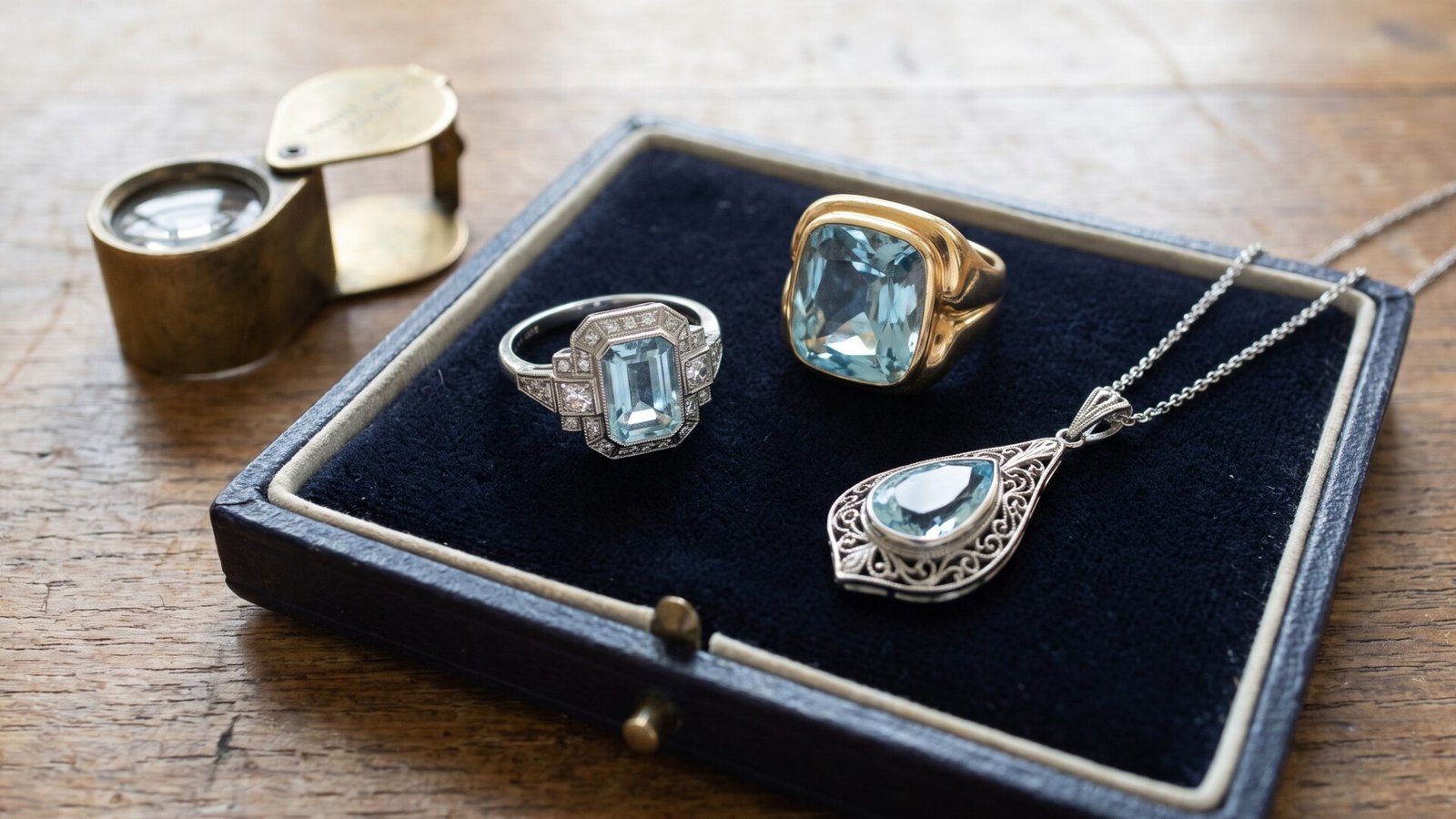
Art Deco is the period most closely associated with vintage aquamarine, and for good reason. Large, clean stones were available, and the era’s love of geometry matched the step cut perfectly.
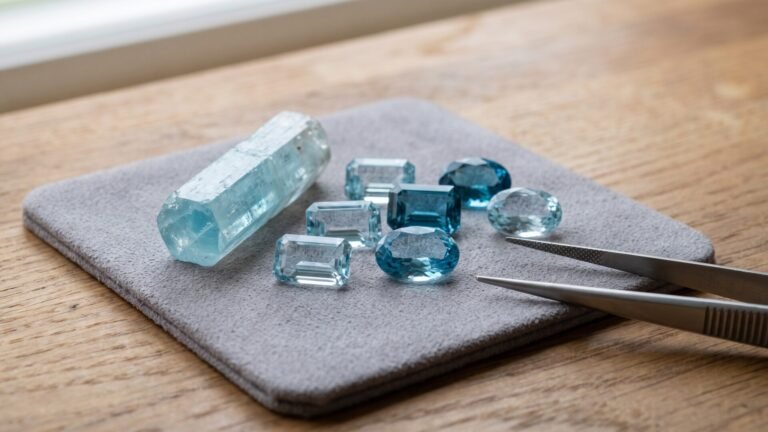
- The emerald (step) cut: Long rectangular facets give broad, open windows into the stone. This suits aquamarine, which is prized for clarity and color rather than fire.
- Platinum and white gold: Cool metals that emphasize the icy blue.
- Symmetry and architecture: Baguette-cut diamonds often flank the central stone, echoing its step cut.
- High contrast accents: Black onyx or enamel sometimes adds drama.
- Substantial stones: Several-carat aquamarines are common in Deco rings, designed to be noticed.
Many buyers today choose Art Deco style for aquamarine engagement rings because the step-cut stone and crisp lines look timeless. In the 1930s, Deco’s geometry began to soften and yellow gold returned, creating a transitional style that bridges Deco and Retro. Those late pieces can be good value relative to high Deco.
Retro (about 1935 to 1950): Volume and Warmth
Retro jewelry is bold and sculptural. During World War II, platinum was restricted for non-military use in the United States, and designers turned to yellow and rose gold, which made warm, chunky settings the signature of the period.
- Large stones: Big step-cut and cushion aquamarines are typical, often ten carats or more in cocktail rings.
- Yellow and rose gold: Warm gold sets off aquamarine’s cool blue.
- Curves and volutes: Scrolls, ribbons and rounded forms replace Deco’s angles.
- Mixed gems: Rubies, sapphires and citrine often accompany the aquamarine for color contrast.
- Cocktail rings and brooches: Statement pieces designed for evening.
Large blue stones in Retro gold are exactly where imitations turn up most often, so read the section on identification below before paying aquamarine prices for a big 1940s cocktail ring.
Mid-Century (about 1950 to 1970): Streamlined and Abstract
Post-war aquamarine jewelry moved toward cleaner lines and more abstract designs. Settings are often asymmetrical, mixed metals are common, and some rings use minimal four-prong mounts that anticipate later solitaire styles. Major houses and designers of the period, including Tiffany & Co., Bulgari, Cartier, David Webb and Seaman Schepps, produced notable colored-stone jewelry, and signed pieces generally command a premium over unsigned ones. Mid-century pieces tend to be more wearable than earlier eras, and the period is often considered underappreciated. Sturdier construction also makes mid-century rings one of the more practical choices if you want a vintage aquamarine you can wear often.
Famous Aquamarines from the Vintage Era
Two well-documented gifts show how central Brazilian aquamarine became in the twentieth century. In 1936, Brazilian President Getúlio Vargas gave Eleanor Roosevelt a 1,298-carat cut aquamarine, now known as the Roosevelt aquamarine and held by the Franklin D. Roosevelt Presidential Library. In 1953, Brazil gave Queen Elizabeth II a coronation gift of an aquamarine necklace and earrings; Garrard later made a matching platinum tiara, and further Brazilian aquamarines were added to it in 1971. For more royal and historic stones, see Aquamarine in Mythology and History.
Is It Really Aquamarine? Imitations and Dating Clues
Most guides to vintage aquamarine focus on style. The bigger risk for a buyer is that the pale blue stone is not aquamarine at all, or is not original to the piece. The good news is that each common substitute appeared at a known point in time, so the stone can also help you check whether a piece is as old as it is said to be.
| Possible stone | Available from | What it means for a vintage piece |
|---|---|---|
| Glass (paste) | All eras | Common in costume and some fine Georgian pieces; softer, may show bubbles and worn facet edges |
| Synthetic blue spinel | About the 1920s onward | Widely used to imitate aquamarine, and still the most common aquamarine imitation in birthstone jewelry; frequent in Deco, Retro and mid-century rings |
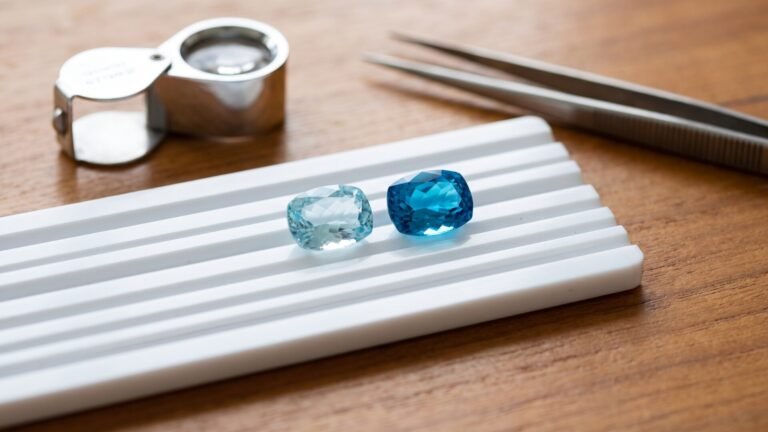
| Natural blue topaz (pale) | All eras | Can look very like aquamarine; a gemologist separates them easily |
| Irradiated blue topaz (Swiss, London blue) | Commercial from 1976; common from the 1980s | A strong or inky blue topaz in a piece sold as pre-1970s points to a later replacement stone |
| Modern-cut aquamarine | Recent decades | A crisp modern brilliant or precision cut in an old mount usually means the stone was replaced |
A simple rule: if a mid-century or earlier ring has a large, perfectly clean, evenly colored pale blue stone at a price well below what natural aquamarine of that size costs, assume synthetic spinel until a test says otherwise. If the blue is intense and electric rather than soft, think treated topaz rather than aquamarine. Neither makes the piece worthless, since a well-made Deco mount with a synthetic spinel is still period jewelry, but it should be priced as such. A jeweler with a refractometer can tell these materials apart in minutes.
Reading the Metal: Marks and Clues
Marks are not always present on older jewelry, and some have been added later, but they are useful alongside style and cut:
- PLAT, PT or IRID PLAT: platinum, typical of Edwardian, Art Deco and post-war pieces. IRID PLAT indicates an iridium-platinum alloy, common in the early twentieth century.
- 14K, 18K, 585 or 750: gold purity in karats or parts per thousand. Rose and yellow gold in a heavy, curvy mount fits the Retro period.
- Platinum face, gold back: suggests a turn-of-the-century platinum-topped gold piece.
- Maker’s or retailer’s signature: may add value, but ask for provenance, since signatures can be faked.
Reading the Cut: What Faceting Tells You
Before modern machine-assisted cutting, colored stones were cut largely by hand and eye, with the aim of saving weight from expensive rough. That leaves clues a buyer can learn to see with a simple 10x loupe:
- Slightly uneven facets: facet junctions that do not meet in perfect points, and facets of slightly different sizes, are typical of older hand cutting.
- Deep or bulky pavilions: older stones often carry extra depth below the girdle to keep weight, which can make them sit high in the setting.
- Windowing: a see-through patch in the center of a pale stone is common in older and shallow cuts, and it makes the color look weaker.
- Softly worn edges: decades of wear round the facet edges and corners, especially on rings. Crisp, razor-sharp edges on a stone in a worn mount suggest a newer stone.
- Cut style versus era: step and cushion cuts fit Deco and Retro, ovals and cushions fit Edwardian pieces, and modern brilliant or concave cuts in an old mount point to a replacement.
None of these clues proves age on its own, because skilled cutters still work by hand and some old stones were recut later. Use them together with the metal, construction and stone identity checks above.
Vintage or Vintage-Style New: Which Should You Buy?
| Factor | Genuine vintage | New vintage-style |
|---|---|---|
| Character | Hand fabrication, period cut, history | The look without the age |
| Stone identity | Must be checked; replacements and imitations are common | Usually disclosed by the seller |
| Durability | Settings may be thin or worn | New metal and prongs |
| Resizing | Can be difficult on filigree and engraved shanks | Usually straightforward |
| Extra costs | Restoration and re-tipping often needed | Few at first |
| Sustainability | No new mining for that stone or metal | Depends on sourcing |
Choose genuine vintage if character and history matter most and you will wear the piece occasionally or have it checked regularly. Choose a new vintage-style ring if it will be worn every day, needs a specific size, or must be an engagement ring that takes knocks. Popular vintage-inspired directions include halo rings with filigree, platinum or white-gold step-cut solitaires, three-stone rings, east-west settings and geometric mounts. For help comparing cuts, see Gemstone Shapes and Cuts Explained.
How to Buy Vintage Aquamarine Jewelry
- Value craftsmanship alongside condition. Vintage pieces show wear: softly rounded facet edges, retipped prongs, small repairs. Evidence of hand work is part of the appeal, but heavy damage or poor repairs are not.
- Ask about the stone. Confirm in writing that it is natural aquamarine, not glass, synthetic spinel, topaz or a doublet, and ask whether it is original to the setting.
- Understand color and treatment. Many older aquamarines have the greenish-blue tone modern buyers undervalue. Heat treatment of aquamarine is common and hard to detect, so you cannot assume a vintage stone is untreated unless a report says so. Our aquamarine color chart explains what to look for.
- Check the construction. Look at prongs, shanks and hinges. Thin platinum, worn prongs and loose stones add restoration costs, so factor repairs into your budget.
- Verify the era. Compare the cut, metal, marks and construction with the period claimed, ask for documentation or an appraisal, and prefer dealers with clear return policies and expertise in that period.
- Do not treat it as an investment. Vintage jewelry values vary widely and resale prices are often below retail. Buy what you love and can afford. This is not financial advice.
Spotting Common Problems
| Issue | What to look for | Why it matters |
|---|---|---|
| Replacement stone | Modern cut in an old mount; mismatched color or wear | Affects authenticity and value |
| Glass or doublet | Gas bubbles, a join line at the girdle, unusually low price | Not aquamarine at all |
| Chipped or abraded edges | Nicks on corners of step cuts | May need recutting or careful setting |
| Worn prongs or thin shank | Prongs that wobble, thin or cracked metal | Risk of losing the stone |
| Poor resizing or repairs | Visible solder, mismatched metal | Can reduce value and strength |
Caring for Vintage Aquamarine
Aquamarine itself is durable at 7.5 to 8 on the Mohs scale, but vintage settings may be fragile after decades of wear. Our full aquamarine care guide covers cleaning in detail. For older pieces specifically:
- Clean gently with lukewarm water, mild soap and a soft brush, and avoid ultrasonic and steam cleaners on older pieces unless a jeweler approves. Wipe, rather than soak, any closed-back or foiled setting.
- Store separately in soft pouches so harder stones and metal do not scratch the aquamarine.
- Inspect regularly, ideally every six to twelve months, and stop wearing a piece immediately if anything feels loose.
- Remove rings for exercise, gardening and heavy cleaning, and insure the piece with an appraisal that reflects current replacement value.
Why Vintage Is Appealing
Many buyers choose vintage aquamarine for craftsmanship and character, and some for sustainability, weighed against the practical costs of restoration. Whether it is an Edwardian drop earring or a Retro cocktail ring, the appeal is partly the story the object carries. For the meanings behind the stone, read Aquamarine Meaning, and for its place on birthstone lists, see the March birthstone page.
Frequently Asked Questions About Vintage Aquamarine Jewelry
Can an antique aquamarine ring be resized?
Often, but not always. Plain shanks can usually be resized by a skilled jeweler. Filigree, engraved or patterned shanks, and rings with stones set all the way around, are harder and can be damaged. Ask for the stone to be removed or protected from torch heat, and consider sizing beads or a spring insert as gentler alternatives when only a small change is needed.
Should I replace or recut a chipped vintage aquamarine?
Small chips on corners are common and often hidden by a prong or bezel, so many owners leave them. Recutting can remove chips but costs weight and the original period cut, which collectors value. Replacing the stone keeps the mount wearable but reduces authenticity. For a valuable or signed piece, get an appraiser’s opinion before changing anything.
Why does my vintage aquamarine look greener than modern stones?
Older stones were often cut from material with more yellow or green in it, and preferences then were different. Today most aquamarine is heat treated to remove the green, so modern stones tend to look purer blue. A greenish tone is normal in vintage pieces, not a defect, and some buyers prefer it as a sign of the period.
Do vintage aquamarine pieces come with certificates?
Rarely. Older jewelry was usually sold without laboratory reports. A reputable dealer should give a written description of the stone and metal, and for higher-priced pieces you can commission an independent gem report and an appraisal. That is worth doing if a seller claims the stone is untreated, unusually large or by a named maker.
Is a vintage aquamarine ring a good engagement ring?
It can be, with care. The stone is hard enough for regular wear, but old prongs and thin shanks are the weak point. Have the ring inspected and re-tipped if needed before daily wear, choose a design with protected corners, and plan regular check-ups. If you want a carefree daily ring, a new vintage-style setting is safer.
Where can I see famous vintage aquamarines?
The Roosevelt aquamarine, given to Eleanor Roosevelt in 1936, belongs to the Franklin D. Roosevelt Presidential Library. Large aquamarines are also displayed at the Smithsonian’s National Museum of Natural History in Washington, including the modern Dom Pedro carving, and in other natural history museums. Royal pieces such as Queen Elizabeth II’s Brazilian aquamarine tiara appear in exhibitions from time to time.
Browse more in our gemstones hub.