Does Aquamarine Fade in Sunlight? Color Stability and Care
I had a customer bring back a ring after two summers. She was certain the stone had bleached out on her windowsill, and she had the receipt and a photo to prove it. What I found under the loupe was a film of hand lotion and dust packed into the pavilion, the underside of the stone, where a ring collects everything your hands touch. The aquamarine underneath was exactly the color it had been the day she bought it. She was not foolish. Nobody tells you that a dirty stone looks like a faded one, and nobody tells you which light will actually hurt the thing.
So here is the short answer. Natural aquamarine is generally stable in ordinary daylight, and wearing it outdoors for an afternoon is not a reason to worry. Long-term storage in direct sun, hot windowsills, saunas, and uncontrolled display lighting are worth avoiding, and treated or unusually pale stones deserve more caution than the rest.
How Stable Is Aquamarine’s Color?
Aquamarine is the blue to blue-green variety of beryl, the same mineral family as emerald and morganite. Its color comes from iron-related color centers in the crystal structure, and that is the detail that matters for this question. Color stability means a gemstone’s ability to keep its appearance under light, heat, and ordinary wear. Aquamarine scores reasonably well on that measure, which is why it has been a jewelry staple for centuries rather than a curiosity kept in a drawer.
It is not in the same category as the genuinely light-sensitive stones. Some materials in the trade shift noticeably under sustained light, and jewelers are taught to keep them boxed. Aquamarine does not carry that reputation. But "generally stable" is not the same as "identical in every specimen," and I want to be straight with you about why.
Color stability varies with the chemistry of the individual crystal, its treatment history, how saturated the color is, and how intense the exposure happens to be. A deeply colored, untreated stone from a good rough will behave differently from a pale, heated stone with a thin margin of color to lose. Neither is a bad purchase. They are different purchases, and they deserve different handling.
Then there is the part almost nobody explains. Pale aquamarine can look like it has faded when nothing has happened to it at all. Bright sunlight washes out low-saturation color the way it washes out a pale blue shirt in a photograph. Move the same stone into shade, or into warm indoor light, and it reads deeper, sometimes greener. The stone did not change. The light did.
If you want to understand why two aquamarines of similar size can look so different, the [aquamarine color chart explained](Aquamarine Color Chart Explained: The Spectrum of Sea-Blue Beauty) breaks down hue, tone, and saturation properly. One warning before you go: a darker stone is not automatically a better or more valuable one. A dark aquamarine with a gray cast and a dead center is worth less than a lively medium blue with good cut. For the wider picture on properties and value, the main [aquamarine guide](Aquamarine Meaning, Properties, Uses & Value) covers the ground this article deliberately leaves alone.
Can Aquamarine Fade in Sunlight?
Prolonged, intense sunlight is a sensible risk to minimize. Ordinary daylight wear is not something I would talk a customer out of. Those two sentences are not in conflict, and the trouble starts when people collapse them into one.
The scenarios are not equivalent, and treating them as if they were is how people either panic unnecessarily or damage something they love.
- An afternoon outdoors in a ring. Low concern. Wear it. Watch for knocks against a car door or a garden wall, which will hurt the stone long before the sun does.
- A windowsill for months. This is the classic mistake. A south-facing window is a slow, cumulative exposure with heat building behind the glass. Store jewelry in a box, not on display in the sun.
- A hot car in summer. This is a heat problem more than a light problem, and heat is the one I take seriously. A car interior can reach temperatures that stress both stone and setting.
- A loose stone under strong display lighting for years. Depends on the stone, the treatment, and the lighting. Controlled, indirect, low-heat display is the sensible choice.
Heat often matters alongside light, and people underestimate it. Repeated heating and cooling cycles stress a gemstone and the metal holding it. High temperatures are a particular concern for treated stones, for anything with filled fractures, for mounted jewelry where the setting and stone expand at different rates, and for older pieces with unknown histories.
Here is the blunt version. If a seller tells you aquamarine is completely immune to light and heat and that no care is required, they are either uninformed or selling you something. If a seller tells you your aquamarine will bleach in a week of normal wear, they are using fear to move you toward a different, more expensive stone. Both are pitches. The truth is in the middle and it is boring: normal wear is fine, prolonged direct sun and high heat are not.
What Most Owners Misidentify as Fading
Most of the "my aquamarine faded" cases I have handled were not fading at all. They were one of five things, and four of them cost nothing to fix.
Dirt and residue. Skin oil, hand lotion, sunscreen, hairspray, and dust collect under the stone, especially in a ring, and a dirty pavilion makes a clean stone look gray and cloudy. This is the single most common cause of a stone that seems to have lost its color.
Surface wear. Aquamarine is durable but not indestructible. Fine scratches on the table, the flat top facet, scatter light and dull the appearance without touching the body color.
Loose or shifted settings. A stone sitting slightly off its seat, or a bent prong, changes how light enters and leaves. It can look darker, lighter, or uneven.
Lighting. This deserves its own paragraph, because it fools almost everyone.
A different stone entirely. I have seen blue topaz sold as aquamarine, and I have seen glass. If the color change came with a purchase from a source you cannot verify, identification is the first question, not fading.
On lighting: the same aquamarine will look different under daylight, cool LED, warm incandescent, a jewelry store spotlight, and shade on a cloudy afternoon. Jewelry store spotlights are flattering and slightly dishonest; they are designed to make everything look its best. Color appearance is not color alteration. A stone that looks deeper in the shop and paler at home has not changed. You have simply left the best lighting it will ever see.
Photographs mislead just as badly. Automatic white balance, overexposure, a reflective background, and phone-camera processing can turn a medium blue aquamarine nearly colorless on screen. I have had customers convinced a stone changed based on a photo taken in different light with a different phone. Compare like with like or do not compare at all.
If you want to check a piece yourself, do this. Clean it gently, then look at it in indirect daylight and again in neutral indoor light. Examine it face-up through the crown, the top of the stone, and from the side profile. If the change is uneven, sudden, or persists across every lighting condition, that is when you take it to a qualified gemologist. Not before.
The Hidden Risk: Treatments, Inclusions, and Unknown History
Aquamarine is routinely heated in the trade to improve color, usually to push brownish or greenish rough toward blue. This is common, widely accepted, and not a scandal. But it is information you are entitled to, and it changes the questions you should ask about heat, light, cleaning, repair, and resale disclosure.
Treatment does not automatically make an aquamarine poor quality. Some of the finest stones on the market are heated. What treatment does is remove your ability to assume. A heated stone with a thin color margin is a different care proposition from a richly colored untreated one, and you cannot manage a risk you have not been told about.
Watch for the language. "Sun-proof," "permanent color," "guaranteed never to fade," and "natural color" with no documentation behind it are marketing, not gemology. And be careful with the reverse pitch too: untreated does not automatically mean valuable. Treatment status is one factor among several, alongside color quality, clarity, cut, size, origin claims, and documentation. An untreated stone with dull color and a bad cut is still a dull, badly cut stone.
For anything expensive or investment-significant, ask for a report from an independent gemological laboratory. Under GIA’s identification standards, a report identifies the gemstone and, where the laboratory can determine it, discloses treatment. That is a meaningful protection. A retailer’s description on a tag is not equivalent to independent certification, no matter how confidently it is worded.
How to Wear, Store, and Clean Aquamarine Safely
Everyday wear and sunlight
Wear it normally. Take it off for prolonged sunbathing, outdoor work in high heat, hot tubs, saunas, and anything that will make the jewelry hot or subject it to repeated impacts.
The format matters more than most people expect. A ring takes far more knocks and temperature swings than a pendant or a pair of earrings, and it should be treated accordingly. An aquamarine pendant worn daily for twenty years will usually look better than an aquamarine ring worn daily for five, and it is not the stone’s fault.
| Situation | Color and heat concern | Practical advice |
|---|---|---|
| Brief outdoor wear | Usually low | Wear normally, but avoid impacts |
| Long hours in intense direct sun | Avoidable | Remove or cover the piece when practical |
| Sunny windowsill display | Moderate over time | Store in a shaded jewelry box |
| Hot car or sauna | High heat concern | Remove jewelry before exposure |
| Strong display or UV lighting | Depends on stone and treatment | Use controlled, indirect lighting |
Storage
Keep aquamarine in a cool, dry, shaded jewelry box or a fabric-lined compartment, away from windows, radiators, and heating vents. That single habit prevents more damage than any product you can buy.
Store it separately from harder gemstones and loose metal. Aquamarine has good wearability for a gemstone, but it is not immune to surface damage, and a diamond or a sapphire rattling against it in a drawer will eventually leave marks.
Keep the paperwork with the piece. The original laboratory report, appraisal, treatment disclosure, and purchase receipt matter enormously for inherited or high-value jewelry, and they are the first thing lost. A stone with documentation is worth more and is easier to insure, resell, or hand on.
Cleaning and repairs
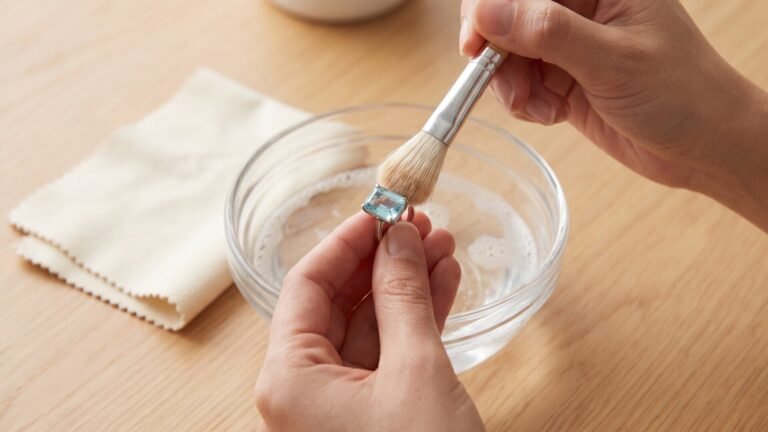
Lukewarm water, mild soap, a soft brush, and a soft lint-free cloth. Rinse thoroughly and dry completely. That is the whole routine.
Skip the steam cleaner and the ultrasonic cleaner when the treatment history is unknown or the stone has visible fractures. Skip harsh chemicals entirely. Avoid sudden temperature changes, which is why you never plunge a stone from hot water into cold. And skip aggressive polishing, which removes material to make a stone look brighter and is not a decision to make casually on a piece you intend to keep for decades.
For the fuller routine, including how often to clean and what to do about stubborn buildup, the [guide to caring for aquamarine stones](How to Care for Aquamarine Stones: A Gentle Guide from the Sea) goes deeper than this article needs to. If you are shopping for a ring specifically, these [aquamarine engagement rings](10 Most Stunning Aquamarine Engagement Rings for a 2026 Proposal) are worth a look for setting styles that protect the stone rather than expose it.
Buying Aquamarine Without Paying for a Color Claim
Four questions will do most of the work.
- Is the color natural or treated, and does the seller state it plainly? A confident, specific answer is a good sign. Evasion is not.
- Is the stone visibly clean and well cut? Look for a bright, even return of light and no dead window, the dull see-through area that appears when a stone is cut too shallow.
- Is the setting secure? Check prongs, check the stone for movement, check the bail on a pendant.
- Does independent documentation support the claims? For a significant purchase, a laboratory report answers questions the salesperson cannot.
Strong color is not the only quality marker, and chasing the darkest stone on the tray is how buyers end up with something dull and gray. A well-cut, lively medium-blue aquamarine is usually the more satisfying purchase, and often the better value, than a darker stone with poor proportions.
On budget: lower-priced aquamarine typically has very pale color, visible inclusions, weaker cutting, or small size, and there is nothing wrong with that if you know what you are buying. Mid-range buyers should spend on face-up color and cut quality rather than carat weight. Premium buyers should insist on treatment disclosure and a reputable laboratory report, and should expect to pay for the documentation.
Buy if the color pleases you in several lighting conditions, treatment information is clear, and the price reflects documented quality.
Pause if the seller promises permanent color without evidence, refuses to discuss treatments, or uses a sunlight claim to justify an unusually high price.
Avoid unless professionally assessed if the stone shows patchy discoloration, unexplained cloudiness, signs of heat damage, or a major change from its documented original appearance.
If you are weighing aquamarine against the cheaper blue option most stores will steer you toward, [aquamarine versus blue topaz](Aquamarine vs Blue Topaz: How to Choose) lays out the appearance, treatment, and value differences honestly.
Which Aquamarine Still Makes Sense in Three Years?
The long-term test is simple. Choose a stone whose appeal comes from its cut, its transparency, its color balance, and the craftsmanship around it, not from a promise that it will never change. Promises expire. Good cutting does not.
| Jewelry format | Best use | Main long-term concern | Buying priority |
|---|---|---|---|
| Pendant | Frequent wear with fewer impacts | Chain and setting wear | Secure bail and attractive face-up color |
| Earrings | Regular use and lower impact | Loss of backs or matched-pair differences | Pair matching and secure closures |
| Ring | Occasional to regular wear | Impacts, scratches, heat, and loose settings | Protective setting and frequent inspection |
| Loose gemstone | Collecting or future setting | Poor storage and uncertain treatment history | Independent report and documented provenance |
Aquamarine generally wears better than many softer ornamental stones, but it is not an automatic investment stone, and anyone who tells you otherwise is selling. Resale depends on quality, documentation, design, provenance, and market demand, not on color stability. A beautiful aquamarine bought at retail will usually resell for less than it cost, the same as most jewelry. Buy it to wear and to hand on, not to flip.
If you are comparing it with blue topaz on durability grounds, [aquamarine versus topaz for durability and color](Aquamarine vs Topaz for durability and color) covers the trade-offs. The short version: blue topaz is commonly treated for color and costs less, while aquamarine’s value conversation leans more heavily on natural color quality, clarity, size, and disclosure. A lower price is not the same as equivalent rarity.
What to Do If an Aquamarine Already Looks Faded
Start with the free checks. Clean the piece properly. Look at it in indirect daylight. Compare it with older photographs only if the lighting is genuinely comparable, which it usually is not. Then look at whether any change is even across the stone or confined to one area.
Some signs justify professional review:
- A sharp boundary between two colors within the stone
- A localized pale patch
- Surface-reaching fractures
- Internal cloudiness that was not there before
- A chipped facet
- Any change that appeared after heat exposure, a repair, or years on display
Take it to an independent gemologist or a reputable gemological laboratory, not only to the seller who sold it to you. Ask for identification, a treatment assessment where possible, and an opinion on whether the appearance is permanent. A good gemologist will tell you plainly if the cause is dirt, abrasion, a setting problem, fracture filling, or lighting. They will also tell you honestly that they cannot promise to reverse a genuine color change, because nobody can.
Do not try home remedies. No polishing compounds, no bleach, no strong acids, no reheating, and no alternating hot and cold in an attempt to shock the color back. I have seen a stone ruined by a well-intentioned attempt to "restore" it, and the damage was permanent in a way the original problem was not.
Frequently Asked Questions About Aquamarine Fading In Sunlight
Does aquamarine fade in sunlight?
Natural aquamarine handles normal daylight wear well. Prolonged intense sunlight and heat are avoidable risks, so storing a piece in direct sun for months is a worse idea than wearing it outdoors for an afternoon.
Can I wear an aquamarine ring every day?
Yes, if the setting is secure and you remove it for high-impact work, extreme heat, swimming, bathing, and anything likely to loosen or strike the stone. Rings need more frequent inspection than pendants or earrings.
How can I tell whether aquamarine has really faded?
Clean it first, then compare it in indirect daylight and neutral indoor light. If the change is uneven, sudden, or persists across lighting conditions, have a qualified gemologist examine it rather than trusting photographs or a seller’s description.
Does heated aquamarine fade more easily?
Treatment history affects the care questions worth asking, but a blanket claim that every heated aquamarine will fade is not reliable. Ask for treatment disclosure and follow the advice of a gemologist who has seen the specific stone.
Is aquamarine safe under a jewelry display light?
Short-term display is less concerning than years under intense, hot, or uncontrolled lighting. Use indirect, low-heat lighting and keep the piece out of continuous direct sun.
Can sunlight change aquamarine's value?
A visible, permanent color change can affect desirability and value. Apparent fading is more often caused by lighting, dirt, or damage, so value should only be reassessed after a professional examination.
Is a pale aquamarine a faded aquamarine?
Not necessarily. Pale is a natural color range for aquamarine, and bright light makes low-saturation stones look even lighter. Only a gemological examination can separate natural paleness from genuine color alteration.
Is aquamarine a good choice for a piece meant to be handed down?
It can be, provided the setting protects the stone and the paperwork stays with it. A documented, well-cut aquamarine in a secure pendant or ring setting will still be wearable decades from now.
The Sensible Care Rule
Here is the cheaper truth. You do not need a special safe, a climate-controlled cabinet, or an expensive care system to own aquamarine well. You need a jewelry box that is not sitting in a window, a bowl of lukewarm water and mild soap, and the discipline to ask one question before you pay a premium: is the treatment disclosed and documented?
That is it. The reader who spends $40 on a soft brush and a divided storage case will protect an aquamarine better than the one who spends hundreds on gadgets and leaves the ring on a sunny sill. The modest routine is enough for almost everyone. The people who genuinely need to spend more are the ones buying a significant stone, an inherited piece with an unclear history, or anything with a color claim attached, and for them an independent laboratory report is the money well spent.
Aquamarine does not need to live in darkness. It needs to live somewhere sensible, and so does your trust in whoever sold it to you.