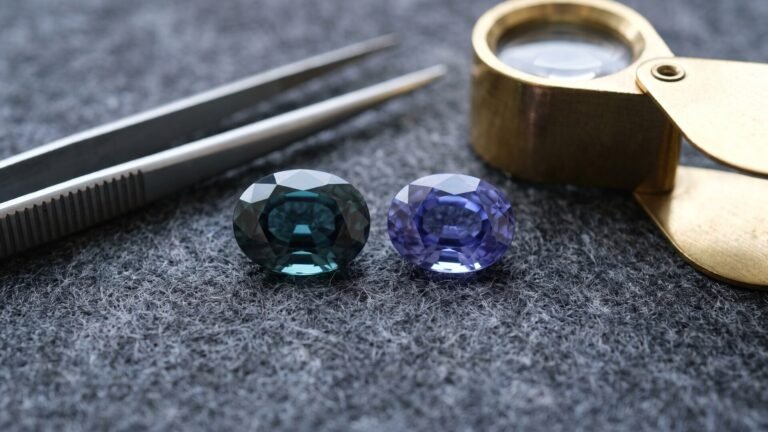
Why Does Alexandrite Change Color? The Science Behind the Effect
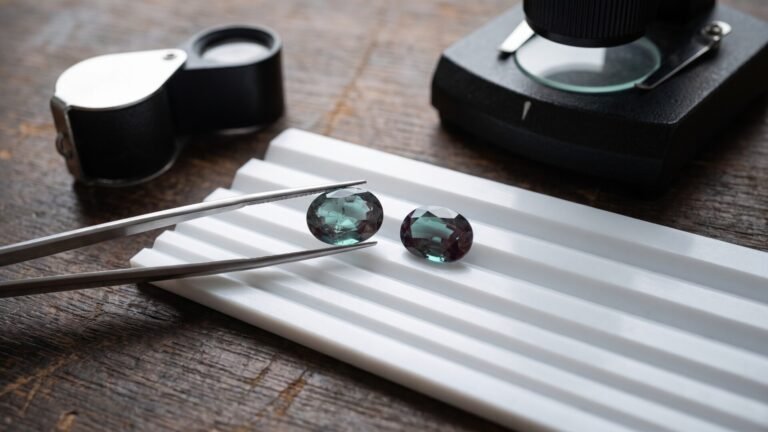
I am standing at a window in a shop that has been in the same family since the 1950s, holding a small brown paper parcel. Inside is a stone a customer brought in to sell. She inherited it from her mother and believes it is a ruby. Under the fluorescent tubes of the office, it is a flat, dark purplish red, and I can see why she thinks so. Then I walk it to the window and open the paper.
The stone goes green. Not a hint of green, not a shadow of it. Green.
The customer makes a small sound. She has owned this thing for a decade and never once saw it do that. What she has is alexandrite, and what she has just witnessed is not magic, not a trick, and not the stone deciding to change its mind. It is chemistry meeting a change in the light.
The Short Answer: Why Alexandrite Changes Color
Alexandrite changes color because trace amounts of chromium in its crystal structure absorb some wavelengths of visible light and let others pass through to your eye. Daylight is rich in blue and green wavelengths, so the stone transmits green. Incandescent light is rich in red wavelengths, so the same stone transmits red. The stone never changes. The lamp does.
The stone in that shop was a textbook example: green at the window, red under the office tubes, and rather muddy in the hallway where the two light sources fought each other. That last part matters more than most sellers admit.
A chromophore is the chemical element or ion responsible for a gemstone’s color. In alexandrite, the chromophore is chromium, and it is doing something more interesting than simply tinting the crystal. It is sitting in a crystal lattice that forces it to absorb light in two competing bands, one in the blue-green region and one in the red. Whichever band the available light feeds more strongly is the color you see.
That is the whole mechanism in a paragraph. Everything else in this article is about what that mechanism means when you are the one holding the money. The strength and beauty of the color change matter far more than the word "alexandrite" on a tag, and the difference between a stone that shifts convincingly and one that merely goes dark is worth hundreds or thousands of dollars.
If you want the broader picture of what this gem is and where it comes from, the main guide to alexandrite’s meaning, properties, and value covers the ground this article builds on.
The core mechanism at a glance
| Lighting condition | Typical appearance | Why it happens |
|---|---|---|
| Daylight or daylight-balanced LED | Green, bluish green, or green with blue undertones | The light contains more wavelengths that favor alexandrite’s green transmission |
| Incandescent light | Red, purplish red, or raspberry | The warmer light contains more red wavelengths that the stone transmits |
| Mixed indoor lighting | Intermediate or less decisive color | Multiple light sources dilute the contrast |
| Dim or poor-quality lighting | Weak, grayish, or brownish appearance | There may not be enough balanced light for a vivid color shift |
Exact colors vary with the individual stone, its cut, its saturation, the exact spectrum of the light, and the conditions of viewing. Two alexandrites side by side under the same lamp can look meaningfully different, and neither is wrong.
How Chromium Creates the Alexandrite Effect
Natural alexandrite is the color-change variety of chrysoberyl, a beryllium aluminum oxide that is otherwise a fairly ordinary yellow-green gem. The color change comes from chromium substituting for a small fraction of the aluminum in the crystal structure. A crystal lattice is the repeating three-dimensional atomic arrangement inside a mineral, and it is the lattice that determines how the chromium behaves.
Chromium in a different lattice produces a different result. In ruby, chromium in corundum gives a red stone that fluoresces under ultraviolet light. In emerald, chromium in beryl gives green. In chrysoberyl, the lattice geometry and the bond lengths around the chromium ion shift its absorption in a way that leaves it unusually balanced between transmitting green and transmitting red. That balance is the alexandrite effect.
I want to be careful here, because it is easy to imply that chromium alone makes a valuable stone. It does not. The concentration of chromium, its exact placement in the lattice, the presence of other trace elements, the transparency of the rough, and the skill of the cutter all influence what you actually see. A stone can have plenty of chromium and still look like a brownish muddle because the rough was opaque or the cut was shallow.
The same absorption that produces the green daylight appearance is what leaves the stone able to transmit red under warmer light. These are not two separate mechanisms. They are two windows in the same absorption profile, and the light source decides which window you are looking through.
Pleochroism is not the same thing
This is where a lot of explanations go wrong, sometimes deliberately.
Pleochroism is the property of showing different colors when viewed along different crystallographic directions. Alexandrite is strongly pleochroic, and a cutter has to decide which orientation to face up so the stone shows its best color. If you rotate a rough alexandrite under a polariscope you will see distinct colors along different axes.
But the celebrated green-to-red shift is not pleochroism. It is an illumination-dependent color-change effect. Pleochroism can make a finished stone look slightly different as it tilts, and it can add complexity to the appearance, but it does not explain why the stone goes red under a lamp. A seller who tells you the color change is "just pleochroism" is either confused or hoping you are.
GIA frames color change as an observed property that a laboratory report can document and describe. A report will identify the material, state whether it is natural or laboratory-created, and note the color change the grader observed. What it will not do is guarantee that you personally will find the shift beautiful, or that it will look the same in your living room as it did in the lab.
What Happens Under Different Light Sources
"White light" is not one standardized spectrum, and this is the single most useful thing to understand before you shop.
Sunlight at noon contains a broad, fairly even spread of visible wavelengths with a strong blue component. Daylight in open shade is bluer still, which is why alexandrite often looks its most convincingly green near a north-facing window. A daylight-balanced LED is engineered to approximate that, sometimes well and sometimes not.
Incandescent bulbs, and the tungsten-halogen lamps still found in a lot of jewelry stores, are heavily weighted toward red and orange wavelengths. Under them, alexandrite’s red transmission dominates. Candlelight and firelight push even further in that direction.
Fluorescent lighting sits somewhere awkward in the middle, with a spiky spectrum that some stones handle badly and others manage fine. Modern broad-spectrum LEDs are usually the least flattering to alexandrite because they are designed to render everything neutrally, which flattens the contrast the stone depends on.
Then there is your phone. Camera white balance, HDR processing, and the color profile of the screen you are reading on all sit between the stone and your eye. A photograph of alexandrite is a photograph of a photograph, and I have seen listings where the "daylight" shot was taken under a cool LED panel and the "incandescent" shot under a filtered bulb chosen to maximize the red.
Viewing angle, background, and surrounding colors also matter. A stone set against white paper reads differently than the same stone in a yellow gold setting. Tilt affects which facets return light to you. None of this creates genuine color change, but all of it changes what you perceive.
A testing method that actually works
Here is what I would do, and what I would ask a seller to let me do.
- View the stone in indirect daylight, near a window but not in direct sun. Give your eyes thirty seconds to adjust.
- Move it to a warm incandescent or tungsten source. Let your eyes adjust again before judging.
- Check it under a neutral indoor light, the kind you actually live under.
- Look at it in the setting it will be worn in, or one similar.
- Ask for unedited video showing the transition, with the light sources named.
Avoid judging from a single photograph, and be skeptical of any listing where the lighting is not described. If a seller cannot tell you what light a photo was taken under, the photo is not evidence of anything.
Why the color can look different from one room to another
The effect is strongest when the two light sources have clearly different spectral balances. A stone that looks greenish in outdoor shade, red under a traditional warm bulb, and muted under a broad-spectrum LED is not being inconsistent. It is responding to three different light environments, exactly as physics says it should.
This is not a grading failure. It is the nature of the gem. A jeweler who tells you a stone "should" look the same everywhere does not understand what they are selling.
What Counts as Strong, Moderate, or Weak Color Change?
The trade uses words like strong, moderate, and weak, and those words are useful but not standardized. One seller’s "strong" is another’s "moderate," and there is no universal scale that everyone is measuring against. Treat the vocabulary as a starting point, not a specification.
What separates a genuinely valuable stone from a merely labeled one is this: a distinct, attractive hue change with good saturation in both lighting environments. Not a stone that becomes darker. Not a stone that becomes lighter. A stone that is green and then is red, and looks good both ways.
Buyers routinely confuse a hue change with other optical events. Extinction is the term for areas of a faceted stone that appear dark because light is not returning to the viewer. A poorly cut stone can have large extinct zones that make it look dramatically different under different lights without any real color change at all. Changes in brightness, transparency, and surface reflection can fool you the same way.
Body color, clarity, cut quality, and saturation all shape how impressive the same underlying color change appears. A well-cut stone with a moderate shift can look better than a badly cut stone with a strong one. This is the part of the equation that photographs never capture.
Here is the contrarian point, and I mean it: a dramatic red appearance in one carefully chosen light source does not automatically indicate a superior alexandrite. I have seen stones that were stunning in a jeweler’s warm display lighting and disappointing at the window. The stone has to be evaluated across multiple lighting conditions, and if a seller only wants to show you one, that tells you something.
A practical buyer’s scale
| Observed effect | What the buyer sees | Buying interpretation |
|---|---|---|
| Strong | Clearly green in daylight and clearly red or purplish red under warm light | Most desirable when the colors are attractive, saturated, and reasonably even |
| Moderate | Noticeable shift, but one side is muted or brownish | Can be attractive and more attainable, but inspect the actual stone carefully |
| Weak | Mostly changes in tone or brightness, with little hue movement | Should not command a premium solely for being called color-change alexandrite |
| Unclear | Different photos show different colors but lighting is not disclosed | Treat the listing cautiously and request neutral, independent images or a report |
What Most Buyers Get Wrong About Alexandrite Color Change
The most persistent myth is that every alexandrite should go from bright emerald green to pure ruby red. It is a lovely idea and it is mostly a marketing inheritance from the Russian imperial legend, which I will not re-litigate here except to say that the stones associated with that story were exceptional, and most alexandrite never looked like them.
Natural stones commonly show bluish green, teal, greenish blue, purplish red, raspberry, brownish red, and intermediate colors that do not have a clean name. A stone that goes from a slightly bluish green to a raspberry red can be beautiful and genuinely valuable. A stone that goes from dark green to dark brownish red is not in the same conversation, even if both are technically color change.
The phrase "100% color change" is another one to treat with suspicion. Unless the seller defines what they measured and how, the number is decoration. Color change is described by appearance, not by a universal numerical scale, and anyone offering a percentage without a method is selling you a feeling.
A genuine alexandrite can have a moderate shift. That does not make it fake. But a weak effect should be reflected in the price, and often is not.
Lab-created is not fake
Laboratory-created alexandrite is not a counterfeit in the way a glass imitation is. It has essentially the same chemical identity and produces the same optical phenomenon, because the chemistry that causes the effect is the chemistry being reproduced. What it lacks is the geological history, the inclusions that come with it, the rarity, and the market value of natural material.
That distinction is real and it is worth money, but it is not a moral distinction. A reader who wants the visual effect at an accessible price and understands what they are buying is making a rational choice. A reader who pays natural prices for lab-created material has been cheated, and that is a different matter entirely.
Do not let the effect confirm the identity
Color change is not proof of alexandrite. Color-change sapphire, color-change garnet, and various coated or glass imitations can all shift color, and some of them shift dramatically. The identity of the gem has to be confirmed independently of the effect. If you want the detailed version of how gemologists separate these materials, the guide to telling natural from lab-created alexandrite goes through inclusions and disclosure in depth.
How Color Change Affects Value, Rarity, and Certification
Natural alexandrite is genuinely rare, and it becomes dramatically rarer in sizes suitable for fine jewelry that also have strong color change, good transparency, attractive saturation, and no distracting inclusions. All five of those things together are uncommon. Any one of them alone is not.
The value factors, roughly in order of how much they move the price:
- Natural or laboratory-created origin
- Strength and attractiveness of the color change
- The specific daylight and incandescent colors
- Saturation
- Clarity
- Carat weight
- Cut quality
- Documented origin, where credible
Carat weight does something particular in fine natural alexandrite. Prices do not rise linearly with size; they compound. A two-carat stone with strong color change and clean transparency is not twice a one-carat stone of the same quality. It is many times rarer, and the market prices it accordingly. This is the single biggest reason buyers are shocked by the jump from a small stone to a larger one.
For any high-value natural purchase, get an independent report from a respected gemological laboratory such as GIA. The report should identify the material, state whether it is natural or laboratory-created, and disclose detectable treatments where applicable. It will not tell you whether the stone is beautiful, and it will not protect you from overpaying for a mediocre example of a genuine stone. It protects you from the more basic problem of buying the wrong material entirely.
Origin claims deserve their own warning. "Russian alexandrite" carries a premium in the market, and it should not be accepted as a value guarantee without credible laboratory support. Origin can matter to collectors. Color quality and natural status remain the central questions, and a beautiful stone from a less glamorous locality beats a mediocre one with a romantic label.
The price question buyers should ask
Frame the value around the complete package rather than the label. Ask, in this order:
- Is this natural alexandrite or laboratory-created chrysoberyl with color change?
- How strong is the shift, under which disclosed lighting?
- Are both colors attractive and reasonably saturated?
- Is the stone transparent enough for its size?
- Does an independent report support what I am being told?
If the seller cannot answer those five questions clearly, the price is not a price. It is a number.
Natural, Lab-Created, and Lookalike Materials
| Material | Can show color change? | Main reason it is confused with alexandrite | Value and buying caution |
|---|---|---|---|
| Natural alexandrite | Yes | Genuine chromium-related color-change effect | Rare and potentially expensive; obtain independent documentation for costly stones |
| Laboratory-created alexandrite | Yes | Similar chemistry and optical behavior | More accessible, but it must be disclosed clearly as lab-created |
| Color-change sapphire | Yes | Can shift between green, blue, purple, or red tones | A different gem species; verify the report and do not pay alexandrite prices |
| Color-change garnet | Yes | Strong shifts can look dramatic in photographs | Different chemistry, durability, and market position |
| Glass or coated imitation | May appear to change | Low-cost color effects and misleading photography | Require accurate material disclosure and avoid unsupported rarity claims |
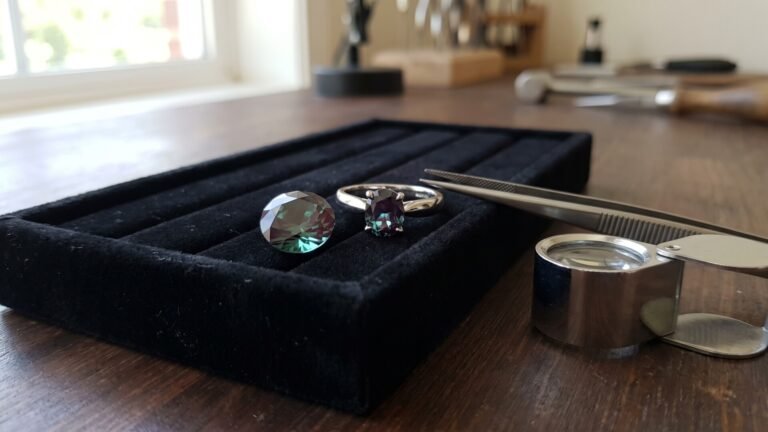
Visual inspection alone is often insufficient, particularly when you are trying to separate natural from laboratory-created material. The inclusions that a gemologist uses as evidence of natural growth are subtle, and a clean lab-created stone can look exactly like a clean natural one to an untrained eye under a loupe.
The presence of chromium-related color change does not prove natural origin, because laboratory-created material reproduces the relevant chemistry deliberately. If you are weighing alexandrite against its most common color-change competitor, the comparison of alexandrite and color-change sapphire lays out where the two diverge in price, durability, and market position.
How to Buy Alexandrite Without Overpaying for the Effect
Buy the stone, not the photograph. That is the whole of it, and everything below is elaboration.
Ask for daylight and warm-light video with the light sources identified. Ask whether the price applies to the exact stone shown or to a representative example. Ask about treatments, return terms, and certification. A seller who answers all of that cheerfully is a seller worth talking to. A seller who gets defensive about lighting questions is telling you something.
An attractive moderate color change in transparent material is often a better heirloom purchase than a larger stone promoted with dramatic but poorly documented images. The larger stone may be genuine and may be worth the money. But if you cannot verify what you are buying, the premium you are paying is for a story.
Budget guidance, honestly: lower-priced options are more likely to be laboratory-created, smaller, included, weakly changing, or sold without strong documentation. Premium natural stones with strong, attractive color change require a meaningful budget and independent verification. There is no clever shortcut around that. The people who find bargains in this material are people who can evaluate it themselves, and if you could do that you would not be reading this.
Compare the report, the color-change performance, the cut, and the transparency before you compare carat prices. A low price per carat is a signal, and usually not a good one. It can mean a weak effect, poor clarity, questionable identity, or undisclosed treatment. The cheapest stone per carat in a search result is rarely the best value in the room.
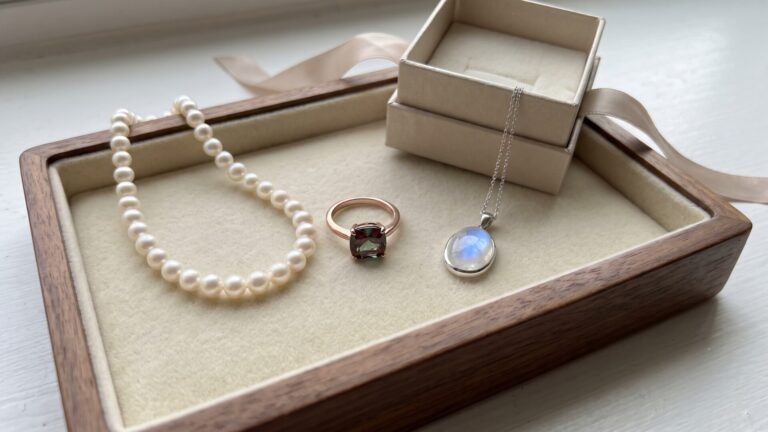
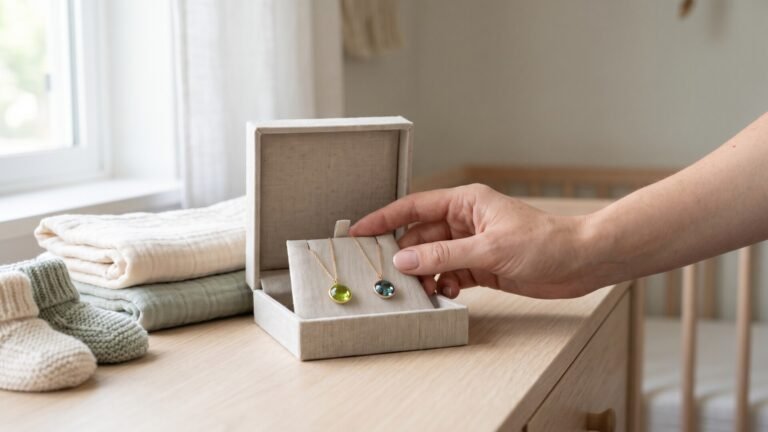
If the purchase is occasion-driven, a June birthday or a new baby, the calculus shifts. The comparison of pearl, alexandrite, and moonstone for June birthdays is worth reading before you commit to alexandrite on the strength of its birthstone status alone, and the piece on birthstone pendants for new moms covers why alexandrite has become a popular choice for that particular gift.
For an expensive natural stone, buy only when the report and the return policy give you enough protection to evaluate the stone under several light sources in your own home. If you cannot return it, you cannot evaluate it. That is not a small point.
When you are ready to look at finished pieces, it is worth browsing a curated collection rather than a single listing, so you can see how different stones behave in different settings: [Affiliate: shop alexandrite jewelry collections].
Frequently Asked Questions About Why Does Alexandrite Change Color
Why does alexandrite change from green to red?
Chromium in the chrysoberyl crystal absorbs selected wavelengths of visible light, and daylight and incandescent light contain different spectral balances. Daylight feeds the green transmission; warm light feeds the red. Your eye receives different colors because the light reaching the stone is different, not because the stone itself changed.
Does all alexandrite change color?
Genuine alexandrite is defined in part by color change, but the strength ranges from weak to dramatic. A weak shift can still be genuine alexandrite, though it should not carry the same premium as a vivid, attractive change. If a seller is charging a strong-change price for a weak-change stone, that is the problem, not the stone’s authenticity.
Is alexandrite's color change caused by pleochroism?
No, not primarily. Pleochroism is the display of different colors along different crystallographic directions, and alexandrite is strongly pleochroic, so it affects how the stone looks as it tilts. But the famous green-to-red shift is an illumination-dependent color-change effect caused by selective absorption, and the two phenomena should not be conflated.
Can laboratory-created alexandrite change color?
Yes. Laboratory-created alexandrite reproduces the relevant chrysoberyl chemistry and the color-change behavior that comes with it. It is not equivalent to natural alexandrite in rarity or market value, and disclosure is essential, but the optical effect itself is real.
How can I test alexandrite color change at home?
View the stone in indirect daylight near a window, then under a warm incandescent or tungsten source, letting your eyes adjust at each step. Also look at it under the neutral indoor lighting you actually live with. Home testing cannot prove natural origin or confirm gem identity. It only tells you how the stone behaves.
Does stronger color change always mean a more valuable alexandrite?
No. Strength matters, but the colors must also be attractive and saturated, the stone must be reasonably transparent, and natural origin, size, cut, clarity, and documentation all affect value. A strong shift between two ugly colors is not worth a premium.
Why do alexandrite photos online look more dramatic than the stone in person?
Sellers may use different light sources for different shots, choose angles selectively, adjust camera white balance, apply color correction, or present images that were never meant to be compared directly. Ask for unedited video with the lighting identified, and rely on an independent report for anything expensive.
Can a jeweler test alexandrite in the store?
A jeweler can show you how the stone behaves under different lights, which is genuinely useful. Confirming identity and natural versus laboratory-created status requires gemological equipment and expertise, and for a significant purchase that means an independent laboratory report rather than a counter opinion.
The split decision
If you are buying alexandrite because you love the effect and want to wear it, a well-chosen laboratory-created stone with a strong, attractive shift is the sensible purchase. You get the green-to-red behavior, you get it at a fraction of the natural price, and you get it without the documentation burden that comes with a five-figure stone. Spend the savings on the setting, which is what people actually see.
If you are buying it as an heirloom, as an investment, or as a piece that will be handed to someone not yet born, buy natural, buy documented, and buy the best color change you can afford rather than the largest stone you can afford. Get the GIA report. Keep the return window open long enough to see the stone at your own window and under your own lamp.
The stone in that shop went to a laboratory, came back confirmed as natural alexandrite with a strong color change, and sold for more than the owner expected and less than a dealer would have charged her for the same stone. She kept the paper parcel. She told me she wanted the next person to open it the way she did, at a window, on an ordinary afternoon, and watch it turn green.
That is the whole trick, and it is not a trick at all. It is chromium, a lattice, and the light you happen to be standing in.