Moonstone Meaning: History, Symbolism, Spiritual Properties & Modern Uses
Moonstone is one of the most loved gemstones in the world, and one of the most storied. Ancient Indian traditions associate it with the Moon, Roman writers linked moon-named stones with the lunar goddess, and today it is a popular choice for people drawn to intuition, new beginnings, and emotional balance.
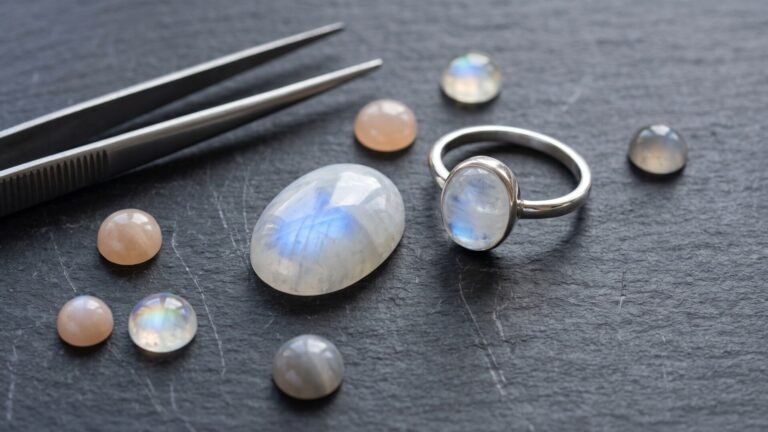
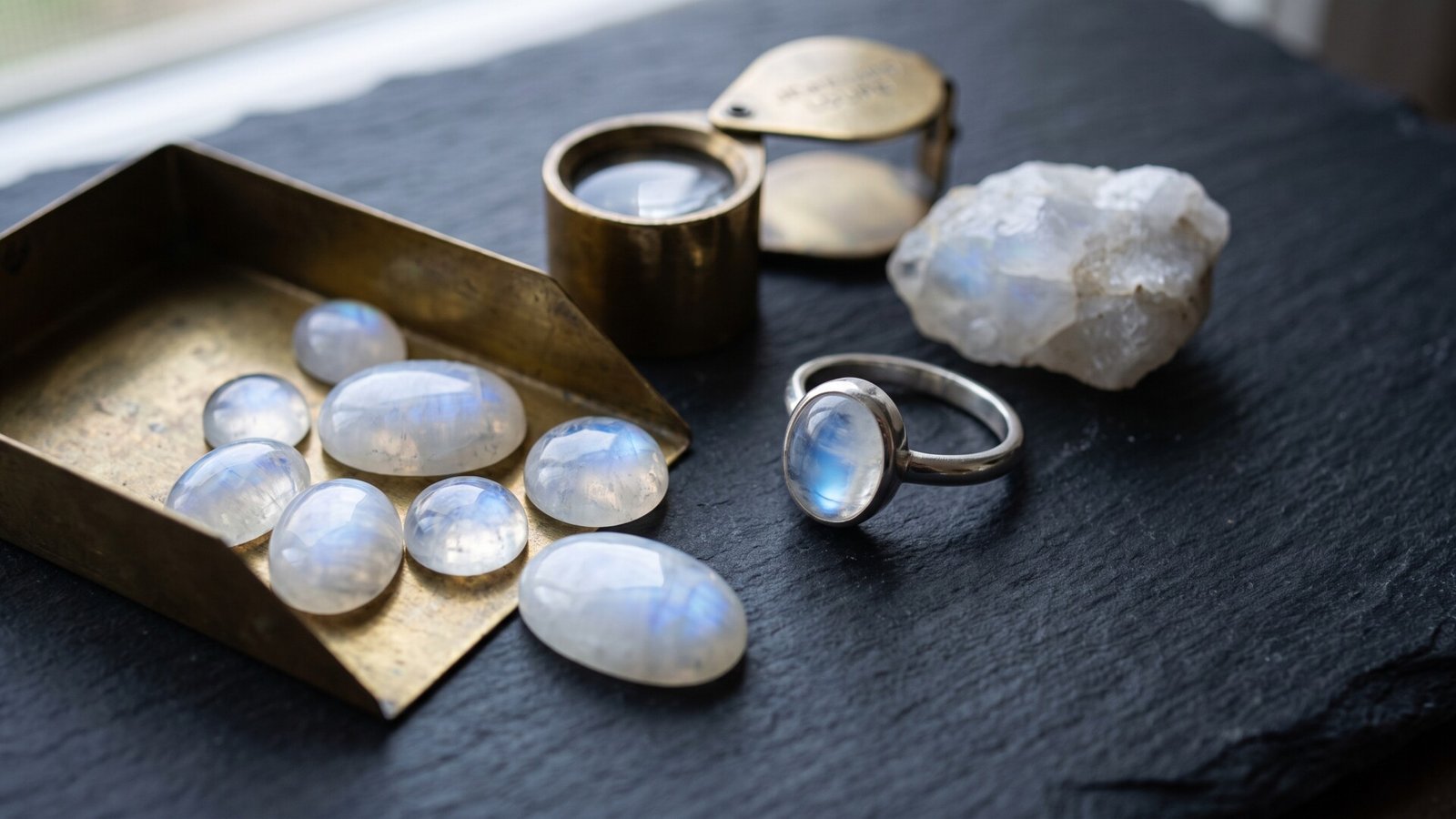
Moonstone is the best-known gemstone of the feldspar group, prized for adularescence: a soft, floating glow that seems to drift across the surface like moonlight on water. This guide covers what moonstone means in different traditions, what is documented history and what is folklore, how it is used in astrology and birthstone lists, and the practical facts you need before you buy or wear it.
A note on approach: sections on symbolism, folklore, and spiritual properties describe cultural beliefs and traditions. They are not scientific fact or medical advice, and gemological facts are kept separate in the tables and the buying and care sections.
Moonstone at a Glance
| Feature | Details |
|---|---|
| Mineral species | Feldspar. Classic moonstone is an intergrowth of orthoclase and albite; some “rainbow moonstone” is a labradorite (plagioclase) feldspar |
| Colors | Colorless, white, cream, gray, peach, blue flash, rainbow flash, green |
| Hardness (Mohs) | About 6 to 6.5 |
| Toughness | Fair to poor. Feldspars have two directions of perfect cleavage, so moonstone can chip or split on a hard knock |
| Common treatments | Usually sold untreated; some material is dyed, coated, or backed to boost color or flash. Ask for disclosure |
| Care | Soft cloth, mild soapy water. Avoid ultrasonic cleaners, steam, harsh chemicals, and knocks |
| Birthstone | June (alongside pearl and alexandrite on the modern list) |
| Zodiac associations (astrology, not gemology) | Cancer, Pisces |
| Traditional symbolism | Intuition, new beginnings, emotional balance, hope, the Moon |
What Does Moonstone Symbolize?
Moonstone’s symbolism comes mainly from two things: its name and its glow. Both point to the Moon, and the Moon has long stood for cycles, intuition, and change. The meanings below are traditional associations, not measurable effects.
Intuition and Inner Wisdom
Moonstone is often called the “stone of intuition.” In crystal-practice traditions, its shifting glow is said to encourage self-awareness and trust in one’s inner voice.
New Beginnings
The Moon waxes, wanes, and renews. Because of that cycle, moonstone is widely used as a symbol of fresh starts, personal growth, and the idea that endings lead to beginnings. This is why it is a popular gift for a new job, a move, or a new chapter.
Emotional Balance
Many people associate moonstone with calm and emotional steadiness, and some use it as a focus object during meditation or quiet reflection. This is a personal and symbolic use, not a treatment for any condition.
The Divine Feminine
Moonstone has long been linked to lunar goddesses and feminine themes such as nurturing and cycles. Today these associations are cultural and symbolic, and moonstone is worn by people of every gender.
Hope and Optimism
The soft glow is often read as a symbol of light after darkness, which is why moonstone appears in jewelry given during difficult transitions.
The Science Behind the Glow
Adularescence is a physical effect. Moonstone forms as alternating microscopic layers of two feldspar minerals (orthoclase and albite). Light scatters as it passes between these layers, creating the billowy blue or white sheen that appears to float just under the surface and moves as the stone or your viewing angle changes. The poetic “moonbeams in stone” description is a metaphor for this effect.
The History of Moonstone Meaning
Moonstone has been used as an ornamental stone for a very long time, and its meaning has changed from culture to culture. Much of the early lore is legend rather than well-documented history, so the sections below separate the two where possible.
India: A Gem Linked to the Moon
In Indian tradition, moonstone has long been considered a sacred, auspicious stone. It is known in Sanskrit as chandrakanta, often translated as “beloved of the Moon,” and a legend says it formed from solidified moonbeams. Traditional accounts also describe it being displayed on yellow cloth as a gesture of respect. These are cultural beliefs and legends, not evidence of how the mineral forms.
Ancient Rome: Moon Goddess Associations
Roman writers described moon-linked stones, and later gem lore connects moonstone with Diana, the goddess of the Moon and the hunt. The details, such as the stone showing the goddess’s image or changing with the Moon’s phases, come from later folklore rather than firm historical record, so treat them as legend.
Medieval and Later Europe: Love and Prophecy
European folklore tied moonstone to lovers and to foresight. One well-known tale says that holding a moonstone in the mouth under a full moon would reveal the future or a beloved in dreams. It was also carried as a protective charm by travelers. These are folk beliefs, and you should not put gemstones in your mouth.
Art Nouveau: Moonstone in Fine Jewelry
Moonstone had a notable revival in Art Nouveau jewelry from the 1890s into the early 1900s. Designers including René Lalique and Louis Comfort Tiffany used moonstones in nature-inspired pieces that moved away from diamond-centered styles.
Modern Crystal Culture
Today moonstone is a staple of crystal and wellness jewelry, where it is associated with intuition, new beginnings, and emotional balance. It also remains a well-regarded jewelry gemstone in its own right.
How the Meaning of Moonstone Has Changed Over Time
| Time Period | Primary Association (tradition) |
|---|---|
| India | Sacred, auspicious stone of the Moon |
| Ancient Rome | Moon goddess lore (Diana) |
| Medieval and later Europe | Lovers, foresight, travel protection |
| Art Nouveau | Artistic inspiration and nature motifs |
| Modern crystal culture | Intuition, new beginnings, emotional balance |
Broadly, older traditions stress protection and fortune, while modern usage stresses personal and emotional symbolism.
Spiritual and Emotional Meaning of Moonstone
These are beliefs, not medical advice. The spiritual properties below come from cultural tradition and personal experience. There is no scientific evidence that moonstone treats anxiety, mood swings, or any other condition, and it is not a substitute for professional care.
In crystal-healing practice, people who work with moonstone commonly describe these themes:
- Intuition and inner knowing: a focus stone for reflection and listening to one’s instincts.
- Calm and emotional balance: a gentle, soothing symbol used in meditation or quiet moments.
- Navigating change: a reminder, tied to the lunar cycle, that transitions are natural.
- Self-trust and self-discovery: a personal talisman for setting intentions about trusting your own judgment.
- Compassion and mindfulness: a token for staying present and connecting with others.
Many people find that a meaningful object simply helps them pause and set an intention. That personal value is real, even though the stone itself has no measured physical effect.
Moonstone in Different Cultures
Different traditions have read moonstone in different ways:
- Indian traditions: a sacred, auspicious Moon stone (chandrakanta).
- Roman and classical lore: moon-goddess associations, with later legends about moonlight captured in stone.
- European folklore: love, dreams, foresight, and a traveler’s charm.
- Modern Western crystal practice: intuition, emotional balance, new beginnings, and meditation.
What these traditions share is the Moon: cycles, change, intuition, and quiet light. What differs is the use. Older traditions stress fortune, protection, and foresight; modern practitioners stress personal reflection and emotional themes.
Types of Moonstone and What They Traditionally Symbolize
Moonstone comes in several colors and looks. The symbolism column below is traditional and varies by author, while the appearance and facts are the practical part.
| Variety | Appearance | Traditional Symbolism | Notes |
|---|---|---|---|
| Blue moonstone | Colorless to translucent body, blue sheen | Intuition, clarity | The most valued look; strong blue adularescence commands the highest prices |
| Rainbow moonstone | White or colorless body, multicolored flash | Joy, creativity | Usually a labradorite feldspar; the flash is not classic adularescence |
| White moonstone | White or cream, soft white or blue sheen | Purity, new beginnings | Widely available and often budget-friendly |
| Peach moonstone | Peach to orange body, soft sheen | Warmth, compassion | Popular for romantic styles |
| Gray moonstone | Silvery gray body, blue or white sheen | Balance, stability | Suits minimalist designs |
| Green moonstone | Pale green body | Growth, renewal | Less common; check whether the color is natural or enhanced |
Moonstone and Astrology
In astrology, moonstone is most often paired with two signs. Astrological stone lists differ by source and are traditions, not established fact.
Cancer (June 21 to July 22)
Cancer is a water sign ruled by the Moon in astrology, which is why moonstone is the classic Cancer stone. Astrologers describe Cancer as nurturing and emotionally attuned, and moonstone is the symbolic match.
Pisces (February 19 to March 20)
Pisces is a water sign traditionally ruled by Jupiter and, in modern astrology, Neptune. Moonstone is often suggested for Pisces because of its dreamy, intuitive imagery.
For more detail, see our Cancer Birthstone Guide, Pisces Birthstone Guide, and Zodiac Birthstones Hub.
Moonstone as a Birthstone
June Birthstone
Moonstone is a modern June birthstone, listed alongside pearl and alexandrite. Birthstone lists differ by country and organization, and they have changed over time. For how the lists developed, see the history of birthstones and our June Birthstone Guide.
Anniversary Gemstone
Some anniversary lists suggest moonstone as a 13th-anniversary gem, though anniversary stone lists are inconsistent between sources.
Gift Symbolism
Because of its traditional meanings, moonstone is a thoughtful gift to express:
- New beginnings: support for a fresh chapter.
- Intuition: trust in the recipient’s judgment.
- Calm and balance: a wish for peace.
- Hope: confidence in their future.
Is Moonstone Good for Jewelry? Suitability by Piece
Moonstone’s hardness of about 6 to 6.5 means it scratches more easily than sapphire, ruby, or quartz-family stones. More importantly, its two directions of perfect cleavage make it brittle: a sharp knock at the wrong angle can chip or split it. Hardness and toughness are different things, and moonstone is only moderate on the first and weak on the second. Choose the piece, and the setting, accordingly.
| Jewelry type | Suitability | Advice |
|---|---|---|
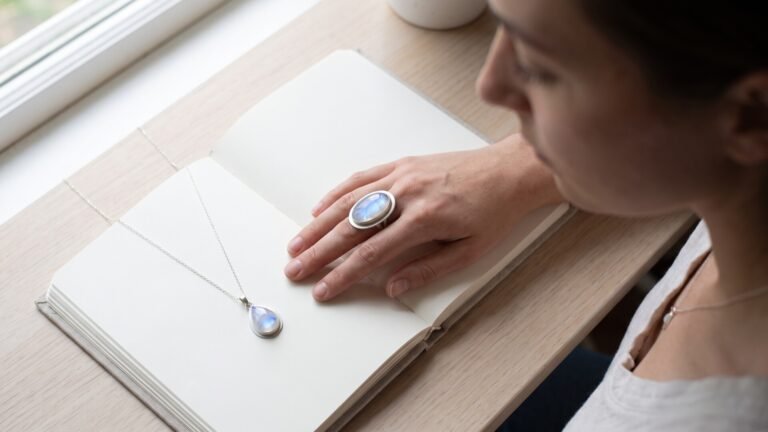
| Pendants and necklaces | Very good | Little impact exposure; ideal for everyday wear |
| Earrings | Very good | Studs and drops are low-risk |
| Bracelets | Fair | Bumps against desks and doors are common; bead bracelets are fine for light wear |
| Rings | Fair to poor for daily wear | Choose a bezel or halo setting, avoid high prongs, and take the ring off for chores, gym, and sports. Better as an occasional or cocktail ring |
Moonstone looks lovely set in rose, yellow, or white gold and in silver. It is also popular in men’s jewelry such as minimalist pendants and rings, with the same ring caution. Our guide to moonstone jewelry for intuition and new beginnings shows styles in more detail. If you want a harder everyday ring in a similar soft-glow look, white sapphire or a moissanite are more durable alternatives, though they do not show the same adularescence.
How to Choose a Moonstone
Moonstone is usually judged more like a colored stone than a diamond. The factors that affect value are:
- Adularescence: the strongest, most even blue sheen on a clear, colorless body is generally the most valued. The glow should move as you tilt the stone.
- Body color and transparency: near-colorless and transparent bodies with blue flash are prized; peach, gray, and rainbow stones are valued for their own looks.
- Clarity and condition: small inclusions are normal. Look out for cracks, surface pits, and cleavage fractures, which weaken the stone.
- Cut: moonstone is most often cut as a smooth cabochon to show the glow. Faceted moonstones exist but are less common.
- Size and origin: larger fine stones cost more. Origin affects value only if it is documented, so do not rely on unsupported origin claims.
Natural, lab-grown, and imitation moonstone
Most moonstone sold is natural and untreated, but you should still ask the seller about treatment and for a clear description of what you are buying. Be aware that some products labeled “moonstone” are not. Glass sold under names such as “opalite” or “sea opal” is a simulant: it imitates the look but not the mineral. A lab-grown stone would share the natural stone’s chemistry, but lab-grown moonstone is uncommon in jewelry, so a very cheap, perfectly uniform “moonstone” is more likely glass or a coated stone. Ask for the species, whether it is natural, and any treatments in writing. Our Natural vs. Lab-Grown Gemstones guide explains the differences. Moonstone is generally an affordable gemstone compared with the major precious stones, but prices vary widely by quality, so compare several sellers. For more on the stone itself, see our main moonstone guide.
Caring for Moonstone Jewelry
- Cleaning: use lukewarm water, a drop of mild soap, and a soft cloth or soft brush, then dry. Avoid ultrasonic and steam cleaners, and harsh or abrasive chemicals.
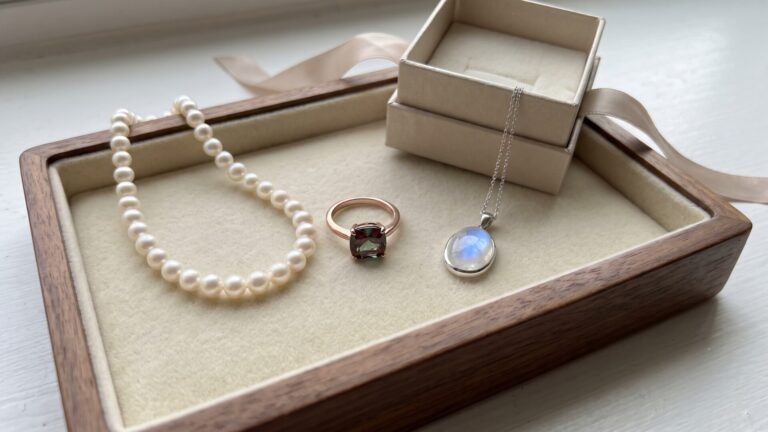
- Storage: keep moonstone in its own soft pouch or box compartment, away from harder stones such as diamond, sapphire, or topaz that can scratch it. See the Mohs hardness scale explained.
- Daily habits: put jewelry on last and take it off first. Remove it before swimming, showering, exercise, and cleaning, and avoid contact with lotions and perfume.
- Temperature: avoid sudden temperature changes and prolonged heat, which can stress a cleaved stone.
Common Myths About Moonstone
Myth: Moonstone is solidified moonlight
It is a feldspar mineral. The moonlight imagery is a legend inspired by its glow.
Myth: Rainbow moonstone is the same as classic moonstone
Both are feldspars, but rainbow moonstone is generally a labradorite (plagioclase), while classic moonstone is an orthoclase and albite intergrowth. Their optical effects are related but not identical.
Myth: A harder-looking stone is tough enough for any ring
Moonstone’s cleavage makes it more fragile than its hardness suggests, so rings need protective settings and careful wear.
Myth: Moonstone means the same thing everywhere
Its meaning has shifted between cultures and eras, from sacred fortune stone to modern emotional symbol.
How to Choose a Moonstone Based on What It Means to You
- For a new beginning: a white or rainbow moonstone pendant or earrings, both practical for daily wear.
- For intuition or reflection: a blue-sheen moonstone in a pendant, which keeps the stone safe.
- For a gift: stud earrings, a solitaire pendant, or a simple bead bracelet. If giving a ring, pick a protective setting.
- For a June birthday: compare moonstone with pearl and alexandrite in our June gift comparison.
Final Thoughts: What Does Moonstone Really Mean?
Moonstone’s meaning is a layered mix of documented jewelry history, lunar folklore, astrology, and modern crystal culture. The mineral itself is a brittle, moderately hard feldspar with a distinctive optical glow; the meanings people attach to it are traditions and personal choices. Whichever you value, choose a piece that suits your lifestyle, ask about treatments, and care for it gently.
Related Guides
- Moonstone: Meaning, Properties, Uses & Value
- Moonstone Magic: The Best Jewelry for Intuition and New Beginnings
- June Birthstone Guide
- Cancer Birthstone Guide
- Pisces Birthstone Guide
- Natural vs. Lab-Grown Gemstones
- Gemstones: Your Ultimate Guide
Frequently Asked Questions About Moonstone Meaning
What is the spiritual meaning of moonstone?
In crystal-healing and spiritual traditions, moonstone is associated with intuition, new beginnings, emotional balance, and the Moon. These are cultural beliefs and personal practices, not scientific fact or medical advice.
Why is moonstone associated with new beginnings?
Its name and glow link it to the Moon, whose cycle of waxing, waning, and renewal is a long-standing symbol of fresh starts. The association is symbolic and traditional.
What does moonstone symbolize?
Traditionally it symbolizes intuition, new beginnings, emotional balance, hope, and lunar themes. Meanings vary by culture and era.
Is rainbow moonstone the same as traditional moonstone?
Not exactly. Both are feldspars, but rainbow moonstone is generally a labradorite (plagioclase) with a multicolored flash, while classic moonstone is an orthoclase and albite intergrowth with a blue or white sheen.
Which zodiac signs are associated with moonstone?
Astrology commonly pairs moonstone with Cancer, which is ruled by the Moon, and with Pisces. Astrological stone lists vary by source and are traditions, not established fact.
Is moonstone a good choice for an everyday ring?
It can be worn, but with care. Moonstone is about 6 to 6.5 on the Mohs scale and has perfect cleavage, so it can chip or split. A bezel or halo setting and removing the ring for chores and sports help. Pendants and earrings are safer choices.
How do I clean moonstone jewelry?
Use lukewarm water, mild soap, and a soft cloth or brush. Avoid ultrasonic and steam cleaners, harsh chemicals, and sudden temperature changes.
Is there scientific evidence for moonstone's healing properties?
No. Its spiritual and healing associations are matters of tradition and personal belief. Moonstone is not a medical treatment, so see a qualified professional for health concerns.
Can anyone wear moonstone?
Yes. Moonstone is traditionally linked to June birthdays and to Cancer and Pisces, but anyone can wear it for its look and symbolism.
Ready to find your moonstone? Browse our collections below.
[Shop Moonstone Jewelry at Blue Nile]
[Shop Moonstone Rings at James Allen]
[Shop Ethical Moonstone at Brilliant Earth]